
Why JSW Greentech Limited Picked Siemens Xcelerator: Teamcenter, Mendix and the Data Spine Behind AMPSTAR
By Sarah Chen — MyTechDailyNews / Tech Daily
A first-time vehicle maker cannot survive scattered engineering data. That is the short answer behind JSW Greentech Limited's decision to adopt Siemens Xcelerator: Teamcenter becomes the single authoritative home for parts, revisions and change requests, while Mendix pushes that same information out to suppliers who will never open a PLM screen. Announced in early November 2026, the programme wires the Pune R&D centre to a greenfield plant in Chhatrapati Sambhajinagar, India.
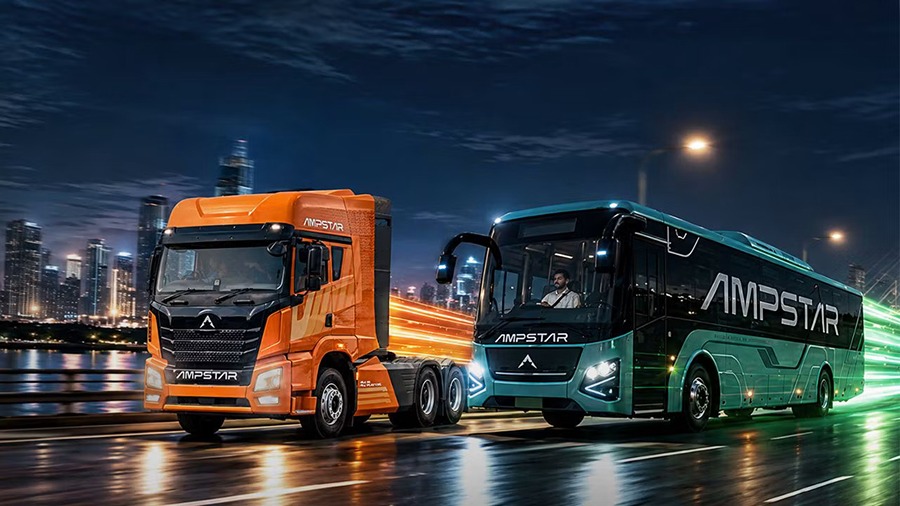
Read past the press release language and a bigger story appears. AMPSTAR is a brand-new commercial electric vehicle line — buses, trucks and a service model around them — being created by an industrial group whose core history is steel and energy, not road vehicles. The software deal is therefore less about licences and more about how quickly a newcomer can learn to behave like an original equipment manufacturer.
What did JSW Greentech Limited actually buy?
In plain terms: a backbone for product information, not a factory tool. JSW Greentech Limited selected software from the Siemens Xcelerator platform to build one integrated digital foundation for commercial electric vehicle development, covering engineering, product development, manufacturing preparation and supplier collaboration.
The foundation splits into recognisable jobs:
- One version of the product. Teamcenter holds product and engineering information, bill of materials (BOM) structures and the relationship between mechanical and electrical design work.
- Controlled change. Requirements management, program planning and change management sit in the same place, so an update to a battery or motor part propagates with a record of who approved it and when.
- Business alignment. Integration between Teamcenter and the company's ERP system keeps engineering data and purchasing or costing data in step — a point repeatedly cited as the hardest part of such rollouts.
- Reach beyond the walls. A Mendix-based portal extends digital workflows to external suppliers, giving visibility and traceability across the wider development ecosystem.
That last item matters for non-technical readers. Mendix is a low-code application layer that surrounds enterprise systems with simpler, task-specific interfaces, which means a component vendor can respond to a drawing revision or a delivery query without buying, installing or being trained on a heavyweight PLM client.
Why does a brand-new EV maker need PLM at all?
Because AMPSTAR is not one vehicle but a rapidly multiplying family of variants, and variants are where engineering data breaks.
Public information around the brand makes the scale of the problem clear. JSW Greentech unveiled AMPSTAR on 22 September 2026, positioning it as a full-stack offer of electric buses and trucks for the Indian market, with bodies described in lengths from roughly seven to eighteen metres and power levels spanning about 150 kW to 500 kW depending on duty. CEO Sumit Mittal has said the company is developing its own vehicle architecture and battery system rather than licensing an existing platform, and has pointed to a localisation ambition of around 50 per cent for its electric trucks — statements reported by trade outlets including Electrive and Gasgoo at launch. Owning the architecture while localising components means owning every revision of every interface, in-house and outsourced, simultaneously.
The commercial pressure arrived almost immediately. Reports from MarkLines note that on 28 October 2026 — a week before the Siemens announcement — JSW Greentech booked its first commercial sale: 100 AMPSTAR 4×2 55-tonne electric tractor trucks destined for industrial freight work at a JSW Cement plant in Vijayanagar, supported by battery-as-a-service and four planned swapping stations along the route. Delivering a fleet under a service contract multiplies traceability duties: serial-number records, part substitutions, software versions and battery configurations must be reconstructable years later.
Teamcenter, Mendix, ERP and the shop floor: who does what?
Conclusion first: each layer answers a different question, and mixing them up is the most common cause of stalled digital programmes.
| Layer | Question it answers | Role in this programme |
|---|---|---|
| Teamcenter | What is the product, and who changed it? | Digital thread backbone: BOMs, product structure, requirements, change control across disciplines |
| Mendix | How do people outside engineering take part? | Low-code supplier and business-process collaboration, portal access without full PLM rights |
| ERP integration | Does the business see the same data? | Synchronises engineering output with purchasing, costing and planning |
| Shop-floor systems | Is it being built correctly today? | Execution and quality at the Chhatrapati Sambhajinagar plant — see the risk section below |
Industry assessments support the choice of the backbone rather than the vendor relationship. In a 2025 vendor comparison circulated on Siemens' Teamcenter blog, ABI Research analysts placed Teamcenter first in PLM, crediting the breadth of its digital thread, open APIs and no-code integration through Mendix — precisely the combination this programme depends on.
Why should readers outside the two companies care?
Because India's electric commercial vehicle market is moving faster than most new entrants can industrialise, and digital readiness is now the gate.
The International Energy Agency's Global EV Outlook 2026 records India as the world's third-largest electric bus market for a second consecutive year, with national electric bus sales passing 4,000 units for the first time in 2025, and describes government procurement schemes — including PM E-DRIVE, which contemplates deployments in the region of 14,000 buses — as the main driver (IEA, Trends in other EV modes). The same report notes electric truck sales rising more than 20 per cent year on year globally in early 2026. Demand is real; the constraint is supply capability.
Capital intensity adds urgency. Indian trade coverage (Autocar Professional) has reported a roughly ₹2,500 crore outlay for the 90-acre Chhatrapati Sambhajinagar facility, with a top-line ambition near ₹12,000 crore and full capacity utilisation painted over a five-to-seven-year horizon. A plant like that earns or bleeds money on programme speed — which is exactly what JSW Greentech lists as its goals: better collaboration, higher engineering quality, shorter development cycle times and faster delivery to the Indian market.
Three risks worth watching
This section is my analysis, built on the public record rather than on statements from either company.
- A split software stack has to be stitched. Indian business press (Economic Times Auto, DQ India) reported in August 2026 that JSW Greentech had separately selected Dassault Systèmes' DELMIA Apriso manufacturing execution system for the same plant. A programme where the product data spine and the shop-floor spine come from different vendors lives or dies on the interface between them: part master, routing and revision hand-off must be unambiguous.
- ERP synchronisation is where cycle-time promises usually leak. If engineering and business records disagree on which revision is current, purchasing buys the wrong part and the "faster delivery" claim reverses.
- Supplier adoption is the quiet failure mode. A Mendix portal only produces traceability if suppliers actually use it — and a 50 per cent localisation drive means many new, digitally immature component makers onboarding at once.
Common misconceptions about deals like this
- "It is just an IT purchase." It is a governance decision about who owns product truth for the next decade of AMPSTAR variants.
- "PLM is an engineer's tool with no customer impact." Service history, recalls and battery provenance all come out of that record; fleet buyers under battery-as-a-service contracts are effectively buying it.
- "A digital thread means robots and 3D models." Mostly it means boring, consistent data handoffs — the BOM, the change order, the supplier answer.
- "One vendor should supply everything." Not here, and not necessarily anywhere: mixed stacks are normal, and integration discipline is the actual differentiator.
Action advice for tech teams and product leaders
- Treat product data as a deliverable. Budget for it alongside hardware tooling; late-stage digitisation is always more expensive.
- Name a data owner per object. One accountable person each for BOM, change requests and supplier records, before go-live.
- Extend, do not expose. Use a low-code layer such as Mendix to give partners exactly the screens they need instead of full licences.
- Instrument cycle time. Measure idea-to-first-prototype and change-request-to-release; these are the only numbers that prove the investment.
- Plan the variant explosion. If your product line is defined by lengths, power bands and service models, model variants on a platform instead of one-off projects.
FAQ
What is Siemens Xcelerator in simple words?
An open digital portfolio that bundles Siemens' design, engineering and manufacturing software with the Mendix low-code platform, so companies assemble a connected workflow instead of standalone tools. JSW Greentech Limited is using it as the base for its commercial electric vehicle programme.
What is the difference between Teamcenter and Mendix here?
Teamcenter is the product lifecycle management system of record — where engineering truth lives. Mendix builds the lightweight applications and portals that let suppliers and internal business teams interact with that truth without living inside the PLM system.
Where will AMPSTAR vehicles actually be built and designed?
Development runs from the R&D centre in Pune, while production is being set up at the greenfield manufacturing facility in Chhatrapati Sambhajinagar, India, with the two linked by one PLM strategy.
Does this mean customers get electric vehicles faster?
That is the stated aim: shorter development cycles and tighter supplier collaboration. Realistically, the benefit shows up first as fewer engineering errors and cleaner change records, then as faster programme delivery — provided the ERP and supplier-adoption risks are managed.
Questions or corrections about this story? Reach the MyTechDailyNews desk at hello@techdaily.com. Published by Tech Daily.
Sources and further reading
- Siemens newsroom — JSW Greentech scales EV development with Siemens Xcelerator: news.siemens.com/en-us/siemens-jsw-greentech
- IEA Global EV Outlook 2026 — Trends in other EV modes: iea.org
- Electrive — JSW Greentech enters e-CV segment with AMPSTAR brand (22 September 2026): electrive.com
- MarkLines — first Ampstar order for 100 electric tractor trucks: marklines.com
- Autocar Professional — revenue and capacity outlook for the Chhatrapati Sambhajinagar EV plant: autocarpro.in
- Economic Times Auto — DELMIA Apriso MES selection: economictimes.indiatimes.com
- Siemens Teamcenter blog — 2025 ABI Research PLM ranking: blogs.sw.siemens.com
- JSW Greentech official site — facility description: jswgreentech.in