
iPhone Duo Display Cracks Put Apple’s John Ternus Under Early Pressure | MyTechDailyNews General
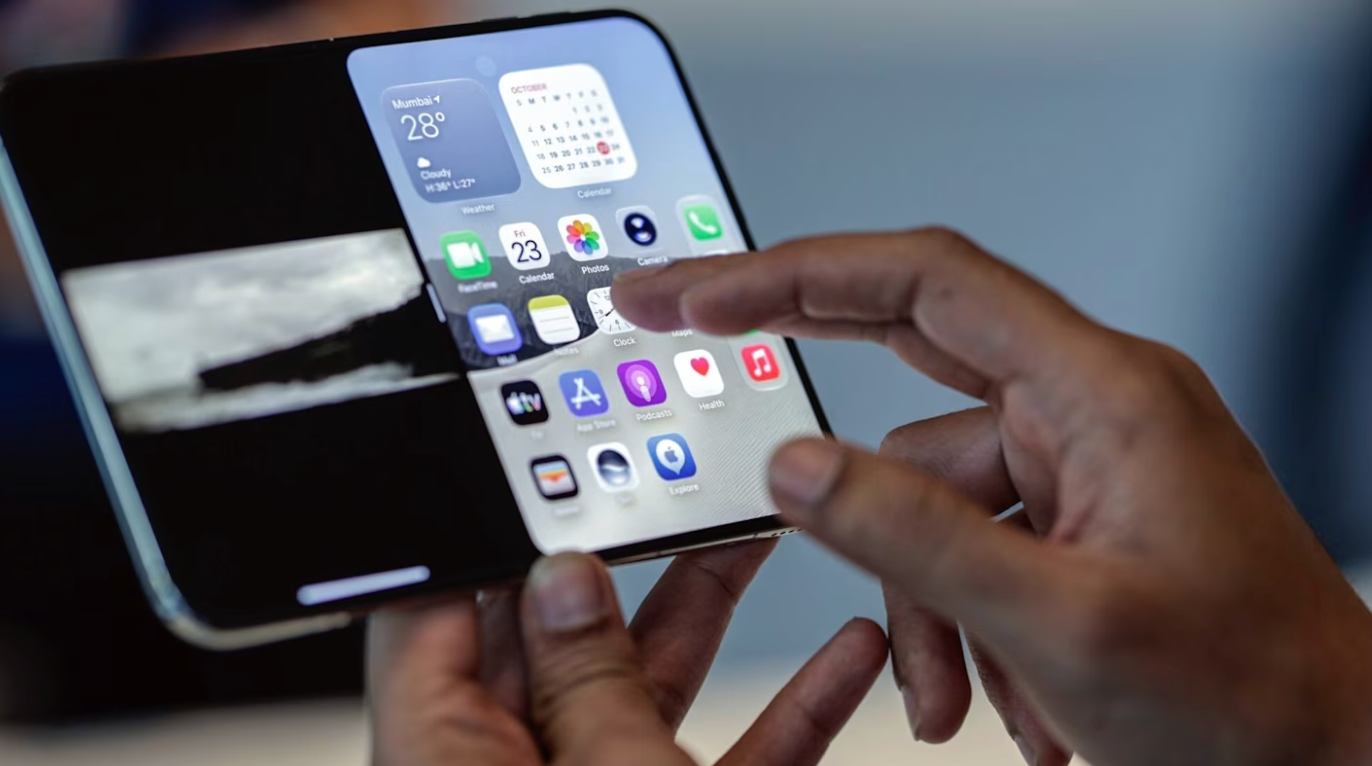
iPhone Duo
A foldable iPhone was supposed to feel like a controlled debut: years of patience, one dramatic design shift, and a premium price point meant to signal that Apple had finally solved the tricky parts. Instead, posts on social media platforms around the world over the past week showed the same visual problem: when the inner screen of the new device was opened, a horizontal crack appeared about two-thirds down from the top. The reports have turned iPhone Duo into an early test not only of Apple’s product engineering, but also of how the company responds during a leadership transition.
The issue lands directly on the desk of John Ternus, Apple’s new chief executive. Ternus replaced Tim Cook last month and is scheduled to host Apple’s quarterly earnings call on Monday for the first time. Investors had been expecting him to bring fresh energy to the product roadmap, only to face a visible product problem almost immediately after iPhone Duo entered the market.
Apple said it had seen damage to a small number of devices since iPhone Duo went on sale last Friday. “We have noticed a small number of iPhone Duo devices with issues on their inner displays. If users encounter iPhone Duo display failures, they should contact AppleCare to request a replacement,” the company said.
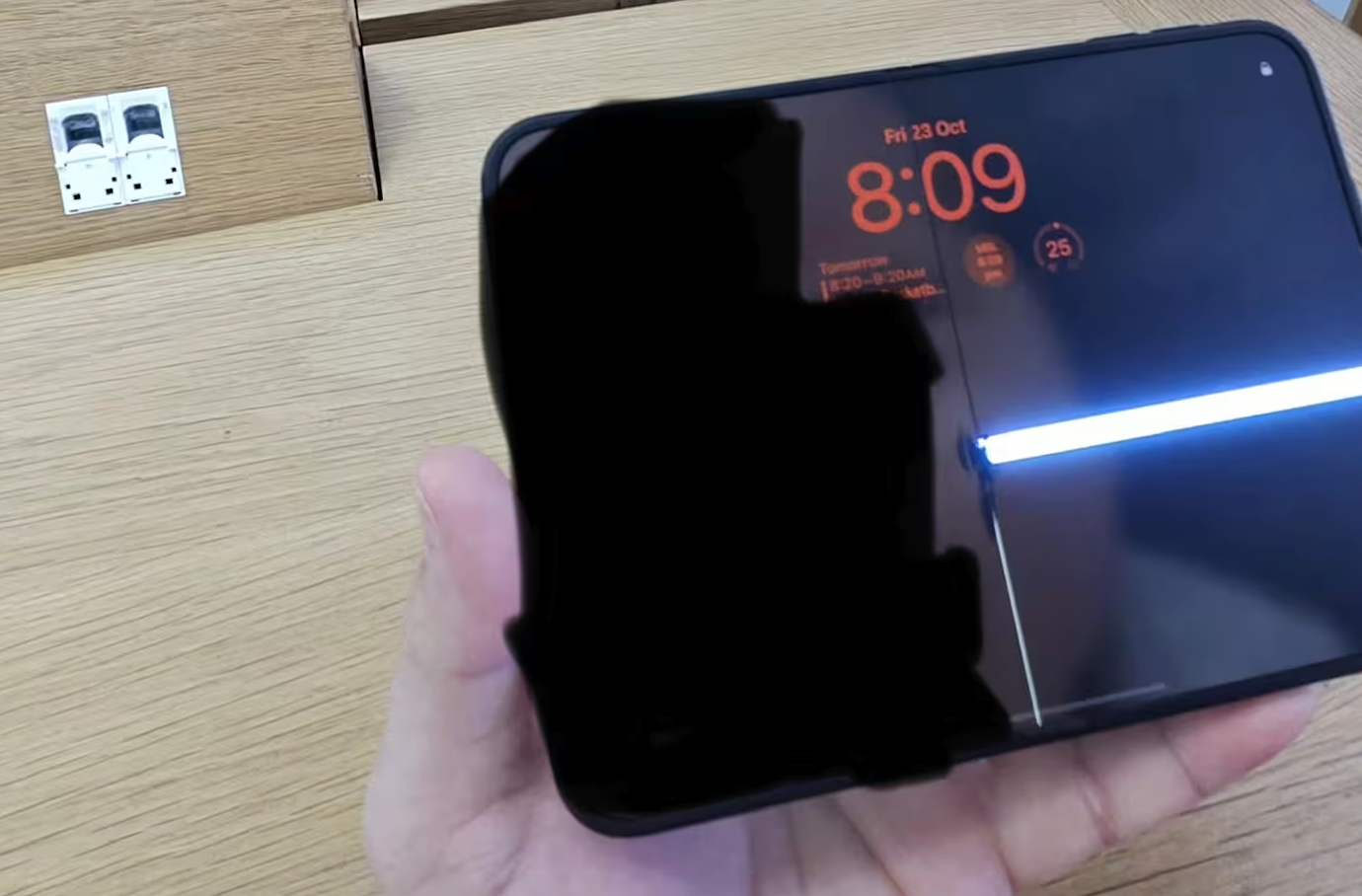
Cracked inner display
Although the full scope of the problem remains unclear, the pattern of reports has made many users refer to the episode as “crack-gate,” a phrase that inevitably brings to mind another iPhone launch problem from Apple’s history.
History gives the reports a familiar shape
Antenna-gate and Apple’s response pattern
In 2010, iPhone 4 users reported dropped calls and weak reception, creating the episode widely known as “antenna-gate.” Apple’s then-CEO Steve Jobs initially blamed user behavior, saying the complaints were tied to “the wrong way to hold the phone.” Apple later offered free protective cases to address the issue.
Apple has not announced a recall of any iPhone Duo. A recall would be an unusual step for the company, which has historically preferred to handle product problems through repair programs and device replacements.

Parody image of iPhone Duo on X
Why iPhone Duo is a higher-stakes product than it looks
The iPhone Duo launched this month at a price above 2,000 USD and represents the largest iPhone design transformation in nearly 20 years. The product also marks Apple’s delayed entry into foldable phones: the company arrived seven years later than Samsung, which introduced its first Galaxy Fold device well before Apple committed to the category.
The “we waited because we could not rush it” argument
Ternus has said that Apple avoided releasing a foldable product earlier because it did not want to ship something “cheap and shoddy.” The company, in his telling, chose to spend time on difficult engineering challenges: building a flat inner display and a hinge that could endure repeated folding.
That positioning makes the current crack reports harder to ignore. The product is not being judged merely as another smartphone refresh; it is being judged as the first foldable iPhone from a company that had long framed its patience as a quality guarantee.
What analysts and former engineers say about the crack reports
Francisco Jeronimo, a vice president at market research firm IDC, said the problem with iPhone Duo demonstrates a broader industry reality: “Even a company with Apple’s strong engineering resources and supply-chain management ability has to explore the foldable space carefully.”
He added that the consistency of online reports suggests one of two possibilities: “This indicates the hinge tolerance design may have a certain sensitivity, or that there may be a problem with how the screen is supported during the folding process.”
Competitors are already adjusting their messaging. Samsung quickly used the moment to promote its own lighter and thinner foldable devices, claiming that it is “leading by several years” in foldable technology.
Why this kind of defect is difficult to catch before launch
A former Apple screen engineer familiar with design and manufacturing processes said the most likely explanation is that only a very small number of devices are affected. Because the failure rate is low, it is difficult to detect during testing. The engineer described the practical problem plainly: “Even if 1,000 devices are tested at once, at least one defective device must appear before the root cause can be investigated.”
The engineer also noted that the issue could be connected to a specific batch of defective components supplied by a manufacturer, which would explain why reports can be concentrated yet still represent a small share of the total population.
Other launch friction has already tested the iPhone brand
This is not the only complication around the iPhone Duo rollout. Early buyers have already faced order delays. Apple attributed the delays to unprecedented demand, while expected delivery timelines have been pushed into next year.
Before the crack reports emerged, Apple also had to deal with another iPhone-related problem earlier this year. Some AT&T customers using iPhone 18 Pro Max experienced permanent cellular network disconnection. Apple later released a software fix to prevent the issue from affecting more devices.
What the situation means for general readers
For people who follow technology news without needing to understand hinge metallurgy or display lamination, the story is best read as a collision between product ambition and operational reality. Apple entered foldables later than its rival, charged a premium price, and built a public narrative around durability and refinement. Now it must answer, in public and quickly, whether the iPhone Duo is a small early-adopter problem or something that can erode trust in a category where physical failure is immediately visible.
It also matters who is in charge. John Ternus is not merely stepping into a CEO role; he is taking over at the moment Apple is shipping a high-profile new form factor, responding to customer complaints, managing production expectations, and meeting investors. The company’s handling of this episode will likely be read as an early signal of how it balances transparency, repair, replacement, and product pride under pressure.
FAQ
- What exactly is being reported? Posts across social platforms have shown a horizontal crack in the inner display of iPhone Duo units, located about two-thirds down from the top when the device is opened.
- How many devices are affected? Apple says it has noticed a small number of devices. The former engineer suggests the likely number is also very small, but the full scope is still not clear.
- Has Apple issued a recall? No. The article says Apple has not announced a recall, and recalls are unusual for the company compared with repair and replacement programs.
- Why is the timing sensitive? iPhone Duo went on sale last Friday, and John Ternus took over as CEO last month. His first earnings call is on Monday.
- Is this Apple’s first major product controversy? No. Apple dealt with antenna-gate in 2010, and the article notes another iPhone-related software issue earlier this year involving AT&T and iPhone 18 Pro Max.
Checklist for readers following the story
- Watch for Apple’s language. The article shows Apple acknowledging a “small number” of inner-display issues, not a broad safety declaration.
- Check whether the issue remains a small batch problem or expands. The former engineer’s testing comment is useful here: a very low failure probability is hard to catch unless at least one defective device appears in a large test group.
- Pay attention to whether Apple says more about hinge tolerance, screen support, or a component batch. Those are the possible explanations mentioned in the article.
- Compare the repair-or-replace approach with a recall. Apple has not announced a recall, but it has told users to contact AppleCare to request a replacement.
- Remember the business pressure. iPhone Duo launched this month above 2,000 USD, delivery estimates have moved to next year, and John Ternus is hosting his first earnings call on Monday.
Common misconceptions
| Claim people may assume | What the article actually supports |
|---|---|
| Every iPhone Duo is defective. | Apple says only a small number of devices have been affected. A former engineer also suggests the number may be very small. |
| Apple has already recalled iPhone Duo. | The article says Apple has not announced a recall. Its usual route is repair and replacement, not recall. |
| This proves Apple cannot make foldable phones. | The article says foldable reliability has also challenged Samsung, whose early Galaxy Fold devices had display problems in 2019. |
| John Ternus personally caused the problem. | The article links the issue to a leadership transition, not to proof of individual responsibility. Ternus became CEO last month; iPhone Duo launched last Friday. |
| Crack reports are random one-off posts. | The article notes a high level of consistency, including the same crack position and repeated social media images around the world over the past week. |
Action suggestions for interested readers and potential buyers
If you already own iPhone Duo and notice display failure, follow Apple’s stated instruction: contact AppleCare to request a replacement. Do not assume the device is unsafe without an official statement; the company has described the affected population as small, while also acknowledging the problem exists.
If you are considering buying iPhone Duo, treat the first weeks as a real-time reliability window. The product is expensive, the design change is significant, and the company is already dealing with order delays and public questions about the inner display. The safest way to understand the situation is to watch for concrete official guidance, replacement details, and whether Apple later describes a batch-level issue, a tolerance issue, or a screen-support issue.
For general technology readers, the useful takeaway is less about a single crack and more about what it reveals: even Apple’s resources do not make foldables a solved category, even Samsung’s seven-year head start does not eliminate reliability pressure, and even a carefully delayed product can become a leadership test the moment it reaches users.