
iPhone Duo: China vs. US Version — A Buyer's Field Guide to the Teardown Storm | MyTechDailyNews
By Sarah Chen · Tech Daily · MyTechDailyNews General
Most people met this story as a short clip of a screwdriver lifting a metal shield off a mainboard. If you are sitting on an order page instead of a repair bench, the useful question is much narrower: what does the iPhone Duo sold in mainland China actually do differently, and what should you confirm with your own eyes before you pay? Here is a working method, step by step.
The 60-second version
- Recently, Huaqiangbei teardown creator Yang Changshun published a strip-down comparison of the iPhone Duo China-market and US models, pointing to visible internal structural differences between the two.
- Apple technical staff replied that the third-party account cannot be verified at this point, that region variants can carry individual adaptation differences during parts procurement and mass production, and that no parts-level list is released to the public.
- Earlier online arithmetic that priced those alleged gaps in the 800 to 1,000 yuan range does not survive a cross-check against Apple's own specification pages.
- The differences that do hold up — satellite messaging, 6GHz Wi-Fi and 25W wireless charging — trace back to domestic radio and service rules, not to a cost-saving switch flipped for one market alone.
Step 1: Read the teardown evidence, not the group-chat summary
The early claim that spread online said the China version had lost its satellite communication module, the 6GHz Wi-Fi antenna, the 25W wireless charging circuit and the matching RF components. Shoppers then attached a number to that shopping list and read it as money Apple saved and money they lost. Treat the figure as a hypothesis rather than a verdict: there is no official parts list anyone can audit line by line, and at least one of the loudest items on that list has already been disproved.
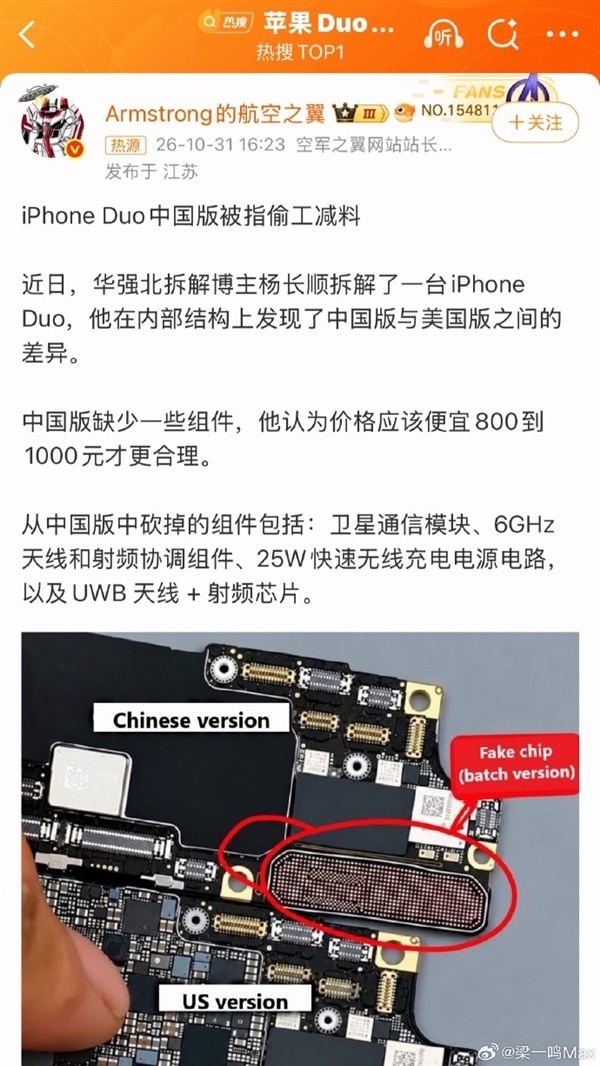
Step 2: Verify one specification yourself before trusting any price estimate
Start with the item that travelled furthest: the claim that the China model had its UWB chip cut. Apple's mainland China official website lists the second-generation Ultra Wideband chip on the China iPhone Duo, with distance measuring and spatial awareness features intact and hardware matching overseas units. Apple's official website is the same place to look up charging and wireless ratings, and it settles arguments faster than a screenshot ever will.
Do the same check on a device you can hold. Open Settings, tap General, tap About, then tap the part number to reveal the A-number and the region suffix, as Apple explains in its model-number guide (support.apple.com). Two phones that look identical outside can carry different radio certifications inside — the single most useful fact for anyone buying a foldable from a reseller.
Step 3: Put the three real differences in one table
| Capability | China-market iPhone Duo | US iPhone Duo | What is really driving the gap |
|---|---|---|---|
| Satellite SOS and location sharing | Corresponding hardware module is built in; the service itself is not switched on | Can send an SOS and share live position where no terrestrial carrier signal exists | Satellite messaging is a licensed service, not a toggle. Domestic rules decide when it can go live. |
| Wi-Fi 7 bands | Wi-Fi 7 opens only the familiar 2.4GHz and 5GHz bands; the 6GHz band is unavailable | All bands open, so measured throughput is clearly higher | Domestic radio-management rules allocate 6GHz elsewhere; the antenna hardware was not deleted. |
| MagSafe wireless charging | Rated up to 15W | Rated up to 25W | Difference comes from domestic wireless-charging frequency requirements, not from withholding a coil. |
Why the 6GHz line is the one readers misread most
The root cause is spectrum policy, which is dull but decisive. China's revised radio frequency allocation rules, effective from 2023, steer the 6425–7125 MHz block toward future 5G and 6G mobile use instead of unlicensed Wi-Fi; IEEE Spectrum (spectrum.ieee.org) describes the country as the only large market that keeps Wi-Fi out of that band entirely. That is why the domestic Wi-Fi 7 experience is capped at 2.4GHz and 5GHz while the US review units run full-band. A practical consequence: the gap is invisible on the network you already own. If your router has no 6GHz band, the phone cannot miss it; if you do own a 6E or Wi-Fi 7 router, you lose the least congested lane rather than losing Wi-Fi.
Two extra data points the argument needs
First, service licensing moves slowly and publicly. In September 2025 the Ministry of Industry and Information Technology granted satellite mobile communication operating licences to the three state carriers, reported by the official China Government Portal (english.www.gov.cn) — the same kind of approval step Apple's engineers describe as the gate. Their analogy is instructive: Apple Intelligence also needs domestic approval before it can be offered to local users, so a feature can sit fully built and still wait for a licence.
Second, the charging gap is a standards-generation gap as much as a regulation gap. The 25W figure belongs to the newer Qi2.2 (Qi2 25W) magnetic-charging profile; accessory makers such as Belkin advertise roughly 0–50% in 25 minutes on recent iPhones at that tier, and they note full speed only arrives on iOS 26 or later (belkin.com). A pad rated to 15W simply sits in the previous tier, which explains the number without needing a conspiracy about the China market.
Step 4: Match the version to your actual routine
- Two physical SIMs? Mainland models ship with dual physical nano-SIM support, while US-market iPhones have been eSIM-only since the iPhone 14 generation, according to Apple's SIM-size guide (support.apple.com). Before any feature argument, an imported unit can strand your second number.
- Commuter, office and home Wi-Fi? The 6GHz ceiling never enters the picture; everyday streaming, video calls and folding-screen multitasking run on the bands the domestic version does have.
- Night-stand charger? If you charge on a MagSafe pad overnight, a 15W and a 25W rating both finish while you sleep. The gap only bites when you need a fast top-up out the door.
- Remote hiking or driving? This is the one case where the difference is genuinely personal rather than theoretical — and it is a licensing question, so watch for the service to arrive rather than for the hardware to change.
Common misconceptions worth deleting
- "The US version is secretly a better phone." The UWB claim, the most-shared example, is contradicted by the public spec page.
- "Every difference is Apple squeezing one market." Satellite, 6GHz and charging-power limits all sit inside rules the company must certify against.
- "A trip abroad flips the lock." These differences are tied to certification and service availability, so do not assume travel changes the experience.
- "The rumoured 1,000-yuan saving is proven." It was an estimate built on a parts list nobody has published, and part of it is already wrong.
- "Importing is the cheap route to full features." Apple's mainland China statutory-warranty terms (apple.com.cn) tie local hardware warranty service to products bought in mainland China; a unit purchased outside the region sits outside that consumer-protection cover, and any teardown or third-party repair can cost you in-warranty service.
Action checklist: six things to do before you pay
- Open the official specification page for your own region and read the wireless-charging and Wi-Fi lines rather than the marketing headline.
- Confirm the model number and region suffix in Settings > General > About, and photograph it before a reseller seals the box.
- Check your own gear: does your router broadcast a 6GHz band, and is your pad Qi2.2 or 15W? The answer tells you whether the difference touches your daily use.
- Decide your SIM plan first, then the version — dual physical SIM versus eSIM-only is the change you will feel every day.
- Keep the invoice, the box and the serial screenshot; ask the seller in writing which service channel covers the device locally.
- Inspect the folding display on day one. iFixit's iPhone Duo teardown (ifixit.com) called it the most repairable foldable it had taken apart, while its analysis pointed to the central support bar and the arched hinge guide as places where stress can reach the inner screen — so open and close it repeatedly, look for crease lines, bright lines and grinding noises, and use the exchange window while it is still open.
FAQ
Is the China iPhone Duo a downgraded phone?
On the hardware that Apple publishes, it is the same phone: the second-generation Ultra Wideband chip is listed, and the satellite module is present on the board rather than removed. What differs is which services and radio bands those parts are permitted to use domestically.
Will Wi-Fi 7 feel slow in practice?
Wi-Fi 7 still works on 2.4GHz and 5GHz, so everyday use tracks the network around you. Only a full-band comparison against a US unit shows the lower measured speed, and that requires a 6GHz-capable router.
Can I use satellite SOS if I buy the US version and bring it home?
Do not plan around it. Satellite messaging depends on licensed service availability in the region where you use the phone, which is exactly the constraint Apple's technical staff point to when explaining the version split.
Should I wait for the next generation?
If the missing items are the ones you genuinely use — satellite coverage on remote routes, a 6GHz router, a 25W desk pad — waiting is a rational call, because those are policy and standards questions that a new model may resolve. If they are not, the current domestic version has no hardware defect to wait out.
Does any of this apply to other brands?
Yes. Every global handset line is certified market by market, so expect different band, charging and service mixes in each region, from any vendor. Checking the local spec page is a habit, not an Apple-specific chore.
Bottom line
The teardown raised a fair question and the internet answered it with an invented price tag. Set the price tag aside, keep the question: which features does the version in front of me certify for the country I live in? Answer that with the official spec page, your own router, your SIM plan and your warranty terms, and the purchase stops being a loyalty test. Tech Daily's hardware desk tracks the licensing side of this story and will update the checklist as Apple publishes more regional detail — reach the team at hello@techdaily.com.