
MyTechDailyNews Breakdown: China Carried the iPhone 18 Pro Launch in Its First Three Weeks
For readers following Apple’s latest premium smartphone launch, the headline number is positive but not self-explanatory. Counterpoint Research data show the iPhone 18 Pro and iPhone 18 Pro Max reached 3.1% year-over-year growth in the first three weeks after launch. The more interesting question is where that number came from. The China market produced a 29% increase, the US market moved 4% backward, the Japan market moved 27% backward, and the India market was better without a published percentage. In other words, the global result was carried by a few strong regional outcomes, not by all major markets moving in the same direction.
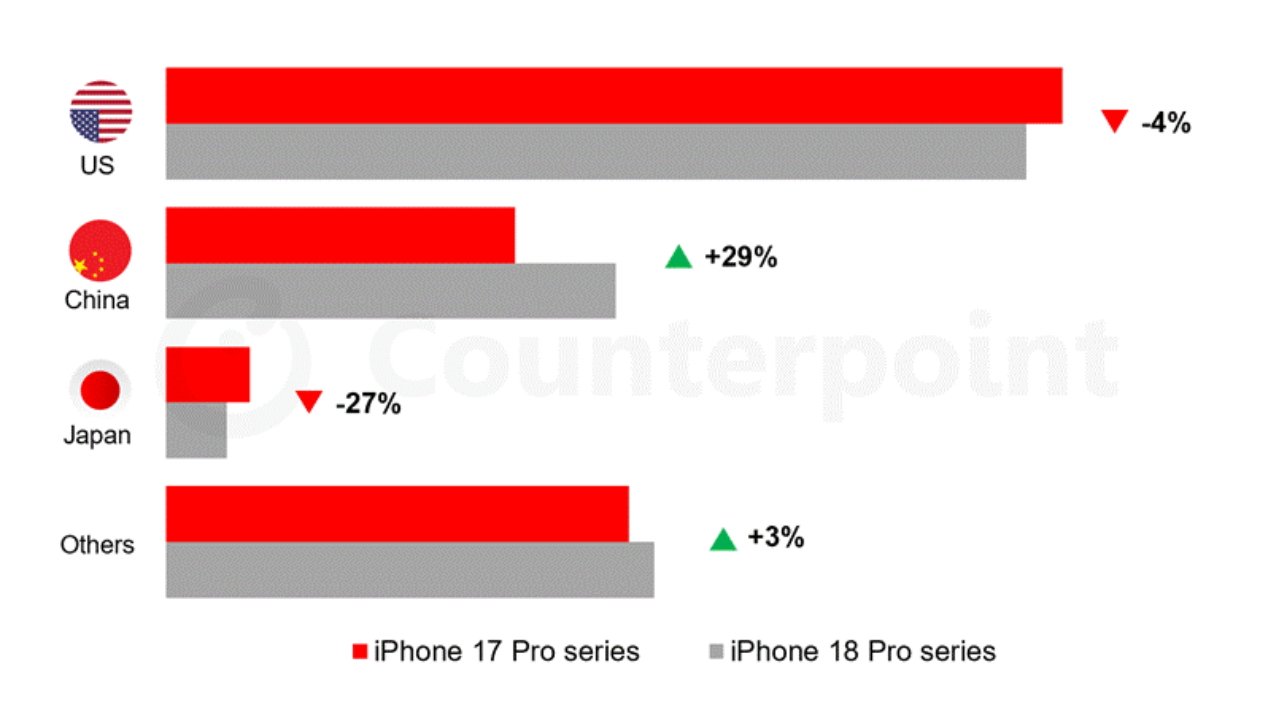
The early iPhone 18 Pro launch numbers in plain language
The iPhone 18 Pro series opened with a global sales picture that is stronger than the previous generation on paper, but the regional composition is uneven. The published comparison uses the first three weeks of each launch period. That time frame is useful because it captures early demand, but it can also hide opposite trends across major markets.
China is the clearest positive driver in the data. A 29% year-over-year rise there is large enough to lift the global figure to 3.1%. Outside China, however, the pattern is not uniformly positive. The US market declined 4%, and the Japan market declined 27%. The India market showed a better direction, but no exact percentage was disclosed.
Regional snapshot: what each published number says
| Market or scope | Direction during the early iPhone 18 Pro launch window | Published change |
|---|---|---|
| Global | Overall sales grew compared with the same launch period for the previous generation | 3.1% |
| China market | Strong year-over-year increase | 29% |
| US market | Decline against the comparable early period | 4% |
| Japan market | Significant decline against the comparable early period | 27% |
| India market | Better direction, but the exact rate was not provided | Not disclosed |
Why China matters more than the global figure alone
The key issue is not simply that the iPhone 18 Pro and iPhone 18 Pro Max grew worldwide. The key issue is how much of that growth was supported by one large market. If the China result is removed, the overall launch performance becomes much weaker. That means the 3.1% global number should be read as a blended result, not as proof that demand improved evenly across Apple’s major regions.
The original account attributes China’s strength to two factors. The first factor described is availability: in the early launch stage this year, stock was better than it was for the previous generation. More consumers were therefore able to buy during the opening window rather than waiting longer or encountering limited supply.
What readers should take away from the split
For a general technology audience, this story is less about smartphone engineering and more about how demand can behave differently from one region to another. A launch can look solid when all regions are combined, while still showing clear softness in individual markets. The global percentage summarizes the result, but the regional percentages reveal its shape.
The same principle applies to many consumer technology products. A single world number may be positive even when major regions move in opposite directions. That is why the early launch window, the geographic mix, and the comparison with the previous generation all matter when interpreting the result.
Common misconceptions to avoid
- Do not read the 3.1% global figure as evidence of balanced worldwide demand. It includes different regional directions.
- Do not treat the India market improvement as a precise growth rate. The source did not publish a specific percentage.
- Do not collapse the story into a single China result. The China market gain was strong, but it operated alongside declines elsewhere.
- Do not assume every buyer saw the same availability. The available explanation links China’s early strength to better early launch stock than the previous generation as the first of two factors.
FAQ for readers tracking the launch
What does “first three weeks after launch” mean here?
It is the early sales window used for the year-over-year comparison of the iPhone 18 Pro series.
Does the global growth mean all markets grew?
No. The global figure was 3.1%, but the US market declined 4% and the Japan market declined 27%.
Why is the China market central to the story?
Because the China market rose 29%, which was the major force supporting the overall global number.
Was India’s performance quantified?
No. The India market was described as relatively positive, but the exact ratio was not provided.
What is the clearest caution?
Do not interpret a positive global total as a sign that every region is experiencing the same demand condition.
Action suggestions for tech readers
- Watch whether Apple’s full regional mix appears in later sales updates.
- Compare future launch windows using the same early period, not only full-quarter totals.
- Treat missing India percentages as missing details, not as a small or large growth figure.
- Use the global number and regional numbers together: the global figure is useful only if the regional split is considered.
The practical takeaway is simple. The iPhone 18 Pro series had a positive global opening, but the launch’s center of gravity was uneven. For readers following Apple’s latest premium smartphones, the more useful story is not just that the global line was 3.1%, but that China, the US, Japan, and India moved along very different paths during the first three weeks after launch.