
MyTechDailyNews Q-Day Guide: What IonQ’s 2028 Roadmap Means for Your Accounts, Wallets and Work Data
IonQ’s blueprint published in September this year says a fault-tolerant machine with 20,000 physical qubits could recover a 256-bit elliptic curve key in less than 26 days. If the company delivers a 10,000 physical qubit computer in 2027 and a 20,000 physical qubit system in 2028, everyday users may only have two years to understand which logins, wallets and records depend on vulnerable signatures. This MyTechDailyNews guide turns the research into a practical checklist for readers who want to know what to watch, what to change and what not to panic about.
 Chris Balance
What Does the 26-Day Estimate Actually Mean?
It means the “impossible” threat became an engineering planning problem, not that a hacker is already inside your wallet. The calculation rests on Shor’s algorithm, created in 1994 by MIT mathematician Peter Shor, which turns hard factoring and discrete-log problems into something a sufficiently large quantum computer can solve. For today’s systems, the same mathematics would take a classical computer billions of years to solve, which is why the estimate has fallen from more than one million physical qubits to around 20,000.
That matters beyond wallets. When U.S. government and corporate IT systems that use 256-bit elliptic-curve signatures for secure communications are included, a cryptographically relevant quantum computer arriving sooner rather than later becomes a shared operational risk. The important point, however, is that IonQ frames the result as a benchmark, not as an attack plan.
“The important point I want to make when we’re talking about this is to not come across as threatening—we’re not trying to attack cryptography,” Chris Ballance, IonQ president, told EE Times. “Cryptography is black and white—you can either solve or not solve the problem—and we can use this as a benchmark metric for our quantum computers.”
“[You can see] if your compiler stack is doing a good job, if you’re a wizard at developing algorithms—all of these different pieces come together in a black and white answer—and it is very rare to have a benchmark that is so clear in a new compute field,” he added.
What Did IonQ Publish, and Why Is It More Than a Math Claim?
The paper is titled “Computing 256-bit elliptic curve discrete logarithms in 26 days on a fault-tolerant trapped-ion quantum computer with 20,000 qubits”. In the 70-page paper, IonQ mapped an end-to-end route to break secp256k1—the elliptic curve protecting Bitcoin and Ethereum—using a trapped-ion design based on the company’s Walking Cat error-correction architecture. The result was not presented as a proof-of-concept demo; it was presented as a full-stack resource estimate for 256-bit elliptic-curve cryptography.
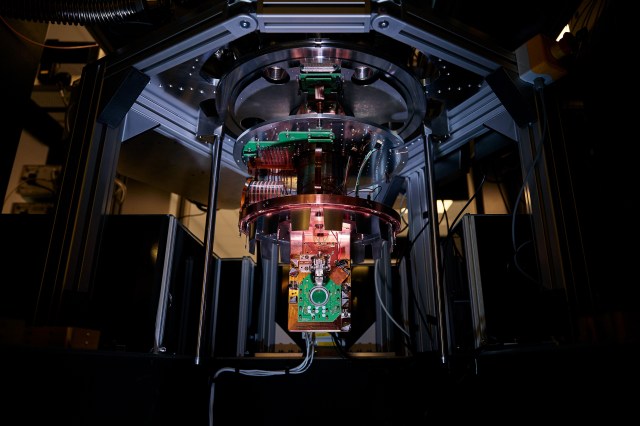 A trapped-ion system from IonQ (Image credit: Fisher Studios)
IonQ said the overall resource requirements were reduced by optimizing the algorithm, compiler, hardware and error-correction layer together. Temporary helper qubits were recycled during calculations, and entangled cat-state resources were reused, helping reduce the qubit count.
“We have every single layer of the stack… and we compiled every operation down to the actual error-correction primitives our architecture runs,” Ballance said. “We haven’t just done mathematical proofs… we have put everything together all the way down to the individual instructions you can run on a quantum computer.”
Ballance also argued that the timing matters because the industry is moving from theory to machine design. “As we’ve started to see how we can build these 10,000 to 20,000 physical qubit-sized devices, people are going from daydreaming to actually having engineering designs—they’re starting to build and put the different pieces together.”
“We have shown how each of the necessary elements come together, and also the tradeoffs that you need to make to throw a gauntlet out to the field, to show what a good solution looks like,” he added.
Why the Hardware Roadmap Made Q-Day Feel Closer
For years, trapped-ion systems depended on complex free-space laser setups, which limited scaling. In September 2025, IonQ changed that path by acquiring Oxford Ionics, an electronic qubit control pioneer co-founded by Chris Ballance and Oxford University researcher Tom Harty. After replacing optical setups with integrated electronics on silicon chips, the company demonstrated prototypes with two-qubit gate fidelity above 99.99%; Google Quantum AI has reported close to 99.88% two-qubit gate fidelity with superconducting qubits.
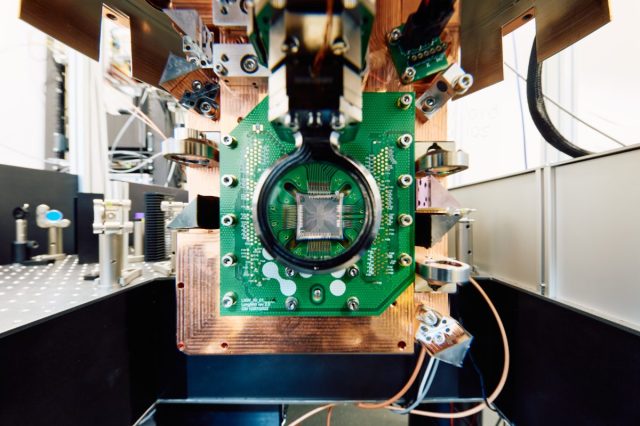 IonQ’s trapped-ion quantum computing processor unit with electronic qubit control (Source: IonQ)
As Niccolo de Masi, chairman and CEO of IonQ, said at the time: “[Our] level of quantum performance has been the industry’s north star for decades.” Ballance added: “In exceeding the 99.99% threshold on chips built in standard semiconductor fabs, we are now on a clear path to millions of qubits whilst unlocking powerful new commercial applications sooner.”
After the technology was demonstrated, IonQ acquired U.S. silicon chip maker SkyWater Technology in July this year to secure scalable manufacturing; come September, it launched Superion 256, a 256 physical qubit platform using electronic qubit control, and the blueprint paper was announced the same day.
“Right now, we have chips at the 10,000 [physical] qubit scale designed and these are going into the fab for our next generation products,” Ballance said. “[Large-scale quantum computing] requires a highly manufacturable hardware platform you can scale without dying on complexity hill—you can’t get stuck in a science experiment, building something like the Large Hadron Collider. The Superion platform allows us to scale out these chips.”
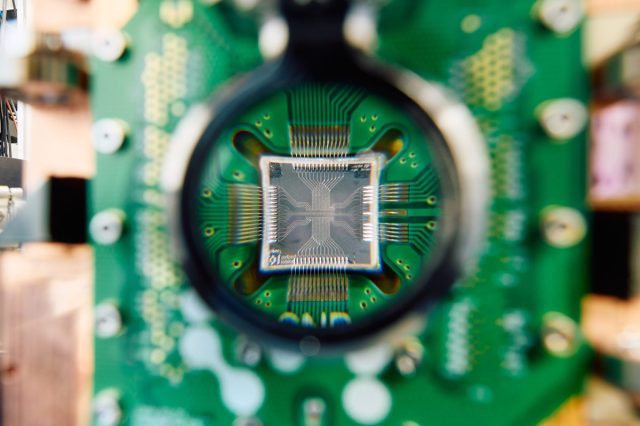 IonQ chip, manufactured with standard silicon facilities and processes (Source: IonQ)
Are Other Quantum Players Saying the Same Thing?
No single company holds the whole story. In March this year, Oratomic—a startup founded by researchers from Caltech, Harvard, Berkeley, Google, and Amazon—worked with Caltech researchers to publish a neutral-atom estimate that could crack the encryption with as few as 10,000 physical qubits in a few days. They wrote: “Although substantial engineering challenges remain, our theoretical analysis indicates that an appropriately designed neutral-atom architecture could support quantum computation at cryptographically relevant scales.”
On the same day, Google Quantum AI, with researchers from the Ethereum Foundation, University of California Berkeley, and Stanford University, published a paper showing that a superconducting machine could break the encryption in roughly nine minutes using fewer than 500,000 physical qubits. The researchers wrote: “We urge all vulnerable cryptocurrency communities to join the migration to post-quantum cryptography without delay,” a direct signal to Bitcoin and Ethereum users.
Thomas Prest, a senior cryptographic researcher at U.K.-based cybersecurity firm PQShield, shares that urgency. PQShield specializes in post-quantum cryptography and works with governments, financial institutions and other organizations moving to quantum-safe standards. “Cryptocurrencies [Bitcoin and Ethereum] are very vulnerable right now as they are using digital signatures that are not quantum-resistant,” he said. “They are aware of this, and Ethereum at least, already has a solid plan to move to post-quantum signatures.”
“But from my point of view, quantum computers represent a threat to not only cryptocurrencies but entire industries that rely on cryptography,” he added. “We’re in discussions with the defense sector and large companies that work with routers, anything that needs encryption at scale—these organizations are most concerned with quantum computing.”
How Close Are the Official Migration Deadlines?
Prest thinks the Oratomic and Google results move the needle toward a cryptographically relevant quantum computer, but more breakthroughs are still needed. He treats them as a warning to move toward PQC as soon as possible, preferably with a 2030 deadline. “This migration takes years, not months, as protocols, software, and hardware implementations all need to be updated,” he said.
Professor Jungsang Kim, chief science and technology strategist for the Provost at Duke University in the U.S., offers a measured view. Kim co-founded IonQ in 2015 and served as CTO until 2024, when he left the company. Looking at recent developments, he believes many engineering challenges remain before Q-Day.
“I’m not sure if there’s any fundamental physics or fundamental questions that are left unresolved,” Kim said. “I think this is now all about the execution… and this will still require substantial technology development and innovation to pose a real threat.”
Kim, like Prest, doubts blockchain elliptic-curve cryptography will be broken by the late 2020s rather than the longer 2030-plus timeline. He notes, however, that progress is hard to forecast, and more investment, larger teams and collaboration could deliver results faster. “I’m still quite optimistic that we won’t be able to crack these codes by the late 2020s, but [the latest results] all point to us needing to go to post-quantum cryptography as quickly as possible—you don’t want to have the slightest chance of taking that risk.”
Deadline language from public bodies also compresses the planning window. The PQC migration roadmap released by the U.S. National Institute of Standards and Technology (NIST) in late October this year says federal high-value and high-impact systems should adopt PQC standards by the end of 2030, while the broader federal transition targets 2035. Canada, Japan, and the U.K. governments stipulate migration by 2035; the Australian government suggests 2030 or sooner; Microsoft has opted for 2033; Cloudflare, however, set a 2029 deadline, and so did Google.
Based on industry developments and recent results, IonQ believes Q-day could arrive toward the end of the decade. “A lot of this comes down to how you care about your security posture… But we’re seeing a lot of organizations around the world re-guiding toward 2028,” Ballance said.
What Else Is Squeezing the Q-Day Window?
At the time of writing, Sydney-based Iceberg Quantum had updated early-2026 estimates indicating that its fault-tolerant quantum architecture could factor the widely used public-key algorithm RSA-2048 using around 98,000 physical qubits in up to a month. The early-2026 estimate was reduced by estimates out last month to 72,000 physical qubits and an expected runtime of just 3.7 days.
Iceberg Quantum’s results were published in a blog rather than a detailed paper, but they still matter for readers because they add to evidence that the resources needed to break public-key cryptography are falling rapidly, narrowing preparation time. de Masi said when the firm released its blueprint: “In 2025, I flagged that the Q-Day time horizon was shifting from the 2030s to the 2020s… Our findings clearly define the risk to elliptic-curve-secured systems.”
Supply-side policy is also accelerating. The source also listed: U.S. Awards Anderon $1B for Quantum Wafer Manufacturing and U.S. Injects $2B into Quantum Computing Companies.
What Should Everyday Users Do Now?
The practical answer is to stop treating Q-Day as a futuristic headline and start treating it as a cryptographic inventory task. A useful new reference point is NIST’s release of the first three finalized post-quantum cryptography standards on August 13, 2024: FIPS 203 for key establishment, FIPS 204 for digital signatures and FIPS 205 for hash-based signatures. That gives product teams and enterprises a concrete target language, rather than an open-ended “quantum-safe” claim.
For MyTechDailyNews readers who do not work in security operations, the immediate job is not to buy a quantum computer; it is to understand which assets depend on public-key signatures. Start with accounts, devices, company VPNs, cloud consoles, password managers, crypto custody tools and any service that stores long-lived records. If you manage a small business, ask vendors a simple question: which NIST PQC standard do you support, and when can we test it in staging? The NCCoE migration guide frames the first step the same way: understand the use of quantum-vulnerable public-key algorithms in hardware, software and services before prioritizing upgrades.
- Make a signature inventory: list ECDSA, EdDSA, TLS certificates, SSH keys, code-signing and wallet key types.
- Rank by exposure: public ledger balances, admin interfaces and archived personal data are more sensitive than one-time logins.
- Watch compatibility, not slogans: quantum-resistant cryptography may change key sizes, certificates and device support.
- Practice crypto-agility: choose vendors that can replace cryptographic components without replacing the whole product.
Which Mistakes Are Most Common?
First, readers often assume a Q-Day machine will instantly drain Bitcoin. The blueprint is an estimate for a fault-tolerant quantum computer, not a claim that public access already exists. Second, people think post-quantum cryptography means replacing every password and every encryption library at once; in practice, migration is phased, and the hard part is finding dependencies. Third, organizations sometimes postpone action because deadlines are written as “by 2030” or later, while IonQ’s roadmap, other papers and the NIST/FIPS standardization timeline show that the decision window is now.
| Mistake | Why it misleads | Better response |
|---|---|---|
| “If no 20,000-qubit machine exists today, I can wait.” | Roadmaps, fabrication and error-correction progress are part of the estimate; waiting also consumes the transition period. | Set a migration owner and inventory deadline before the next vendor contract. |
| “Post-quantum is only for governments.” | Companies set deadlines such as 2033 or 2029 because supply chains and user trust are connected. | Ask whether your payment processor, cloud host and identity vendor can upgrade signatures. |
| “A new algorithm makes old risk disappear.” | Protocols, apps and hardware still need testing; vulnerabilities can remain in dependencies. | Use a staged test: inventory, vendor assessment, pilot, monitoring. |
FAQ: Quick Answers for Readers
What is Q-Day?
Q-Day is the informal point at which a quantum computer is large and reliable enough to break common public-key cryptography, including the schemes used for digital signatures, key exchange and many certificates.
Does the IonQ paper prove Bitcoin is already unsafe?
No. It proves the problem can be quantified in engineering terms: the paper argues that a future fault-tolerant IonQ system with 20,000 physical qubits could run the task in less than 26 days. The risk is real, but the machine and broad access have not been shown to exist today.
Should I move my crypto now?
Do not make panic moves. Review custody methods, watch official Bitcoin and Ethereum security discussions, avoid unknown wallet apps, and back up keys offline. If you are an institutional user, start a cryptographic inventory and ask wallet, exchange or custody vendors about post-quantum roadmap support.
What is the single best action for a non-technical reader?
Ask your important service providers—email, cloud, banking, crypto custody and identity management—when they will support NIST post-quantum standards. The question is useful because it exposes whether a vendor has a plan or only a marketing phrase.
Action Checklist Before Your Vendor Gives You a Deadline
- Write down the systems that store money, identities, health records or work credentials.
- For each system, note the certificate, signature or key exchange mechanism if visible; otherwise ask support.
- Check vendor status against NIST post-quantum standards, especially FIPS 203, 204 and 205.
- Run a small pilot before replacing production systems, because certificate and key formats may change.
- Record exceptions and long-tail hardware, because older devices often block migration faster than servers do.
Reference Sources
- IonQ blog: “We Just Published the First Full-Stack Blueprint for Breaking 256-Bit Elliptic-Curve Signatures”
- IonQ newsroom: world-first compiled blueprint for breaking 256-bit elliptic-curve signatures
- NIST: first 3 finalized post-quantum cryptography standards
- NIST NCCoE: migration to post-quantum cryptography
- CISA quantum risk-management guidance