
Intel Q4 Guidance Miss: MyTechDailyNews General Tech Explains the 23.43% Stock Drop and PC Market Impact
Intel’s latest quarterly outlook moved the stock far more after regular trading than during it. After closing Thursday down 3.6%, the shares fell 23.43% in Thursday after-hours trading. The guidance showed fourth-quarter sales expected to land between $15 billion and $16 billion. Bloomberg’s analyst estimate pointed to $17 billion, and some forecasts had been above $18 billion. Intel also guided adjusted earnings per share to 25 cents, while Wall Street had expected 43 cents.
For general tech readers, the news is not only about one company’s results. The company tied the weaker outlook to a PC market downturn, memory chip shortages, and rising component prices. Those factors can affect PC availability, pricing, and the timing of demand, even for people who never follow earnings reports.
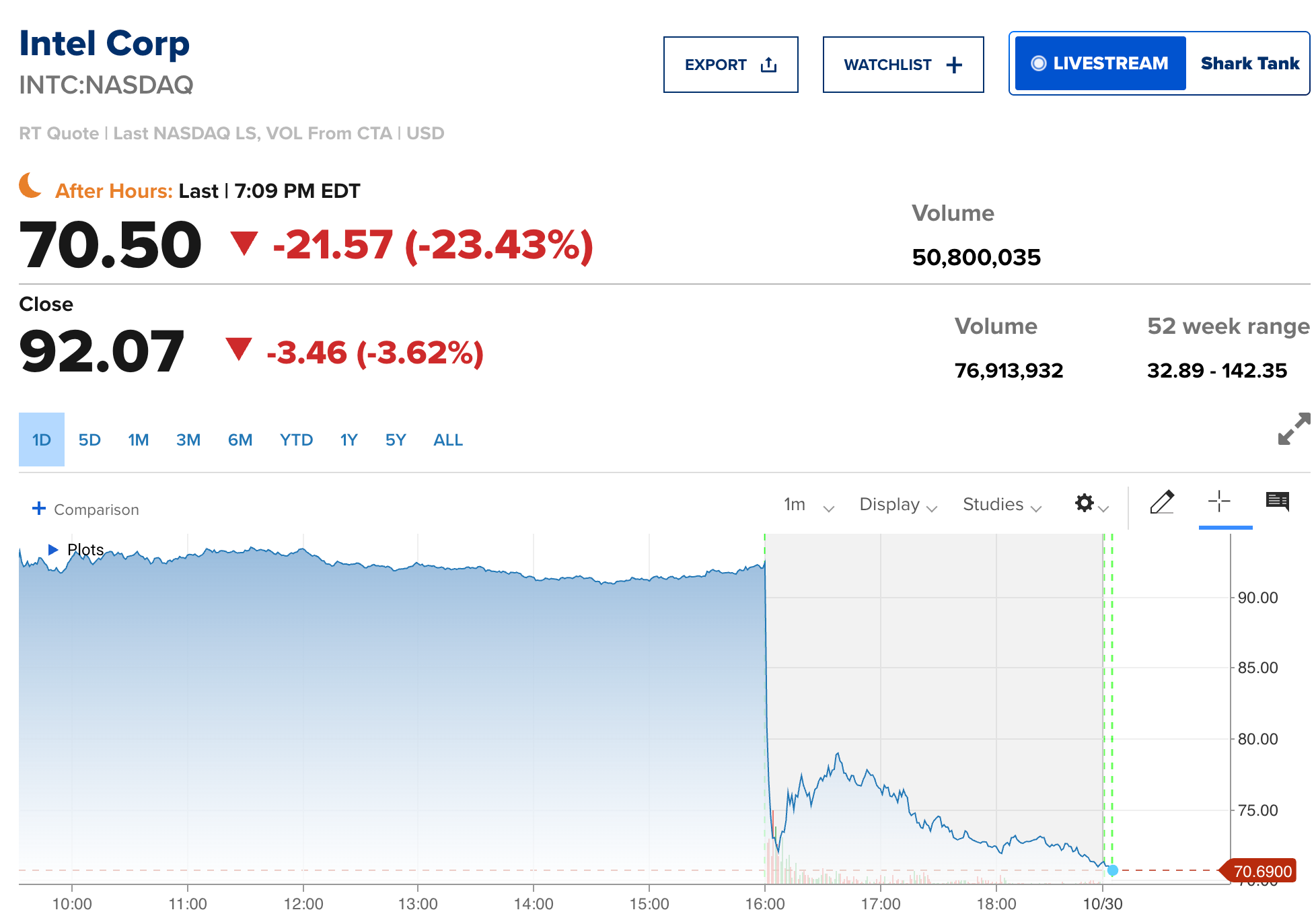
The after-hours decline showed how sharply investors read Intel’s fourth-quarter guide.
The numbers that changed investor sentiment
| Measure | Intel’s result or guide | Reference from Bloomberg or Wall Street |
|---|---|---|
| Q4 sales range | $15 billion to $16 billion | Bloomberg consensus: $17 billion |
| High-end expectation | Not met by the guide | Some forecasts exceeded $18 billion |
| Adjusted EPS | 25 cents | Wall Street expectation: 43 cents |
| Thursday close | Down 3.6% | Regular-session move |
| Thursday after-hours | Down 23.43% | Post-guidance move |
Why the warning reached beyond Intel
Intel’s current pressure comes from the PC segment, where the company’s main customers are laptop and desktop makers. The company said those customers are facing memory chip shortages and higher component prices. As a result, PC shipments are falling, and user demand is being suppressed.
That situation matters because the PC chain is connected across suppliers, manufacturers, and buyers. When memory chips become tighter and more expensive, the pressure is passed through the system, and the end market can become weaker for a longer period than a single quarterly forecast would suggest.
CEO Lip-Bu Tan points to short-term supply pain
Intel CEO Lip-Bu Tan said the company was not able to satisfy strong customer demand this quarter. He pointed to manufacturing supply shortages, an unprecedented memory chip shortage, and the resulting softening of PC demand. He said in the call: “I’m a bit disappointed, because this quarter we did not meet strong customer demand. We face short-term challenges, including manufacturing supply shortages, an unprecedented memory-chip crunch, and the resulting softening of PC demand.”
He placed memory chips at the center of the problem. “One of the main challenges is essentially memory chips. Memory prices have surged. I expect this to become a very serious problem for all of us by 2027. We are not the only company affected; the entire market has been hit,” Tan said.
Data-center outlook, Israel factory outage, and PC timing
Tan said Intel’s data-center division would have performed better if the company had not faced some raw-material shortages and the shutdown of a factory in Israel. He added that Intel is working to solve those supply-chain problems. Earlier, the company said the fatal explosion at an Israeli factory would cause roughly $600 million in lost revenue within two quarters.
The PC market forecast is also long. Intel expects the PC market downturn to last at least through the first half of 2027. It sees next year’s market size declining by another 10% after this year’s 12% decline.
Long-term view: capacity building and other chipmaker orders
Over the longer term, Intel remains optimistic about demand for its products. The company is increasing investment in new equipment to raise capacity. Tan said Intel has growing confidence that it can attract other chipmakers to place orders and use Intel’s factories to produce chips for those companies.
Checklist for general tech readers
- Compare current availability and price when shopping for a laptop or desktop.
- Watch for PC-maker updates that mention memory shortages, component costs, or shipment timing.
- Track Intel’s future statements, because the company links its outlook to memory chips and PC demand.
- If you need a device soon, consider whether waiting changes the choice you can actually buy.
- Use the stated timeline—through the first half of 2027—as a reason to plan PC purchases more deliberately.
Common misconceptions
- Misconception: The stock drop was only an Intel execution issue. Reality: The report also pointed to memory chip shortages, higher component prices, and weak PC demand.
- Misconception: The weakness is limited to one quarter. Reality: Intel expects the PC market downturn to last at least through the first half of 2027.
- Misconception: New capacity investment immediately fixes current shortages. Reality: The company is raising capacity, but short-term problems include manufacturing supply shortages and a memory chip crunch.
- Misconception: Only Intel is affected. Reality: Tan said the entire market has been hit by rising memory prices.
FAQ
What did Intel guide for Q4?
Intel said fourth-quarter sales are expected to be $15 billion to $16 billion, with adjusted earnings per share of 25 cents. Bloomberg’s consensus revenue estimate was $17 billion, some forecasts were above $18 billion, and Wall Street expected 43 cents.
How much did the stock fall after hours?
Intel shares fell 23.43% in Thursday after-hours trading. By Thursday close, they had already moved down 3.6%.
Why is memory being highlighted?
CEO Lip-Bu Tan said memory chips are one of the main challenges, with memory prices rising sharply. He expects the issue to remain a severe problem by 2027 and said the whole market is affected, not only Intel.
What did the company say about the Israeli factory?
Intel said a fatal explosion at a factory in Israel would cause about $600 million in lost revenue within two quarters. Tan also said the shutdown and raw-material shortages prevented better data-center performance.
Is the outlook entirely negative?
No. Intel remains optimistic about long-term demand for its products, is investing in new equipment to lift capacity, and expects growing confidence that other chipmakers may use Intel’s factories.
Action advice for readers planning tech purchases
- Read Intel’s outlook as a signal about PC supply conditions, not just a stock-news item.
- Check whether a desired laptop or desktop is in stock and at a stable price before deciding to wait.
- Follow updates from PC makers and component markets, because the company’s own explanation focuses on memory chips and component prices.
- Remember the time horizon: Intel expects PC market weakness at least through the first half of 2027.
- If planning a replacement device, factor in that shortages can change availability and demand patterns.
Intel’s fourth-quarter guide turns a routine earnings update into a broader warning for the PC ecosystem. The stock’s 23.43% after-hours decline reflected the gap between Intel’s $15 billion to $16 billion revenue range and the $17 billion Bloomberg consensus, along with the gap between 25 cents adjusted EPS and the 43-cent Wall Street expectation. The next issue for general tech readers is less about the daily stock move and more about whether memory chip shortages, higher component prices, and PC demand softness will keep the market pressured into the first half of 2027.