
Intel's Post-Earnings Selloff: PC Pressure, an Israeli Fab Hiccup and the Missing Foundry Clock
For MyTechDailyNews General readers, the earnings story can be read as three clocks: the PC refresh clock, the data-center supply clock and the foundry revenue clock. In the earnings call a few hours ago, Bank of America did not begin by praising the scorecard; it asked when external foundry customers would move from evaluation to formal tape-out — design finalized, handed to a fab for wafer starts — and when external revenue could enter a model. CEO Lip-Bu Tan said customer details would not be disclosed; on packaging, he said, "in the next two quarters, there will be people ready to announce." For 18A and 14A, the answer was still "later," leaving no timetable and no modelable number.
The current quarter was not the problem; next quarter was. Revenue and non-GAAP EPS guidance came in far below relative consensus, while PC demand was pressed by higher memory prices. At the Israel factory, southern Kiryat Gat Fab 28 — once the mainstay of Intel's early 10nm volume production and still carrying some server 10nm products — suffered an explosion at the beginning of this month and stopped production for about two weeks. The stock fell nearly 30%, with the move pointing to softer PCs, lower gross-margin guidance and the still-unresolved external foundry "later."
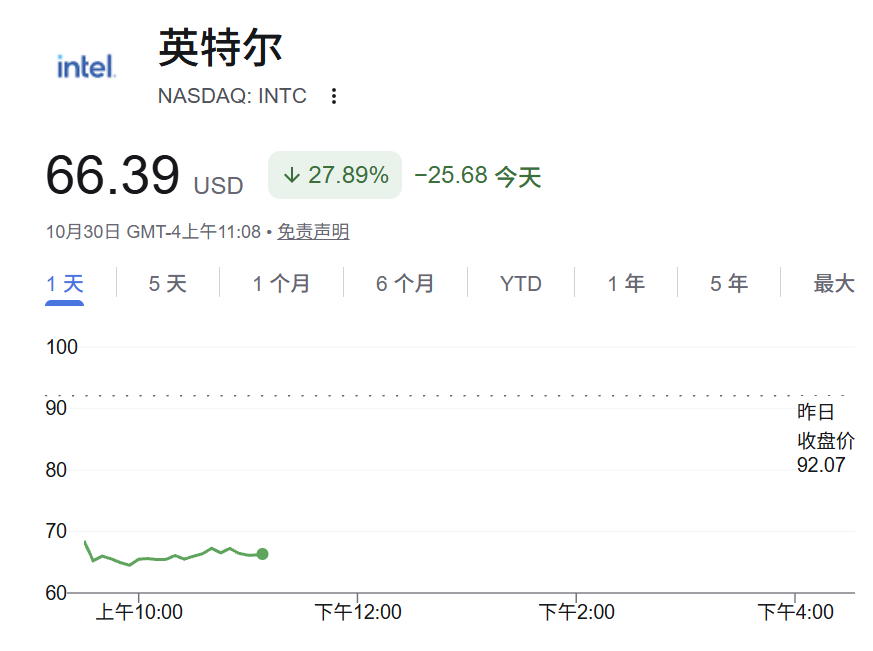
The Report Was Better Than Feared; the Guide Was Not
Historically, Intel's revenue leaned heavily on PCs. After process leadership slipped, former CEO Pat Gelsinger bet on IDM 2.0: use Intel's fabs not only for internal supply but also external orders, while investing in new factories and advanced-process catch-up. A year and a half after Lip-Bu Tan took office, some investors guessed he might shrink the foundry push to clean up the financials. Instead, foundry priority rose. Around August, Intel raised about $23 billion, thickening cash reserves and making the market more willing to base valuation on the idea that "shortages will ease, 18A will ramp, and external customers will pay."
Then came the quarter. For this quarter, Intel reported revenue of $16.513 billion, up 21% year over year and almost matching relative consensus of about $16.5 billion. Non-GAAP earnings per share were $0.52, beating relative consensus of about $0.40 and the company's own guide of about $0.38. Chief Financial Officer Dave Zinsner opened with, "We delivered another solid quarter ... including the strongest data center revenue growth in fifteen years."
The guide for Q4 was the issue. Revenue guidance of $15.0 billion to $16.0 billion was below relative consensus of about $17.1 billion, while non-GAAP EPS guidance of $0.25 trailed relative consensus of about $0.43. Before earnings, some optimistic analysts had pushed the Q4 revenue midpoint to $17.1–$17.5 billion. When the guide landed, those forecasts collapsed. Asked how a gap of about $1.8 billion below relative consensus split between the Israel factory and PC demand, Zinsner said the preliminary assessment pointed to about $0.3 billion in Q4 revenue from the Israel accident, almost all tied to 10nm server products, and about 200 basis points of gross-margin pressure. The impact on Q1 revenue could be similar, with most scrapped wafers booked in Q4 and the larger burden still coming from PC sales.
PCs Are Being Pressed From Both Ends
The client business was the part that cracked. CCPG, which mainly sells CPUs for PCs and laptops, reported revenue of $8.097 billion, down 5% year over year and down 9% sequentially, below internal expectations. Operating profit was $2.285 billion, for an operating margin of about 28%. The segment remains the largest piece of the revenue pie, but volume started to fall first. For Q4, the company expects another sequential decline of more than 20%.
Zinsner warned, "Looking ahead, we expect PC slowdown to last at least until the first half of next year," and said destocking would drag at least into the first quarter. Intel's own industry view was colder: in 2026, PC unit TAM is expected to fall about 12%, with the second-half decline exceeding 20%; in 2027, the market is expected to fall about another 10%. Higher memory prices raise the total bill for a PC and reduce upgrade willingness. The same memory can attract higher bids from data centers, while PC buyers balk at cost, so Intel — the CPU seller — is exposed first. Morgan Stanley estimates that continued deterioration in the client segment could drag the company's revenue consensus by about $3 billion to $4 billion.
Data Centers Look Strong, But Supply Is the Gatekeeper
DCAI, which sells server CPUs and AI accelerators, was the bright side. Its revenue reached $7.318 billion, up 78% year over year and up 17% sequentially; operating profit was $3.039 billion, a margin of about 42%, higher than CCPG's profit. Lip-Bu Tan said, "Despite near-term PC industry headwinds, our demand for CPUs remains strong ... the urgent priority is to open additional supply to meet exceptional demand for Xeon family."
The bottleneck is not only fabs. Management said Intel 3 output is ramping, but advanced organic substrates are scarce across the industry, limiting EMIB advanced packaging. Wafers may be produced, but packaging materials cannot keep up, so server CPUs still cannot ship. The company expects server CPU shipments to grow more than 30% annually in 2026 and 2027, with tightness possibly lasting to the end of 2027, or even into 2028. For full-year DCAI, management said the result could be about $10 billion better than the beginning-of-year expectation.
Morgan Stanley still treats the strong numbers with skepticism: the outcome depends heavily on a shortage environment, and Intel's flagship products remain weaker than peers. On the call, another analyst noted that AMD's server-related revenue guidance was about 70% higher and that Arm architecture was also taking server share. Competitors discuss revenue slope and share; Intel says share depends on supply, so share moves only as far as supply improves. When substrates and packaging are short, shortage creates delivery pressure, demand rises, but specific share targets are not given.
Foundry Needs External Revenue, Not Only Internal Orders
Foundry revenue, which carries internal and external wafer manufacturing and packaging, was $6.697 billion. Most of it was internal. External foundry revenue was $0.411 billion, up $0.118 billion sequentially, mainly from one-time customer projects, and the segment's operating loss was $1.853 billion. TSMC remains the benchmark for external foundry: the story works only if customers are willing to keep paying for advanced process capability.
SemiAnalysis said 18A has shipped, but its transistor density does not lead TSMC's comparable process, and high-end GPU and I/O chips still require a mix of TSMC capacity. Morgan Stanley said confidence in Intel's foundry story is largely a bet on 14A landing in 2028 or 2029, while external high-volume customer commitments remain very small. It also worries about structural capability: if Intel cannot satisfy its own demand, that would be the worst advertisement.
Cash Is Not the Issue; Timetable Is
In August, the equity raise left quarter-end cash plus short-term investments at about $54 billion. Diluted shares stood at about 5.3 billion, Q4 guidance assumed fully diluted shares of about 5.44 billion, and interest-bearing debt totaled about $50.1 billion. Cash is not missing. What is missing is external foundry revenue becoming modelable. Bank of America's question kept returning to the same line. The prepared statement had already said customer details would not be disclosed; in Q&A, when asked again about formal tape-out and modelable revenue, the answer was still "later."
Analysts also asked how much next year's capital expenditure would be and when free cash flow could turn positive. For capex, 2026 gross spending is still about $20 billion, while 2027 is described as "significantly higher." The company has not locked the absolute amount, and higher round figures circulating in the market are rough estimates. Zinsner said next year is an investment year and "probably won't have positive free cash flow." Adjusted free cash flow for the quarter was still $1.6 billion: operating cash flow of about $5.1 billion, less gross capex of about $4.2 billion, plus adjustments such as government incentives and partner contributions. That positive number is unlikely to hold through next year. Cash comes from operating receipts and the August raise, then flows into wafer fabs, packaging lines and a foundry segment still losing money. Faced with that financial model, Morgan Stanley judges that even if later numbers are revised upward, the stock's current price is already roughly fully valued.
Checklist: What to Watch After the Drop
- Formal tape-out evidence. Customer evaluation is not the same as design finalized and handed to a fab; watch for repeatable external wafer starts.
- Packaging announcements. The company said, "in the next two quarters, there will be people ready to announce." Track whether that becomes named customers, volume commitments or revenue.
- 18A and 14A timing. The foundry valuation depends less on slogans and more on whether 18A ramps and 14A arrives in 2028 or 2029.
- PC inventory. The slowdown is expected at least into the first half of next year; watch whether destocking ends after Q1.
- Data-center delivery. Xeon demand is strong, but substrate and EMIB constraints determine shipments and share.
Common Misconceptions
- Misconception: the selloff happened because the quarter was bad. The quarter beat on EPS and nearly matched revenue consensus; the next-quarter guide was the problem.
- Misconception: the Israel factory explains most of the guide gap. The preliminary Q4 hit was about $0.3 billion and about 200 basis points of margin; the larger drag was PC weakness.
- Misconception: data-center growth automatically means share wins. Morgan Stanley says strong results are shortage-dependent, and Intel's supply improvement must be enough to move share against AMD and Arm.
- Misconception: the cash raise fixes the story. The about $23 billion raise strengthened the balance sheet, but did not provide modelable external foundry revenue.
FAQ
Why did Intel's stock fall after a $16.513 billion quarter?
Because next-quarter guidance was far below relative consensus, PC demand was pressured by memory prices, and the external foundry roadmap still lacked a formal tape-out and modelable revenue timetable.
How much did the Israel incident cost?
Intel's preliminary estimate was about $0.3 billion in Q4 revenue, almost entirely on 10nm server products, plus about 200 basis points of gross-margin pressure. The company said the Q1 revenue impact could be similar.
Is the data-center segment enough to offset PCs?
Not yet. DCAI revenue grew 78% year over year and the company expects full-year DCAI about $10 billion better than the start-of-year view, but substrates, EMIB packaging and competitor supply dynamics still limit the ability to convert demand into share.
What would make the foundry story believable?
Named external customers moving to formal tape-out, repeatable external revenue, packaging announcements, and credible 18A ramp or 14A timing. One-time projects are not enough.
Action Advice
For a general tech audience, avoid treating the headline and the valuation issue as the same thing. The headline said the quarter beat EPS; the market responded to guidance and timelines. Practical next steps are simple: watch for Q4 revenue moving closer to relative consensus, for inventory correction to finish after Q1, for substrate and EMIB bottlenecks to ease, and for external foundry language that replaces "later" with dates. If those checkpoints remain missing, the PC recovery slope and foundry roadmap will continue to look unpriceable.
Server orders are still queued, and AI demand has not collapsed. What changed is price sensitivity: PCs are trapped by memory costs, margin guidance moved down, external foundry still cannot be modeled, and free cash flow is unlikely to be positive next year. The market is no longer willing to pay for an unfulfilled foundry timetable or an assumed PC recovery slope. Until evaluation becomes formal tape-out, the gap between Intel's story and its modeling remains the real risk.