
Arc B580 End-of-Life Rumors: A MyTechDailyNews Checklist for Intel GPU Buyers
Affordable graphics cards rarely make headlines; a card that now trades at well over twice its original shelf tag almost always does. That is the situation around the Intel Arc B580 this week. Availability has tightened at major retailers, street prices have crept upward, and a leak on X has attached the phrase "end of life" to one of the few genuinely budget-friendly GPUs of the past two years. Below, MyTechDailyNews separates what is confirmed from what is speculation, then turns the story into decisions you can actually make tonight — whether you already own the card, are holding cash for one, or specify parts for other people's machines.
The Rumor in Plain English
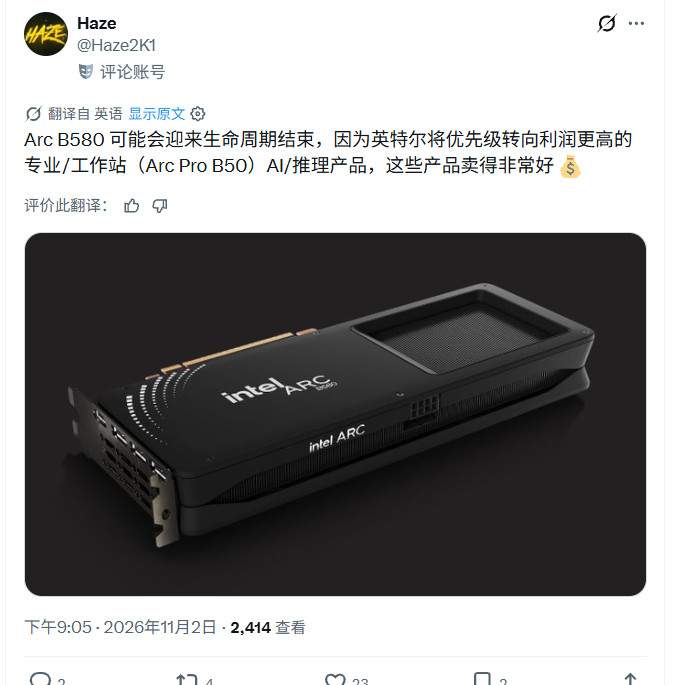
The claim comes from leaker Haze (@Haze2K1), who suggested that Intel may put the Arc B580 on an end-of-life list and redirect resources toward the Arc Pro series, with the Arc Pro B50 named specifically. The stated reason is commercial rather than technical: the company's professional graphics cards are reportedly in strong demand for artificial intelligence inference work, where margins are friendlier than in gaming. As with every earlier version of this story, Intel has issued no official notice, and the same pattern of unverified supply claims now surrounds Nvidia — neither of the two companies has confirmed anything.
Worth remembering: this is not the first time the desktop Arc line has been declared dead. In June 2026 Intel publicly pushed back on rumors that it would abandon Arc desktop cards, reiterating that Arc matters to its PC business, and Intel community support told users facing empty listings that a stock shortage does not necessarily mean a product has been discontinued. Rumor history matters when you decide whether to change your plans.
One Chip, Two Very Different Paychecks
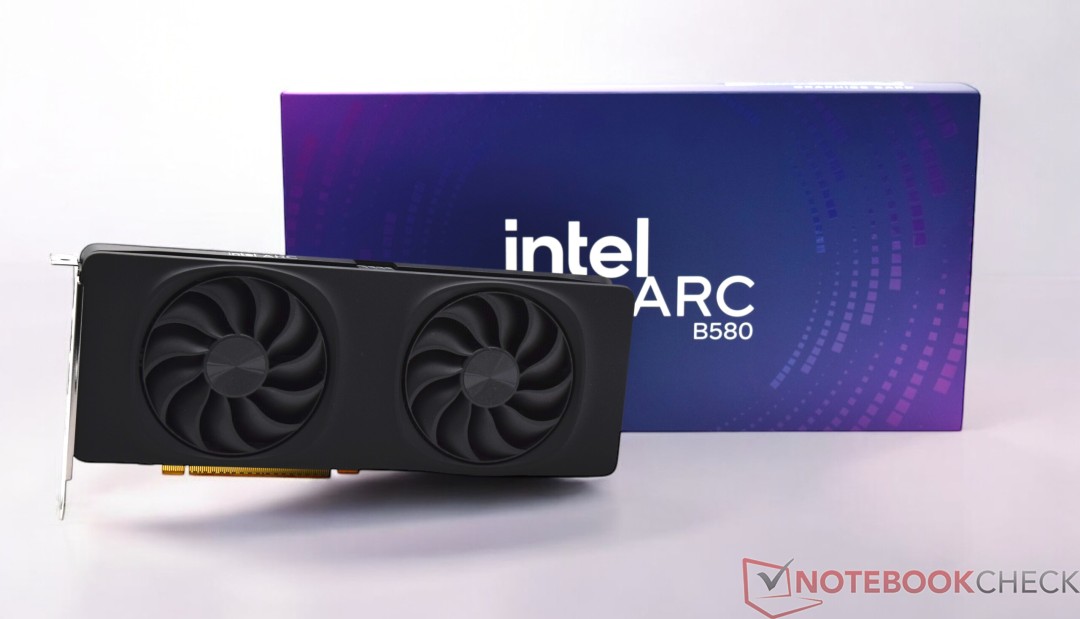
The technical detail that gives the rumor its shape is the silicon itself. The Arc B580 runs on Intel's BMG-G21 chip, and that same silicon family also sits inside professional cards such as the Arc Pro B50 and the B60. The consumer B580 ships with 20 Xe cores and 12GB GDDR6 memory; the B60 uses the same 20 Xe core configuration but carries 24GB memory, and board partners including Maxsun and Sparkle ship versions with up to 48GB memory. Cores are not what changes between the two products; the price tag and the customer do.
The memory difference is the practical story for anyone eyeing local AI work. Reviewers measured roughly 456GB/s of bandwidth on the B580's 12GB buffer (PCMag, "First Look: Intel Sends Battlemage to Workstations With 24GB Arc Pro B60"), while larger-buffer pro cards can hold bigger models in VRAM instead of spilling to system memory — which is exactly the workload Intel is reportedly steering its wafers toward.
The Nvidia Parallel: GB202's Quiet Reassignment
Nvidia is living a nearly identical headline. Multiple reports have said the company is shifting GB202 GPU capacity away from the GeForce RTX 5090 toward higher-margin RTX Pro workstation cards. One follow-up report — that a board partner could not even pre-order RTX 5090 kits — seemed to corroborate it. Nvidia has insisted the RTX 5090 is not discontinued and that shipments will continue. The parallel matters for readers because it shows a pattern in the 2026 market: when AI demand competes with gaming demand for the same die, the gaming SKU is the one that usually gets squeezed first, in price if not in name.
Follow the Price Tags
| Data point | Arc B580 (consumer) | Why it matters to you |
|---|---|---|
| Launch | Released in December 2024 with a launch price of $249 | Still the reference price for judging today's quotes |
| Original positioning | A card priced under $300, aimed at RTX xx60-xx70 territory | Its whole pitch was value, so overpaying erases the reason to buy it |
| Current street price | Has risen to about $330 at Newegg; some UK models near 500 pounds | Roughly 33%–100% above launch MSRP, with stock thin at most retailers |
| Supply record | Tight availability even before the AI boom | Scarcity here is partly habitual, not proof of an end-of-life decision |
| Sibling on the same die | Arc Pro B60 listed around $599 in retail (ASRock's 24GB Creator model, per 163.com), with some partner cards quoted near $799 | Shows how much more revenue the identical silicon can generate for Intel |
Five Signals That Separate Rumor From Roadmap
- An official product-change notice. Genuine discontinuations surface in Intel's product specification and orderable-SKU pages, or through distributor price and availability letters — not first on a leak account.
- Driver cadence. Intel's Arc Graphics driver download page (ID 785597 on intel.com) kept publishing WHQL builds covering the Arc B-Series as late as October 2026, including game-day "Game On" drivers. Steady driver support is the cheapest signal that a gaming line is still alive.
- Where new driver pages are growing. Intel's separate Arc Pro driver page (ID 741626) now lists workstation parts such as the Arc Pro B60 alongside B65 and B70 entries — a fair indicator of which SKUs are getting launch-window attention.
- Partner behavior. Check whether Maxsun, Sparkle and other add-in-card partners still list the card, still warranty it, and still ship new cooling variants; partners stop first when a die is truly being reassigned.
- The Nvidia precedent. RTX 5090 shortage chatter turned into a firm denial plus continued shipments. Treat "sold out" and "discontinued" as different claims until an end-of-life notice says otherwise.
Your Scenario Playbook
You already own an Arc B580
- Nothing changes: hardware you own keeps its warranty and its driver path while support continues.
- Record your purchase invoice and serial number now; resale value usually rises when a card is rumored dead.
- Update to the latest Intel Graphics driver before troubleshooting anything, since many reported "B580 regressions" are driver-side, not silicon-side.
You were planning to buy one
- Set a walk-away ceiling before you shop. The card's reason to exist was a sub-$300 value pitch; at about $330 the math narrows sharply.
- Compare the alternatives at today's prices, not at launch prices: the 18 Xe core, 10GB Arc B570 (TechPowerUp GPU database) has been reviewed at $219, and older Radeon and GeForce parts fill the gap when B580 quotes inflate.
- Watch the gap between asking price and sold price. A listing at 500 pounds in the UK that nobody fulfils is noise, not a market.
- Buy from sellers with a clear return window while rumors are unresolved; grey-import listings are where bad prices and bad warranties cluster.
You build PCs for clients or resell components
- Quote customers with a substitution clause: an equivalent card at the same performance tier if the B580 is unavailable at budget.
- Stop promising delivery dates on zero-stock SKUs until an official availability statement exists.
- For design, CAD and AI-inference clients, price the Arc Pro B50 and B60 options directly — the rumor story is essentially a marketing story about the same silicon.
You want a card for local AI inference
- Memory capacity, not Xe core count, is your bottleneck: 12GB GDDR6 limits model size, while 24GB and 48GB configurations open it up.
- Expect workstation cards to cost more per frame of gaming performance — that trade is exactly what this rumor is about.
Four Misconceptions Worth Retiring
- "No gaming successors means the product is dead." Intel's Battlemage gaming lineup has been thin all along — the long-rumored Arc B770 never reached store shelves (igorslab.de), which is a roadmap story, not an end-of-life notice.
- "Discontinued means unsupported." Ended production and ended driver support are different events; GPUs routinely receive years of driver updates after their final shipment.
- "The Pro cards are totally different hardware." They share the BMG-G21 silicon; the differences are memory configuration, certified drivers and pricing.
- "One leaker plus one price chart equals confirmation." The leaker himself frames it as a possibility, and both companies have declined to confirm.
FAQ
Is the Arc B580 officially discontinued?
No. As of the reports behind this story, Intel has published no official notice on the Arc B580; the claim that it may be placed on an end-of-life list comes from leaker Haze (@Haze2K1) and remains unverified.
Why would Intel move production away from a gaming card?
Margins. The same silicon sells as a workstation product at multiples of the consumer price, and demand for AI inference hardware is reportedly strong, which is where Arc Pro B50 and B60 sit.
Should I sell my B580 now?
Selling decisions should follow your needs, not rumors. If the card still does the job, an unconfirmed end-of-life report is a reason to watch the market, not to liquidate hardware at an artificially high quote.
Are the Nvidia RTX 5090 rumors the same problem?
Mechanically yes: Nvidia is reportedly redirecting the GB202 GPU from the GeForce RTX 5090 toward RTX Pro cards, while insisting the RTX 5090 will keep shipping. Both are cases of scarce capacity meeting higher-margin demand.
What would a real end-of-life signal look like?
An orderable-SKU or product-change notification from Intel, distributor end-of-life letters, stalled driver releases on the Arc Graphics download page, and board partners such as Maxsun and Sparkle pulling listings. None of those has happened for the B580 in the reporting cited.
Bottom Line
Treat the B580 story as a pricing event with a rumor attached, not as a product funeral. The verified facts are narrow: a card launched in December 2024 at $249 is now hard to find at that number, the pro variant of the same silicon costs two to three times as much, and Intel's gaming lineup is thin. The useful response is equally narrow — hold your price ceiling, keep a substitute ready, and wait for Intel's own documentation before you change a build. Send tips, price screenshots or correction requests for tech stories like this one to the MyTechDailyNews desk at hello@techdaily.com.