
MyTechDailyNews General: What OktoberTech 2026 Shows About Edge AI, SDVs, and the 800 VDC Future
For everyday tech readers, the clearest signal from the 10th annual OktoberTech meeting was that AI is now a hardware-and-power problem as much as a software problem. On Oct. 22, Infineon convened the event at the Computer History Museum in Mountain View, California, with briefings on physical AI, robotics, automotive systems, and data-center energy delivery. The practical question was not whether AI is coming, but how devices, vehicles, factories, and servers must change so that more autonomous systems can operate reliably.
Moving through the museum’s exhibits, attendees heard a historical framing before the company sessions. Michio Kaku—a theoretical physicist, City College of New York professor, and best-selling author—discussed the waves of innovation, a concept closely tied to economist Joseph Schumpeter and creative destruction, where newer inventions make older technologies obsolete. Kaku traced a path from steam, through the transistor and the Information Age, to the AI revolution, then pointed toward quantum computing and brain-computer interfaces (BCIs) as possible sources of new industries.
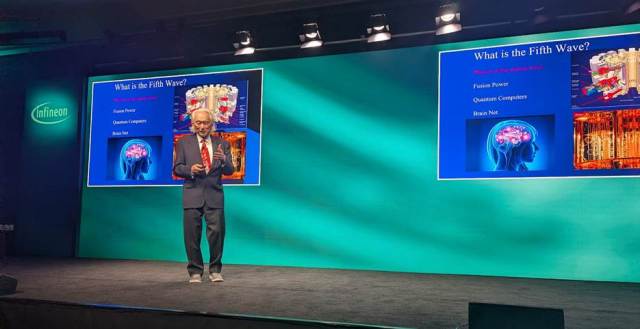 Figure 1: Michio Kaku presenting on the different waves of technological innovation (Source: Aalyia Shaukat, OktoberTech 2026, Computer History Museum)
The event’s common thread: chips are still central
Although the agenda spanned automotive semiconductors, power electronics, and embedded processing, the recurring point was that AI infrastructure raises demands on semiconductor technologies and manufacturing capacity. For general readers, that means chip availability, local processing capability, and power conversion are now visible forces behind many consumer-tech and industry stories.
Why this edge AI moment is not just another IoT echo
Some journalists at the session pressed on earlier hype around IoT, edge computing, and software-defined vehicles (SDVs). IoT, for example, once appeared as if every device would connect wirelessly and stream monitoring data to the cloud. One journalist noted that the billions of connected devices once promised over cellular, Wi-Fi, and low-power networks never materialized, and that IoT conferences that once drew 12,000 to 14,000 in Silicon Valley no longer exist. Given that history, they asked why the industry should expect edge AI to be any different.
Stefan Zizala, division president of edge systems at Infineon, answered by describing IoT as “an unfulfilled promise” rather than a failure. His distinction was that today’s microcontrollers have more capability and memory, allowing AI models to run locally. “Not every piece of information needs to be fed back to the cloud,” Zizala said. He summarized the shift this way: “I think that’s the big difference…they are processed with AI right at the edge…and the results are then sent back to the cloud…So, it’s a conceptual change.”
He said the change is already visible in everyday devices such as power tools and home appliances. In one session, he noted that machine-learning algorithms are now used in electric motor control for predictive maintenance, and he cited practical reasons to keep processing local: the cost of cloud tokens, lack of connectivity, latency, and data protection.
Software-defined vehicles: less central computing, more software control
Peter Schiefer, president and CEO of the Automotive Division at Infineon, put SDVs in perspective. He said only about 10% of vehicles have a software-defined architecture today, leaving roughly 90% without one. He forecast the share would rise to around 40%. Audience members argued that newcomers, particularly in China, can design vehicles from a “clean sheet of paper” without legacy architectures. Schiefer agreed that greenfield companies have an easier path.
Schiefer also pointed to another setback: Western OEMs had tied SDV launches to new EV platforms, so when those platforms were canceled, SDV rollouts were delayed as well. China, he noted, has reached about 50% EV penetration, which has given Chinese automakers a competitive edge. His conclusion was that legacy OEMs can only manage growing complexity by controlling their own software. That requires consolidating the roughly 100 distributed control boxes, each with its own dedicated software, into a central computer. “That’s the only way traditional OEMs can survive. And I think meanwhile they recognize it, and they need to catch up,” Schiefer said.
Data-center power, the Dresden fab, and the road to 800 VDC
Most of OktoberTech focused on physical AI, but the power systems briefing placed stronger emphasis on data centers. In October, Infineon announced a series of data-center-related developments: a 27 kW three-phase PSU reference design; an 800 VDC and ±400 V digital hot-swap controller; the first 900-V GaN bidirectional switch (BDS) used in Enphase’s IQ solid-state transformer (SST); and an 800 V to 50 V, 12 V, 6 V GaN intermediate bus converter (IBC) collaboration with Nvidia.
That investment also connects to manufacturing. In July, Infineon opened its €5 billion (~$5.58 billion) Smart Power Fab in Dresden, a 300-mm facility for power and analog/mixed-signal devices and the largest single investment in company history. Adam White, president of Infineon’s Power and Sensor Systems division, presented the site as capacity ready for AI buildout. “This facility is at the moment empty, okay? But I promise you now, with the demand that we’re seeing, that facility will be ramped.” He added that the fab is “open there for the industry.” Full production is set to ramp up in late 2026.
When asked when 800 V DC would reach the market, White said, “We may start seeing some of the first, whether they’re prototypes or mass productions, definitely in ‘28.” He described it as the end state of a longer path, from single-phase to three-phase and ultimately from high-voltage AC to medium-voltage DC at the facility level, which he called “the holy grail to get to the 1 MW rack.” That differs from today’s sidecar approach, where 800 V is produced locally from three-phase AC. White also cautioned that barriers remain, including maintaining UL certification and safety from the beginning.
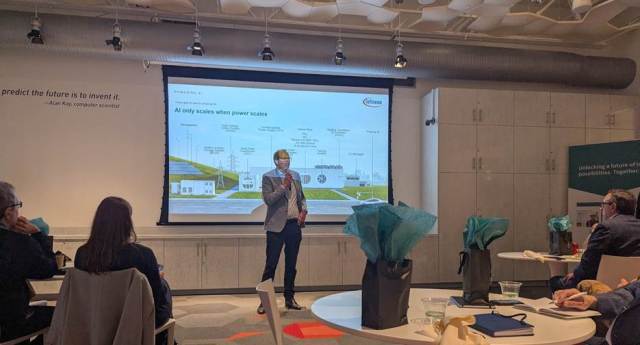 Figure 2: Adam White, president of Infineon’s Power and Sensor Systems division, presents the company’s grid-to-core view of AI data center power. (Source: Aalyia Shaukat, OktoberTech 2026, Computer History Museum)
What the IBC reference designs tell readers
Regarding IBCs, Infineon released the 800-to-50 V and 800-to-12 V IBCs in March 2026; both use 650-V CoolGaN on the primary side.
| Product | Configuration | Rated power | Efficiency | Footprint | Power Density | Devices |
|---|---|---|---|---|---|---|
| HV IBC: 800 V to 50 V | ISOP, planar PCB-integrated transformer | 6 kW TDP (up to 10.8 kW for 400 µs) | >98% full load | 60 × 60 × 11 mm | 2.5 kW/in³ | 650 V CoolGaN primary+ multiple synchronous rectifier stages |
| HV IBC: 800 V to 12 V | ISOP LLC, matrix transformer | 6 kW TDP (up to 10.8 kW for 400 µs) | 98.2% peak, 97.1% full load | 130 × 40 × 8 mm | >2.3 kW/in³ | 650 V CoolGaN + 40 V OptiMOS 7 |
Table 1: Specifications of Infineon’s 800 V-to-50 V and 800 V-to-12 V CoolGaN IBC reference designs
The October release strengthens GaN’s role in IBCs, an approach also pursued by other power vendors such as Renesas, TI, ST, and Navitas. It also confirms Infineon is actively developing IBCs for 800-to-6 V conversion. Such IBCs draw 800 VDC from the sidecar and convert closer to the core, potentially leaving room for power converters to take the 6 V directly to sub-1V core voltages, though there is room for debate.
The physical logic is straightforward: I²R losses dominate as voltage drops and current rises. The 20 kW-class 800-to-6 V converters shown at GTC 2026 push more than 3,000 A at their output (20 kW / 6 V ≈ 3,300 A). As voltage approaches core level, the electrical path to the xPU must become shorter, which has driven the need for VPD on AI processors, namely GPUs.
In a discussion about power delivery to xPUs such as GPUs, CPUs, and TPUs, a panelist noted lateral power delivery (LPD) will remain applicable for CPU-heavy agentic racks. While GPU remains dominant for training with an 8:1 GPU-CPU ratio, inference (~4:1) and agentic (~1:1) workloads shift the ratio toward CPUs. “From the customer interactions that we’re having, there are clear commitments I see from some of the bigger companies to go down to a ratio of 1:1,” White said. “Of course, that’s a dramatic change from 8:1 ratios that were there previously.”
FAQ: Quick answers for general tech readers
- Q: Is this just another chip conference story? A: No. The session linked semiconductor capacity to edge devices, vehicles, and data centers; the core claim was that physical AI needs capable local compute and stable power delivery.
- Q: Why should an ordinary reader care about 800 VDC? A: The discussion presented 800 VDC as part of the path to denser, higher-power AI infrastructure, with prototypes or mass production possibly arriving in ‘28.
- Q: What does SDV mean for car buyers? A: It means more centralized software control and potentially easier updates, but only about 10% of vehicles currently have the architecture; around 40% was the forecast share.
- Q: Does edge AI mean no cloud? A: Not necessarily. Stefan Zizala described a conceptual change: process some data with AI at the edge, then send results back to the cloud.
Checklist: What to watch next
- Watch whether more capable microcontrollers move AI from cloud services into appliances, power tools, and industrial equipment.
- Watch vehicle software centralization: the panel argued legacy OEMs must move from roughly 100 distributed control boxes toward a central computer.
- Watch data-center power announcements: 800 VDC, IBCs, GaN components, and the Dresden fab ramp schedule are all part of the same story.
- Watch workload ratios: training used an 8:1 GPU-CPU ratio, while inference and agentic use may move toward ~4:1 and ~1:1.
Common misconceptions
- Misconception: IoT failed, so edge AI must also fail. The session’s rebuttal was that IoT was “an unfulfilled promise,” while edge AI now benefits from more capable microcontrollers and local model execution.
- Misconception: physical AI is only a robot story. OktoberTech covered robotics, automotive, and power systems, showing that AI hardware needs semiconductor manufacturing and energy conversion too.
- Misconception: 800 VDC will solve data-center power immediately. White positioned it as the end state of a longer path and noted UL certification and safety barriers.
- Misconception: only new companies can build software-defined vehicles. Schiefer agreed greenfield “clean sheet of paper” designs are easier, but argued legacy OEMs can catch up by controlling central software.
Action suggestions
- For everyday readers: treat AI feature announcements as questions of local compute, connectivity, latency, privacy, and power—not just model quality.
- For product teams: ask whether each feature needs cloud round-trips or can be handled by edge AI with only results sent back.
- For automotive watchers: look for central computing architectures rather than simply “connected car” marketing.
- For infrastructure and enterprise readers: connect AI roadmap decisions to semiconductor supply, GaN power devices, and future 800 VDC facility designs.
References
- Omdia, Power Semiconductor Market Share Database, 1H26 (2025 Base Year), May 2026. Cited in Infineon Technologies AG, Q3 FY2026 Company Presentation, August 2026. https://www.infineon.com/assets/row/public/documents/corporate/company/fy2026-q3-web-en.pdf
- S. Bowerman and G. Ableidinger, “The CPU is back: Rethinking the CPU-GPU split for LLM inference,” Red Hat Blog, August 6, 2026. https://www.redhat.com/en/blog/cpu-back-rethinking-cpu-gpu-split-llm-inference
Final takeaway
For MyTechDailyNews General readers, the through-line is that AI’s next phase will be shaped by ordinary infrastructure choices: whether a motor can diagnose itself, whether a car’s software can be centralized, whether a factory chip supply can ramp, and whether a rack can receive power efficiently. The OktoberTech 2026 conversation did not promise instant adoption; it showed where the engineering, economics, and standards work are being pointed.