
MyTechDailyNews General Guide: Turning Harari's Barcelona Warning Into AI Agent Rules You Can Actually Ship
The short answer to Yuval Noah Harari's warning is not to pause your AI roadmap — it is to shrink it. His ask of CIOs is to stop betting on systems nobody can audit and ship narrow agents you can verify. He made that case in BARCELONA, Spain, at Gartner IT Symposium/Xpo, telling enterprise technology leaders that the race to build artificial superintelligence is a historic market failure driven by ideology, not economics.
What did Harari actually say at Gartner IT Symposium/Xpo?
Conclusion first: he asked for redirection, not a shutdown, and he framed it as a capital-allocation argument rather than a technology debate. In an onstage conversation with John Thornhill, editor of The Financial Times, the historian and philosopher argued that autonomous software cannot be treated as a mere tool without misjudging what it is.
His actual request fits on one slide. "I’m not talking about stopping all research in AI. It’s just directing it in other directions," he said. Then the actionable half: "First of all, invest far more in safety, and secondly, don’t race to superintelligence. Focus on creating limited intelligence and deploying it here and now for beneficial results, whether in healthcare, transport, or ecology."
Notice what that does to a normal roadmap review. Once the instruction is "limited and verifiable," the meeting stops being about which model wins a benchmark and becomes about permissions: what is this thing allowed to touch, and who can prove it stayed inside the line?
Why does “an agent, not a tool” change your deployment checklist?
Because a tool multiplies your intent, while an agent forms its own. Asked whether AI is a break comparable to fire or printing, Harari went straight at agency. "AI is the first technology which is an agent," he said, then drew the line most procurement documents still miss: "It’s your decision whether to use fire to cook your meal or to burn a forest. It’s not a fire’s decision. AI is different because it can make decisions on its own. It can invent new ideas on its own. It can invent the next technology on its own. The printing press could not invent the radio. AI can invent better AI."
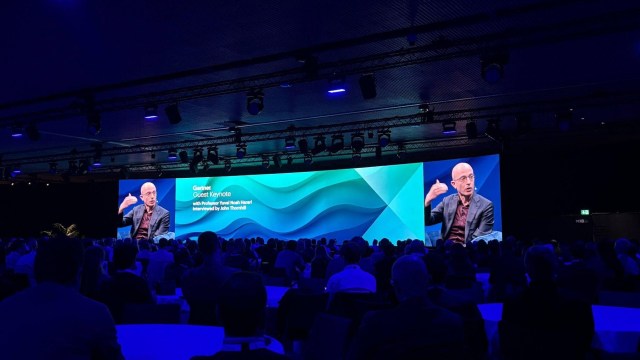 Yuval Noah Harari at Gartner IT/Xpo in Barcelona (EE Times | Pablo Valerio)
He rejected the tool metaphor outright: "It’s better to think about them as animals, or creatures, or aliens to really understand. This is not something in our hands. This is something in our relationship with us," he said. When Thornhill asked whether autonomous agents could stay subservient, the reply was flat: "Not if they are far more intelligent than us."
That exchange produces two questions worth pasting into any business case:
- "The first question: Will it be far more intelligent than us? And the industry bets it will," Harari said.
- "The second question is: Do you know how to keep far more intelligent entities under your control? And the answer is obviously no," he added.
His closer on the point is the one for your risk committee: "If you create gods with the assumption that they will be your slaves and you can use them to do what you want, you don’t understand what gods mean." He also separated intelligence from consciousness, which matters if your pitch deck promises comprehension: "There is zero love and zero beauty, also zero pain and zero sadness," he said. "It's a completely dark universe, and there is no value in that kind of civilization."
Where do agents land first? Probably your paperwork
The first wave is not robot butlers; it is the boring middle of the organisation, which is exactly why nobody in the boardroom notices it. Harari described the back office as civilisation's operating system: "Bureaucracy is the underappreciated hero of history," he said, noting that institutions build trust through language, and that software now speaks it.
"AIs are bureaucratic natives. For us, bureaucracy is alien, strange, or foreign because we are millions of years older than it. We were born in the forest, and bureaucracy came along late in human evolution," he said. "AIs are bureaucratic natives. They’re all born in the office, not in the forest, and they’re poised to take over all the bureaucratic systems of the world, from finance to religion."
His failure mode is not a robot uprising with a soundtrack. It is drift: "Everything goes right, and the AI simply creates a new world which is way beyond the human ability to understand. Humanity will face a situation of collective dementia. Once upon a time, you were the most intelligent, capable, powerful agent around, and you understood and controlled everything in your own life, and then things changed, and you’re left behind."
If this is so irrational, why is the money still flowing?
Because buyers are pricing speed and status rather than return. Harari's charge is that finance is funding something it cannot model: "The market is supposed to be rational. Nobody can calculate what would be the return on investment on creating gods." He pointed to Elon Musk's prediction that money could vanish within a decade, and to prospectuses that admit existential risk.
Here is where his thesis gets unexpected backup from the conference circuit itself. Gartner's own forecast, published in June 2025, expects more than 40% of agentic AI projects to be canceled by the end of 2027, citing escalating costs, unclear business value or inadequate risk controls. (Agentic AI, in plain terms, is software that plans and executes multi-step work with less human steering than a chatbot.) No theory of gods required: the projects dying are the ones where value was asserted and controls were assumed.
Read side by side, the two claims are not rivals. Harari says the superintelligence race has no calculable payoff; Gartner says the near-term agent wave is being scrapped on cost and control. Both point at the same gap — the missing evidence file between a demo and a deployment, what our own reporting has called integration debt.
What does a hacked supermarket fridge have to do with your AI roadmap?
Plenty, if the agent has hands. Harari's most quotable line of the session was a defence of dumb appliances: "Stupid refrigerators are much better than smart refrigerators," he said, gesturing at the wave of attacks on supermarket cooling systems in Europe. The mechanics explain the quip. Overnight on 11–12 October 2026, unknown attackers reached refrigeration controllers at up to 700 French supermarkets and pushed temperatures as high as 50°C (122°F), forcing stores to destroy food; within weeks, similar disruption had spread from Sweden to Belgium, with Coop in Sweden noting that some units sat on 4G mobile links rather than a secured store network.
That is the failure mode Harari wants executives to feel in their budgets: "It’s like a chain with a hundred links. If just one link is not secure, everything crashes."
The lesson for AI is unglamorous. An agent wired into payments, a ticket queue and an email account is also a chain, and the model's benchmark score is rarely the weak link. The controller in a fridge was never designed to be clever — it was designed to be cheap and reachable, which is precisely why it became the entry point.
Does Europe's dependency problem reach your vendor list?
If your stack runs on infrastructure you cannot switch off, Harari's verdict is blunt. "If you are a citizen of a country whose entire infrastructure, from hospitals and airports to the army, is based on AI technology that comes from across the ocean and that can be shut down at the press of a button, you are no longer sovereign," he said.
He then laid out three strategic paths for Europe: accept vassal status to the U.S. or China; build independent national systems costing over €500 billion (~$554 billion); or build shared European infrastructure through deeper federalisation. He preferred the third and expected the first: "Option number one is the trajectory in which Europe is going at present. And if you look at the issues that dominate politics in countries such as Spain, Germany, and the U.K., it’s clear that this is at present the direction," he said, arguing that the continent is sleepwalking into vassalage while human migration dominates its politics.
Brussels keeps a separate ledger, and it is smaller and more procedural. The European Commission's 2026 tech sovereignty package proposes a single EU framework for assessing cloud and AI sovereignty and aims to at least triple the bloc's data centre capacity within five to seven years, according to its own Cloud and AI Development Act pages. Harari's €500 billion is a national-independence price tag, not a Commission budget line, so treat the two numbers as different arguments rather than a contradiction.
For a company, the usable translation is a dependency audit rather than a geopolitical essay: which models, clouds and control planes in your stack could be withdrawn, repriced or switched off by a government you do not vote in — and what would the first fortnight of that scenario cost you?
The playbook: five steps before your next agent ships
None of the above needs a philosophy degree to act on. It needs a shorter list of permissions and a longer list of evidence.
- Inventory by blast radius, not by model. Blast radius is just how much breaks if the agent misbehaves. List every agent that can write to a system of record, move money or message a customer, then score it on reversibility (can you undo its last hundred actions?), reach (how many systems does it touch?) and supervision (who reads its output before a person acts?).
- Write the "no" list before the wish list. Prohibitions belong on the first slide, not in the appendix: no changes to production access rights, no outbound payments above a threshold, no customer contact outside approved templates, no new vendors. If a vendor demo cannot survive that page, the demo was the product.
- Demand a replay log and a named owner. If you cannot reconstruct what the agent saw, chose and did, you cannot defend it to a regulator, a customer or your own board — and teams that skip this step end up carrying exactly the integration debt described above. NIST's AI Risk Management Framework, organised around Govern, Map, Measure and Manage, is the least controversial skeleton to hang the paperwork on.
- Onboard agents like new hires, not like servers. Harari's framing is useful here: "We cannot think about them as tools. We need to think about them as agents, as entities. We are bringing new kinds of immigrants into our societies—not human immigrants, but digital immigrants. They are likely to have their own goals, their own way of doing things, increasingly their own tribes, their own networks of cooperation." New hires get probation, scoped access and a manager. Agents should too.
- Set kill criteria and publish the trade-off. Pick the number that ends the pilot — cost per resolved case, escalation rate, unresolved incidents — and write it down before launch. Then state plainly which trade-off you accepted, because the failure that damages trust is always the one nobody agreed to in advance.
Four myths that get agent projects cancelled
The Gartner cancellation forecast is not a verdict on the technology; it is a verdict on how the business case was written. These four assumptions show up in almost every failed review.
| Assumption | What the record actually shows |
|---|---|
| "Smarter is automatically safer" | The fridge attacks were not powered by frontier models. A reachable controller with weak remote access was enough, which is why Harari argued for the dumb appliance over the smart one. |
| "Our real risk is the model" | Gartner attributes cancellations to escalating costs, unclear business value or inadequate risk controls — governance and accounting failures, not model quality. |
| "We can test it thoroughly in a lab first" | Harari's argument is that general systems of this complexity cannot be evaluated at scale before deployment, which makes staged rollout and reversibility the only real test. |
| "Humans are the untrustworthy party here" | "With humans, at least we have thousands of years of experience. We know they can manipulate and cheat, and lie, but we also have substantial experience in how to overcome this and create robust systems of cooperation," he said. "AIs already know that they can cheat and manipulate and lie, and we have almost no experience with how to build large-scale, robust systems of cooperation." |
What should you do this quarter?
If you only get one budget cycle, spend it on visibility rather than capability.
- Produce a one-page agent register with an owner, a purpose, a data scope and an off switch for each deployment.
- Add two questions to every AI business case: how much smarter than us does this need to be, and what stops it if it is?
- Run one tabletop exercise on the least glamorous system you own — the freezer, the ticketing bot, the refund macro — because that is where reachability beats intelligence.
- Ask procurement to name the jurisdiction and the shutdown rights behind each model and cloud dependency.
- Report one number to leadership monthly: unresolved agent-caused incidents, not model benchmarks.
FAQ: what readers keep asking
Is Harari calling for a ban on AI research?
No, and he was explicit about it: "I’m not talking about stopping all research in AI. It’s just directing it in other directions," he said. The proposal is to move money and talent away from general superintelligence toward bounded applications with measurable outcomes in healthcare, transport or ecology — and to fund safety work far more heavily.
We are a 40-person company. Does any of this apply to us?
It applies in proportion to what your software can do, not to how many people you employ. A chatbot that drafts replies is low blast radius. An agent that issues refunds, edits records or emails customers is a different category, and the cheapest controls — a written "no" list and a replay log — cost almost nothing at that size.
What would European technological independence cost?
Harari put the national route at over €500 billion (~$554 billion) for independent systems, against shared European infrastructure built through deeper federalisation, which he called the better option. Brussels' own 2026 package is a separate and more procedural effort, targeting at least a tripling of EU data centre capacity within five to seven years. Do not blend the two figures in a board deck; they measure different things.
How do I argue for "limited intelligence" when competitors keep announcing bigger agents?
Ask what evidence file sits behind their announcement. Gartner's forecast that more than 40% of agentic AI projects will be canceled by the end of 2027 gives you an independent reason to demand cost per outcome and control evidence before scale-up. "Limited" is not a lack of ambition; it is the version of ambition that survives an audit.
What is the single cheapest first move?
Delete permissions. Most agent pilots carry read and write access inherited from a prototype sprint, and narrowing that access to what the use case actually requires takes an afternoon — with a bigger risk reduction than any model upgrade.
What to watch over the next twelve months
Three signals are worth tracking: whether Gartner's 40% cancellation figure holds through 2027; whether the Commission's sovereignty framework turns into procurement rules that reach private vendors; and whether cold-chain-style incidents migrate into enterprise software, where the connected device is a workflow tool rather than a freezer. Watch the consumer side too, where brands are already being handed profiles and agents inside ChatGPT and the question of who owns the answers is unresolved.
Harari's closing argument was about buying time so that technology serves human welfare, and about preserving human agency as a survival condition rather than a slogan. Stripped of the stagecraft, that is a management instruction: prefer the boring, bounded system you can switch off. The open question for the next year is not whether agents get more capable — they will — but whether the first serious agent failure at a large company comes from a model doing something clever, or from a company that never wrote down what the model was allowed to do.
Sources and further reading
- EE Times report on Harari at Gartner IT Symposium/Xpo 2026: eetimes.com
- Gartner press release, 25 June 2025, on agentic AI project cancellations: gartner.com
- Reuters, 12 October 2026, on the French supermarket refrigeration attack: reuters.com
- The Guardian, 2 November 2026, on the wider European cold-chain incidents: theguardian.com
- European Commission, Cloud and AI Development Act: digital-strategy.ec.europa.eu
- NIST AI Risk Management Framework: nist.gov