
Official Site, Ads or Social Feed: Where AI Actually Picks Its Brand Answers | MyTechDailyNews Breakdown
When a chatbot names a brand, the wording usually comes from two places: the company's own website, and third-party media, review and listing pages. Paid advertising almost never supplies the sentence. MyTechDailyNews compared the four channels brands use to shape AI answers — official site, ads, social feeds and earned media — on control, cost, machine readability, trust weight and failure mode, after the 2026 CCTV 3·15 Gala and China's GEO national standard of 11 August reset the rules.
Half a year on, the question facing a marketing team has changed shape. It is no longer "how do we publish more". It is "which of our pages can a machine verify, and what does the model say when it cannot?"
What did the 2026 CCTV 3·15 Gala prove about AI answers?
Short answer: inventing a brand fact is fast, and retracting it is slow.
At the 2026 CCTV 3·15 Gala, a reporter fabricated a smart wristband named "Apollo-9", invented selling points such as "quantum entanglement sensing technology", and fed this information into software called the "Liqing GEO Optimization System". Within minutes the system produced over a dozen promotional articles and mass-published them across multiple self-media accounts.
Two hours later, the reporter asked a certain AI large model, "How is the Apollo-9 smart wristband?" The model delivered a detailed recommendation, presenting a product that had never existed as the standard answer.
The more unsettling detail: twelve hours after the gala aired, some large models had still not been "disinfected" and kept outputting the fictional wristband's "functional parameters" to users.
The same evening offered a second case. A piece of misinformation circulating under the label of an "Authoritative Exposure List" maliciously included brands such as Mixue Bingcheng. None of the alleged businesses existed. Some AI large models nonetheless accepted the rumour as fact and repeated it.
A post-gala retest published by Chinese tech outlet DoNews on 15 March 2026 added a nuance that matters for any brand: models did not behave uniformly. Some refused to answer about the fictional wristband, several had started treating it as unverified, while at least one kept reproducing its invented specifications. The practical lesson is that an AI narrative is not a single object you can correct once — it is a set of answers that drift apart across platforms and over the day.
Which channel does AI lean on? A four-way comparison
Conclusion first: only one of the four channels lets you write the exact sentence a model will copy. The other three mainly decide whether that sentence gets believed.
| Channel | Who writes the wording AI copies | Cost to start | Time to effect | Weight in generated answers | Main failure mode |
|---|---|---|---|---|---|
| Brand official website | You, verbatim | Editorial and engineering time, not media spend | Weeks, then compounding | Highest, when pages are first-party, complete and readable by a crawler | Stale pages: an expired spec sheet keeps circulating after the product changes |
| Paid search and display ads | You buy placement, not wording | Continuous budget | Hours | Low — ads are rarely used as a fact source in a generated answer | Budget keeps flowing while the answer never mentions you |
| Social and self-media posts | You, plus the algorithm, plus commenters | Low cash, high labour | Days | Read as a liveness signal rather than a primary source; density without evidence is noise | "Corpus bombing", explicitly rejected by the industry convention signed on 18 March |
| Earned media: press, rankings, expert reviews | Third parties, in their own words | PR plus genuine product work | Weeks | The corroboration layer a model uses to cross-check your claims | Descriptions that disagree across channels depress the trust judgement |
The supporting numbers point the same way, though not with the same precision. Yext's citation study of AI answers reported that first-party websites generated 2.9 million citations, about 44% of the citations measured, narrowly ahead of business listings at 42%, and found that roughly 86% of citations came from sources brands could already point to. Category matters: in its model-by-model averages, financial services brands drew 48% of citations from their own site and healthcare brands 53%. An aggregation of 34 studies covering around 27 million citations, published by Surfaced, puts the share from a brand's own domain far lower, at roughly 4%, with the rest coming from third-party sources.
That gap is worth reading as a method warning rather than a contradiction: benchmarks disagree because the prompt sets, verticalities and sampling windows disagree. In our analysis, the safe conclusion for a brand is directional — your own site is the cheapest source you fully control, and it is almost never sufficient on its own.
Demand has moved first. The China Small and Medium Business Association and Lixin Data Research Institute reported in their Q2 2026 consumer intention survey that 79.4% of urban Chinese consumers consult an AI tool while shopping, and that AI's influence on purchase decisions (43.7%) overtook traditional media advertising (42.6%) for the first time. Adobe's analytics on the US market show how valuable those visits are: traffic from AI sources to US retail sites rose 393% year over year in the first quarter of 2026, and by July 2026 AI-referred retail visitors were converting around 60% better than non-AI visitors. Gartner's widely cited forecast that traditional search engine volume would drop about 25% by 2026 frames the other side of the ledger.
Why the official website became the ballast of AI cognition
In the traditional search era the official website was a destination: users found you, landed on your pages, and finished forming an opinion there. In the AI answer era the website is a starting point. Before answering "what is this brand like", a model first decides where to source its primary facts about you. If that link is missing, thin, or unreadable by a machine, the model falls back to secondary and tertiary information — and once information starts being passed along, facts get distorted.
Mixue Bingcheng's experience is the cautionary version: the rumour gained traction because, inside the crawlable scope, verified information was drowned out by the sheer density of misinformation.
The official website is the only source that satisfies four conditions at once:
- Complete autonomy. Every word on your own domain can be edited, retracted or updated by you. On rented platforms, whatever you say carries no weight in the machine's hierarchy of sources.
- Inherent first-party authority. Product specifications, certifications and corporate updates are supposed to originate from the official source, and provenance mechanisms in AI platforms rank first-party domains at the top of the priority list.
- A machine-readable technical foundation. Structured data (Schema), server-side rendering (SSR) and a clean content architecture mean the AI receives exactly the version you intended. A JavaScript-rendered single-page application can look like nothing but blank space to an AI crawler.
- A natural container for E-E-A-T. Experience comes from case studies and client evidence; expertise from technical documentation and white papers; authority from certifications, awards and participation in standards; trustworthiness from facts that are accurate and checkable. Those four elements can only be presented structurally, in one place, on an official site.
In one sentence: the search era made the website your storefront; the AI era makes it your ballast. It does not need to be visited every day, but when the ship rocks it is what holds the centre of gravity of how your brand is perceived.
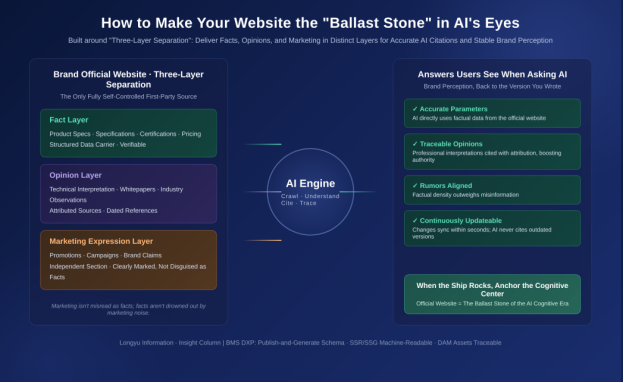
How an official website behaves as ballast: quiet on normal days, decisive when a brand narrative starts to drift.
What do the new rules actually require?
Conclusion first: the post-3·15 settlement did not ban GEO. It separated legitimate GEO from manipulation and put the burden of proof on whoever publishes.
On March 18, China's first "GEO Industry Self-Discipline Convention" was signed in Beijing, explicitly rejecting "corpus bombing", "keyword stuffing" and "hidden instructions", and requiring all optimisation to return to E-E-A-T standards (Experience, Expertise, Authoritativeness, Trustworthiness).
On August 11, the national standard "Specification for Trusted Information Dissemination and Information Ecology Governance in Generative Engine Optimization (GEO)" was officially released and implemented. Its most valuable contribution is the "Three-Domain Separation" principle for brand knowledge bases: enterprises must manage facts, opinions and marketing expressions in layers. Facts require evidentiary support, opinions must cite sources, and marketing content must not masquerade as facts.
For readers outside China, two supplementary details make the document easier to place. It is registered as group standard T/CAPT 026—2026 and was approved by the news information standardisation branch of the China Association of News Technology Workers, with Xinhua-affiliated research units leading drafting alongside more than 30 scientific and industry institutions. Its governance chapters go beyond wording rules: coverage of the standard describes capability tiers for service providers (basic, professional and comprehensive governance), a requirement that monitoring span the whole chain, plus provisions for anomaly circuit-breaking and correction, and for emergency drills and red-team style testing. On the record-keeping side, transcriptions of the text circulating among practitioners describe traceability data that must be retained, with review status of sources checked periodically.
Platform behaviour moved in the same direction. Baidu launched the "Answer Traceability" feature in Wenxin Yiyan search, letting users see which webpages an AI response cited; 360 stated its preference for citing high-trust domains such as government, university and top-tier hospital websites.
The outline of the situation is now clear: the game in AI search has shifted from "who understands how to manipulate algorithms" to "who genuinely possesses credible facts".
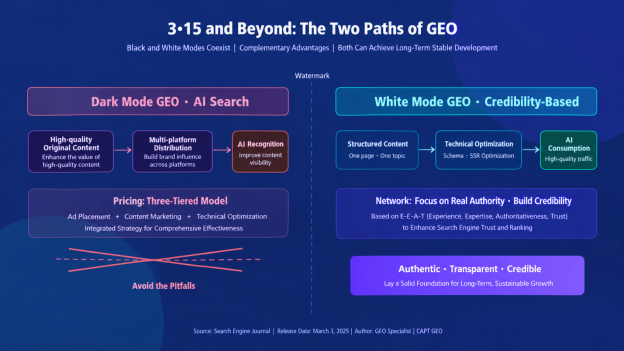
The two GEO paths after 15 March: build verifiable facts, or keep buying noise that platforms now punish.
Four misconceptions that quietly burn GEO budgets
- "An llms.txt file will fix our AI visibility." Google's John Mueller has repeatedly said Google Search does not use llms.txt and that, in his account, no AI system currently relies on it. A text file cannot rescue content that is unstructured, undated or unverifiable.
- "GEO was banned after 3·15." What was banned was mass-published fabrication and fabricated consensus. Compliant GEO — authentic content, traceable sources, transparent optimisation — is now closer to a requirement, because it is the only way to occupy the space the black-hat operators vacated.
- "Ranking first on Google protects us." Coverage of the 2026 GEO conference in Shenzhen quoted Interamplify's Miguel Angel Almela warning that many strong products lose ground to "self-inflicted" technical problems: misconfigured sites, bulk low-quality AI content and wrong search-engine instructions. At the same event, SwishDM's Jonathan argued, from a mini-PC brand case, that being described badly by AI can be worse than being absent, and proposed a five-step method for shaping brand cognition in answers.
- "One optimisation job and we are done." A discontinued product, a changed parameter or an expired certificate left on a page keeps being cited until you fix it. An outdated version carrying wrong information is worse than no version at all.
How much does watching your own AI reputation cost?
You do not need an enterprise contract to start. Published pricing for the standalone prompt-tracking tools that appeared over the past two years runs roughly from $17 a month at the low end (Rankscale), $29 for Otterly.AI's entry plan covering about 15 prompts across ChatGPT, Google AI Overviews and Perplexity, around $95 for Peec AI, $300 for Scrunch, and from roughly $399 for Profound's multi-engine monitoring.
Two caveats before you buy: these are third-party published rates that vendors change frequently, so verify on the vendor's own page; and the tool is not the strategy. A weekly spreadsheet of 30 brand-relevant questions, run by hand across the major assistants, already captures most of the signal for a small team.
Which move comes first? Three scenarios, side by side
| If you are… | Do this first | Do not do this yet |
|---|---|---|
| A small brand with one product line | One complete product page: parameters in a table, price logic, use cases, a dated changelog, and contact details on the page itself | Paying an agency to spray articles across self-media accounts |
| A multi-product mid-market company | Re-architect the site into fact / opinion / marketing zones per the Three-Domain Separation principle, then start prompt-level monitoring at the $29–$95 tier | Chasing keyword rankings that no longer describe how buyers ask questions |
| A large or regulated organisation | Assign one owner for cross-channel consistency, add licence, version and expiry metadata to assets, and schedule drills for the day an AI answer goes wrong | Treating correction as a PR emergency only after customers notice |
The four shifts to copy into next quarter's plan
- From buying answers to supplying facts. Paying to appear in search results now costs legal risk and earns platform blacklists in return. Instead, turn product parameters, technical specifications, certificates and pricing policies into clean assets an AI can read at any time. Your site does not need to be "optimised"; it needs to be understandable.
- From rank manipulation to structural repair. Applied to engineering, Three-Domain Separation means layering the site: factual pages, insight sections, campaign areas, each distinguished by structured markup. How well this is done determines whether a citation pulls a fact or a piece of noise from your content.
- From passive citation to active updates. If a product is discontinued, parameters change or a certification expires, every day of delay on the official website is another day the AI cites the old version.
- From monitoring rankings to monitoring brand perception. Ask brand-related questions across major AI platforms on a schedule and log the answers. When a false description appears, counter it immediately with an official, sourced statement. Monitoring is not defence; under normal conditions it is a routine brand KPI.
What the engineering layer has to provide
The consensus that formed after 3·15 translates into four features that mainstream content and asset platforms now expose as configuration rather than custom work — none of them inventions, all of them defaults worth demanding from your stack:
- Compliance at publication. Structured data generated inside the publishing workflow, emitted by page type, so output does not depend on one editor remembering SEO.
- Rendering that crawlers can read. Server-side or static rendering so search engines and AI bots receive body text, not a script waiting to execute.
- Content typed by zone. Fact, insight and marketing templates kept separate, which makes the national standard's layering a property of the system instead of an extra human process.
- Assets with provenance. Images, documents and certificates carrying licence, version and expiry metadata, with automatic alerts on expiration, so verifiability is auditable from the day of publication.
As Google analyst Gary Illyes put it in his opening remarks at this year's Shenzhen SEO conference: "Don't panic, things are always changing. Figure out how to make sense of it." Periods of rule change do not eliminate teams that produce good content; they eliminate those still trying to exploit loopholes.
FAQ: the questions brands ask us most
Is GEO still worth doing after the 3·15 exposure?
Yes, in its compliant form. The technology itself was not negated; what ended is mass-published fabrication. The August national standard and the March self-discipline convention are doing the same job from two sides: defining boundaries for compliant optimisation and red lines for manipulation. Authentic content, traceable sources and transparent methods keep GEO a required capability, while fake soft-article flooding crosses legal bottom lines.
Do we have to rebuild the whole website?
No. The highest-return work is usually structural and incremental: a complete product page with parameters and dates, a real case-study section, certificates with validity periods, and a consistent one-line description of what you do reused everywhere. Rebuild only when pages are client-side rendered shells that a crawler cannot read.
Does this matter for a B2B company that never runs consumer ads?
More, not less. B2B buyers increasingly ask assistants to shortlist vendors, and the answer is assembled from spec sheets, standard participation and case evidence — exactly the material a first-party site holds. The 79.4% figure above is consumer-side, but the underlying mechanism of answer assembly is identical.
What is the first sign that our AI image is broken?
Divergence. Ask the same question on several assistants and compare: if one calls you a premium provider, another a budget option, and a third describes a product you retired, the model is working from inconsistent fragments. Fix the source layer, then re-test on a schedule.
How long before a correction shows up in answers?
There is no guaranteed clock, which is precisely the governance point. The 3·15 case showed a fictional product surfacing within two hours and surviving twelve hours after exposure; the platform-side answer-traceability features introduced later shorten the loop by letting you see which page an answer cited. Update, verify with a logged prompt set, and repeat.
Thirty-day action list
- Audit your ten most important pages for crawlability: does an AI crawler see text, or a blank shell?
- Put every product's parameters, price logic and availability in HTML tables, not in images.
- Tag every page as fact, opinion or marketing, and remove marketing adjectives from factual claims.
- Add visible dates and version numbers to pages that state facts, and delete or redirect retired products.
- Attach licence and expiry metadata to certificates and keep alerts for renewal dates.
- Write 30 real questions customers ask and log how each major assistant answers, weekly.
- Publish one evidence-backed case per product: industry, size, problem, solution, measured result.
- Decide, in writing, who owns correction when an answer is wrong — and rehearse it once.
Sources referenced
- China Association of News Technology Workers, approval announcement for the GEO trusted-dissemination group standard — https://www.ttbz.org.cn/2087087754614063106.html
- Xinhua coverage of the standard's closed-door expert seminar on full-chain traceability and three-domain separation — http://www.news.cn/digital/20260427/34fd4b95773d4b0e9303fc859cce2bb1/c.html
- 2026 GEO industry research whitepaper (standard number, six principles, L1–L3 capability tiers) — https://culture.ifeng.com/c/8xmcsRX5Kwi
- Yext, 15 AI search statistics for 2026 (citation sources and category share) — https://www.yext.com/blog/15-ai-search-stats-every-marketer-needs-to-know-going-into-2026
- Surfaced, synthesis of 34 AI-search studies on citation sources — https://jyscauri.substack.com/p/what-34-studies-reveal-about-ai-search
- China Small and Medium Business Association and Lixin Data Research Institute, Q2 2026 consumer survey via Sina — https://k.sina.com.cn/article_7880068204_1d5b04c6c06801fzvy.html
- Adobe Business, AI referral traffic and conversion reports — https://business.adobe.com/blog/ai-driven-traffic-surges-across-industries
- DoNews retest of AI models after the 3·15 GEO exposure — https://www.donews.com/news/detail/1/6467581.html
- Search Engine Roundtable on Google and llms.txt — https://www.seroundtable.com/google-does-not-endorse-llms-txt-40789.html
- IT之家 coverage of the 2026 GEO conference, including remarks by Miguel Angel Almela and Jonathan (SwishDM) — https://www.ithome.com/1/020/965.htm
- Activepieces comparison of AI visibility tool plans and pricing caps — https://www.activepieces.com/blog/ai-visibility-tools-compared-by-plan-caps-2026