
GPT-6.1 Sol Cut Its Surgical Targeting Error in Half Across Three Mouse Brain Attempts: What Actually Happened in the Lab
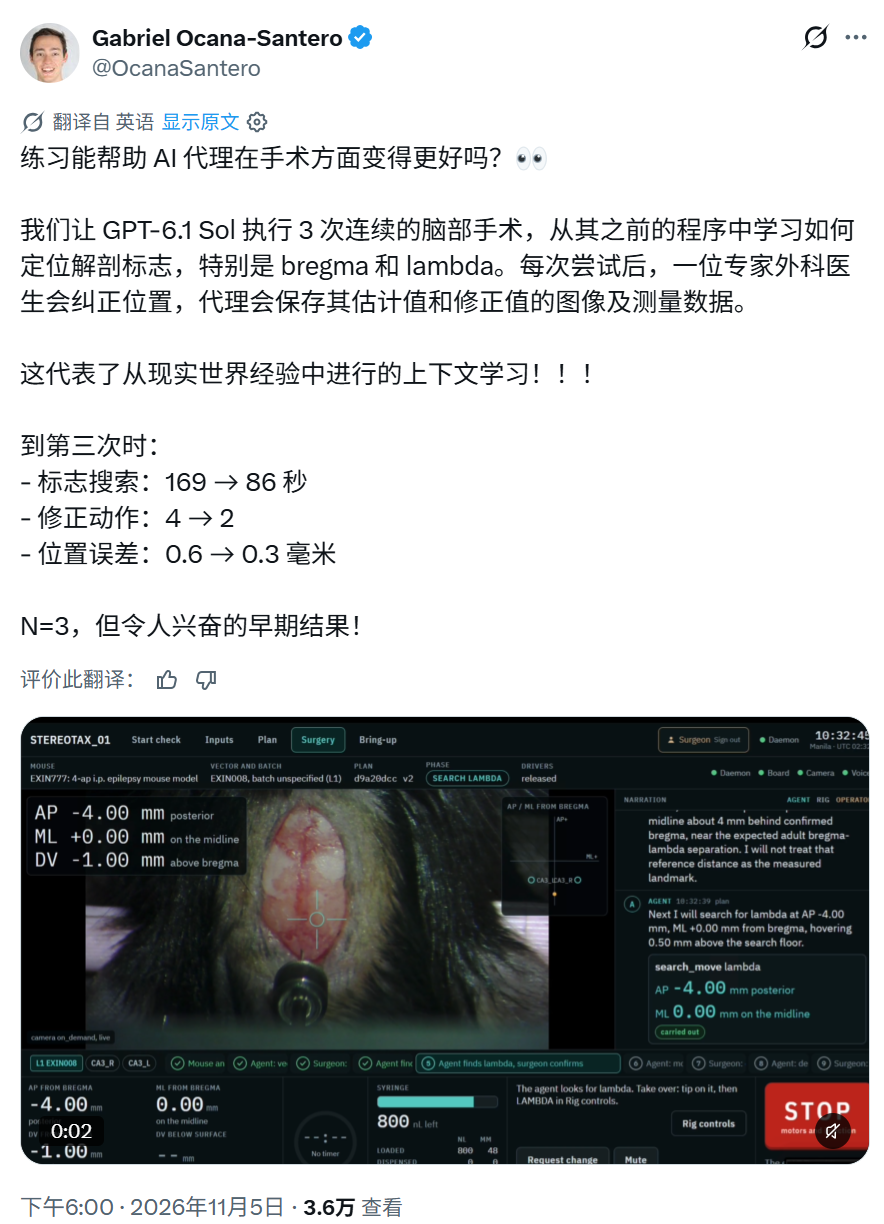
On its third attempt, OpenAI's GPT-6.1 Sol needed 86 seconds instead of 169 to locate the two skull landmarks that anchor a mouse brain surgery, and its positioning error fell from 0.6 mm to 0.3 mm. Biotech startup Exin Therapeutics says the gain came from a surgeon's corrections carried into the next operation — no retraining, no parameter updates, just three rounds of real-world feedback.
That narrow detail is the reason the result matters outside neuroscience. For years the standard assumption in AI was that a model only gets better at a physical task when someone re-trains it with new data. What Exin described instead is a model reusing its own observations, measurements and an expert's fixes as working memory for the next case — the same reasoning loop that powers chatbot instruction-following, pointed at a live animal and a motorized surgical rig.
What was tested — and what was not
Short answer: the test was about perception and calibration, not about an AI surgeon operating solo.
Exin Therapeutics put GPT-6.1 Sol through three consecutive rounds of landmark localization inside live mouse brain surgery. Each round ended with a professional surgeon correcting the positions the AI had identified; the model then stored the related images, measurement data and correction records for the next round to consult. The two targets were Bregma and Lambda, the front and rear junctions of the skull sutures. Everything downstream in the procedure — needle coordinates, injection depth, which brain region gets the payload — is computed from those two points, which is why a small error there is not small at all.
How the numbers moved from round 1 to the third attempt
The headline pattern is a steady, measurable cleanup rather than a leap.
| Metric | First round | Third round | Change |
|---|---|---|---|
| Time to identify the key anatomical landmarks | 169 seconds | 86 seconds | Roughly halved |
| Human corrections required | 4 | 2 | Halved |
| Targeting error | 0.6 mm | 0.3 mm | Down 50% |
Put those figures next to purpose-built lab tools for scale. A 2020 PLOS ONE study that trained a dedicated machine-vision system to auto-detect Bregma and Lambda on rodent skulls reported mean localization accuracy of about 0.26 mm — so 0.3 mm is now in the same neighborhood as specialized calibration software, reached by a general-purpose language model that was never engineered for this job. The asymmetry matters, though: the vision system was benchmarked across a controlled dataset, while GPT-6.1 Sol's numbers rest on three operations.
Why two dots on a skull decide the whole experiment
Stereotaxic neurosurgery in mice is coordinate geometry. Researchers level the skull, measure the distance between Bregma and Lambda — a span commonly scaled against a reference of roughly 9 mm in adult mice — and then read every brain target off that frame of reference.
Get the origin point wrong and every downstream coordinate inherits the mistake. A 2023 methods paper by Marcel N. Cecyn and Cristovam W. Abrahao (published in the PMC archive) reviewed exactly this problem and found that where and how you define Bregma shifts results enough to matter, with inconsistent landmark definition listed among the main sources of stereotaxic targeting error and of poor reproducibility across labs. Skull sutures are frequently hard to read: they can be partly fused, obscured by tissue, distorted by the head-holder's angle, or simply different from one animal to the next. For a junior technician, reliably finding those landmarks and leveling the head is the basic skill that takes weeks of repetition — which is precisely the skill Exin asked an AI to demonstrate.
Learning without retraining: what Exin's CEO says happened
Gabriel Ocana-Santero, co-founder and CEO of Exin Therapeutics, posted the results on the social platform X on November 5 and framed the process as in-context learning driven by real-world experience rather than by model updates.
Translated for everyday readers: nobody went back and retrained anything. Between operations, the model kept a notebook of what it saw, what it measured, and what the surgeon changed — and fed that notebook into its next attempt. The analogy that fits best is a trainee who reviews a marked-up log of yesterday's corrections before the next case, instead of attending a new course. Because the improvement lives in the context, not in the weights, it also has an obvious fragility: change the camera, the rig, the strain of mouse or the format of that notebook, and there is no guarantee the gains travel with it.
Three models, 19 treatment options, three different answers
This was not Exin's first brush with AI-run animal work. Earlier experiments had Anthropic's Claude Sonnet 5, OpenAI's GPT-6.1 Sol and xAI's Grok 4.7 each participate in live mouse brain gene therapy work.
The three models were handed the identical set of 19 candidate gene therapy approaches, and tasked with choosing a treatment for mice with epilepsy and then driving a motorized stereotaxic device to deliver it. They diverged: Claude targeted the entorhinal cortex, GPT-6.1 Sol picked the hippocampus, and Grok chose the somatosensory cortex.
The hippocampus choice is the one a clinician would recognize. Mesial temporal lobe epilepsy is one of the most common focal epilepsies in adults, and more than a third of those patients continue to seize despite anti-seizure medication — the reason hippocampus-directed gene therapy is an active field. At the 2023 American Epilepsy Society meeting, researchers reported a hippocampus-delivered gene therapy that reduced seizures by an average of 87% versus controls in mice without impairing memory or behavior.
Crucially, none of that validates Exin's experiment. Whatever each model selected still has to be judged by watching the animals' behavior and brain activity over time; the efficacy of all three picks remains unproven.
Who actually held the scalpel
The human guardrails were more interesting than the autonomy.
During the procedure the AI could watch the surgical field through a camera, plan injection coordinates, dose, speed and waiting time, and command the equipment to execute. In one experiment GPT-6.1 Sol looked at the camera feed 59 times, and it paused over a small dark-red point at the craniotomy site, suspecting bleeding, and escalated its read to the surgeon. Researchers later said the finding was not abnormal bleeding for this type of surgery — an alarm raised by the machine, adjudicated by a person.
The operations were not AI-solo work. A licensed veterinarian performed the incision, the opening of the skull and the suturing, supervised the whole procedure, and had to approve irreversible steps. The rig itself carried motion-range limits, injection-dose caps and an emergency stop switch.
The safety story also has a strange prequel, first reported by WIRED in late October 2026: the team initially tried to have Claude Opus 5.5 run the task, and the model refused to push an injection needle into a living mouse's brain. Exin switched to Claude Sonnet 5, which completed the injection, and then extended the testing to GPT-6.1 Sol and Grok 4.7 before the current three-round experiment.
Five common misconceptions about this experiment
- "An AI performed brain surgery." Not as described. The model handled landmark localization and directed an instrumented injection; a licensed veterinarian cut, opened the skull, closed it and approved irreversible steps.
- "The model got smarter." There was no retraining or parameter update. Gains came from retained images, measurements and expert corrections replayed into the next attempt — and may not transfer to a different rig or subject.
- "It now beats human calibration." Three rounds is an anecdote, not a benchmark. The team's own lead says the sample is far too small to prove stable skill.
- "An AI found a cure for epilepsy." The chosen mechanisms and brain targets are unvalidated; outcome data on seizure behavior has not been reported.
- "Next stop, human patients." These results have not been independently replicated or fully peer-reviewed, and the gap to human neurosurgery is measured in years of protocol, oversight and safety evidence.
What this signals for AI and physical labs
Here we shift from reported results to our own analysis. Two trend reads stand out for a general tech audience.
Feedback loops are becoming the cheap upgrade path. If a model can cut a physical-precision error by half just by accumulating expert corrections, expect that pattern to migrate fast into lab automation, semiconductor equipment handling, robotics and clinical imaging review — anywhere a human fix already exists as a text or image log. It is a different, faster kind of progress than training runs, and it lands while the broader question of how fast AI is really improving is still being argued over by independent measurement groups.
Accountability now lags capability. Existing oversight for vertebrate animal work in the US runs through institutional committees (IACUC) that require trained, named personnel and protocol review; that framework was written assuming a human is the operator of record. An AI agent that plans an injection and raises bleeding alarms does not fit neatly into any signature line. We could not confirm from public disclosures how Exin's experiments were protocol-reviewed, and that silence — not the 0.3 mm figure — is the part regulators will eventually have to answer. It is the same boundary question we have examined around consumer products, where the debate is over where the line should sit for AI health tools.
Action advice: five checks before you trust an "AI did the task" headline
- Ask for n. How many operations, trials or users? Three rounds is a demonstration; treat it as a hypothesis.
- Ask whether weights changed. Retraining, fine-tuning or plain in-context memory are different claims with different durability.
- Ask who authorized irreversible actions. Look for the licensed professional, the approval gate and the hardware stop switch.
- Convert accuracy into physical units. "Improved dramatically" means nothing; 0.6 mm to 0.3 mm means a lot, because needle tracks in mouse brains are planned at sub-millimeter resolution.
- Check for peer review and replication. Until an independent group repeats it, a company's own post on X is a press release with numbers.
FAQ: the questions readers are actually asking
Did OpenAI run this experiment?
No. The work is from Exin Therapeutics, a neuroAI startup developing precision drugs that modulate neural activity. OpenAI's role in the story is that its GPT-6.1 Sol model was used as the agent inside the experiment.
Exactly how much did performance improve?
Across three rounds of live mouse brain landmark localization, identification time fell from 169 seconds to 86 seconds, required human corrections dropped from 4 to 2, and targeting error halved from 0.6 mm to 0.3 mm — a 50% reduction.
Was the model trained on surgical videos?
Exin says no retraining or parameter update was involved. The model kept its own images, measurements and the surgeon's corrections from each prior operation and used them as context on the next one.
Which brain regions did the three models choose?
Given the same 19 candidate gene therapy options for epileptic mice, Claude went for the entorhinal cortex, GPT-6.1 Sol chose the hippocampus, and Grok picked the somatosensory cortex. None of those choices has demonstrated efficacy yet.
Is AI-run brain surgery on humans close?
Not on this evidence. The sample was three operations, the results have not been through full peer review or independent verification, and human neurosurgical standards add layers of validation this experiment does not touch.
References
- WIRED, "An AI Agent Injected Drugs Into a Live Mouse's Brain" (October 2026) — https://www.wired.com/story/an-ai-agent-did-brain-surgery-on-live-mouse/
- Exin Therapeutics, company profile — https://www.exintherapeutics.com/
- Cecyn, M. N. & Abrahao, C. W., "Where do you measure the Bregma for rodent stereotaxic surgery?" (2023) — https://pmc.ncbi.nlm.nih.gov/articles/PMC10776314/
- Zhou, P. et al., "Automatically detecting bregma and lambda points in rodent skulls" (PLOS ONE, 2020) — https://journals.plos.org/plosone/article?id=10.1371/journal.pone.0244378
- EurekAlert, hippocampal gene therapy reducing seizures by 87% in mice (2023) — https://www.eurekalert.org/news-releases/1011100
- Desloovere, J. et al., drug-resistant temporal lobe epilepsy research (PubMed, 2019) — https://pubmed.ncbi.nlm.nih.gov/31608439/