
XCPE After the Takedown: Is Your Android TV Box Clean, and What Does a Certified Badge Really Buy You
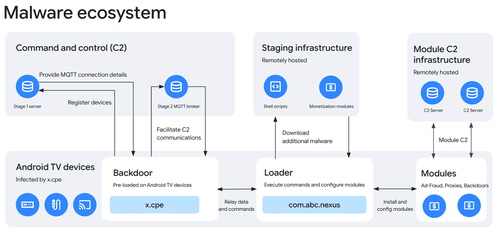 XCPE malware overview
Short answer: the network lost its coordinator, the boxes kept their code. In late October 2026 Google and a group of industry and law-enforcement partners took the control servers behind XCPE offline, cutting remote tasking for a fleet of more than 1.3 million compromised Android devices — and the manufacturer they blame wrote the trapdoor in on purpose. What the takedown did not do is walk into living rooms and uninstall anything.
So the useful headline is not “botnet destroyed”. It is “millions of machines now sit unmanaged, still carrying code that survives a reboot.” If the streaming box on your TV arrived in the last two years from a marketplace listing you half-remember, the question has narrowed from “am I infected?” to something far more practical: what are my realistic options, what does each one cost, and which one am I actually willing to do this weekend.
What happened
Google’s Threat Intelligence Group published its account of the operation on 2 November 2026. Its conclusion is unusual in one specific way: this was not a criminal who broke into a supply chain, it was the supply chain. Researchers assessed with high confidence that Videostrong Technology deliberately developed, deployed and ran the backdoor, and that over 1.3 million devices were enrolled in the resulting botnet for profit.
Two facts do most of the explaining. First, the code hid while the hardware was going through device compatibility and security review, then appeared after the box's first power-on at the owner's home. Second, it lived in a firmware partition that normal user actions cannot touch. In plain terms: the thing you paid for was clean at the shop and not clean at home.
Why switching the servers off does not switch your box clean
XCPE ran as a privileged system process. According to the technical write-ups, it could rebuild itself from an unmodifiable firmware partition after a reboot, which is exactly why uninstalling a suspicious app achieves nothing. The same behaviour is what makes a factory reset unreliable: the payload re-seats itself from the partition rather than from your app drawer. Researchers also flagged that it may interfere with Google Play Protect, install applications silently, run commands, take screenshots and scan the local network.
Two follow-on points matter for anyone holding a remote right now. TrendAI's analysis, published alongside the takedown, describes the backdoor operating as a system application carrying a vendor signature — which, in its view, is a job for vendor intervention, platform-level protection or hardware replacement, not for the owner's settings menu. And reporting on Google's own blog notes no universal firmware repair pushed to affected boxes; outlets such as Malwarebytes point out that the code stays resident in firmware until someone replaces it.
Ad fraud or bandwidth resale: two ways to sell a stranger's living room
The operators monetized infected devices along two lanes, and they feel different from inside a house.
| Monetization lane | What your box is actually doing | What you might notice at home | Why a TV box suits it |
|---|---|---|---|
| Advertising fraud | Generating fake impressions and clicks from a real residential address | Sluggish menu response, odd ad traffic, unexplained downloads | Always plugged in, always online, nobody audits it |
| Residential proxy / bandwidth resale | Letting third-party traffic exit through your own home internet address | Sites flagging your connection, captchas, region oddities, some upload load | Your IP is exactly the asset a buyer wants |
That second lane is not a side hustle. Craig Labovitz, writing on Nokia's blog after his NANOG97 talk in June 2026, cites analyst estimates that residential proxy networks grew from a sub-$100 million niche five years ago into a $2–3 billion business, and that disrupted command-and-control servers typically migrate to new infrastructure rather than disappear. KrebsOnSecurity reported Benjamin Brundage of Synthient describing proxy resellers parting with bandwidth for as little as 60 cents per gigabyte — under a dollar to borrow somebody's trusted network address.
Google's own estimate is that breaking the affiliates’ control infrastructure could cut off access to at least 10 million additional compromised devices. Read that number carefully: it is a wider estimate of reach being severed, not a count of XCPE-infected boxes and not a count of boxes repaired.
Who got hit, and where
| Device category | Reported involvement | Practical reading |
|---|---|---|
| Android TV boxes | Most affected devices | A household problem: check the box behind the TV |
| Telehealth equipment, karaoke machines and digital signage | Also involved | A business and compliance problem: shared network, patient or customer data nearby |
| Other Android-based consumer hardware, including projectors | Reported in partner telemetry | Do not limit your sweep to the TV corner |
Reporting on the takedown describes infections spanning more than 170 countries, with the largest concentrations of online infected boxes in Malaysia, Brazil, Iraq, Mexico and Taiwan. TrendAI's separate measurement is worth reading as a method lesson rather than a scoreboard: across an observation window from 3 June to 1 October 2026, it counted roughly 1.47 million infected devices spread over 206 model names, with the United States, Germany, the United Kingdom, Australia and Canada each in the 26,000–42,000 band. Google's figure remains the reference point here; the gap between the two counts is a reminder that nobody has a census.
The available research does not establish how many affected devices are located in India, even though that market buys enormous volumes of streaming hardware. Nor has the disruption necessarily cleaned devices already sold. Owners of potentially affected boxes may therefore remain exposed until the firmware or the hardware is replaced.
For operators — a clinic running Android-based telehealth terminals, a bar with Android karaoke boxes, a chain with wall signage — the calculus is harsher than for a household. These devices sit inside a corporate network, and there is no consumer playbook for “replace the firmware”. Treat them as untrusted hosts, move them to a quarantined VLAN, and ask the reseller in writing who built the board.
Certified Android or AOSP: what is the badge worth?
This is the question the story actually forces, and it is the one with the least satisfying answer. The Google report does not name the affected models, nor does it state how many infected devices were Google-certified. Another study shows that some affected devices were certified and others were AOSP-based, so certification cannot be assumed for every affected box.
What independent researchers published is narrower but usable. Synthient released a list of 182 device model names seen in the campaign and bought a MECOOL KM9PRO Max — a retail line tied to the accused OEM — that already carried the backdoor out of the factory. Critically, matching your model to that list does not confirm infection; it only raises the priority of the checks below.
So the badge is best understood as a compliance snapshot taken once, not a leash that keeps holding. We have argued the same point in a completely different setting, where a risk label did not stop the AI support action sitting behind it. Google says its counter-move was procedural: revised review plus firmware-integrity checks for certified devices, and obfuscation is now something it is explicitly looking for.
Keep, isolate or replace: the decision grid
| Option | Cost and effort | Residual risk | Pick it if |
|---|---|---|---|
| Keep using it as-is | Zero today | Highest: a firmware-level implant that ordinary app removal cannot eliminate | Your model is nowhere near the published lists, Play Protect is on, and you never sign work accounts into the box |
| Keep it, but isolate it | 30–60 minutes of router settings | Medium: it can still do its old job, but not reach your devices or your accounts | The box still streams well and replacing it is not worth the money right now |
| Replace the hardware | Full purchase price | Lowest, assuming a mainstream maker with a real update history | You use the box for paid work, health devices share your network, or you cannot identify the OEM at all |
Isolation, for the record, is cheap and underrated: a guest or IoT SSID, no account sign-in, block or monitor outbound traffic from that VLAN at the router, and remove the box from any network that touches patient, payment or corporate systems.
Four things people get wrong
- “I deleted the weird app, so I am fine.” Uninstall and factory reset do not eliminate a firmware-level backdoor that re-seats itself after reboot.
- “The servers are down, so my box is dead weight now.” Severing control stops tasking; it does not remove the resident component or the ability to reconnect to whatever comes next.
- “My box is Google-certified, so this can't be mine.” Some affected devices were certified, others AOSP-based; the certification status of the fleet was never published model by model.
- “A certification badge is a security control.” It is a one-time conformance check. Continuous protection needs attestation, update cadence and third-party telemetry — none of which a sticker guarantees.
A 10-minute check you can do tonight
- Open Settings and write down the exact model name, the brand and — if it is listed — the manufacturer or ODM behind it.
- Compare that model against Synthient's published 182-model list. A match raises priority; it is not proof of infection.
- Turn Play Protect on and let it run a full scan; treat any blocked system component as a signal, not noise.
- Look for anything you did not install that pays you to share excess internet bandwidth. Google explicitly advises against those apps — they are the same economics, consumer-sized.
- Install apps only from trusted application stores, never from a side-loaded APK “required” by a reseller.
- Move the box onto an isolated network or guest SSID if you keep it, and drop any work, health or finance sign-in from it.
- When you next buy, choose devices from reputed manufacturers with a documented update history — and keep the receipt, because the fix may arrive as a vendor action you can claim later.
What Google and its partners did
Beyond the seizure of related servers and domains through legal action, Google changed its own pipeline: revised review and firmware-integrity checks, and a prohibition on Videostrong and its affiliates producing certified Android devices. The collaboration list reads like a map of who owns which slice of the internet: Japan’s National Police Agency for the investigative leg, Lumen and HUMAN Security for network and abuse response, with the industry release additionally naming Plume, TrendAI and Synthient alongside Google.
What to watch next
- Whether any OEM actually ships a firmware repair for affected boards, and how quickly — that is the difference between “isolated forever” and “fixed”.
- Whether the affiliate takedown figure holds up. Google framed at least 10 million devices as access being severed, and history suggests proxy pools refill elsewhere rather than shrink.
- Whether certification evolves from a pre-shipment check into continuous firmware attestation; the Cloud Security Alliance research note on this case frames the core risk as “the manufacturer is the adversary”.
- What the secondhand and grey-market channel does with returned and unsold Videostrong stock.
FAQ
Is my Android TV box infected right now?
Nobody can tell you from the outside. The takedown cut command servers, not implants. Start with the model name, the 182-model list, and whether anything in your app drawer promises money for spare bandwidth — then decide between keep, isolate or replace using the grid above.
Does a factory reset fix it?
No, and this is the central technical point of the story. XCPE could rebuild itself from an unmodifiable firmware partition after rebooting, which is why ordinary app removal and user-level resets are ineffective.
Is a Google-certified box safer than an AOSP one?
Generally yes on app compatibility and update expectations, but not automatically on this incident. Reporting indicates some affected devices were certified while others were AOSP-based, and Google did not publish how many infected boxes held certification.
My country was not on the top list — am I off the hook?
Infections spanned more than 170 countries, and no figure exists for India or many other large markets. Low visibility in telemetry usually reflects how much that market bought, not how clean it is.
What is the cheapest sensible upgrade?
Isolation costs nothing but time: an IoT or guest network, no account sign-in, and router-level monitoring. Only pay for replacement if the box is on a network that touches work, health or payment systems.
Here is the observation I would keep if I had to pick one. The most expensive part of this story is not the malware; it is that a trusted badge turned out to be a photograph of a device rather than a promise about it. If your next purchase decision is “certified box versus AOSP box versus something with a five-year update record,” the numbers in this case suggest you should be asking sellers a different question entirely: what happens to my device after you ship it?
Sources
- Google Cloud Threat Intelligence, “Shutting the Door on the XCPE Botnet” — cloud.google.com
- Industry release on the coordinated takedown, 2 November 2026 — prnewswire.com
- Synthient, “The Internals of a Badbox Operation” — synthient.com
- Craig Labovitz on residential proxy botnets after NANOG97 — nokia.com
- Brian Krebs on proxy resale pricing and enterprise exposure — krebsonsecurity.com
- TrendAI measurement of the campaign, 3 June – 1 October 2026 — newsroom.trendmicro.com
- Coverage and partner detail — cybersecuritynews.com, thehackernews.com, malwarebytes.com, howtogeek.com, mcafee.com, securityweek.com, theregister.com, arstechnica.com
- Cloud Security Alliance research note on OEM supply-chain trust — labs.cloudsecurityalliance.org