
No AI or No Search? How U.S. Schools Can Handle Google's Coming K-12 Default-Off Rules
By Sarah Chen · Tech Daily · MyTechDailyNews General desk · story tips: hello@techdaily.com
Short answer: Google is switching AI tools off by default for student accounts in the United States that it manages for K-12 schools, and a district that declines AI altogether also loses Google Search on those accounts, because the company says search and AI are now fused together. There is no official "search without AI" toggle inside Google's products. Districts that want classic link-based searching have to choose one of three workable routes: turn AI on selectively, move the search entry point to another engine such as DuckDuckGo, or block AI surfaces at the network-filter layer.
What began as a settings-menu change has become a wider argument about who decides how children read the internet. This guide covers what changes, when, and the concrete steps school staff — and parents — can take now.
What exactly is changing for K-12 accounts?
Conclusion first: the announcement is a change of defaults, not an outright ban on classroom AI.
Under the new management rules for K-12 education users, a school may keep Gemini and other artificial-intelligence tools closed. The catch is attached to search: if a district refuses to enable AI at all, student accounts also lose access to Google Search. Google's stated reason is that search and AI capability have been integrated so deeply that a version of search fully stripped of AI is not something it can ship.
On the control panel that school administrators will inherit, the following items are expected to sit in the "off until explicitly enabled" category:
- Gemini and related assistant features on student accounts.
- Gemini Notebook, the note-and-source companion tool.
- AI Overviews and AI Mode surfaces that ride along with search results.
- Google Search itself — which disappears for students whose district keeps every AI option closed.
Timing matters for planning. Google announced the shift on 3 November 2026, and coverage by The New York Times and CBS News described the default-off configuration as arriving "early next year" for K-12 student accounts, after consultation with schools, teachers, researchers and policymakers. MyTechDailyNews treats that date as announced but still rolling out: if you are reading this before the change reaches your tenant, you have a planning window rather than a fire drill.
Why can't a district keep Google Search and switch AI off?
Because Google has tied the two together, and says the bundle is a product decision, not a negotiating position.
Schools that block AI will see search simply become unavailable to students, who are shown a message saying the service is not enabled by their school. That behaviour was described publicly by Chris Phillips, Google's vice president of education, in the company's briefing to news outlets covering the policy.
Google's further clarification — that schools can enable Gemini, Gemini Notebook or search independently — is technically true but, as several outlets noted in reporting on the exchange, it does not remove the AI surfaces that already sit inside search results. The result is the all-or-nothing situation educators are reacting to.
DuckDuckGo disagrees with the premise. The company has argued to the press that an AI summary module behaves like any other result type a search engine already chooses when to show — maps, weather cards, flight times — so Google can decide when AI appears and when it does not. In its public statements, DuckDuckGo also says students do not need AI summaries, chatbots or generated content to complete ordinary information retrieval and school research tasks.
Why educators are pushing back, and what the evidence says
Conclusion first: the dispute is a proxy war over a real anxiety — whether students still learn to find things themselves.
Many teachers and school leaders hold that learning still requires a classic search tool that returns links rather than an answer written by a model. Critics worry that leaning on generated content can weaken independent research and critical-thinking habits. That worry is not purely speculative:
- A March 2026 Education Week report found that roughly seven in ten middle and high school students said they were concerned that using AI for schoolwork was eroding their own critical-thinking skills — the students themselves are the witnesses here.
- In a July/August 2026 item in the American Psychological Association's Monitor on Psychology, researcher Michael Gerlich was quoted saying that research points to AI use, mediated by cognitive offloading, reducing critical thinking.
Google has tried to answer the pedagogical concern directly with a feature called Guided Learning, which walks students through reasoning steps instead of handing them an answer. Even so, the master fact of the dispute is unchanged: for part of the school system, what they actually want is the option to turn AI off completely, not a gentler AI.
What DuckDuckGo is pitching, and why the offer matters
Conclusion first: DuckDuckGo is turning a competitor's backlash into a distribution channel.
Founder and chief executive Gabriel Weinberg posted publicly to show schools how to make DuckDuckGo their default search engine, adding that the company is willing to help education institutions with migration and deployment. Kamyl Bazbaz, the company's chief public affairs officer, went further, calling the act of forcing AI onto students a classic exercise of market dominance and urging schools to demonstrate by action that they still have a choice.
The company's pitch to education buyers rests on a deliberately plain search experience:
- No AI-generated summary dropped into the results page.
- No forced chatbot or assistant in the middle of research work.
- AI features that can be opened or closed without losing the search service itself.
There is precedent for the opening working commercially. When Google overhauled consumer search in May 2026, DuckDuckGo reported that U.S. app installs grew an average of 18.1% week over week and peaked at 30.5% on 25 May, with iOS installs peaking at 69.9%; visits to its AI-free endpoint, noai.duckduckgo.com, averaged 22.7% weekly growth and peaked at 27.7% on 24 May, according to TechCrunch's coverage. An earlier wave of backlash, in other words, translated into measurable installs — which is exactly why the education pitch is being made loudly now.
Districts should also remember Weinberg's own 2023 testimony in Google's search antitrust case, where he described how hard it is to move users away from an entrenched default. A policy change is easy; changing habits, bookmarked tools and curriculum links is the expensive part. MyTechDailyNews reads that as a caution against over-promising a smooth migration in either direction.
Which route should a school take: three options compared
Conclusion first: there is no free lunch, only different bills.
| Route | What you keep | What you give up or add | Best fit |
|---|---|---|---|
| A. Enable AI selectively inside Google | Google Search, Classroom workflow, single sign-on, existing curriculum links | A pure "no AI" environment; added duty to define grade-level rules for Gemini, Gemini Notebook and Guided Learning | Districts that already teach AI literacy and can supervise usage |
| B. Keep Google accounts, move search to a non-AI engine | Traditional blue-link search results; often stronger privacy posture | Losing Google Search's index reach and integrations; needing device-policy work and a vendor review of student-data terms | Districts whose instruction depends on open web research more than on Google tools |
| C. Keep Google Search, block AI at the filter layer | Search access plus an attempted AI-free results page | Cat-and-mouse maintenance; third-party filtering products or self-built rules; coverage gaps on unmanaged devices | IT teams that control the network gateway and can monitor changes weekly |
Step by step: how to keep link-based search on managed devices
Conclusion first: on managed Chrome devices and Chromebook fleets, the search box is a policy, not a preference — and it can be pointed somewhere else.
- Inventory where search actually lives. List the lessons, assessments and worksheets that assume students will type into the browser address bar or a Google Search page. This list, not the philosophy debate, determines how much disruption a change causes.
- Write the AI policy before touching settings. Record which products are permitted for which grade bands — Gemini, Gemini Notebook, Guided Learning, search-only — and who approves exceptions. Administrators will be able to enable these products item by item, so an unrecorded default becomes an undocumented policy.
- Pilot on one organizational unit. Google's Chrome Enterprise and Education administration documentation describes a default-search-provider policy that administrators can enforce per organizational unit, and notes that it is handled independently of Google's AI-integration setting. Apply it to a single school or grade band first, not district-wide.
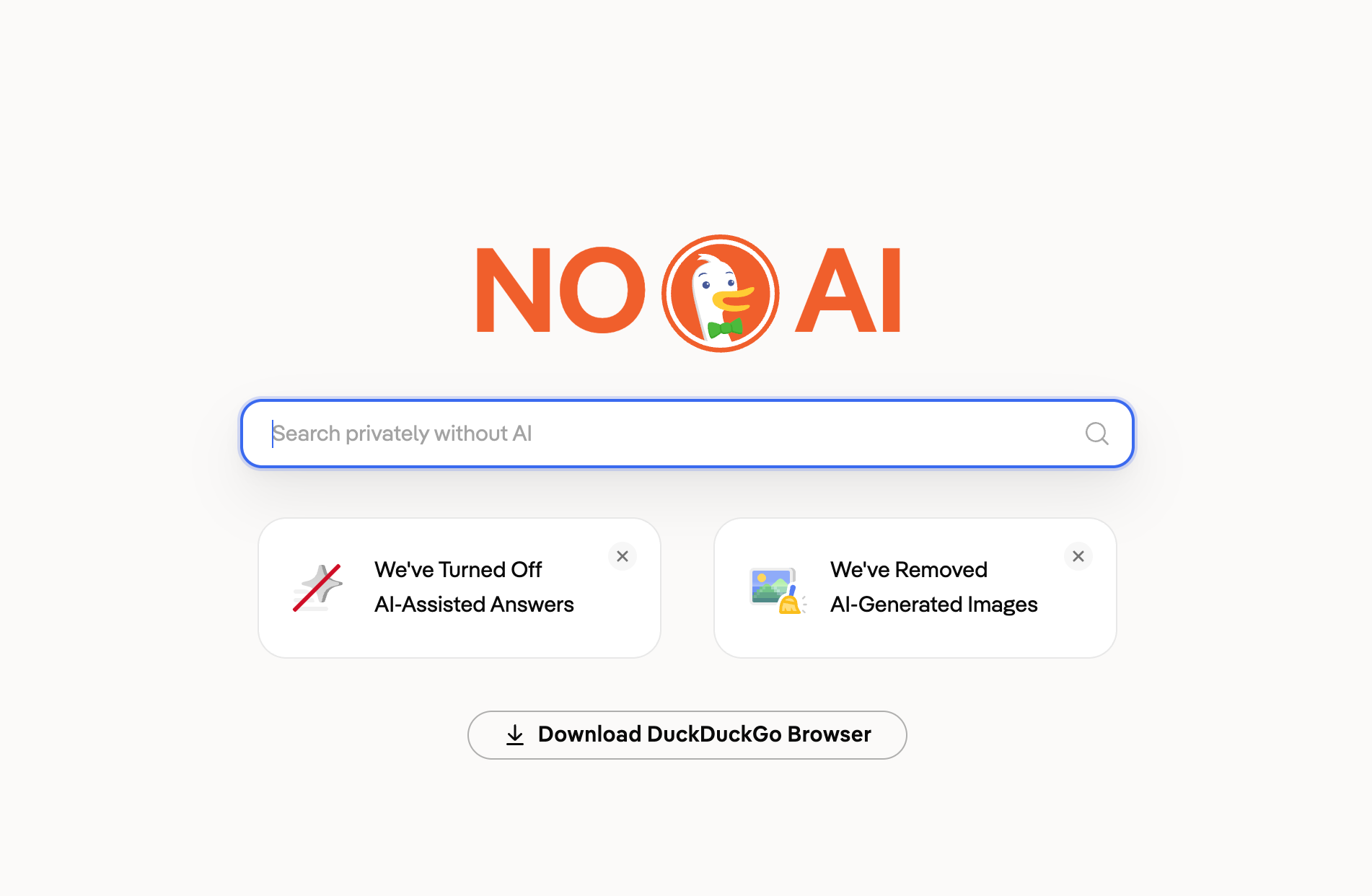
- Point the search box at a non-AI endpoint if that is the chosen route. DuckDuckGo documents noai.duckduckgo.com as the same search with AI-assisted answers, AI-generated images and AI feature suggestions disabled — no configuration needed by the student.
- Test with a real student account. Confirm the omnibox searches where you expect, confirm the existing content filter and SafeSearch behaviour still apply to the new engine, and confirm that links copied into learning-management assignments still open.
- Close the side doors. Device policy on managed machines does not govern AI reached from a personal phone, an unmanaged browser or a private window. If the goal is a genuinely low-AI research environment, pair the default-search change with gateway filtering and a written classroom norm.
- Tell families and staff in plain words. A parent letter that explains what is enabled, what is blocked and what students will see when a tool is unavailable prevents the "the school broke Google" support tickets.
These steps follow Google's own public administration documentation and DuckDuckGo's public help material; the sequencing and the pilot advice are MyTechDailyNews analysis, not a directive from any standards body.
Five common misconceptions to clear before the rollout lands
- "Turning Gemini off turns AI off everywhere." It does not. AI summaries and AI modes are part of the search experience, which is why they stay attached to the search decision.
- "The ban starts today." The default-off configuration is described as arriving early next year for K-12 accounts; the announcement date and the enforcement date are not the same thing.
- "Students without Google Search cannot search." They lose that one entry point. Library databases, a different default engine and non-Google accounts still work — which is precisely the leverage question critics are raising.
- "DuckDuckGo means no AI can ever appear." The company sells an optional assistant, Duck.ai, on top of its search products. The distinction districts are buying is opt-in rather than mandatory.
- "Google's default-off posture means schools have lost the argument." The opposite reading is also available: the company moved from pushing AI into every student account to requiring an explicit adult decision, which is what many school boards had been demanding.
A 60-day readiness checklist for IT and academic leaders
- Days 1–10: inventory search-dependent curriculum; document current admin-console settings with screenshots so the pre-change state is auditable.
- Days 11–20: publish the AI tier policy (grade bands, permitted products, teacher exception process); brief principals.
- Days 21–35: run the pilot organizational unit; verify search results, filtering, sign-in and reporting.
- Days 36–50: review the vendor terms and student-data posture of any replacement engine before a district-wide switch; check whether the provider offers deployment help.
- Days 51–60: roll out district-wide with a parent letter, a staff one-pager and a named owner for weekly monitoring of product changes.
FAQ: what readers are actually asking
Can a U.S. school keep Google Search and disable all AI?
Not inside Google's own products. Google states that search and AI capability are integrated, so a school that declines AI entirely also loses search access on the managed K-12 accounts, showing students a message that the service is unavailable. An AI-free search box has to come from another engine or be filtered at the network layer.
When does the change take effect?
Google announced the policy in early November 2026 and described the default-off settings for K-12 student accounts as arriving early next year. Administrators should expect tenant-level change notices rather than assume the current settings will hold.
Does this affect personal Google accounts?
The policy as reported applies to school-managed K-12 accounts. A student's personal account is outside district administration, which is why device, network and classroom-norm controls matter as much as the admin console.
Is switching to DuckDuckGo a compliance shortcut?
No. It changes where queries go, so the district still owns the review of terms, data handling, student-consent rules and the content filtering that wraps around results. DuckDuckGo's public offer of migration help lowers the technical effort, not the governance obligation.
What is Guided Learning?
A Google feature that leads students through reasoning steps rather than dispensing an answer, intended to ease school concerns about AI doing the work for them. For districts that want an AI-free option, it does not replace the ability to switch generative features off.
The bottom line
Google's K-12 rule converts an editorial preference — how much machine-written answer a child should see — into an administrative choice with a price attached. The practical response for any school in the United States is the same regardless of which side of the argument it lands on: know what search-dependent teaching you have, decide the AI tier deliberately rather than by default, pilot before you broadcast, and put the reasoning in writing before the change arrives. As DuckDuckGo's pitch and the last six months of install data show, alternatives exist; what remains unproven is how many classrooms can move without losing the workflow they were built around.
References and further reading
- The New York Times, "Google Will Turn Off Search for Schools That Reject A.I." — https://www.nytimes.com/2026-11-03/us/google-search-schools-restrict-ai.html
- CBS News, "Google will block search access for schools that ban AI use" — https://www.cbsnews.com/news/google-search-access-schools-ai-tools/
- TechCrunch, "Google will let schools disable its AI tools, but not without sacrificing search" — https://techcrunch.com/2026-11-03/google-will-let-schools-disable-its-ai-tools-but-not-without-sacrificing-search/
- TechCrunch, "DuckDuckGo installs are up 30% as users reject being 'force-fed' Google's AI Search" — https://techcrunch.com/2026-05-26/duckduckgo-installs-are-up-30-as-users-reject-being-force-fed-googles-ai-search/
- DuckDuckGo help pages, "About noai.duckduckgo.com" — https://duckduckgo.com/duckduckgo-help-pages/ai-features/about-noaiduckduckgocom
- Google Chrome Enterprise and Education help, "Set Chrome policies for users or browsers" — https://support.google.com/chrome/a/answer/2657289
- Education Week, "Students Are Worried That AI Will Hurt Their Critical Thinking Skills" — https://www.edweek.org/technology/students-are-worried-that-ai-will-hurt-their-critical-thinking-skills/2026/03
- American Psychological Association, Monitor on Psychology, "How AI is reshaping human skills and thinking" — https://www.apa.org/monitor/2026/07-08/ai-job-skills-thinking
- Tom's Guide, "DuckDuckGo fires back at Google: schools don't need AI to search" — https://www.tomsguide.com/ai/google-is-giving-schools-a-choice-allow-ai-or-lose-google-search