
When Phone Makers Pull Back: MyTechDailyNews Explains the Q3 Smartphone Shipment Decline
The latest phone cycle feels less like a normal holiday buildup and more like a carefully managed pause. Manufacturers are holding back on shipments, retailers are thinking twice about inventory, and the cost of key internal parts has pushed the market in a different direction. For readers, that changes the practical experience: promotional discounts may look thinner, replacement cycles may stretch, and product timelines can run across seasons.
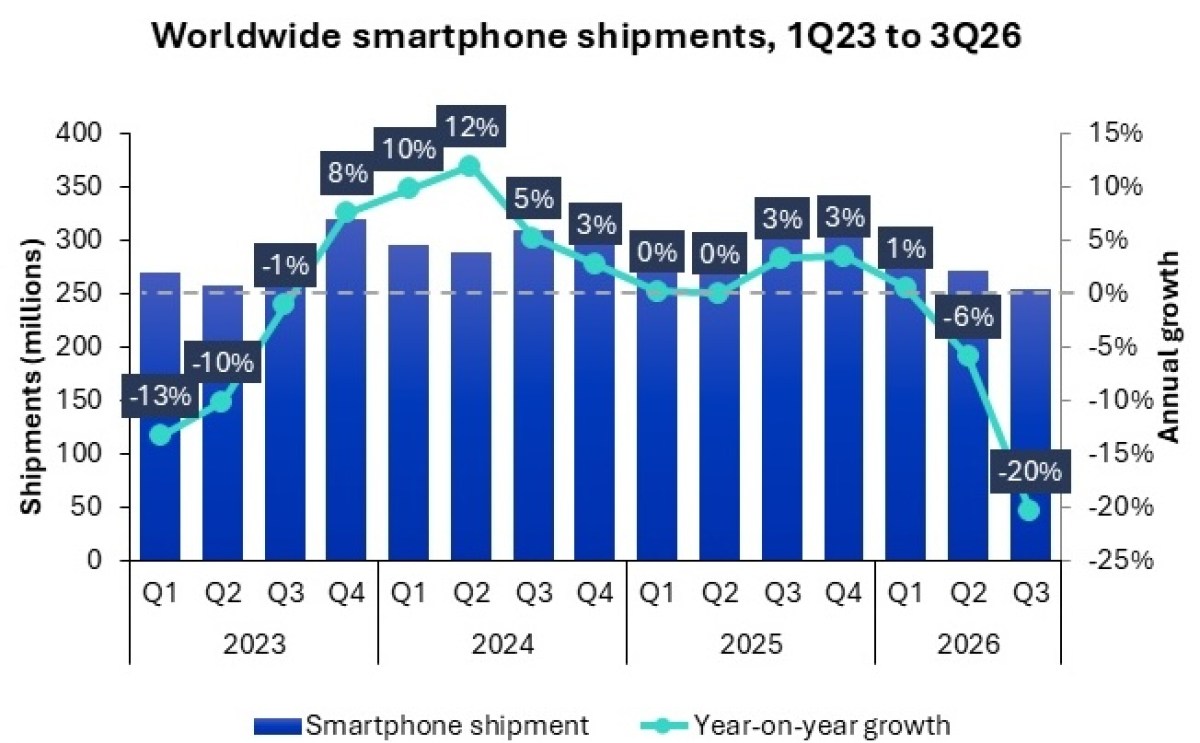
Omdia data published on October 29, 2026, shows that shift in numbers. Global smartphone shipments reached 254.7 million units in Q3, a 20% year-on-year decline, making it the worst third quarter since 2013. The softening market combines less consumer willingness to buy with a deliberate choice by phone makers to limit shipments.
Why the squeeze happened: higher memory costs and cautious channels
DRAM and NAND flash prices have continued rising. Because memory is a core component in every smartphone, higher component prices lift the material cost of the whole device. Entry-level and midrange phones, where margins are normally thin, are especially exposed. The result is not a single reaction but a series of adjustments:
- Some phone makers have raised selling prices.
- Some have changed memory and storage configurations to protect profitability.
- Some have reduced shipment volumes instead of filling channels with low-margin inventory.
Distributors and retailers have become cautious as well. Because new handsets cost more to stock, each unit ties up more cash. That has discouraged many partners from building the large inventory normally expected before the year-end shopping season. As a consequence, the volume manufacturers shipped through the channel fell further.
Vendor scorecard: Samsung and Apple lead while the middle tier falls back
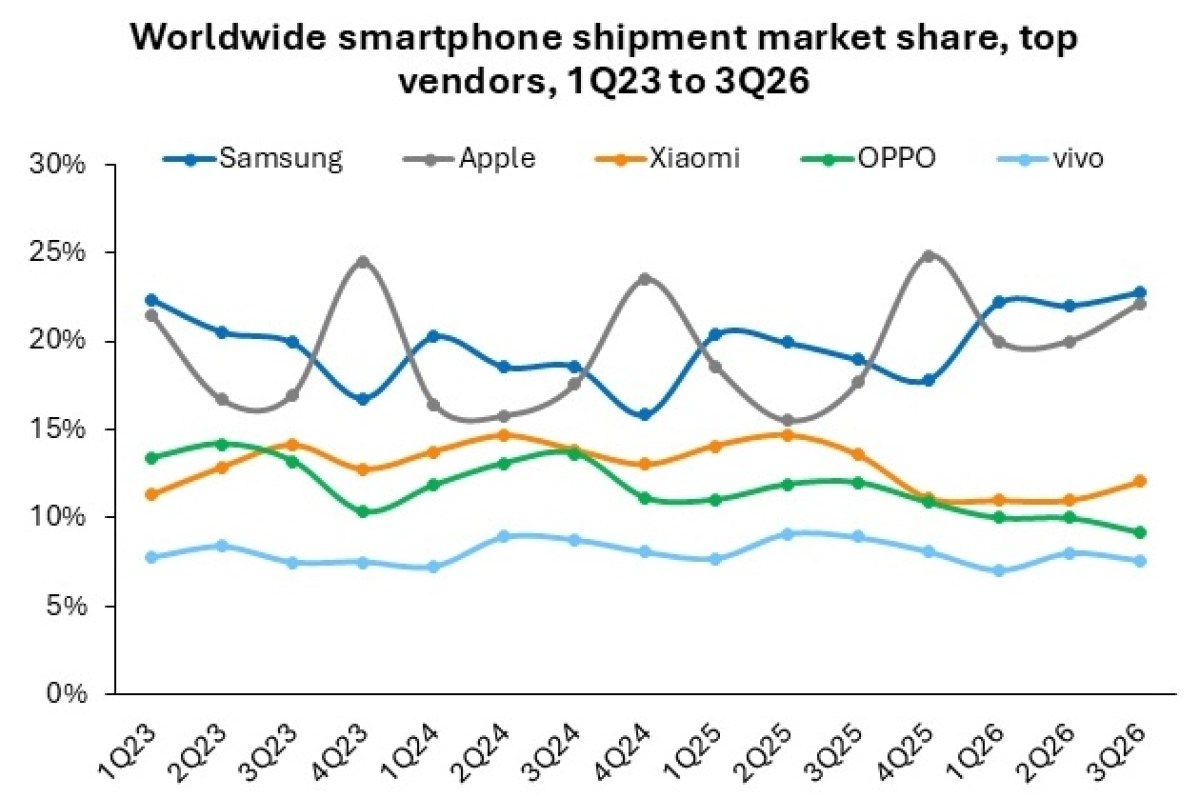
Within that broader decline, the top two vendors were more stable, while the mass-market players saw sharper reductions.
| Vendor | Q3 position | Shipments | Year-on-year change | Market share | Key context |
|---|---|---|---|---|---|
| Samsung | Global No. 1 | 57.8 million units | Down 5% | 23% | Galaxy A series remained competitive in entry-level and midrange markets; Galaxy Z8 series launched in August supported premium sales; trade-in and device-upgrade promotions stimulated replacement demand. |
| Apple | No. 2 | 56.5 million units | Roughly flat versus same period last year | 22% | Demand remained relatively solid in China and North America; iPhone 17 series continued selling. In September, Apple introduced iPhone 18 Pro, iPhone 18 Pro Max, and its first foldable smartphone, iPhone Duo, while postponing the standard iPhone 18 to 2027. |
| Xiaomi | No. 3 | 30.7 million units | Down 29% | - | China shipments declined 20% and India shipments declined 28%. The company adjusted prices across markets and placed more focus on margin than shipment scale; Redmi A7 Pro and Redmi 17 provided support but did not offset broader softness. |
| OPPO Group, including realme and OnePlus | No. 4 | 23.4 million units | Down 39% | - | Higher memory costs prompted selective price increases in key markets; midrange and lower-priced models face buyers with high price sensitivity. |
| vivo | No. 5 | 19.3 million units | Down 33% | - | Similar pressure from rising storage costs and consumer caution in price-sensitive segments. |
The overall market decline of 20% makes Samsung and Apple's relative stability more visible. Apple in particular held shipment scale nearly flat, while iPhone 18's postponed standard model extended the sales cycle for iPhone 17 and put more marketing emphasis on premium handsets.
Regional snapshot: emerging markets felt the cost pressure first
| Region | Q3 shipment change | What it means for users |
|---|---|---|
| Africa | Down 39% year on year | Among the weakest major regions; currency depreciation, inflation, and higher living costs reduced purchasing power, causing many users to keep phones longer, buy refurbished devices, or switch back to lower-priced traditional feature phones. |
| Asia-Pacific excluding Greater China, the Middle East, and Latin America | Declines exceeded 20% | Price increases bite harder where budgets are tight and retail financing options are less common. |
| North America | Relatively stable | A high share of premium phone buyers plus carrier installment plans, trade-in offers, and device-upgrade programs partly offset higher device prices. |
What manufacturers are changing next
Phone makers are adjusting beyond simple price increases. The industry is working to protect core competitiveness while absorbing cost shocks:
- Reducing low-margin models.
- Tuning memory and storage options to keep profitability under control.
- Absorbing some cost rises selectively to maintain key product lines.
- Shifting product mix toward midrange and premium devices, where average selling price is higher.
That strategic shift is easier for scale leaders than for smaller brands. Companies with weaker balance sheets lack the same supply-chain bargaining power and cannot tolerate compressed margins for long. Omdia says future competition will be less about raw shipment volume and more about financial strength, lean inventory, and operational efficiency, with software services, after-sales support, and value-added offerings as possible new revenue sources.
Outlook: full-year 2026 falls 12%, and 2027 brings a slower decline
Omdia expects global smartphone shipments to decline 12% for full-year 2026. The fourth quarter should still face pressure because storage chip prices are continuing to rise, while promotional discounts during the year-end shopping season have limited room.
In 2027, the market is expected to shrink again, but the decline may be slower than in 2026. The reason sits in memory supply itself: high-bandwidth memory, or HBM, demand is growing for AI data centers and servers, consuming capacity that would otherwise flow into traditional DRAM. Memory makers are prioritizing AI data center and server demand, so smartphone manufacturers do not have much near-term cost cushion.
Samsung and Apple now hold a combined 45% market share, supported by premium product portfolios, large-scale supply chains, and steadier customer bases. Xiaomi, OPPO, and vivo, whose businesses are more tied to mainstream consumers, are caught between rising component costs and weaker buying power. For buyers, the near future may look like more expensive smartphones, fewer low-end configurations, and longer replacement cycles. The fight for memory capacity is also showing that AI infrastructure demand can ripple through supply chains far beyond the data center.
Common misconceptions
- Misconception: This is only a consumer-demand story. Omdia's data also shows manufacturers actively compressing shipments because costs and channel behavior changed.
- Misconception: Apple's iPhone 18 delay means it lost momentum. The standard iPhone 18 postponement helped extend the iPhone 17 sales cycle and shifted promotion toward premium models.
- Misconception: A move toward higher-end phones works the same for all brands. Smaller vendors lack the supply-chain bargaining power and balance-sheet strength that make this transition viable.
- Misconception: North America is stable because phones are cheaper there. The stability is tied more to premium demand and carrier installment, trade-in, and device-upgrade programs that ease price pressure.
Checklist: What readers should watch
- Memory prices. The cost trajectory of DRAM and NAND flash affects phone prices and configurations.
- Vendor priorities. Samsung and Apple emphasize premium stability, while Xiaomi, OPPO Group, and vivo manage pressure from midrange and lower-priced demand.
- Regional vulnerability. Africa and several emerging markets saw sharper declines; North America proved more resilient.
- Product timing. Apple's September launches and the standard iPhone 18 delay to 2027 shape how older and newer models sell at the same time.
- Holiday-season discounts. The year-end shopping season may offer less promotional room than usual.
- Industry structure. A combined 45% share for Samsung and Apple signals a shift toward stronger, scale-led competition.
Action advice: how to respond before your next phone purchase
- Before shopping, compare the total cost of a new phone with keeping your current device for another cycle, since replacement cycles are lengthening.
- If you are interested in Apple models, check whether a still-supported iPhone 17 series makes sense while the standard iPhone 18 is delayed to 2027.
- If you are comparing Samsung or other Android devices, look at the exact memory and storage configuration rather than the model name alone, because makers are adjusting specs to protect margins.
- In North America, check carrier installment plans, trade-in credits, and device-upgrade programs; these mechanisms can reduce the immediate cost of a more expensive handset.
- In Africa, the Middle East, Latin America, and parts of Asia-Pacific excluding Greater China, price sensitivity is higher; refurbished devices and lower-priced traditional feature phones may remain more accessible options.
- Do not assume year-end discounts will be large. With storage chip prices still rising, manufacturers and retailers have less promotional latitude.
- If your budget is tight, watch whether brands reduce low-margin models; this can shrink the number of genuinely entry-level choices.
FAQ
Why did smartphone shipments drop so sharply in Q3?
The 20% year-on-year decline to 254.7 million units was caused by a double squeeze: rising DRAM and NAND costs raised the price of building phones, and cautious channel partners ordered fewer units because each one tied up more capital. Omdia also points to softer consumer purchasing power, especially in price-sensitive markets.
Which companies performed best against the decline?
Samsung remained global No. 1 with 57.8 million units, down 5% year on year, and 23% market share. Apple took No. 2 with 56.5 million units, holding shipments roughly flat versus same period last year and reaching 22% share. The overall market was down 20%, so both brands looked more stable than the industry as a whole.
Which brands were hit hardest?
Xiaomi was No. 3 with 30.7 million units, down 29%; China shipments fell 20% and India fell 28%. OPPO Group, including realme and OnePlus, was No. 4 with 23.4 million units, down 39%. vivo was No. 5 with 19.3 million units, down 33%. Their pressure comes from midrange and entry-level buyers who are more sensitive to price increases.
What does this mean for 2026 and 2027?
Omdia projects full-year 2026 global smartphone shipments to decline 12%, with continued fourth-quarter pressure and limited discounts in the year-end shopping season. The market may shrink again in 2027, but the decline could be slower than in 2026. The bigger constraint is memory supply: AI data center demand for HBM is pulling capacity away from traditional DRAM, leaving phone makers with less cost protection.
Is the industry just raising prices?
Not only. Companies are reducing low-margin models, adjusting memory and storage configurations, and moving portfolios toward midrange and premium devices. Some are absorbing cost increases where needed. The future competitive advantage, according to Omdia, will include balance-sheet strength, lean inventory, efficient operations, and potential revenue from software services and after-sales support.