
How to Judge gen AI Marketing Tools Today: A Buyer’s Comparison of Adoption, Hype, and Reality
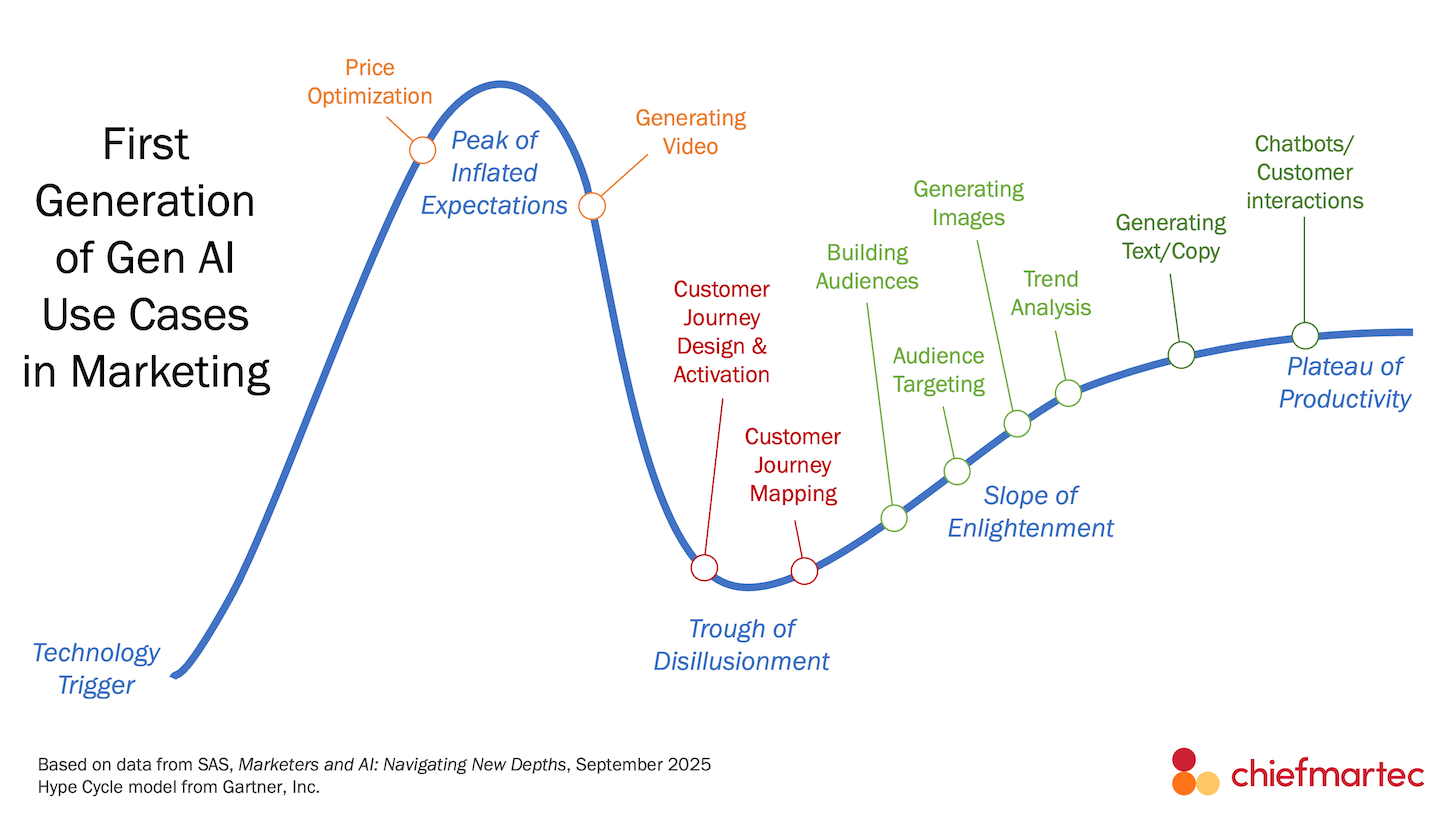
For general readers, gen AI in marketing is not a single roller coaster. Some uses, such as chatbots, trends analysis and text generation, are already practical; others, such as video and journey mapping, have cooled after early excitement. The smart comparison today is use-case-by-use-case. Drawing on a SAS report released this week and the 2024 versus 2025 comparison (n=300), buyers should prioritize proven workflows before chasing next-generation claims.
What Is Actually Being Mapped on the Marketing Hype Cycle?
Read it as a portfolio, not a verdict. “gen AI” is a shorthand that covers several products at very different stages. A chatbot that answers simple questions can already sit on a plateau of practical value, while the same category’s next-generation agent may sit near an inflated peak. F. Scott Fitzgerald wrote that the test of a first-rate intelligence is the ability to hold two opposed ideas at once; marketing buyers now need that skill when comparing AI tools.
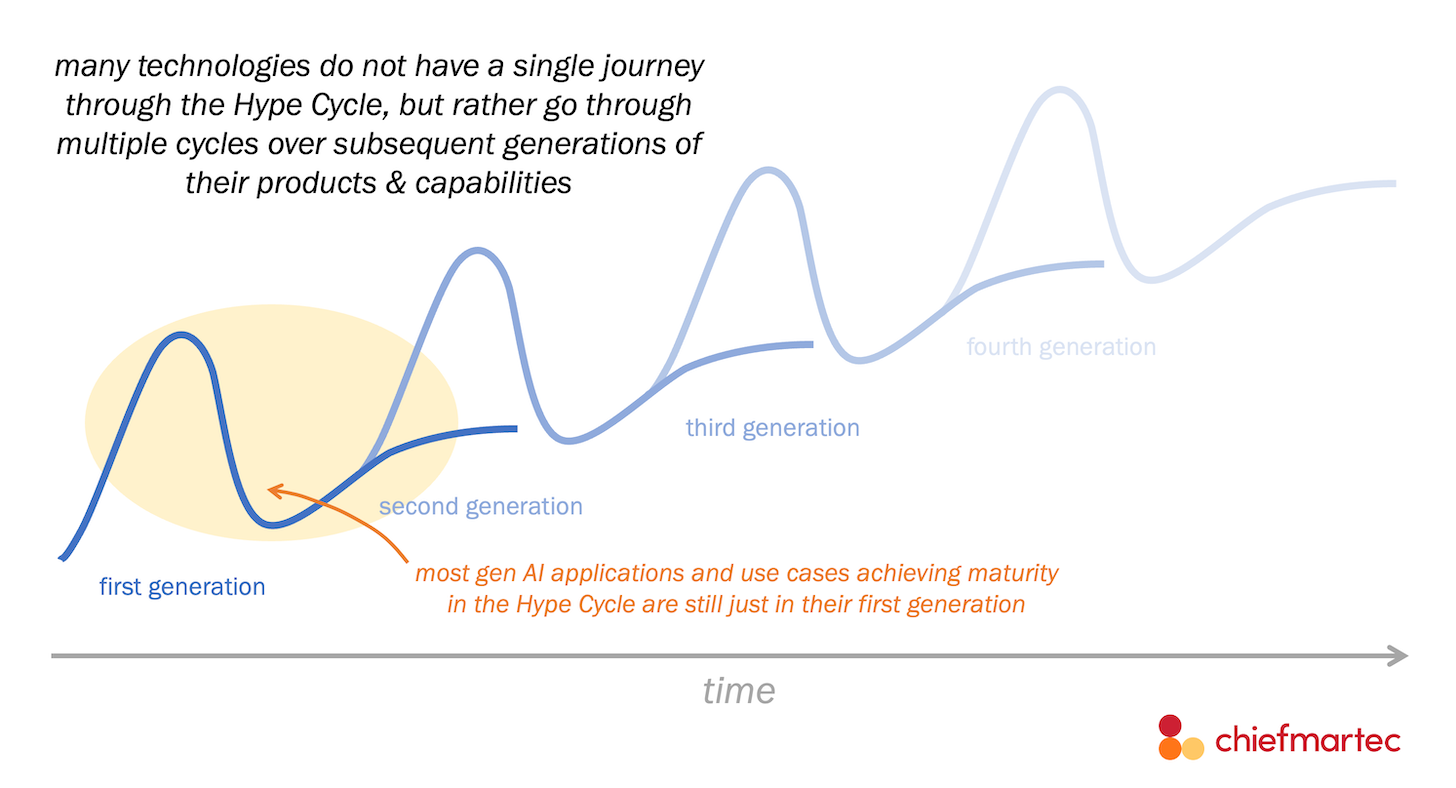
Each generation gets a new cycle. What feels normal in 2 years may feel routine in 5 years and may look primitive in 10 years. The practical lesson is that a good purchase today does not have to be the final version of the technology.
How Does the SAS 2024 and 2025 Comparison Reveal the Shift?
The most useful piece of the SAS report released this week is not the label “Hype Cycle”; it is the comparison of adoption versus planning for 10 gen AI applications, drawn from n=300 responses in 2024 and 2025. That makes the chart less a narrative device and more a scoreboard for this past year.
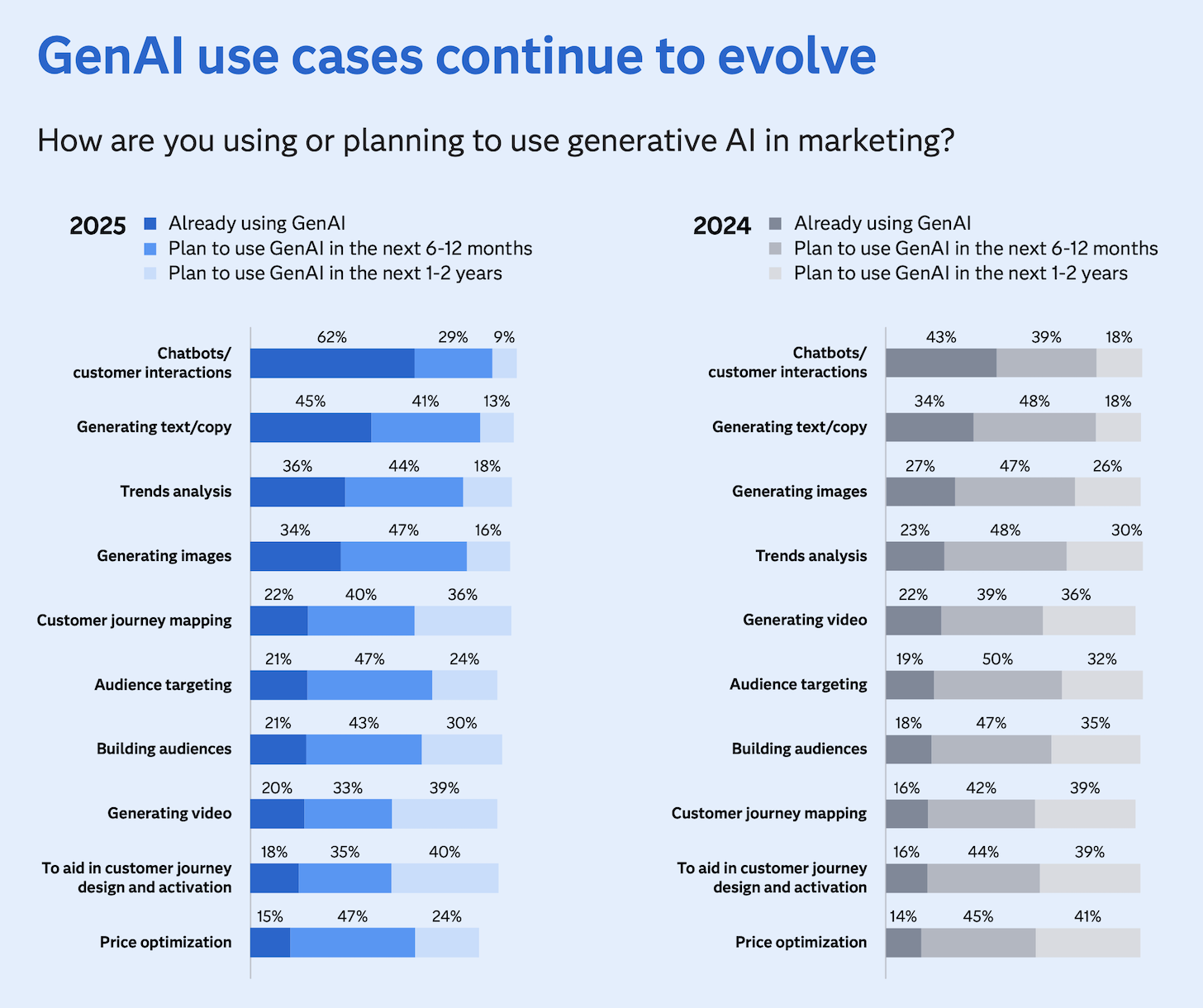
The 12-month change separates three groups. The first group is accelerating from a real base: trends analysis jumped +56.5%, chatbots/customer interactions rose +44.2%, and text generation climbed +32.4%. Those are not merely novelty spikes; they are workflow habits. Trends analysis is often the quiet winner because it helps marketing teams turn scattered customer data into decisions.
The second group shows adoption level and momentum together. In the same SAS comparison, chatbots reached 62% adoption, generating text reached 45%, and trends analysis reached 36%. The third group reversed. Generating video fell -9.1%, and customer journey mapping fell -4.3%. That pattern is enough to place some tools near productivity and others near a disillusionment trough, but it is not enough to declare an entire category dead.
Where Does Each Use Case Sit in the First-Generation Curve?
The map at the top is an editorial approximation. It is not an official Gartner product; Gartner’s model is the frame, while the placement comes from the SAS comparison and the broader martech conversation.
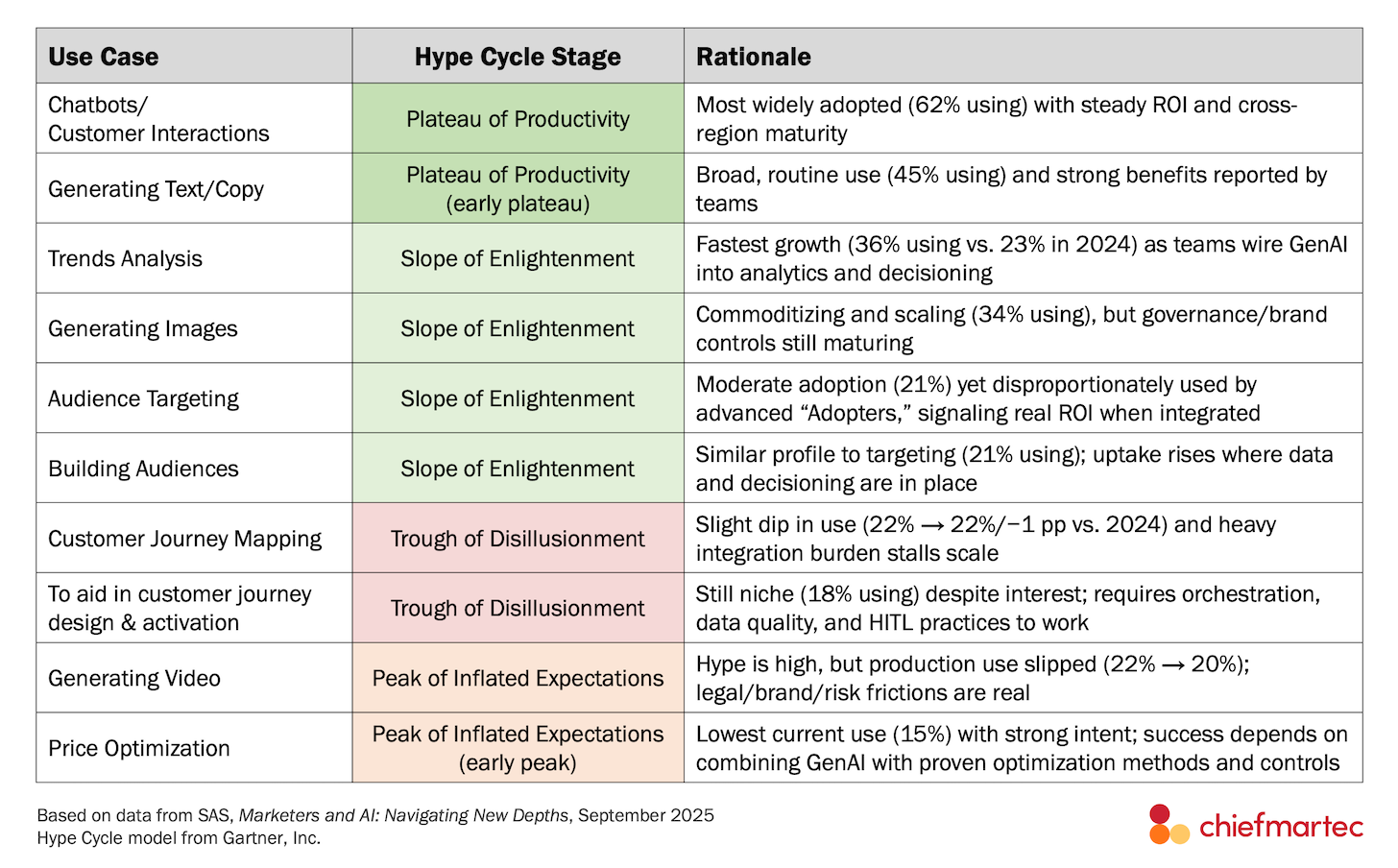
A year ago, several video and journey-mapping products received loud applause. This past year’s data suggests those categories are now being tested for control, cost, brand safety, and workflow depth. Chatbots, copy, and trends analysis are more likely to sit on a plateau for first-generation uses. Agents, however, can re-enter the peak because their capability story is expanding.
Why Do Buyers Feel Both Excited and Confused?
Georgia Tech’s February 2026 review of 2025 predictions graded AI adoption as “Hard to define,” saying adoption advanced while hype outran reality. That matches the SAS pattern: some marketing use cases are already ordinary, while new promises reset expectations. The result is not a dead market; it is a split market.
McKinsey’s August 2025 conversation with Ariel Kelman describes why some gen AI uses spread faster: “Gen AI is really good at summarizing things, doing generative search, and finding information across multiple documents.” For a non-specialist, that means AI can help answer “what happened in this campaign report?” before it replaces creative judgment.
Additional reporting on the SAS research also points to a broad shift: 85% of marketers reported using gen AI in 2025, and budget planning remained strong. The exact numbers behind the 10 use cases matter more than the headline because they show whether adoption is already embedded or only planned.
What Is the Best Decision for General Readers?
For a general marketing reader, the comparison should not be “AI yes or no.” It should be “use case yes, use case no, use case wait.” The table below maps each category to buyer profile and risk.
| Use case | Signal in data | Best fit | Biggest risk | MyTechDailyNews verdict |
|---|---|---|---|---|
| Trends analysis | +56.5% adoption gain; 36% adoption | Marketing teams with recurring reports | Garbage in, garbage out | Start with one question: which customer behavior changed? |
| Chatbots/customer interactions | +44.2% adoption gain; 62% adoption | Customer service and CX operators | Complex requests still need humans | Deploy with escalation paths, not as a replacement promise. |
| Generating text/copy | +32.4% adoption gain; 45% adoption | Content teams under deadline | Generic output without brand rules | Use drafts, style guides and human editing. |
| Generating video | -9.1% adoption change | Short product demos or concept tests | Brand consistency and cost control | Pilot one asset before scaling a campaign. |
| Customer journey mapping | -4.3% adoption change | Teams with mature CRM and journey owners | Over-engineering without action | Only adopt if the map triggers real campaign changes. |
Which Hype Cycle Mistakes Should Buyers Avoid?
- Treating gen AI as one technology. It is not.
- Mistaking a plateau for permanent value. A plateau can be temporary between generations.
- Ignoring the 12-month direction. Adoption level alone hides momentum.
- Letting demo videos outrank operational readiness. The data shows why video and journey mapping slowed.
- Using Gartner’s curve as a shopping list. Gartner provides a frame, not a vendor scorecard.
What Should a Team Do This Week?
- Audit three workflows where gen AI could reduce manual review: customer-service answers, copy drafts, campaign trend summaries.
- Compare your baseline with the SAS figures: 62% for chatbots, 45% for text, and 36% for trends. Decide whether a gap is risk or opportunity.
- Keep a human review layer for outputs that touch customers, especially where a first-generation system can overreach.
- Recheck assumptions before treating a 12-month gain as durable. The next generation may reset expectations again.
- If a tool only looks impressive in video, ask for a cost, control and brand-safety report.
FAQ: What General Readers Ask About the gen AI Hype Cycle
Is gen AI in marketing already overhyped?
Some applications are past hype; others are still early. First-generation chatbots, text tools and trend analysis have practical adoption, but agents and future-generation experiences may begin a new peak. The answer depends on the job, not the label.
Why did video and journey mapping decline?
The SAS-based numbers show -9.1% for generating video and -4.3% for customer journey mapping. A reasonable interpretation is that buyers found quality, consistency, ownership and integration costs harder than expected. That is analysis based on the adoption reversal, not a new report number.
What is the safest first project?
For general readers, start with summarization or search, where McKinsey’s Ariel Kelman describes gen AI as strong, or with trend summaries that support decisions. Keep high-risk autonomous actions for later.
Does plateau mean vendors can stop improving?
No. It can mean only today’s basic version is productive. Future generations can handle more complex customer scenarios, take actions, and expand service roles.
References
- SAS, “Marketers and AI: Navigating New Depths,” https://www.sas.com/content/dam/sasdam/documents/20250124/marketers-and-ai-navigating-new-depths.pdf
- McKinsey & Company, “A new tech-driven era of impactful marketing and sales,” https://www.mckinsey.com/capabilities/growth-marketing-and-sales/our-insights/a-new-tech-driven-era-of-impactful-marketing-and-sales
- Georgia Institute of Technology, “Grading 2025’s Biggest Predictions and What They Signal for 2026,” https://www.gatech.edu/news/2026/02/05/grading-2025s-biggest-predictions-and-what-they-signal-2026