
MyTechDailyNews General: The Practical AI Workflow Behind a Small Data-Center Fan Engineering Team
For readers of MyTechDailyNews General, the GEHA story is less about futuristic demos and more about a practical industry question: how can a small engineering group keep a complex manufacturing workflow steady while product types, customers, and project sizes change? The short answer is that Jan Bos, the company’s manager of engineering and R&D, uses Designcenter Solid Edge, Siemens tools, and a set of AI assistants to support industrial fan work. Since 1957, GEHA has built fans in Nieuw-Amsterdam, the Netherlands. Fan housings run up to 7.3 meters in diameter, and the customer mix once leaned toward refineries and chemical plants. Now, the data center is a growing line in the order book.
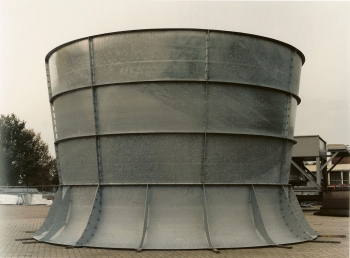 GEHA supplies industrial air-cooling solutions. (Image: GEHA.)
For a global manufacturer of datacenter cooling systems serving the North American market, GEHA is producing fans of more than 2.1 meters (7 ft) in diameter at high volume. A single datacenter campus may require several hundred of these large fans. The positioning is simple: “We make the biggest and most silent fans for data centers,” Jan Bos says, adding, “That’s our specialty.”
The output is notable because of who is doing the engineering. The department once had four people; when the oil market changed in 2017, it shrank to two. Today, Bos works alone with Designcenter Solid Edge and a growing kit of review, automation, and document-checking tools. He says, “I’m on my own and running the whole show without problems,” and adds, “And I’m enjoying my work.”
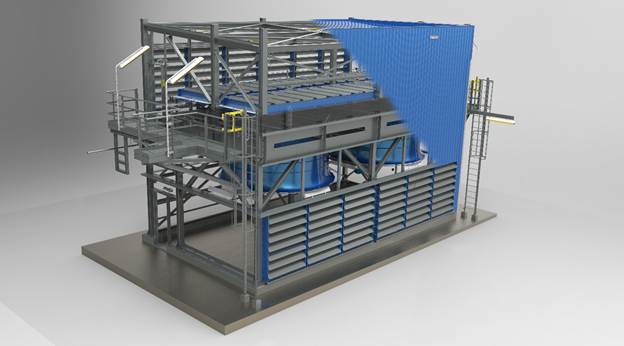 Rendered model of a complete cooling system designed in Designcenter Solid Edge. (Image: GEHA.)
One engineer, one long path to 3D CAD
Bos first met the software in 1997, on version 3.5. He had been working in 2D CAD and was not convinced until a colleague’s son showed him how quickly a part could become a drawing view, a detail, and a cross-section. After moving into 3D CAD, he kept returning to one phrase: “out of the brains, out of the paper, into the model.” In 2003, he brought Solid Edge to GEHA to put models, drawings, and production information in one place.
He later helped found the Benelux user group, became one of Siemens’ Community Catalysts, and presented at Realize LIVE on topics ranging from Visual Basic automation to a refinery retrofit built from a point cloud. This year in Detroit, his session was titled “Practical AI as an Everyday Solid Edge User.” His opening slide is a plain statement many readers can recognize: “Not a programmer. Just an engineer who got curious.”
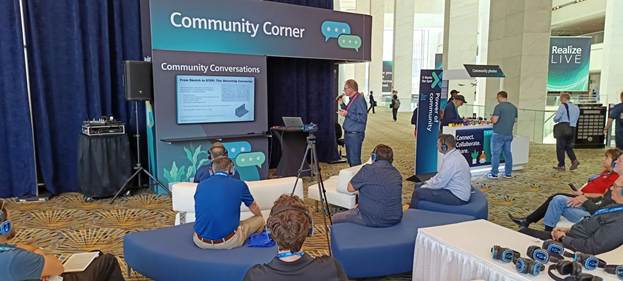 Jan Bos, lead engineer and designer at GEHA, presents his AI design hacks to the community at Realize LIVE Detroit 2026. (Image: GEHA.)
A home-office checking ritual
For Bos, the turning point began with a Sunday morning habit. On large projects he printed drawings and checked them at home on Sunday mornings with a red pen, a highlighter, and coffee. A 150-drawing project took about two to three hours. He says, “It only goes wrong when it’s a big project,” and adds, “So, if it’s a big project with a lot of parts, you have to check it very well.” The shift can be summarized in a small phrase: Sunday morning, two minutes.
In spring 2025, he exported a full drawing set to PDF and loaded it into Google AI Studio running Gemini 2.5 Pro, asking the model to act like an old-fashioned drawing checker with close attention to the bill of materials. It found uneven hole spacing on a perforated plate and asked whether it was intentional; it was not. It also flagged a transport wheel listed in the BOM with no diameter and suggested 150 mm, a value pulled from the detail drawing. “The AI did what a real drawing checker would do,” Bos says.
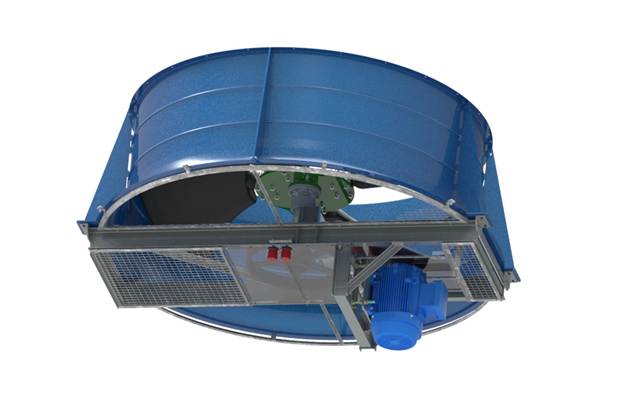 Typical fan in the GEHA product line: machine-produced fan rings are up to a diameter of 7.30 meters, with components such as drives, bearing blocks, louvre dampers and plenums. (Image: GEHA.)
AI review is now standard on every major GEHA project. Bos has turned the checker into a reusable skill and taught it about the people who work in the factory, so feedback is framed around construction, assembly, work preparation, and laser cutting. He says, “[AI] tells me, ‘Jan, you made a heavy construction, but there is no hoisting lug on this one, and your colleague Eric will not be very pleased,'” and adds, “It holds up a mirror.”
Given a PDF or a STEP file, the model can also flag a hole placed too close to a bend, where forming may distort it. That kind of design-for-manufacturability note once depended on a shop-floor veteran catching it early. Bos has used the same idea to check GEHA’s technical construction files against updated machine-safety regulations.
Does he trust the output? “Yes,” he says, and calls the results “very solid.” Part of the trust comes from scope: the model checks his drawings against his standards instead of roaming the open internet. The other part is that the AI does not make the call. One of his Detroit slides says, “AI amplifies expertise. It doesn’t replace it. You still need engineering judgement.”
The second front: automation without a programmer team
The second front is automation. Bos had a library of VB6 and VB.NET macros that “sort of worked,” built by adapting examples. Using the open-source coding tool OpenCode with a paid Claude model, he converted an old VB6 utility called PM-Tabelle into Fit Table, a C# macro that connects directly to Designcenter Solid Edge without opening Visual Studio. Every GEHA macro is now C#. When the AI needs to understand the programming interface, it can read the online programming documentation, and Bos can start from one of the roughly two dozen example programs he has collected over the years.
He tested the limits with a property add-in that launches on his second monitor, something he had wanted for years. After a few failed attempts, the AI asked whether he had other add-ins it could study, found one in a folder, and produced a working version. Bos refined the layout by marking up screenshots with red arrows in Microsoft Paint. The total time to develop the concept was about an hour and a half. The experiment once would have cost five or six days of a contract programmer’s time; he ultimately preferred his own macro and shelved the add-in.
The same approach cleared a downstream bottleneck. A colleague used to spend half an hour on each of roughly 20 orders a week splitting Designcenter Solid Edge BOM reports into lists for purchasing, laser cutting, and other departments. Bos gave Claude Code an emptied-out report as a template, and it built a Python tool that does the job with a right-click.
Some newer work skips CAD at the start. With Claude connected to SketchUp, Bos can photograph a dimensioned hand sketch of a bracket and get back a STEP file ready to import into Solid Edge or send to a 3D printer. In the other direction, he has handed the model a STEP file of a GEHA bearing block and received a bill of materials, plus a conversation about bearing selection and where the part could be made cheaper.
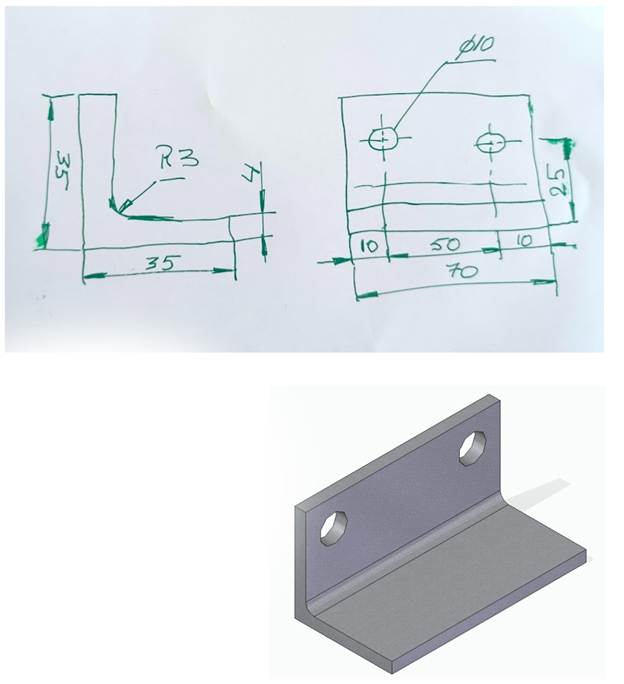 Bos went from whiteboard to STEP 3D model without opening a CAD tool. (Image: Jan Bos | GEHA.)
A stable model underneath the AI layer
For all of this, Bos is clear about what holds it together: AI is the layer on top, and Designcenter Solid Edge is the base. “Solid Edge is a very, very stable building block,” he says, and adds, “Everything we communicate to suppliers, it’s always spot on.” What he wants next is for the software to absorb the work he has been bolting on. “The nice thing about being an engineer is the creating part, solving the puzzle,” he says. “We don’t like making a drawing, checking a drawing, printing drawings, doing conversions. All that stuff should be handled by Solid Edge.”
His Detroit presentation wish-list starts with native batch drawing management: gather every drawing, verify that it is current, update hundreds of drawings at once, and report what changed. Bos sees that as a path toward AI that drafts and checks drawings alongside the engineer, ideally on a local model so data never leaves the building. Siemens is working toward AI-driven drawing creation and checking, and Bos sees Designcenter Solid Edge 2026 already heading that way. He says, “We are getting spoiled,” and then asks, “Why not?”
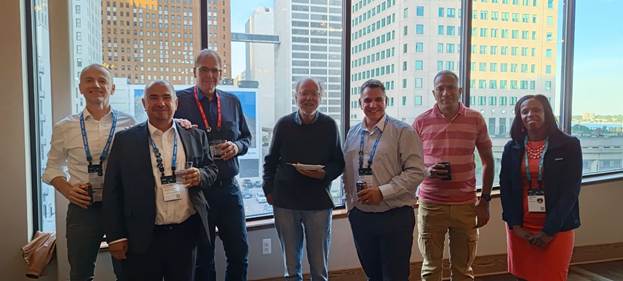 Jan Bos, third from the left, joins fellow Community Catalysts and Siemens staff at Realize LIVE Americas 2026. (Image: GEHA.)
He keeps Friday afternoons free for “sharpening the tools.” The feeling, he says, returns him to that afternoon in 1997, when a cross-section appeared from a 3D model in seconds. He says, “It’s that magic feeling I had in ’97,” and adds, “It’s a multiple of that magic at the moment.”
FAQ: What general readers should take from the GEHA case
Q: Is the story really about AI replacing engineers?
A: No. The article keeps returning to the same boundary: AI review, drawing checks, and automation can support speed, but the engineering decision remains with the engineer.
Q: Why does a small team matter to ordinary tech readers?
A: Because the workflow shows how product teams can handle larger and more complex orders without adding a full department, using a stable CAD base and targeted review tools.
Q: Is this only a CAD example?
A: It is CAD-centered, but the pattern is broader: a trusted model, a documented standard, and an AI pass that checks against that standard rather than guessing.
Checklist: What made the workflow stable
- A clear product niche: large, quiet fans for data-center cooling.
- A single source of truth in Designcenter Solid Edge models, drawings, and BOM data.
- Manual review habits converted into AI-assisted checks for big projects.
- Automation built from existing templates, reports, and example programs.
- Human responsibility for final approval, drawing corrections, and manufacturing judgement.
Common misconceptions
| Common misconception | What the case suggests instead |
|---|---|
| AI should make the design decision. | Bos keeps the call; AI checks against standards and points out possible misses. |
| Automation needs a software team. | A non-programmer engineer used OpenCode, Claude, and existing documentation to convert macros. |
| Small teams cannot handle complex products. | One engineer supported large-fan projects with tools, templates, and review routines. |
Action suggestions for readers and teams
- Start with the highest-risk routine, not the most exciting demo. For Bos, it was drawing review on large projects.
- Make the review standard explicit before adding AI. The model worked best when asked to check BOM consistency, dimensions, and local rules.
- Keep the master data stable. A reliable model and drawing set are the base for automation and report splitting.
- Turn successful prompts into reusable skills. The drawing checker later understood who assembles, cuts, and prepares work.
- Use automation only after the output is checked against a real template. Emptied-out reports and existing examples became starting points.
This is a general technology-news feature for MyTechDailyNews, published by Tech Daily. Contact: hello@techdaily.com. Author: Sarah Chen.