
Three Jobs, One Silicon Die: Comparing GigaDevice's New GD32H7 Industrial MCUs Before You Design In
The best industrial MCU is rarely the fastest one — it is the one that lets you delete a chip from the board. That is the case GigaDevice made on November 10, 2026 in Munich, Germany, where its new-generation GD32H7 portfolio was introduced: one shared die, three job descriptions. Pick by the peripheral you cannot source separately, not by megahertz.
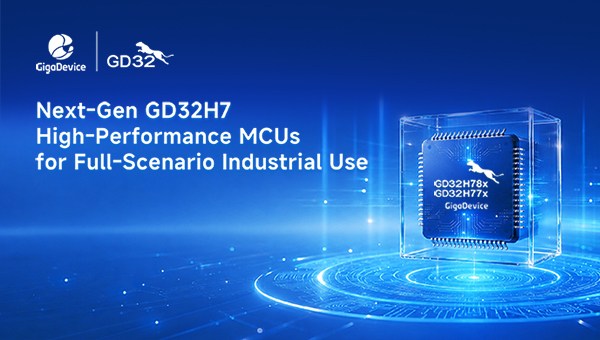
What actually happened on the Munich opening day
GigaDevice — a fabless supplier of Flash memory, 32-bit microcontrollers (MCUs), sensors and analog products — timed the announcement to electronica, the electronics trade show that runs November 10–13, 2026 in Munich and draws roughly 80,000 visitors from more than 100 countries, according to the US International Trade Administration. The demo list says more than the datasheet does: a six-axis collaborative robot arm built on the GD32H77R, and three graphical interfaces running on GD32H7 hardware for control panels. The company clearly wants this family judged on what is alive on the board.
Underneath all of it sits a unified chip architecture. Instead of inventing new silicon per market, GigaDevice keeps one homologous die and changes the IP configuration, the peripheral set and the tuning per scenario — which is why the three variants share tools, certifications and most of their behaviour.
What every GD32H7 part gives you — before the variants split
Short answer: the baseline is identical, so clock speed is a weak tie-breaker. Every device uses an Arm® Cortex®-M7 core, ordered either as 600 MHz(GD32H77x series) or 750 MHz(GD32H78x series), with a peak CoreMark® score of 3,736.
Memory and storage are standardised across the range:
- 640 KB of CPU-synchronous Tightly Coupled Memory (TCM), so instructions and data run with zero wait states;
- 2 MB high-speed executable Flash, 8 MB large-capacity storage Flash and 1.2 MB high-speed SRAM;
- two OSPI ports clocked at 200 MHz with double data rate (DTR) mode, for external memory when graphics or logs outgrow the die;
- a dedicated hardware math engine for trigonometric calculation, FFT and FIR filtering — the quiet workhorse behind motor loops and signal analysis.
Connectivity follows the same logic: multiple U(S)ART, I²C, SPI and I²S ports, two 10/100 Mbps Ethernet ports, 3 CAN-FD high-speed buses, multi-channel ADC/DAC with comparators and high-speed digital filters, plus USB HS/FS and SDIO. Operating voltage spans 1.71 V to 3.6 V, with several configurable low-power modes.
One habit worth borrowing from this product logic: treat memory as a budget, not a leftover. We argued the same point from the consumer side when we compared local AI memory costs on laptops; on a joint drive board or a 10-inch panel the arithmetic is identical.
Which GD32H7 is built for which job?
Three variants, three different definitions of success. Here is the honest trade-off view before you read the bullet lists.
| Variant | Job it was cut for | The feature you cannot easily buy separately | What to watch before committing |
|---|---|---|---|
| GD32H7xR Series (GD32H77R) | Robotic joint servo, miniature drives, high-precision CNC | Integrated EtherCAT® slave controller plus two 100 Mbps Ethernet PHYs, latency below 50 ns, FSoE support, 9mm×9mm BGA169 | One part number and a fine-pitch BGA: board layer count and assembly inspection are decided early |
| GD32H7xD Series (GD32H78D/77D) | Industrial touch panels, embedded displays, medical and premium smart-home HMIs | Native 2-Lane MIPI DSI up to XVGA, Image Processing Accelerator, GUI portability across LVGL, emWin, Embedded Wizard and ThreadX GUIX | Display buffers compete for the same 640 KB TCM and 1.2 MB SRAM as your control task |
| GD32H7xE/7×9 Series (GD32H78E/77E, GD32H789/779) | Multi-axis motion control, general automation main controllers, gateways, drives, digital power | xE: hardware EtherCAT slave with DC synchronisation down to 62.5 μs and native EnDat, BiSS-C, Tamagawa and HIPERFACE DSL; x9: 14-bit ADC with HPDF digital filtering | Two different products under one name — decide whether you need deterministic motion or analog precision, not both |
GD32H7xR Series (GD32H77R): the variant that eats a communication chip
Buy this one when the board has to fit inside a joint. The single-die GD32H77R pairs the Cortex-M7 core with an integrated EtherCAT® slave controller and two 100 Mbps Ethernet PHYs, so external PHY components disappear; GigaDevice quotes transmission latency below 50 ns and adds FSoE safety protocol support. It handles mainstream industrial position-feedback protocols for closed-loop position and speed control, and lands in a 9mm×9mm BGA169 body aimed at cramped drive boards, with dynamic power and thermal behaviour tuned for hot, long-running installations. Choose it for cobots, humanoid joints and mini servo drives; skip it if your product speaks a different fieldbus and you have board room to spare.
GD32H7xD Series (GD32H78D/77D): buy this one for pixels and audio
Here the differentiation is visual. A native 2-Lane MIPI DSI interface drives mainstream high-definition screens from QCIF to XVGA resolution, and a dedicated Image Processing Accelerator (IPA) keeps rendering smooth. Framework support covers LVGL, emWin, Embedded Wizard and ThreadX GUIX, which matters more than it sounds: it is the difference between porting an interface and rewriting one. Audio comes with 4 SAI channels, 4 I²S channels and S/PDIF, enough for microphone-array input and decoding. Speed is the only real choice to make — 750 MHz (GD32H78D) if you are pushing large panels and animations, 600 MHz (GD32H77D) if the interface is functional rather than flashy.
GD32H7xE/7×9 Series (GD32H78E/77E, GD32H789/779): two products wearing one banner
The GD32H7xE series is the motion-control half: a hardware EtherCAT slave controller with DC synchronisation accuracy up to 62.5 μs, native EnDat, BiSS-C, Tamagawa and HIPERFACE DSL support, and an integrated resolver-to-digital converter. Read that list as a bill-of-materials statement — external signal-conditioning circuits drop out, which shortens both the board and the supplier list. The GD32H7x9 series is the general-purpose half: the same computing power and safety feature set, plus a 14-bit high-resolution ADC and HPDF high-speed digital filter for acquisition, variable-frequency speed regulation, digital power and process automation. If your product is a main controller that mostly shovels data, the 7x9 pair (GD32H789/779) is the standard pick; if axes have to move in sync, you are in GD32H78E/77E territory.
Is one chip really cheaper than a chip set?
Conclusion first: on the board, yes; on the risk register, it depends. The strongest single number behind the servo variant is ecosystem scale. EtherCAT is no longer an alternative bus: the EtherCAT Technology Group counted 105.2 million installed nodes worldwide as of April 2026, including 16.9 million added during 2025 alone, using a deliberately conservative method that only partly credits multi-protocol chips and FPGA designs (ethercat.org press release, 20 April 2026). ETG executive director Martin Rostan read that jump as post-chip-shortage inventory finally working out of the channel, with organic growth still intact. When the bus is that common, moving its slave controller and PHYs onto the MCU is not a spec-sheet trick — it is a second source of failure removed.
Demand context for the joint play: IFR's World Robotics statistics put global industrial robot installations at 542,076 units in 2024, more than double the total a decade earlier (ifr.org), and collaborative and humanoid platforms are the newest entrants in that curve. A chip designed around joint-size integration is answering a market that already exists.
Where integration cuts the other way — and this is our analysis, not vendor data. A common die across multiple products means one silicon errata can touch several of your designs at once. A 9mm×9mm BGA169 saves PCB area but raises assembly and inspection demands, and often layer count. And a single supplier covering controller, bus, PHY and safety library is convenient until procurement asks you to qualify a second source the way automotive buyers do. The classic counterweight — discrete chips from several vendors — costs more board area and more certification paperwork, but keeps switching options open.
Does the safety and cybersecurity work actually help a buyer?
It saves time, not responsibility. The family already holds IEC 61508 SC3 (SIL 2/SIL 3) functional safety certification from TÜV Rheinland, backed by safety manuals, FMEDA reports and dedicated self-test libraries. Inside the silicon sit hardware security blocks for AES encryption, SHA-256 hash verification, a True Random Number Generator (TRNG) and a unique chip UID, with secure boot, authenticated firmware upgrade and anti-rollback. GigaDevice positions those features against the EU Cyber Resilience Act (CRA).
Regulatory calendar, from the European Commission's own summary: incident-reporting duties under the CRA begin 11 September 2026, and the main obligations apply from 11 December 2027 (digital-strategy.ec.europa.eu). That timing is the quiet headline of this launch. Parts that reach mass production in April 2027 will be designed into machines sold in the EU in 2028, when the full regime already applies — so a component with documentation pre-packaged is worth real money to a compliance team. What certification does not do is close your safety case: SIL-rated silicon still needs system-level engineering around it.
When can teams design it in?
Full sample availability is targeted for January 2027, with mass production scheduled for April 2027, according to GigaDevice. Between now and then the support package is the useful part: evaluation boards, firmware examples, FOC motor reference projects, joint drive development kits, GUI development kits and the functional safety documentation set, requested through a local sales representative. Practically, that means firmware, GUI porting and safety planning can start on evaluation hardware well before volume boards exist — while any product promising customers shipping before April 2027 should not bet on this family.
Common misconceptions about this family
- "750 MHz must be better." Clock speed only pays off when the workload is compute-bound; HMI and servo-joint designs are usually limited by memory, bus and display throughput.
- "Unified architecture means one firmware binary." What is shared is the core, toolchain, safety documentation and most peripherals; peripheral sets and packages still differ per variant.
- "A certified chip gives me a certified machine." The IEC 61508 SC3 (SIL 2/SIL 3) paperwork supports your safety case — it does not replace it.
- "8 MB of storage Flash removes the need for external memory." Graphics caching and high-speed logging are exactly the cases the dual OSPI expansion exists for.
- "Samples in January 2027 mean supply in January 2027." Volume production is a separate date: April 2027.
What to do next: a six-step checklist
- Write down the communication link you cannot live without — EtherCAT® slave and position-feedback protocols point to GD32H7xR and the GD32H7xE series; a plain control panel does not.
- Budget display memory before you choose graphics silicon: panel resolution, frame buffer depth and animation all compete with your control task for the same memory.
- Ask for the FMEDA report, safety manual and self-test library in the first email, not after layout.
- Map your product's EU market date against 11 December 2027, and keep secure boot and firmware-update paths in the architecture from day one.
- Request evaluation boards now, and plan the production ramp behind the April 2027 mass-production date.
- Decide your second-source strategy while the family is still new, and document which GD32 parts could substitute if lead times move.
Frequently asked questions
Is this the same GD32H7 I saw a few years ago?
No. The name predates this industrial lineup: GigaDevice's first GD32H7 Cortex-M7 family was announced back in May 2023 as 27 part numbers across three series in five package types — BGA176, LQFP176, LQFP144, BGA100 and LQFP100 (GlobeNewswire, 29 May 2023). What Munich showed is a scenario-differentiated reorganisation of the architecture around HMI, automation and robot joints.
Which variant should a robot joint design use?
The GD32H7xR Series, specifically GD32H77R, because the EtherCAT® slave controller, two integrated 100 Mbps PHYs and the 9mm×9mm BGA169 package are exactly what a joint board lacks space for.
Do I have to rewrite my interface software?
Probably not from scratch. The HMI parts list compatibility with LVGL, emWin, Embedded Wizard and ThreadX GUIX, so existing interface code has a porting path rather than a graveyard.
Does functional safety certification mean the part is CRA-compliant?
They are different questions. IEC 61508 covers functional safety; the CRA covers cybersecurity for products with digital elements. The GD32H7's secure boot, anti-rollback and crypto blocks are meant to help with the second one, but the declaration of conformity is still the manufacturer's job.
Can I order these today?
No. Samples are targeted for January 2027 and mass production for April 2027; until then the route is evaluation hardware and reference projects through a local sales representative.
The company behind GD32
GigaDevice Semiconductor Inc., founded in April 2005, is a global fabless supplier of Flash memory, MCU, sensor and analog products; it established its global headquarters in Singapore in 2025 and runs branch offices in numerous countries. Its portfolio carries ISO26262:2018 automotive functional safety ASIL D certification, IEC 61508 product certification against the 61508 standard, plus ISO9001, ISO14001, ISO45001 and Duns certifications, and it works through alliances with foundries and assembly and test plants to manage supply. GigaDevice and GD32 are trademarks or registered trademarks of GigaDevice Semiconductor Inc.
What we are still watching
Two dates matter more than the launch itself: whether sample silicon really arrives in January 2027 and whether production holds at April 2027, because industrial buyers design on calendars, not on CoreMark® scores. And the bigger question this line raises: if one die with three personalities starts replacing controller-plus-ASIC designs, will the rest of the industry copy the playbook — and what happens to the chip suppliers whose business was that extra component?
Sources
- European Commission, "Cyber Resilience Act" (obligation dates): https://digital-strategy.ec.europa.eu/en/policies/cyber-resilience-act
- EtherCAT Technology Group press release, 20 April 2026 (node counts): https://www.ethercat.org/download/press/etg_022026_en.pdf
- International Federation of Robotics, World Robotics industrial robot statistics: https://ifr.org/ifr-press-releases/news/global-robot-demand-in-factories-doubles-over-10-years
- GigaDevice at electronica 2026, showcase programme: https://www.gigadevice.com/about/news-and-event/news/gigadevice-at-electronica-2026
- electronica 2026 dates and venue: https://electronica.de/en/ ; visitor scale via the US International Trade Administration: https://www.trade.gov/germany-events-electronica
- Earlier GD32H7 family announcement, 29 May 2023: https://www.globenewswire.com/news-release/2023-05-29/2677645/0/en/GigaDevice-Launches-the-GD32H7-Arm-Cortex-M7-MCU-Product-Family-Delivering-Exceptional-Performance-for-Embedded-Systems.html