
MyTechDailyNews General: Why Samsung and SK hynix Are Racing to Lock Up EUV Machines
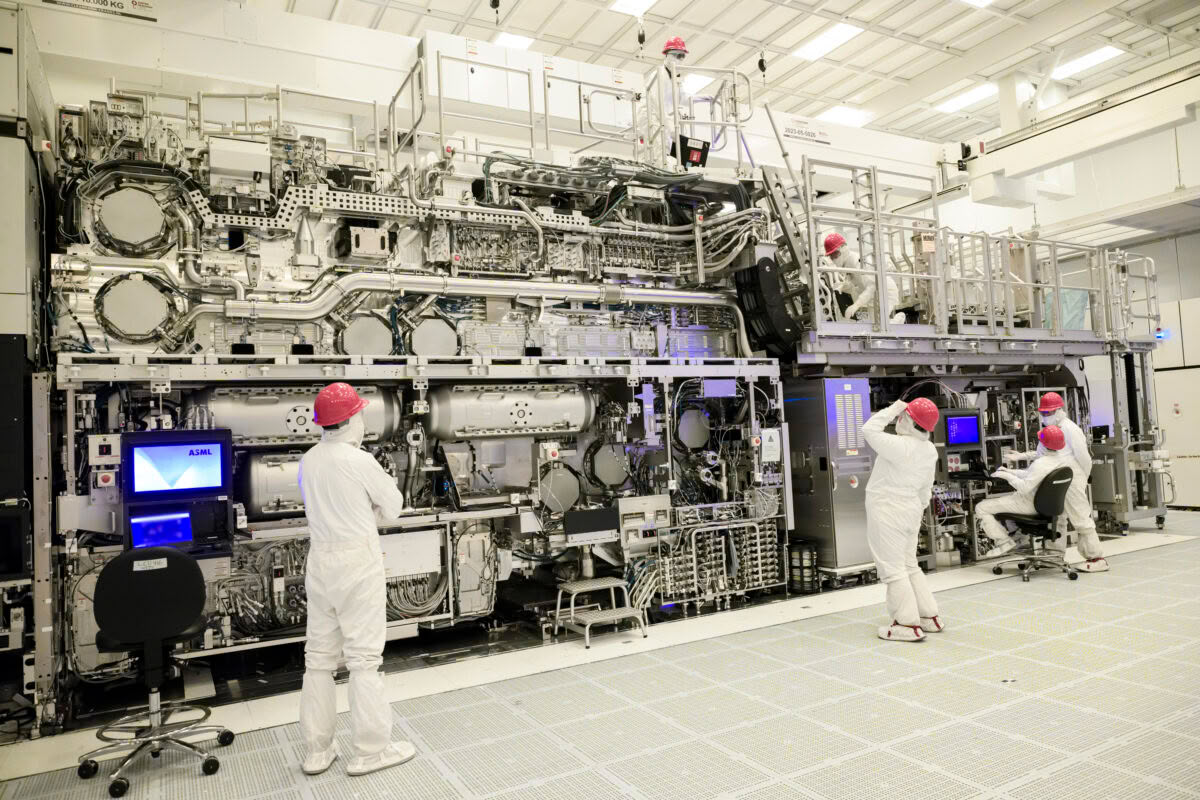
The short answer is that delivery windows, not capital alone, now decide how fast advanced memory capacity can grow. Samsung and SK hynix are trying to secure ASML extreme ultraviolet tools earlier, while key equipment waits have stretched to twice the longest cycle seen before. For everyday readers, the signal is that AI-linked DRAM supply may stay tighter than simple demand headlines suggest.
Why are EUV machines the gate for advanced DRAM?
An EUV scanner behaves like a reservation ticket, not a commodity server. It uses a 13.5 nanometer light source to draw circuit patterns, reducing the multiple-exposure and multiple-patterning steps that once limited precision and yield. For 10nm-class sixth-generation, or 1c, DRAM, circuit spacing keeps narrowing, so the number of process layers using EUV rises. TrendForce has said SK hynix plans to apply EUV to more than 5 layers in 1c DRAM, two more layers than the previous generation. That makes tool availability a central business variable rather than a procurement footnote.
What are SK hynix and Samsung doing with orders?
The two companies plan to start receiving ASML EUV equipment from next year in phases. SK hynix said in March that it would purchase EUV tools worth about 11.95 trillion won, an amount reported by Reuters as roughly $7.97 billion, with a delivery deadline of December 31, 2027. Because supply is tight, lead times for core equipment have stretched to twice the previous longest cycle. The companies are considering earlier ordering, and additional orders remain possible, lifting the chance of higher capital spending.
Samsung Electronics is tying its purchases to the Pyeongtaek site. Last November, Samsung announced a five-year, 450 trillion won domestic investment plan that includes Pyeongtaek P5, with production targeted for 2028. A single P5 fab is reported to require more than 60 trillion won. P5's phase-one cleanroom project is expected to be completed in the first half of next year, when equipment can move in; Samsung has already ordered lithography tools for the line.
How much supply is ASML expected to provide?
In its third quarter this year, ASML said its currently planned supply for 2027–2028 would not fully meet customer demand. The company expects EUV shipments this year to be about 65 units, up nearly 50% from 44 units last year. Even a planned 30% capacity increase in 2027, and another 30% being assessed for 2028, would still leave the market short. The price effect of core products is expected to begin next year and become fully visible in 2028. In the same quarter, memory accounted for 46% of ASML's system sales.
ASML's official third-quarter update adds another telling detail: customers are raising demand forecasts as AI investment visibility improves, and some are showing interest in orders for 2029 and even 2030. That quote, from President and CEO Christophe Fouquet, reframes the shortage as a multi-year allocation problem rather than a short-term backlog.
Why does High-NA EUV matter to the next memory generation?
The transition is already visible in the makers' histories. In March 2020, Samsung shipped the industry's first EUV-based DRAM module and is regarded as the memory maker with the most EUV tools. SK hynix installed its first EUV machine at the Icheon M16 fab in February 2021 and, last September, introduced the industry's first High-NA EUV production tool. On September 8, Samsung announced an expanded ASML partnership and a plan to bring High-NA EUV into DRAM mass production in 2028.
Is packaging a separate bottleneck?
Yes, and the signal is unusually direct. Backend equipment suppliers already have order backlogs for two to three years. Industry reports say HANMI Semiconductor and Amkor are essentially full on pre-production orders while expanding critical tools for AI data centers, including thermocompression bonders. A semiconductor industry person said: "AI data center chips are not only about advanced front-end processes; to reach high capacity and high performance, the value of back-end processes that perform multi-dimensional packaging and interconnection for each chip keeps rising. As the ecosystem forms, HANMI Semiconductor and Amkor are deeply tied to the boom cycle of front-end makers."
What does this mean for ordinary tech readers?
For readers who buy PCs, phones, graphics cards or server hardware, the practical effect is a slower supply reaction curve. Advanced DRAM capacity cannot be added only by budget approval; it requires delivery slots, cleanroom readiness, machine installation and process qualification. The first pressure points may appear in server memory, HBM and high-end consumer devices, then in price volatility across mainstream products. Our Q3 2026 DRAM numbers case study shows why the Samsung-SK hynix duo is so important to the next cycle.
Common misconceptions about the EUV race
- More spending means faster supply. It can buy priority in a queue, but it cannot instantly create machines, cleanrooms or trained installers.
- This is only an AI story. EUV layers are now part of advanced DRAM scaling, and backend packaging feeds AI and ordinary devices.
- A 2027 deadline solves the shortage. SK hynix's order runs to December 31, 2027, but receiving tools is not the same as volume production.
- Front-end lithography is the only choke point. HANMI Semiconductor and Amkor show packaging equipment backlogs are a parallel risk.
Action checklist: what to watch next
- Follow ASML's next capacity and pricing disclosures, especially whether the 2027 30% step and the 2028 30% plan are enough to reduce delivery anxiety.
- Track Samsung's Pyeongtaek P5 phase-one cleanroom completion in the first half of next year; that is the gate for equipment move-in.
- Watch SK hynix's 1c DRAM EUV layer count, where TrendForce expects more than 5 layers, to judge how tool-heavy future DRAM will become.
- Monitor HANMI Semiconductor and Amkor for HBM packaging equipment news, since two to three years of backlogged orders can delay capacity conversion.
- Use market-share context, not only order headlines, before assuming which company wins the memory cycle.
FAQ: decision-focused answers
Does a larger EUV order immediately increase memory output?
No. It moves the company forward in a delivery queue. Equipment still needs to arrive, install, qualify and support production lines, which is why the Samsung P5 target is 2028, not an immediate capacity jump.
Is this a bad sign for everyday PC or phone prices?
Not automatically. The risk is that advanced DRAM supply reacts slowly while AI and HBM demand stays strong, so pricing may become more uneven. Mainstream price effects depend on inventory, product mix and how much capacity shifts to premium memory.
Why does the 46% memory share matter?
Because it shows ASML's constrained production is not a side segment. If nearly half of a quarter's system sales is memory-facing, a mismatch between orders and tool supply can affect multiple industries.
What is the clearest next catalyst?
Equipment move-in and capacity announcements. The next visible tests are ASML's updated supply outlook, P5 cleanroom progress, High-NA DRAM mass-production plans and backend packaging backlog changes.