
MyTechDailyNews General: After Two Embryo-Editing Shutdowns, Investors Still See a Business
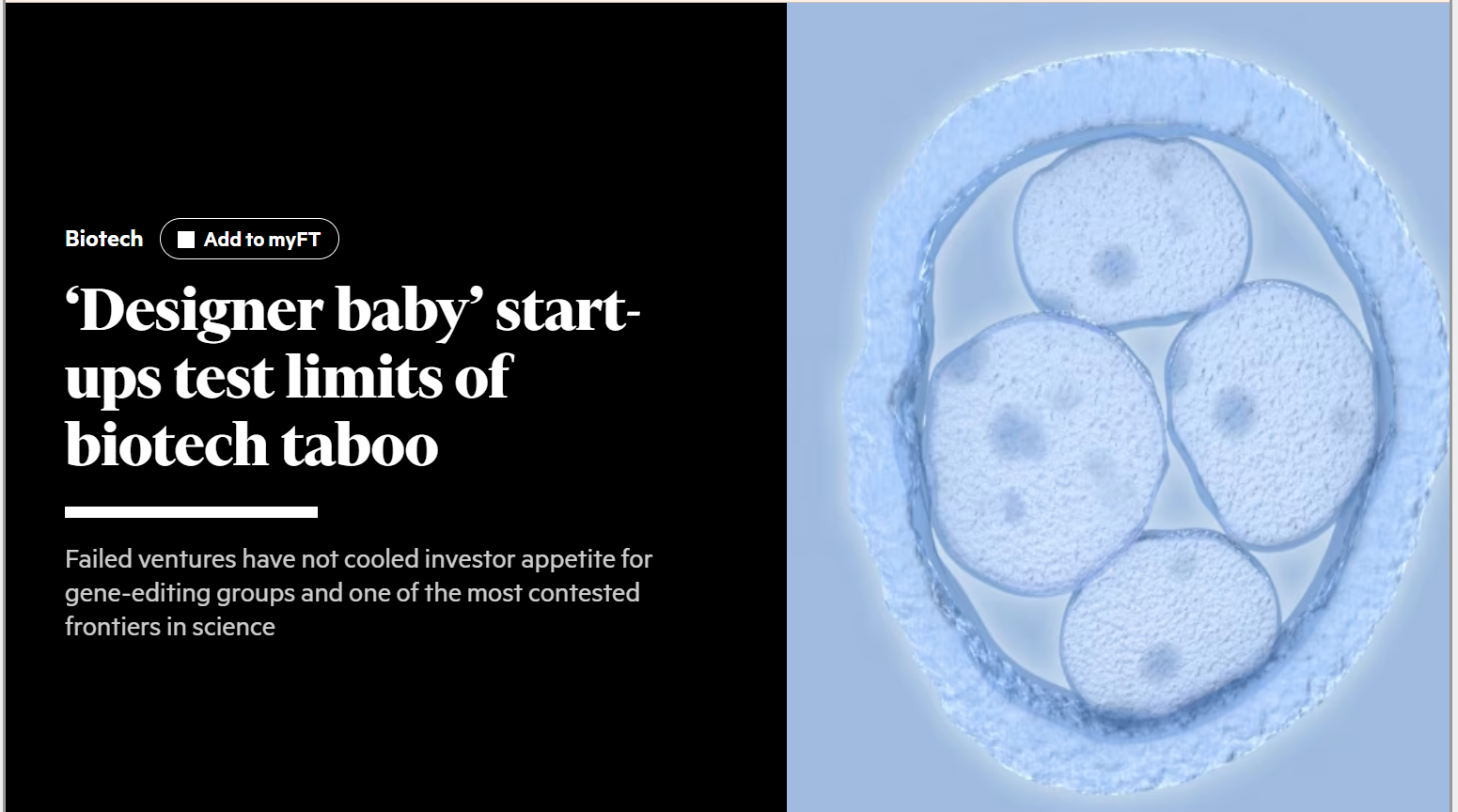
Two United States startups that explored editing DNA in human embryos have stopped operating within the past year, but the sector has not gone quiet. Bootstrap Bio closed after it could not continue raising funding, and Manhattan Genomics dissolved after a founder dispute. The two companies have not announced scientific breakthroughs. Even so, new companies have appeared, investors remain involved, and adjacent screening businesses are building routes toward a controversial field: germline gene editing.
Preventive, a San Francisco-based embryo editing startup, raised nearly $30 million from investors last year. Its backers included Sam Altman, the chief executive of OpenAI, and his husband, as well as Brian Armstrong, the chief executive of Coinbase. Nucleus Genomics is supported by Founders Fund, the firm associated with Peter Thiel, and is funding further academic research on germline gene editing. Germline gene editing means changing DNA in egg cells, sperm cells, or embryos; Nucleus Genomics says its goal is to eventually commercialize that technology.
The founder circuit did not stop after the shutdowns. This March, several months after Manhattan ceased operating, Cathy Tie, a co-founder of Manhattan Genomics and a serial biotech entrepreneur, founded Origin Genomics, one embryo editing company.
From Preventing Disease to Questioning Trait “Enhancement”
These companies are exploring ways to alter human embryo DNA. Their publicly stated starting point is preventing inherited disease, but some supporters imagine using the technology to influence traits such as intelligence. That wider vision is why germline editing is controversial on both scientific and ethical grounds. Critics worry that commercialization could create a path from treating disease to designing preferred traits.
Chase Denecke, founder of Bootstrap Bio, attributed the shutdown to a funding shortfall. “We raised some money … we just could not raise any more,” he said.
Reports disclosed another problem. Qichen Yuan, Bootstrap Bio’s chief scientific officer, was arrested in August 2025 and charged with attempting to sex traffic children; Yuan was indicted the following month. Yuan has pleaded not guilty. Denecke said Yuan was no longer chief scientific officer when the arrest and prosecution occurred, having moved to part-time consultant work. Denecke said he learned of the charges only after the company closed in late 2025. “Clearly, if I had known at the time, he would not have been employed by us,” Denecke said. He added that Bootstrap Bio’s closure was unrelated to the arrest.
Manhattan Genomics dissolved after a founder dispute. Cathy Tie said she and another co-founder and chief scientific officer, Eriona Hysolli, disagreed about where the business would operate. After Manhattan dissolved, all capital was returned to investors.
Why Scientists Remain Divided
Last year, three gene and cell therapy organizations proposed a 10-year pause on heritable human genome editing. Some scientists also doubt the stated mission of curing genetic disease. Fyodor Urnov, a genetics professor at the University of California, Berkeley, said the real goal is often “they just want to create improved babies.”
Supporters argue germline editing could eventually be cheaper and more effective than existing gene therapies. They contrast it with somatic gene therapy, which targets non-reproductive cells and affects only the patient receiving treatment; such therapies can cost $2 million or more. Companies in the “designer baby” area suggest embryo editing could ultimately cost about $5,000 per embryo.
Robin Lovell-Badge, a developmental biologist at the Francis Crick Institute, gave a more measured answer. He said somatic gene therapy is valuable, but has risks and is difficult to deliver to relevant parts of the body. “It is not surprising that they want to try to find alternative ways to handle genetic problems,” he said. If embryo editing can be shown to be safe and effective, it could have promise, and serious academic research is under way. But he said most startups in the field lack scientific credibility, and attempts to enhance traits such as intelligence are “very unreliable.”
The Regulatory and Funding Bottlenecks
For companies trying to turn research into a business, a more immediate barrier is law: many jurisdictions worldwide prohibit using germline gene editing for reproductive purposes.
Denecke said early customers might be prospective parents traveling to countries where in vitro fertilization regulation is more relaxed. Financing is not easy either, he said, because few venture capitalists understand the technology or its path to commercialization. Progress requires “enough wealthy people to form a critical mass.” “In this field, this is harder than in most fields,” he said.
Other investors remain cautious. Hysolli said regulatory uncertainty could suppress investment. Will Harborne, a general partner at LongGame Ventures, said ethical issues have made his firm reluctant recently to invest in embryo gene editing.
Even with those obstacles, companies continue attracting money because a broader market for screening embryos—and potentially editing them later—still exists.
Screening Offers a Market Path Before Editing
Preventive said it will first confirm whether embryo editing to treat disease can be performed safely before commercializing the technology. “We will not sacrifice safety standards to accelerate the timeline,” the company said in a statement.
Embryo screening companies are also expanding the commercial market around reproductive genetics. Nucleus Genomics promises to help prospective parents “have the best baby” by analyzing embryos for more than 30 diseases and traits. The analysis can include eye color, IQ, and baldness. Nucleus Genomics also provides testing for more than 2,000 inherited diseases in prospective parents.

An advertisement for Nucleus Genomics.
Nucleus is funding further human germline gene editing research at Columbia University and hopes to offer gene editing services to customers eventually. Its existing screening business may therefore give it a path into a market that embryo editing companies do not yet have.
Nucleus’s screening service costs $9,999 and is currently available at more than 165 clinics worldwide.
Even skeptics do not expect “designer baby” startups to disappear. “It pains me to say this … they cannot be stopped,” Urnov said. “How much impact will there be on gene medicine therapies? I hope (this impact) will be minimal.”
FAQ for General Readers
Are the shutdown companies already changing babies?
The reporting describes these firms as exploring or seeking to commercialize embryo DNA editing. Neither Bootstrap Bio nor Manhattan Genomics announced a scientific breakthrough, and Preventive says it will first confirm safety before commercialization.
What is the difference between embryo screening and embryo editing?
Screening analyzes embryos for diseases or traits. Editing would change DNA in egg cells, sperm cells, or embryos. Nucleus Genomics currently promotes screening and funds editing research; Preventive focuses on editing for disease.
Why is intelligence mentioned?
Some supporters imagine using the technology to influence traits such as intelligence. That is the part many scientists call controversial, and Robin Lovell-Badge described attempts to enhance intelligence as “very unreliable.”
Checklist: Questions Worth Asking
- Has the company announced a scientific breakthrough?
- Is the product screening, editing, or research?
- Does the offer involve reproductive use, and what rules apply where it is sold?
- Does the company discuss safety standards before commercialization?
- Are investors backing disease prevention or broader trait enhancement?
Common Misconceptions
| Misconception | What the reporting states |
|---|---|
| Shutdowns mean investors have exited. | Preventive raised nearly $30 million last year, and Nucleus Genomics is supported by Founders Fund. |
| Germline editing is already widely legal for reproduction. | Many jurisdictions worldwide prohibit germline gene editing for reproductive purposes. |
| Screening and editing are the same thing. | Screening analyzes embryos; editing would change DNA in egg, sperm, or embryo cells. |
Action Advice for Everyday Readers
- Separate marketing language from safety milestones: treat claims about traits such as intelligence as open questions, not established medicine.
- Watch the regulatory boundary: reproductive germline editing is banned in many jurisdictions worldwide.
- Follow companies that state safety-first conditions, such as Preventive’s pledge not to sacrifice safety standards to accelerate the timeline.
- Notice business models built on screening first, such as Nucleus’s $9,999 service offered at more than 165 clinics.