
Doubao AI Moves Into the Driver's Seat: Inside the 2026 Model Year Mercedes-Benz Long-Wheelbase E-Class Launch
By Sarah Chen · Tech Daily · MyTechDailyNews
There is a very specific kind of friction that defines modern car ownership: you say one sentence to the dashboard and are rewarded with a blank screen. Mercedes-Benz is betting that the cure for that small daily frustration now arrives inside a luxury sedan rather than inside a smartphone, and the messenger is a car aimed squarely at Chinese buyers. The hardware story barely changed; the argument for upgrading is now about how well the cabin listens, remembers and reacts.
What actually landed today, in plain terms
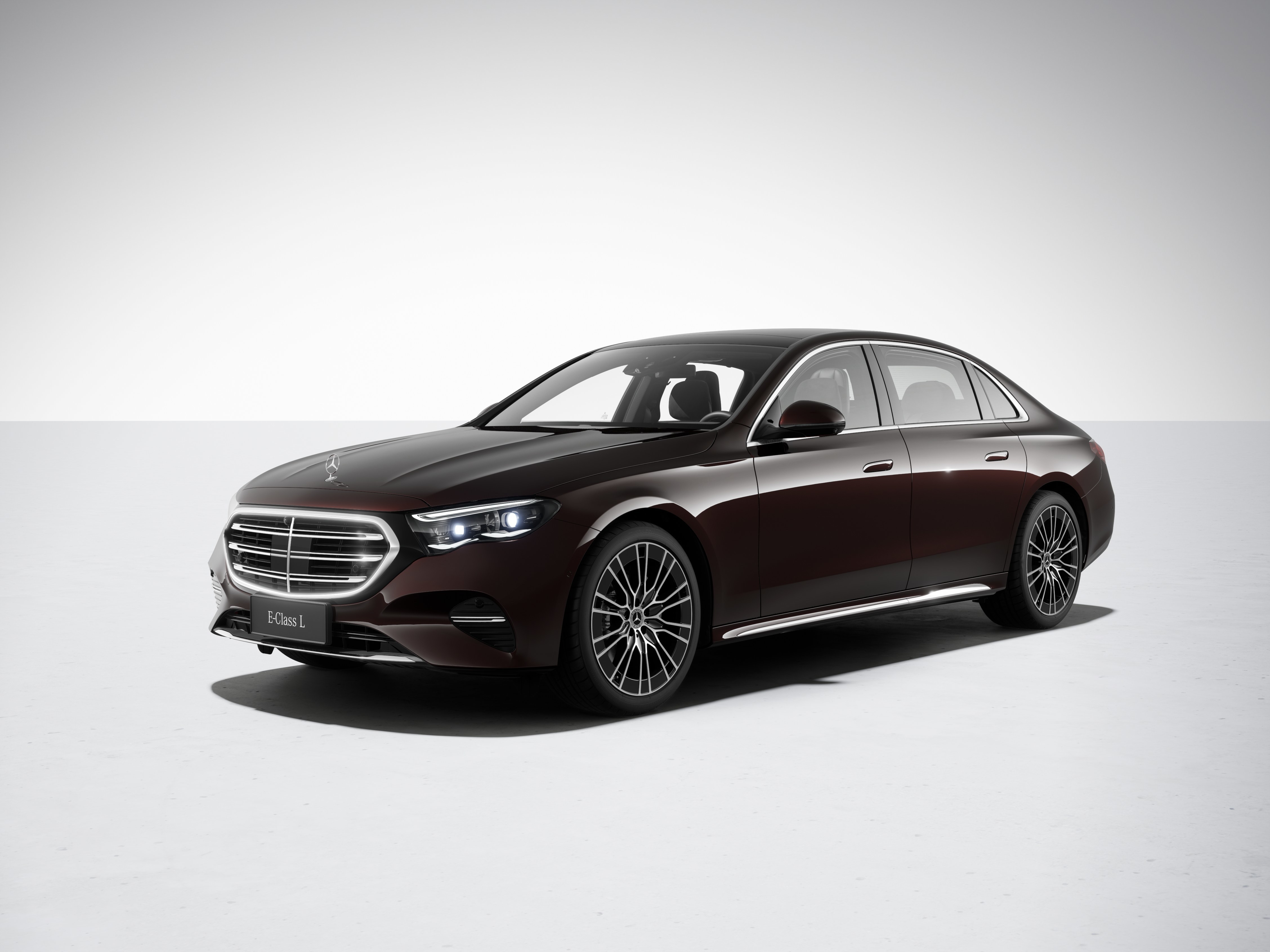
Mercedes-Benz opened sales on November 2 for the 2026 model year long-wheelbase E-Class, with three models on the price list and an entry figure of 423,800 yuan — the 42.38 wan-yuan starting price that carried the launch coverage in China. The most consequential change is the first fitment of a brand-new AI smart cockpit, a system that Mercedes-Benz says was led by and independently developed by its China R&D team rather than adapted from a global parts bin. That local engineering decision explains the two features buyers will feel first: a virtual assistant hooked into the Doubao AI large model, ByteDance's conversational model family, and voiceprint recognition that tells one family member from another. Mercedes also notes the 2026 line-up arrives with a refreshed trim-naming structure, so the badges you compare on the order sheet are new this year.
The voice upgrade, translated for non-engineers
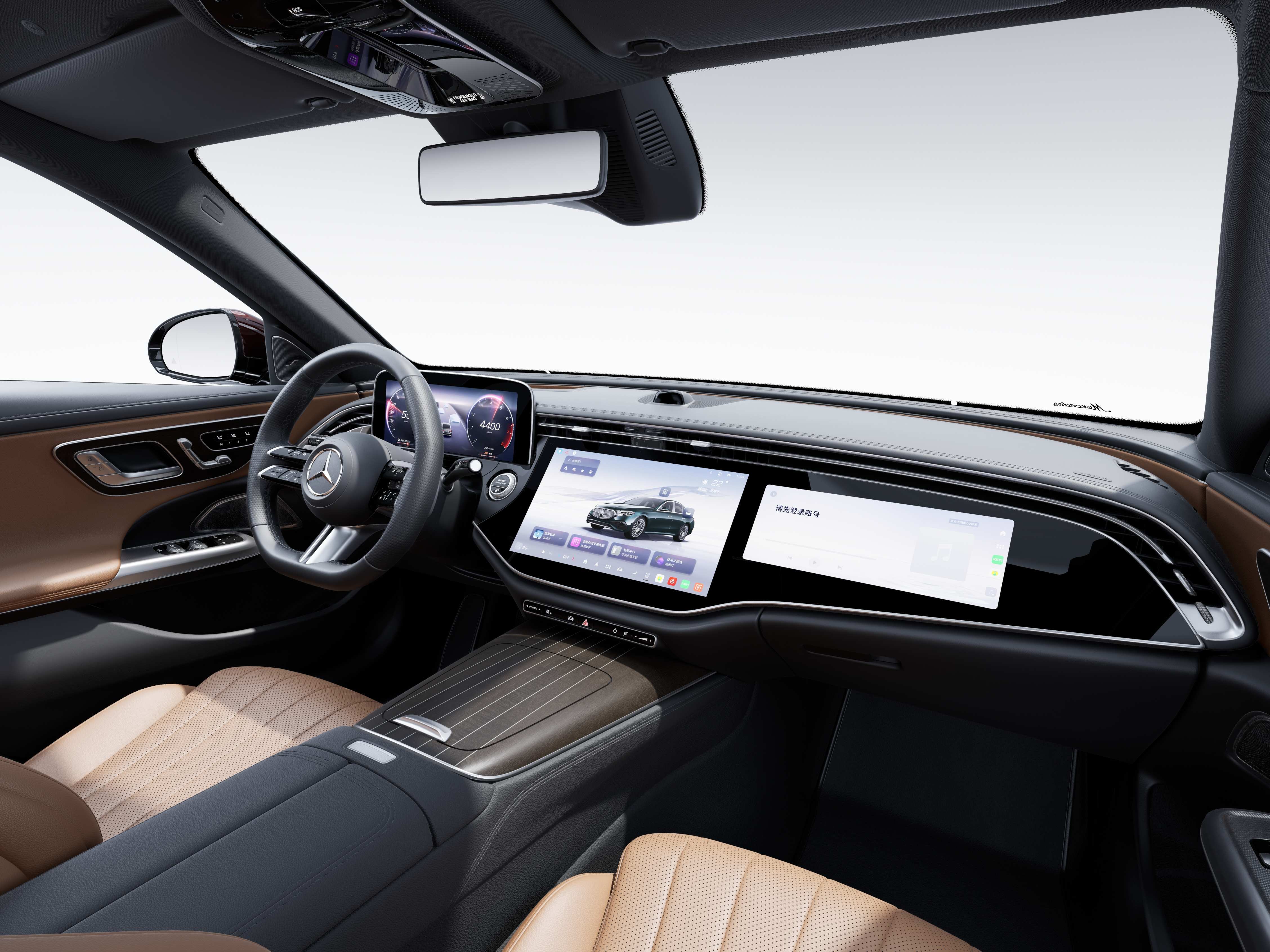
Mercedes-Benz's own explanation boils down to one idea: anything drawn on the screen can be reached by speaking. Buttons and labels are voice-operable, third-party multimedia apps can be launched or closed on command, and audio and video content can be searched and picked without touching glass. Two published numbers frame how fast the experience is claimed to be. The virtual assistant wakes in as little as 0.25 seconds, and multi-zone interaction — the ability to work out which seat the voice came from — reaches a 98% positioning accuracy rate.
The family angle is where voiceprint recognition earns its keep. One account can store the voiceprints of up to 6 people, and the assistant builds a separate memory dashboard for each of them, logging individual tastes and then pairing them with live context such as weather and time of day to make suggestions. In practice, the rear passenger's favourite playlist does not overwrite the driver's commute queue, and a child's voice is less likely to be obeyed as though it came from the owner.
Scene Assistant: your car becomes a list of if-this-then-that rules
Rather than hide automations behind dealer-coded packages, the new cockpit exposes a Scene Assistant. Owners combine conditions drawn from 11 trigger categories with actions drawn from 15 action categories to describe a moment of their own — arriving home after dark, running errands on a hot afternoon, switching a weekend into family mode. Think of it as the same logic you use for smart-home routines, only pointed at a vehicle.
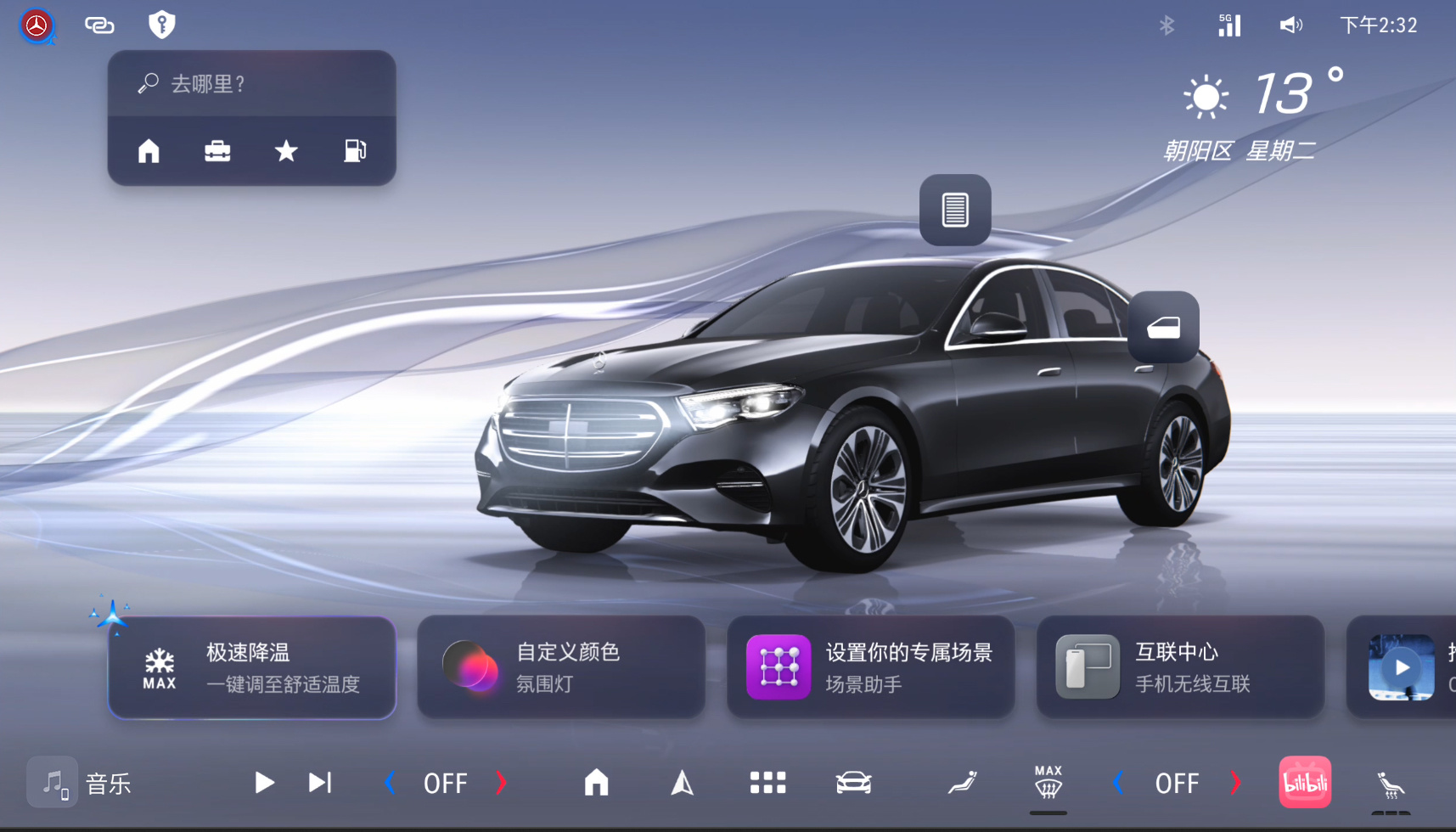
The interface layer got similar treatment. A 3D car model on the screen doubles as a control surface: it shows the state of doors and windows and lets you work the windows and the sunshade straight from the rendered vehicle. Cards in the navigation bar and the quick-access bar can be rearranged freely, while media and call functions can be pinned as small floating windows, so the layout follows your habits instead of forcing you into theirs.
Phone linking and navigation: Huawei HiCar joins the roster
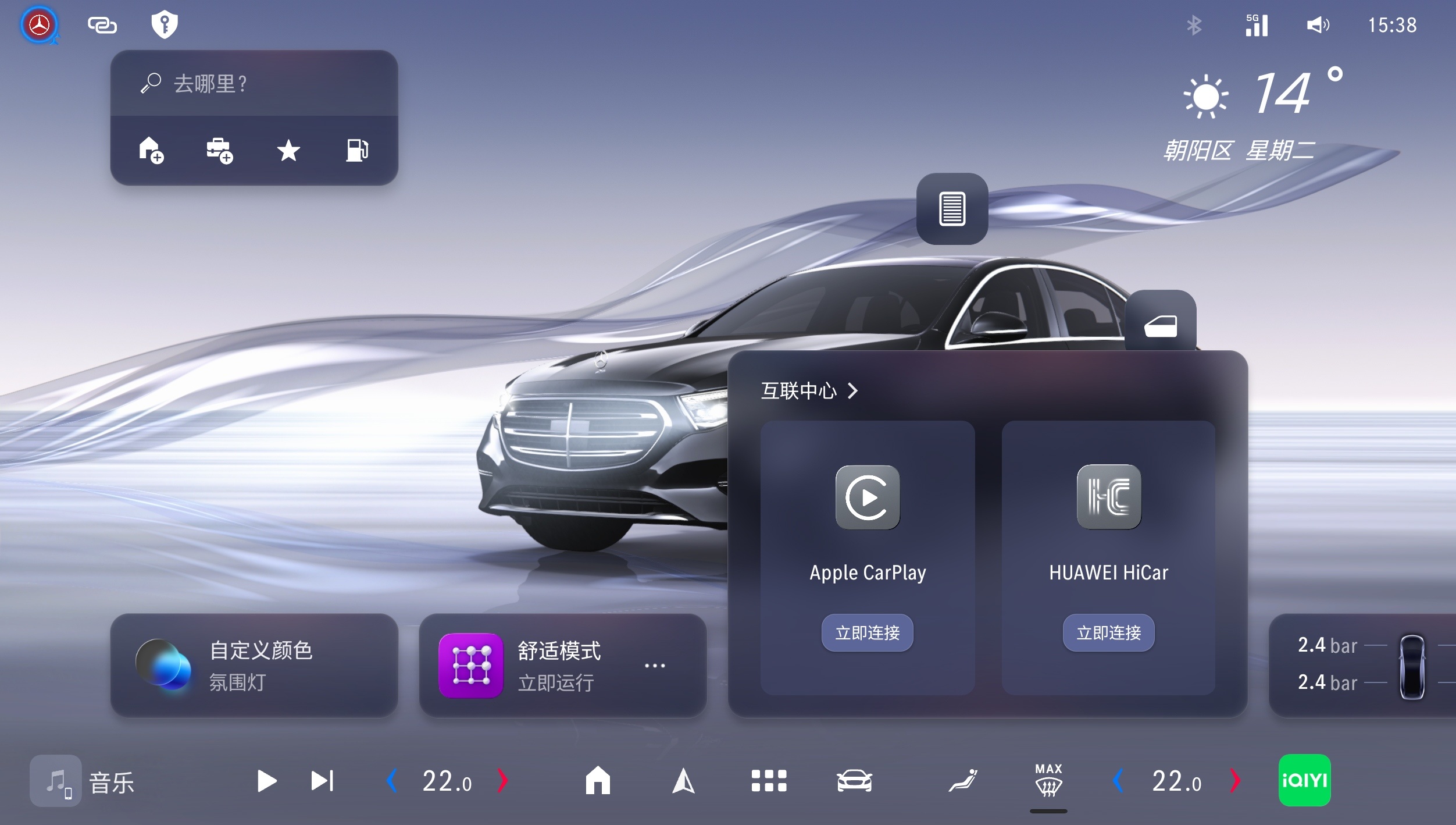
For Chinese users, mirror-your-phone support has become as decisive as fuel economy. The 2026 model year long-wheelbase E-Class adds Huawei HiCar, and Mercedes-Benz describes the convenience loop that matters most: after one first-time pairing, a HiCar-capable phone reconnects automatically when you get back in the driver's seat. Commands given to the Xiaoyi voice assistant can drive HiCar apps as well, so the phone's ecosystem stays reachable through the car's own microphone. On the mapping side, Mercedes-Benz states that the in-car Amap navigation display has been lifted to 60 frames per second, which is the difference between a map that slides and a map that stutters.
Updates, and why the release calendar matters more than the spec sheet
Mercedes-Benz says the AI smart cockpit is built around quarterly major over-the-air releases, and that the same system will progressively spread to more of its combustion-engine and battery-electric models. Read together, those two statements reframe the purchase: you are not buying a fixed infotainment generation any more, you are joining a release cadence.
Context beyond this single launch supports that framing. The Doubao AI large model reaches carmakers through Volcano Engine, ByteDance's cloud arm, whose automotive AI offering has been reported by Chinese state tech media as already deployed across a very large installed base of vehicles, with luxury and domestic brands alike signing on to local large-model cockpit partners over the past year. Mercedes-Benz's move is therefore best read as a mainstream premium brand choosing a China-specific AI stack — and committing to keep it current through software.
Price list: three models, one ladder
| Model (2026 model year long-wheelbase E-Class) | Suggested retail price | Wan-yuan shorthand |
|---|---|---|
| E 300 L Huiyin | 423,800 yuan | 42.38 |
| Liujin | 466,800 yuan | 46.68 |
| Xingbo | 509,800 yuan | 50.98 |
Prices are the manufacturer's figures announced at the November 2 launch. Equipment differences between the three models should still be confirmed with a dealer: the cockpit story is shared across the line-up, while comfort and driver-assist content usually is not.
Checklist: run these seven tests before you sign
- Wake test from every seat. Speak once from the driver's seat and once from the rear, then judge the response against the 0.25-second wake claim and the 98% multi-zone figure.
- Voiceprint test. Register the driver and one passenger and confirm two separate memory dashboards appear, neither overwriting the other. Remember the ceiling is 6 stored users per account.
- Screen-free control test. Ask the assistant to open and then close a third-party multimedia app, and to search for a specific song or show.
- Scene test. Build one routine from the 11 trigger categories and 15 action categories — a dark-arrival scene that closes windows and moves the sunshade is the fastest sanity check.
- 3D car model test. Toggle a window and the sunshade from the rendered vehicle instead of from a menu, so you learn whether the twin is a controller or decoration.
- HiCar round trip. Pair a Huawei phone, switch the car off, get back in and verify automatic reconnection; then try driving a HiCar app with the Xiaoyi voice assistant.
- Map smoothness test. Scroll and zoom the in-car Amap navigation and look for the fluidity implied by 60 frames per second.
Common misconceptions worth clearing up
- "0.25 seconds means every task is finished instantly." That figure describes wake speed, not the end-to-end time to complete a complex request.
- "98% accuracy means the assistant never mishears." The metric concerns locating which seat the voice came from, not flawless speech understanding in every noise condition.
- "Voiceprint recognition is a security lock." It is presented as a personalisation tool for telling household members apart, so treat it as preference management rather than a replacement for a key.
- "Building a scene means learning to code." You are combining existing trigger and action categories, not writing scripts.
- "Quarterly OTA means hardware-level change." Major releases reshape software features and interfaces; the sensors and screens are fixed at purchase.
FAQ: the questions owners ask first
Does the cabin really run a large language model?
Mercedes-Benz's virtual assistant in this cockpit is connected to the Doubao AI large model, which is what gives the assistant its conversational reach — understanding spoken intent against menus, media and context data rather than matching a fixed command list.
How many people can share one account?
Up to 6 users' voiceprints can be stored per account, each with its own memory dashboard of preferences.
Do I have to re-pair my phone every time?
No. For HiCar-capable phones, the first pairing is followed by automatic reconnection on later drives, and the Xiaoyi voice assistant can operate HiCar apps.
Will my current Mercedes get this cockpit?
Mercedes-Benz's stated plan is to extend the AI smart cockpit to more combustion and electric models over time, on a quarterly major-OTA rhythm. Model-by-model eligibility was not covered in the launch materials, so ask your dealer to confirm it for your specific vehicle.
What does the update promise cost me in downtime?
The launch information covers upgrade cadence and scope, not installation duration or workshop time, so treat that as a dealer question before you commit to a purchase date.
Action advice from MyTechDailyNews
If you keep cars for four or five years, buy the cockpit rather than the badge: a quarterly major-OTA commitment is the part of this launch that changes the value of the vehicle while you own it. If your household runs on Huawei devices, weigh HiCar plus Xiaoyi voice control as the single most tangible daily benefit, and make the automatic-reconnection test a deal-breaker instead of a demo trick. If you are comparing the three models purely on price, walk the ladder from 423,800 yuan to 509,800 yuan only after booking a drive at dusk — the voiceprint, scene and 3D-view features that define this generation are far easier to judge when the cabin lighting changes and the passengers start talking over you.