
DeepSeek V5 Placeholders Surface Early: A MyTechDailyNews General Guide to What the Code Hints Mean
A technical trace updated by DeepSeek surfaced online last night, and the names now visible in a public repository have shifted the conversation from rumor to mechanism. The most useful way for general readers to understand the signal is that a release pipeline may already be reserved, while the actual V5 version is not yet confirmed as a live model.
According to the reports, the DeepSeek Harness code repository began showing entries related to DeepSeek-V5, V5-open and V5-next. The same discussion tied the appearance to a large-model fingerprint update and speculated that the next model could be larger than V4.1 Pro. The image below shows the kind of trace that triggered the attention.
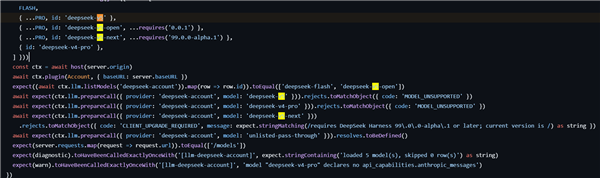
But a repository entry is not the same thing as a public announcement. Da Fei Yu, a participant cited in the discussion, described the current situation as a prepared mechanism with V5 still functioning as a placeholder. That distinction is important: it tells readers that DeepSeek may have built the rails before deciding when to run the train.
The reported idea is straightforward. DeepSeek official could expose a new model by changing /models on the server side. In everyday terms, /models acts like a menu card that can be edited behind the counter; the customer does not need to reinstall the restaurant. Because of that design, the client may not need a new release for every model introduction.
Two paths are implied by the named entries. The first is deepseek-v5-open, which follows a no version threshold route. The second is DeepSeek-v5-next, which follows a must upgrade client route. Together, the two paths cover the likely delivery styles: one can appear through a server-side switch, while the other may become usable only after a client update.
Why the naming history keeps the story uncertain
DeepSeek’s naming history makes the current trace harder to translate into a clean launch timeline. On September 17, the released V4.1 Flash was described as a fully new architecture that no longer stood beside the earlier V4 in a straightforward comparison. Yet the public label continued in the 4.0 series. A later release marked as 1017 also brought a substantial improvement, but the version name did not advance to V4.2.
That history explains why early code names such as V5 should be read carefully. They may point to a future product family, but they do not necessarily match the public release label at the moment of launch. The V5 label may become official, or it may remain an internal placeholder while the service uses a different public name.
The context around the V4 Pro final release adds another layer. The article treats that memory as uncomfortable, which makes a clean break with a new flagship name a reasonable possibility. In this reading, DeepSeek V5 Pro could be one way to separate a next generation from an older label, but that remains a plausible interpretation drawn from the article, not an extra fact.
What ordinary users should focus on
For ordinary users, the practical question is not whether one line in a repository means immediate access. It is whether the release design reduces future friction. A no version threshold path could let a model become visible without forcing every user to install a new client first. A must upgrade client path implies the opposite: the user may need to update before the new V5 version is usable.
That distinction is where everyday behavior differs. If a model is surfaced through the server-side switch, users may notice a name appearing without a dramatic update cycle. If a path requires a client update, users will likely need to check their app or client version before seeing the same capability.
Two paths at a glance
| Reported entry | Path behavior | General-user impact |
|---|---|---|
| deepseek-v5-open | no version threshold | Could be enabled through server-side changes without a mandatory new client release. |
| DeepSeek-v5-next | must upgrade client | May require users to install a newer client before the capability is visible or usable. |
Common mistakes to avoid
- Assuming that seeing DeepSeek V5 in a repository proves the V5 version is already available to all users.
- Confusing a large-model fingerprint update with a confirmed public launch.
- Treating V5-open and V5-next as identical because both carry the V5 label.
- Overlooking the fact that previous naming decisions, such as the 4.0 series continuation, did not always match architecture changes.
- Believing that V4.1 Pro or the Flash version must disappear the moment a placeholder appears.
FAQ
Is the DeepSeek V5 series already released?
Based on the article, no. The current interpretation is that the release mechanism is reserved while V5 remains a placeholder. That means the groundwork may exist, but public availability is not established.
Why can the client avoid a release?
The article says a server-side change to /models could expose the model, so the client would not need a new version for that kind of delivery.
What does the must upgrade client route mean?
It means some future path may require users to update the client before accessing the model, in contrast with the no version threshold route.
Is the timing known?
The article suggests not this month and points toward November. If the window moves to mid-November, V5 Pro and V5 Flash could update together, making the naming less confusing.
Quick checklist for following the story
- Watch for an explicit announcement rather than relying only on repository names such as V5-open or V5-next.
- Check whether /models changes, because the article frames that server-side change as the release switch.
- Note whether the service uses the deepseek-v5-open path or the DeepSeek-v5-next path.
- Confirm whether your client version needs to be updated before trying a new model.
- Compare the naming with the September 17 V4.1 Flash case before assuming that a label reflects a full architecture break.
Action suggestions
If you use DeepSeek models in everyday work or study, the best short-term action is simple: do not change your workflow based only on a placeholder. Keep a note of the current model you use, watch the official service surface for a /models change, and only plan around V5 Pro or V5 Flash after a public launch or client update notice. That approach avoids mistaking a reserved mechanism for a finished release.
For readers following the broader technology story, the more interesting takeaway is how quietly AI releases can be prepared. The names may appear early, but the user experience can remain stable until the operator decides to open the switch. The DeepSeek V5 trace is therefore less a headline and more a sign that the plumbing has been installed.
In the end, the strongest signal from last night is not that the next model has arrived, but that the rails for arrival are visible. The DeepSeek V5 series may still wait, the current V5 version may still be a placeholder, and the exact public name may not match the repository entry. What is clear is that the mechanism has been reserved, and the remaining question is when, not whether, those rails are used.