
DeepSeek's Hundred-Billion-Yuan Second Round: Tencent and CATL Head Nearly 30 Backers as State Capital Jumps to About 27%
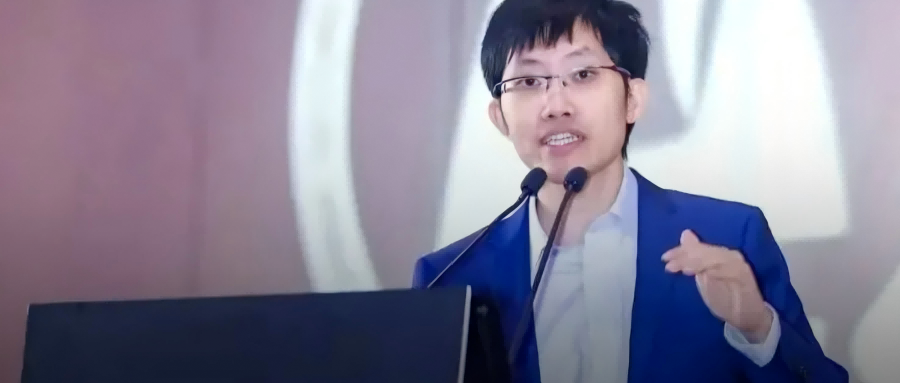
Big funding headlines are easy to skim and hard to remember, so here is the plain-language version first. According to a report by The Information, DeepSeek has raised 105.5 billion yuan — roughly 15.8 billion US dollars — in its second funding round, a hundred-billion-yuan-scale event that brought nearly 30 institutions into the deal. Tencent and CATL (the battery giant many investors still call by its Chinese nickname, "Ning Wang") are the two lead backers. Two details matter more than the headline number: the share of Chinese state investors climbed to about 27%, up from 2% in the first round, and the company doubled its fundraising target halfway through. If you use AI products every day, that mix of capital, chips and policy is what the next stretch of the industry will be built on.
The Numbers at a Glance
- Raised in round two: 105.5 billion yuan, or about 15.8 billion US dollars, as reported by The Information.
- Who joined: nearly 30 institutions spanning internet platforms, semiconductors, manufacturing, telecom, finance and state investment vehicles.
- Lead investors: Tencent and CATL, both on the 10 billion yuan level in the latest round.
- State money: about 27% of the newly raised amount, compared with 2% in the first round.
- Why the round grew: one server carrying 8 Nvidia B300 chips went from about 15 million yuan to 19 million yuan over the four months the raise was open.
Who Actually Signed the Checks
The investor list reads less like a normal venture-capital roster and more like a map of Chinese industry. Tencent put in 10 billion yuan in each of the two rounds. CATL and its chairman contributed 5 billion yuan in the first round and 10 billion yuan in the second. Memory-chip maker ChangXin Memory Technologies and its chairman Zhu Yiming took part, as did the state-backed wafer foundry SMIC; the sums from those two companies have not been made public.
The consumer and industrial names on the cap table are equally broad. Meituan, vivo, Xiaohongshu, Geely, Midea, Luxshare Precision and Trip.com all appear, with each of those companies investing somewhere between 1 billion and 3 billion yuan.
| Backer | Reported commitment | Category |
|---|---|---|
| Tencent | 10 billion yuan in each of the two rounds | Internet platform |
| CATL ("Ning Wang") and its chairman | 5 billion yuan in round one, 10 billion yuan in round two | EV batteries |
| ChangXin Memory Technologies and chairman Zhu Yiming | Amount undisclosed | Memory chips |
| SMIC | Amount undisclosed | Wafer foundry |
| Meituan, vivo, Xiaohongshu, Geely, Midea, Luxshare Precision, Trip.com | 1 billion to 3 billion yuan each | Internet, phones, autos, manufacturing, travel |
| National AI Industry Investment Fund of China | 1 billion yuan, the same as in round one | State fund |
| China Mobile, China Telecom, CICC, CITIC Securities, China Life | 2 billion to 8 billion yuan each | Telecom and finance |
| Monolith Management (Beijing) | 3 billion yuan in round one, 7.5 billion yuan in round two | Venture capital |
| IDG Capital | 6.5 billion yuan across both rounds | Venture capital |
| Boyu Capital | 3.5 billion yuan in round two | Private equity |
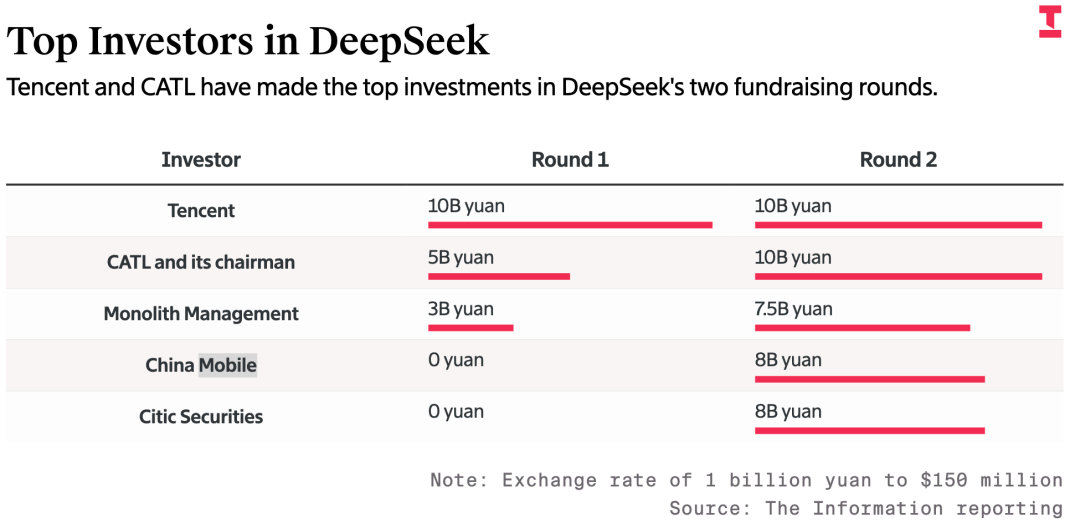
▲ Funding committed in each of the two rounds (source: The Information)
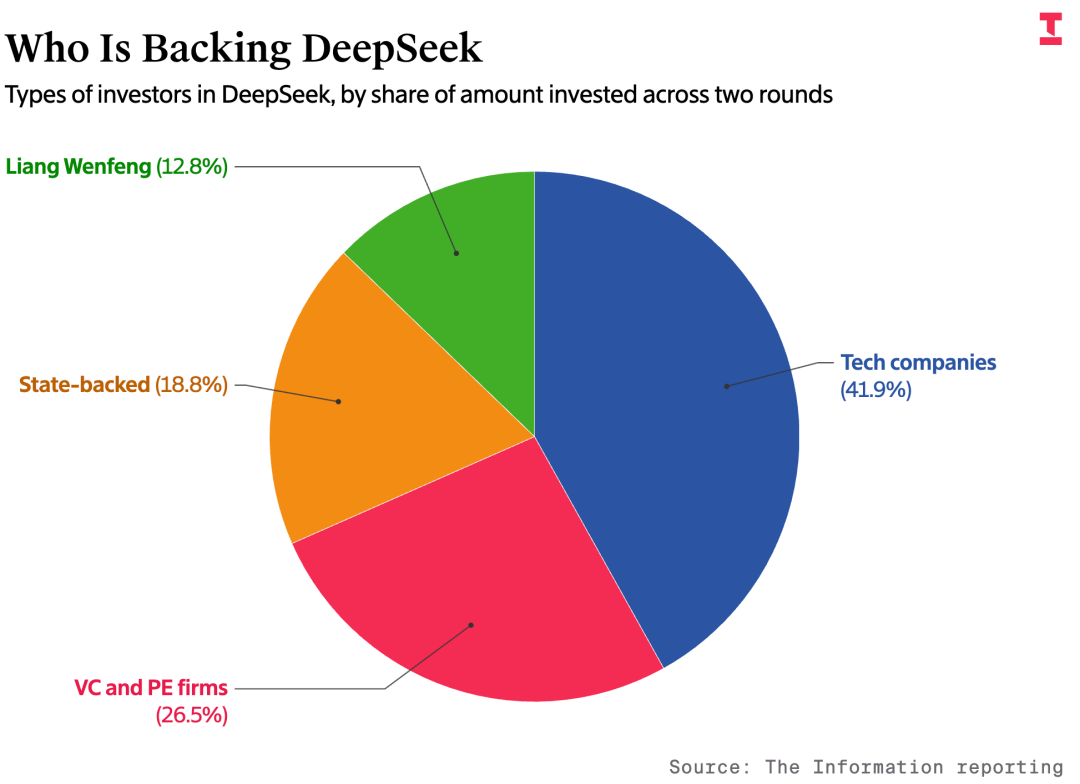
▲ Pie chart of DeepSeek's cumulative funding to date (source: The Information)
Counted across both rounds together, technology companies supplied roughly 42% of DeepSeek's total funding, state investors about 19%, and venture and private equity firms rank third in the mix.
One structural detail from the first round is still worth knowing, because it shapes how these investors relate to the company. Apart from the National AI Industry Investment Fund, backers were required to place their money into an entity held by Liang Wenfeng, surrender voting rights, and accept a five-year lock-up on their shares unless the company goes public sooner.
Why the Target Doubled Halfway Through
Two people with knowledge of the process told The Information that during the four months the raise was open, the price of one server equipped with 8 Nvidia B300 chips rose from about 15 million yuan to 19 million yuan. That figure alone is more than 5 times what the same type of server sells for in most other countries.
Layer on top of that the US restrictions on exports of advanced AI chips and a tight global memory-chip supply, and computing power becomes the decisive competitive variable for Chinese AI companies. DeepSeek needed cash both to fund model development and to absorb the rising cost of buying hardware — which is why the company expanded the second round's size by a factor of two mid-process.
The report also points to a defensive motive. DeepSeek is reportedly preparing for the possibility that an AI sector bubble could unwind. Already-listed AI players MiniMax and Zhipu both saw their shares slide sharply, partly because unlocked stakes held by pre-IPO investors created selling pressure. Building a cash cushion now is a way of leaving room for a potential industry downturn.
What This Means if You Only Use AI Products
For ordinary users, the practical takeaway is less about valuations and more about capacity. Training and running large models depends on expensive hardware, and this round explicitly funds that infrastructure. The investor roster also connects DeepSeek to memory and foundry suppliers, device makers, telecom operators and manufacturers — relationships that can matter later for sourcing chips, distributing products and building services.
Money, however, does not erase the constraints. Higher hardware prices and limited access to the most advanced processors mean development costs keep climbing, and a larger raise raises a harder question: how the company balances research spending, technical progress and the returns its backers expect.
Common Misconceptions
- "State investors now control DeepSeek." The disclosed share is about 27% of the money in the second round and roughly 19% of the cumulative total — a substantial jump from 2%, but not a controlling position.
- "This was a standard venture round." The list spans internet platforms, semiconductor makers, automakers, phone brands, home appliance and component manufacturers, travel, telecom, insurers and brokerages, on top of VC and PE firms.
- "The chip companies' stakes are public." The amounts from ChangXin Memory Technologies and SMIC were not disclosed.
- "Bigger funding means the chip problem is solved." A single B300 server jumping from about 15 million to 19 million yuan in four months shows cost and supply pressure are still running the other way.
FAQ
Q: How much did DeepSeek raise in its second round?
A: 105.5 billion yuan, equivalent to about 15.8 billion US dollars, with nearly 30 investors participating, per The Information.
Q: Who led the round?
A: Tencent and CATL were the two main investors. Tencent invested 10 billion yuan in each of the two rounds, while CATL and its chairman put in 5 billion yuan in the first round and 10 billion yuan in the second.
Q: How much state money is involved?
A: Chinese state investors contributed about 27% of the 105.5 billion yuan raised, versus 2% in the first round. The National AI Industry Investment Fund of China again put in 1 billion yuan, and China Mobile, China Telecom, CICC, CITIC Securities and China Life each invested between 2 billion and 8 billion yuan.
Q: Why did the fundraising target double?
A: Two factors cited: escalating Nvidia hardware costs — one 8-chip B300 server moved from about 15 million yuan to 19 million yuan during the raise — and a desire to build reserves against a possible AI market correction.
Q: Are other listed AI companies relevant here?
A: Only as a warning signal. Shares of the already-listed MiniMax and Zhipu fell noticeably, partly because pre-IPO investors were able to sell unlocked holdings.
Checklist: How to Follow This Story From Here
- Track the state-capital percentage round by round; the move from 2% to about 27% is the clearest signal of how Chinese AI financing is changing.
- Watch hardware pricing rather than headline valuations — the 15 million to 19 million yuan jump on one server explains the doubling better than any valuation figure.
- Read the first-round governance terms — money routed through Liang Wenfeng's entity, no voting rights, five-year lock-up unless an earlier listing — before judging who actually steers the company.
- Treat recent listings such as MiniMax and Zhipu as a live risk barometer for sector-wide repricing.
- Keep the source attribution straight: the investor-level detail comes from The Information.
The Bottom Line
Roughly 30 names from very different corners of the economy have now placed a bet on the same AI lab, and the composition of that bet — heavy on tech strategics, increasingly heavy on state capital, lighter on traditional venture money — says as much about where the industry is heading as the 105.5 billion yuan figure itself. The capital buys time and computing power, and it weaves DeepSeek into chip, manufacturing and telecom supply chains. It does not buy a way around rising hardware prices or constrained access to advanced processors. What happens next depends on how the company converts this hundred-billion-yuan-scale war chest into technical progress that its backers — and its users — can actually see.
Written by Sarah Chen, Tech Daily / MyTechDailyNews. Questions, corrections or tips? Contact us at hello@techdaily.com.