
Changpeng Zhao’s X Reply to Elon Musk’s Frowning Emoji: A General Tech Reader’s Guide to the SpaceX Stake Claim
Everyday technology readers usually learn less from a polished statement and more from the way a public conversation changes after it starts. A reply, a screenshot, a single emoji, and a delayed answer can all shape what people believe. That is why the exchange around Changpeng Zhao’s user reassurance post deserves a plain-language breakdown.
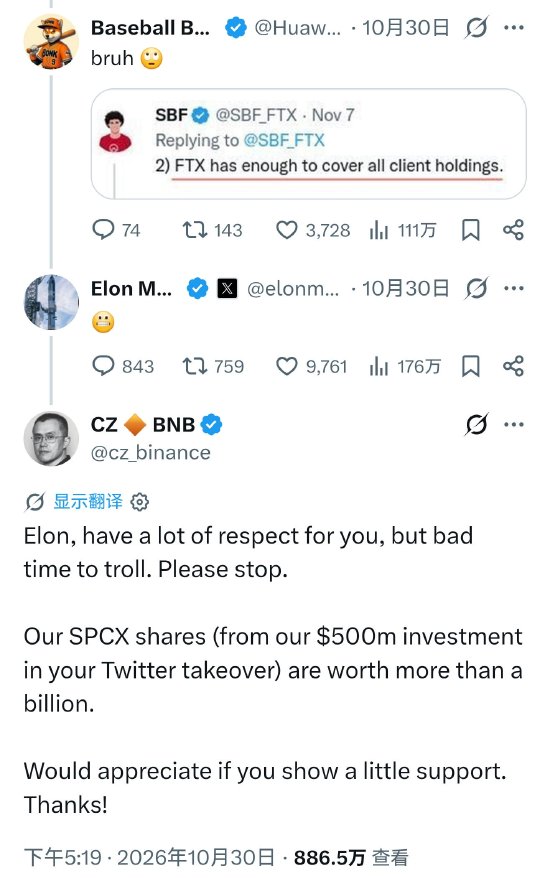
The visible sequence is simple. Zhao had posted a message aimed at calming users and promising compensation. Under that post, an X user attached a screenshot connected to Bankman-Fried, a notorious crypto practitioner and former rival of Zhao, and presented it as a similar kind of statement. Elon Musk then reacted with a frowning emoji. Five hours later, Zhao answered.
“Elon, I deeply respect you, but now is not the time for jokes,” he wrote. “Please don’t do that.”
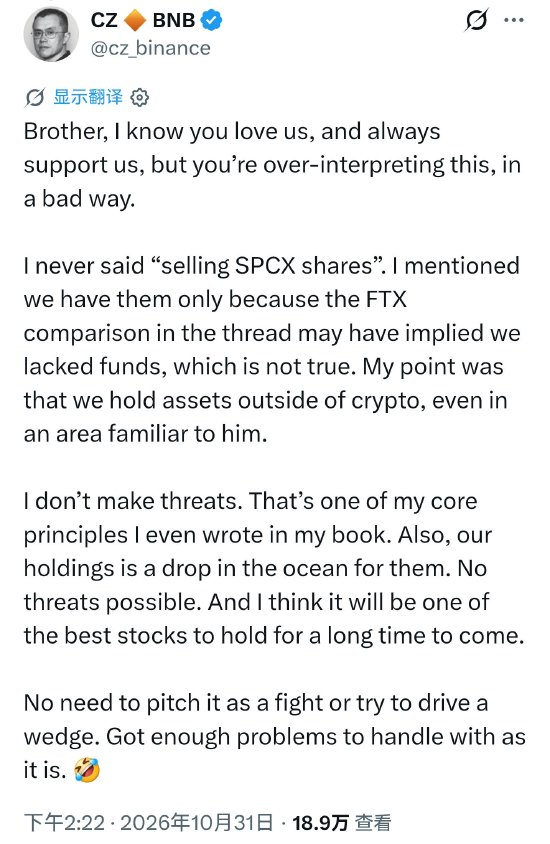
He also said that he understood Musk’s general support, but argued that the reaction had been taken too far: “I know you love us and also support us, but you overread this, and in a bad way.”
Then he introduced the asset point. “The SpaceX shares we hold are now worth more than $1 billion, and those shares came from the $500 million we invested when you acquired Twitter.”
For general tech readers, this is not mainly a celebrity argument. It is a lesson in how platform signals work. A public reply thread, a comparison screenshot, an emoji, and a high-value asset mention can all shape trust at once. The person asking not to be joked about is also the person discussing user compensation, while the other participant is a major figure in the technology conversation. The reader’s job is to separate what is visible, what is implied, and what is still unknown.
Quick map: what changed, and what did not
| Element | What the posts show | Reader takeaway |
|---|---|---|
| The starting point | A post from Changpeng Zhao about calming users and promising compensation. | The public discussion begins with reassurance, not with the emoji itself. |
| The side comparison | An X user attaches a screenshot linked to Bankman-Fried, described as a similar statement. | Comparison posts can pull a thread away from its original purpose. |
| The reaction | Elon Musk replies with a frowning emoji. | A small reaction can be read as approval, doubt, disapproval, or something else entirely. |
| The answer | Five hours later, Zhao says he respects Musk but asks that no joke be made about this matter. | The delay suggests the response was not an automatic comeback. |
| The financial detail | Zhao says the SpaceX stake is now worth more than $1 billion and came from the $500 million invested when Musk acquired Twitter. | This explains the value he highlighted, but it is still separate from the compensation message. |
Why a general reader should pay attention
A high-profile public exchange can affect trust in several directions at once. First, there is the question of whether a company’s founder is responding directly enough to users who have been promised something. Second, there is the question of whether a platform owner’s reaction is being read as a verdict. Third, there is the question of whether a financial number is being used to remind everyone of scale.
That last point matters because it can distract readers. Mentioning a SpaceX stake worth more than $1 billion may sound like a strong answer, but it does not by itself explain the details of user compensation, timelines, eligibility, or platform behavior. It is a statement about asset value and origin, not a step-by-step process update.
The same is true of the screenshot comparison. When an X user brings in Bankman-Fried, the conversation shifts from the original promise to a broader comparison among controversial crypto figures. Readers can benefit from that context, but only if they do not confuse comparison with proof.
Checklist: How to read a social media response like this
- Start with the original post. If the main topic is user reassurance and compensation, keep that as the center of the story.
- Identify the exact trigger. Was it a written reply, a screenshot, a meme, or an emoji? Each carries different interpretive weight.
- Note the timing. A response that comes five hours later is different from an immediate retort or a same-day correction.
- Separate emotional signals from factual signals. “I deeply respect you” and “Please don’t do that” convey tone; the SpaceX stake sentence conveys a financial fact.
- Do not treat a comparison as evidence. A screenshot connected to Bankman-Fried can signal a pattern to the poster, but it does not automatically establish one.
- Check what is missing. If Musk’s frowning emoji is the only visible written reaction described, avoid inventing his private intention.
Common misconceptions
- “The emoji is a formal statement.” It is not. A frowning emoji can express confusion, disappointment, irritation, or a casual reaction, and readers should not over-interpret it without added text.
- “Mentioning a SpaceX stake explains the user payout.” It does not. The stake statement talks about asset value and origin, not compensation mechanics.
- “A delayed answer means Zhao ignored the moment.” A five-hour delay can simply reflect a deliberate response, but the post itself does not explain his reasoning.
- “Because Bankman-Fried is mentioned, Zhao is being accused in a verified legal sense.” The post shows a user-made comparison; it does not provide the legal status of anyone beyond the described context.
- “If a major figure replies, that settles the conversation.” It does not. Public replies can intensify interpretation, but they are not a substitute for official notices, product updates, or user-facing guidance.
Action advice for readers following this story
- Save the original post and the follow-up reply. Screenshots can travel out of context, while saved posts preserve sequence.
- Read the compensation promise before reacting to the emoji. The main user issue is whether the reassurance post answers what users need.
- Compare statements across official channels if you are affected by payout or account decisions. Social media can provide tone, but it rarely provides complete procedure.
- Use the asset disclosure as a separate fact. If the SpaceX stake is worth more than $1 billion and came from the $500 million invested during the Twitter acquisition, treat that as a financial disclosure, not a direct proof of platform policy or customer-service practice.
- Avoid forwarding comparison screenshots unless the context is attached. A Bankman-Fried screenshot under a Zhao compensation post may draw attention, but it can also collapse distinct events into a single impression.
FAQ: The Changpeng Zhao and Elon Musk exchange in plain terms
What happened between Changpeng Zhao and Elon Musk?
Changpeng Zhao posted a message aimed at calming users and promising compensation. In the replies, an X user attached a screenshot related to Bankman-Fried and framed it as a similar statement. Elon Musk reacted with a frowning emoji. Five hours later, Zhao replied that he respected Musk, said the moment was not suitable for joking, and asked that no joke be made about the situation.
Why did Zhao mention SpaceX?
He said that the SpaceX shares held were now worth more than $1 billion and that those shares came from the $500 million invested when Musk acquired Twitter. For general readers, the key point is that he was highlighting a high-value asset position tied to an earlier transaction, not directly describing how user compensation would be handled.
What does the Bankman-Fried comparison add?
It introduces a contrast. Zhao is described as dealing with a user reassurance and payout message, while a screenshot linked to Bankman-Fried suggests a similar type of past statement. That can affect how readers interpret trust, but it should not be treated as proof of equivalence.
Does the frowning emoji tell us Musk’s exact view?
No. A frowning emoji is a reaction, not a detailed statement. In the exchange described, the only explicit visible response attributed to Musk is that emoji. Zhao’s reply treats the emoji as something more than a harmless joke, which shows how differently public reactions can be read.
What should everyday tech readers take from the $1 billion and $500 million numbers?
They show scale and origin: a stake now worth more than $1 billion, tied to an earlier $500 million investment in connection with the acquisition of Twitter. They also show how a financial fact can enter a conversation that began with user trust and public reassurance. Readers should keep the two threads distinct.
The bottom line
The most useful takeaway for MyTechDailyNews General readers is that a short public reply thread can contain several different kinds of signal at once. There is the original reassurance, the side comparison involving Bankman-Fried, the reaction from Elon Musk, the delayed response from Changpeng Zhao, and the financial mention of a SpaceX stake now worth more than $1 billion. None of those pieces should be flattened into one conclusion. A careful reader can appreciate the drama while still asking the quieter questions: What was promised, who is reacting, what evidence exists, and what does the next official communication say?