
GPT-6.2 Astra Shows Up in Codex Usage Data: MyTechDailyNews General Desk Decodes OpenAI's Quiet Test
Somewhere between an ordinary coding prompt and an auto-generated activity receipt, a model name that has never been announced slipped into public view. During November 2, a cluster of posts on X described the same oddity: people opening their Codex account statistics found a line item reading gpt-6.2-astra sitting beneath the familiar GPT-6 Astra label that the product interface still shows. No keynote, no blog post, no press kit — just a row of numbers on a settings page. Here at MyTechDailyNews, we unpacked the screenshots, the reasoning that points to a staged rollout rather than a display bug, and what an unannounced flagship experiment means for readers who simply want their AI tools to behave.
How the leak actually surfaced
Codex, the coding assistant from OpenAI, exposes per-account usage statistics that split a user's requests by model. Those tables exist for troubleshooting and bill sanity checks, not for marketing. That is exactly why the reports carried weight: a backend ledger is far harder to stage than a polished launch video.
Token Gremlin, an account on X that tracks AI model movements, wrote that OpenAI appeared to be running a low-key A/B test of GPT-6.2 Astra, and that the model was already visible inside Codex usage statistics. The observation matches the wave of user posts dated November 2.
The surrounding context is what turns a curiosity into news. As of these reports, the most recent model OpenAI has publicly shipped is GPT-6.1 Terra, while GPT-6.1 Astra has never launched at all. Seeing a 6.2 badge appear directly in the top of the family — skipping the rung everyone expected — is a gap in the ladder that watchers are still trying to explain.
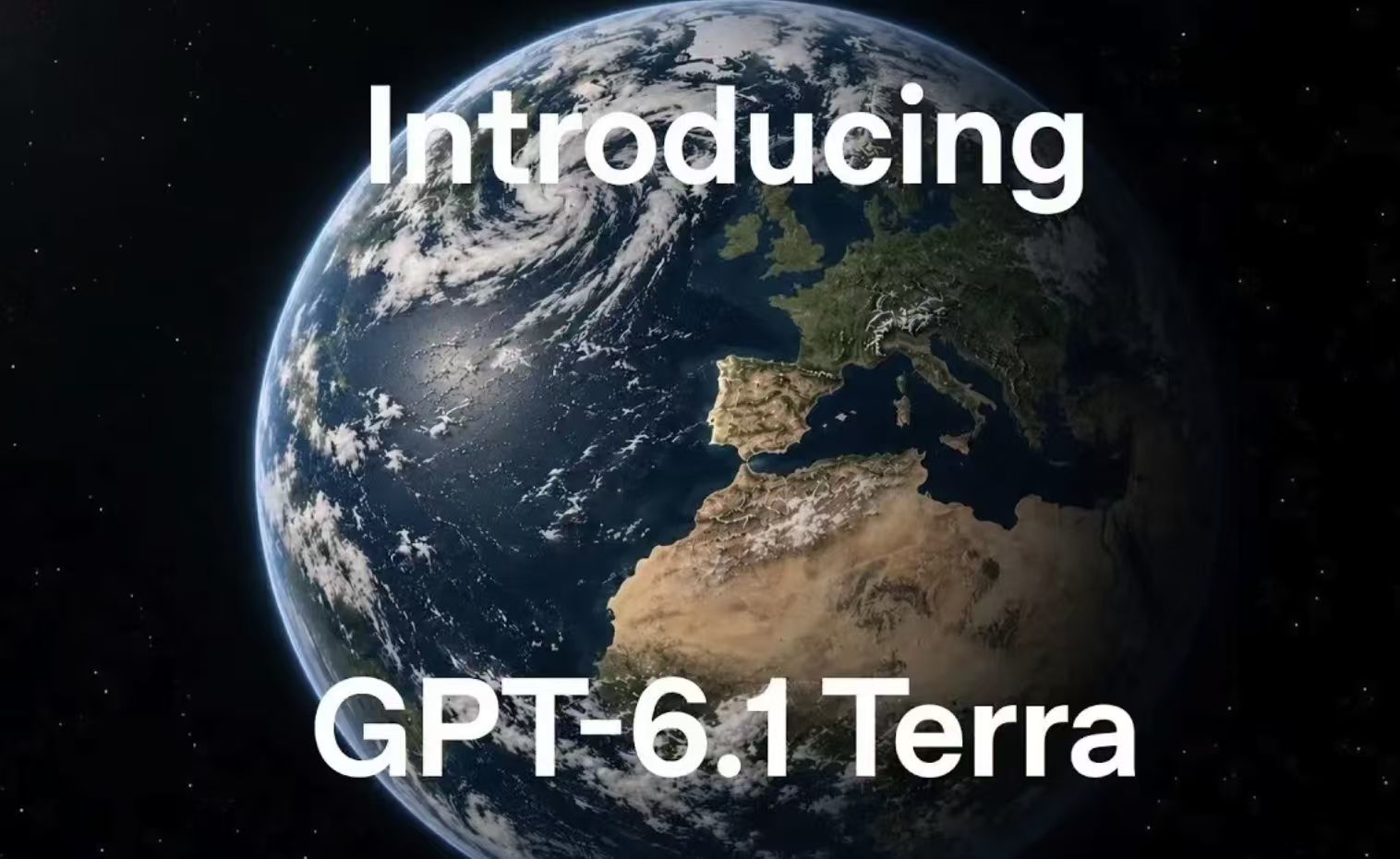
GPT-6.1 Terra
Two screens, two different stories
The detail that keeps getting reposted is the mismatch between what the front door advertises and what the back office records. Side by side, the reported picture looks like this:
| Where you are looking | What users reported seeing |
|---|---|
| Model selector in the interface | Still reads GPT-6 Astra |
| Account usage breakdown | A separate entry labelled gpt-6.2-astra |
| Traffic share in the breakdown | Roughly 19.8% of requests routed to the new label |
| Latest publicly available model | GPT-6.1 Terra |
| Expected intermediate step | GPT-6.1 Astra, never released |
| Official launch communication | None; everything so far is user-sourced |
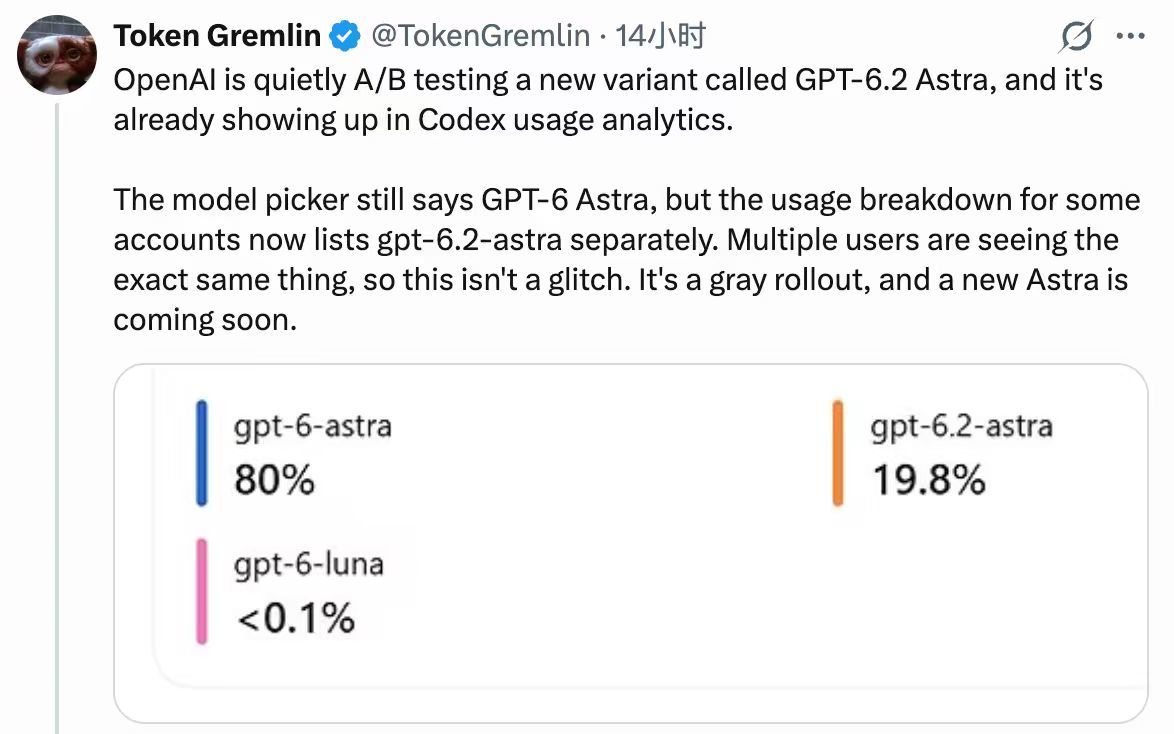
Why the 19.8% figure matters more than the name
Several unrelated accounts described the identical pattern, which makes a simple rendering glitch the weaker explanation. The real tell is the proportion. A brand-new label quietly absorbing close to a fifth of traffic — the reported figure is 19.8% of requests — behaves like a deliberate allocation, the kind of split that only exists when someone is comparing two variants and measuring the difference.
A useful everyday comparison: it is closer to a restaurant serving a revised recipe at a handful of tables before reprinting the whole menu than to a typo on the sign outside. The kitchen is already working; only the front-of-house text has not caught up. In platform terms this is what staged or gray-scale testing usually looks like, and it is a reasonable signal that a next-generation Astra is nearer than any public schedule suggests.
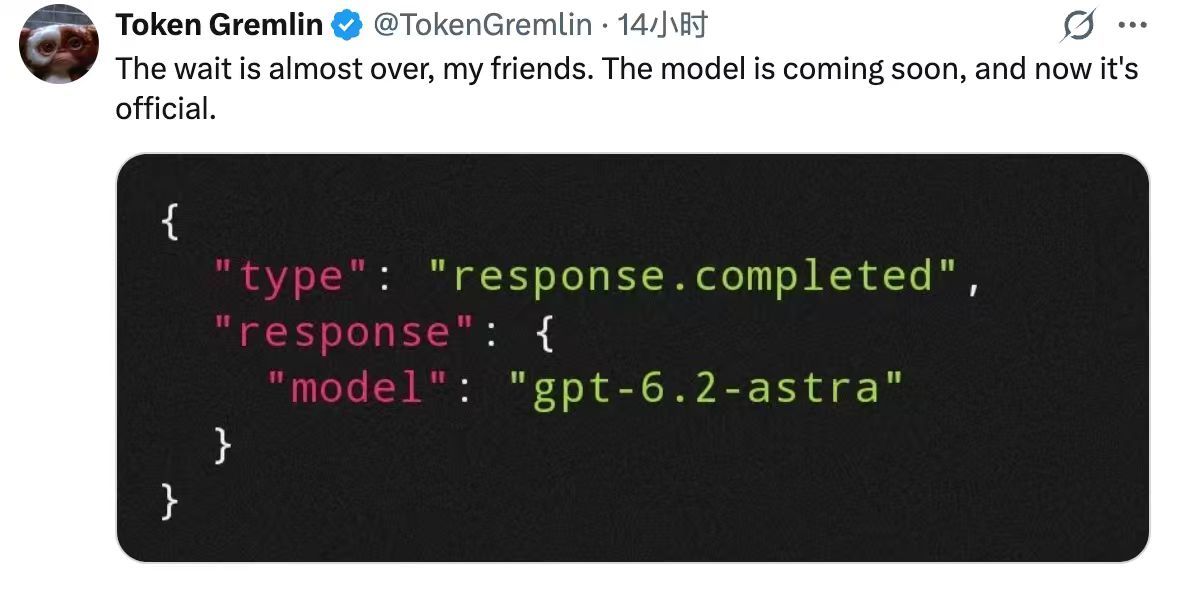
GPT-6.2 Astra
The performance claim, and the rival it points at
Token Gremlin's assessment is that GPT-6.2 Astra could bring a major step up over GPT-6 Astra, with the possibility of overtaking Opus 5.5 in several areas. That is a strong statement about an unreleased model, and it should be read as one tracker's judgment rather than a measured result — no independent benchmark has been attached to the sighting.
In a follow-up post, the same account suggested the version may arrive quickly, adding that it had checked with a few contacts in China whose own interfaces displayed the same model designation. Cross-region consistency is a meaningful pattern, though it is still hearsay at the level of screenshots, not documentation.
Reading the nameplate: what "Terra" and "Astra" already tell you
Developer discussions and community explainers describe OpenAI's recent naming as a tier system rather than a random vocabulary lesson: lower-cost options sit at one end, balanced everyday models in the middle, and the strongest tier carries the Astra designation, which is also where the company's own agent workloads are understood to run. Under that reading, a hidden 6.2 label appearing inside the flagship line — instead of a cheaper tier — points to engineering attention being spent on the top of the stack.
A handful of circulating images also appeared to show the identifier being reachable by name through the command-line side of Codex. Those posts came without logs or reproduction steps, so we are keeping them firmly in the "unconfirmed" column.
Five signals worth tracking
- Whether the gpt-6.2-astra line item grows beyond a single account's percentage or quietly disappears.
- Any official movement in OpenAI's model catalogue that finally lists a 6.2 entry.
- Whether GPT-6.1 Astra stays unbuilt — a skipped tier is unusual and may itself be explained in a release note.
- Named comparisons against Opus 5.5 that come with reproducible benchmarks rather than impressions.
- Whether the model picker in the interface catches up with what the usage ledger already says.
Three misconceptions worth clearing up
- "My account shows it, so it must be live." A label in a statistics table means your traffic is being measured against something, not that a product has shipped.
- "A glitch is the simplest answer." It is possible, but repeated reports of the same 19.8% split across accounts point toward intentional routing.
- "Version numbers mean a guaranteed upgrade." The jump past an absent GPT-6.1 Terra sibling shows that internal numbering and real-world quality are not the same axis.
Quick answers for everyday readers
Is GPT-6.2 Astra officially available?
No. The evidence as of November 2 is user screenshots and posts on X, not a launch announcement from OpenAI.
Why does my picker say GPT-6 Astra but my usage page says something else?
The interface label and the internal model identifier are maintained separately. During staged tests the front-end name typically stays the same while traffic is quietly split behind it.
Does 19.8% mean a fifth of my work runs on a new model?
That is how the reported breakdown reads for the affected accounts, but the figure is one data point from one table, not a platform-wide guarantee.
Is the GPT-6.1 Terra comparison still relevant?
Yes. Until a new release is announced, GPT-6.1 Terra remains the newest publicly available model, and Astra-tier users are still on GPT-6 Astra.
Should I wait before paying for a plan?
Only if your purchase depends on a feature you have not otherwise described. Rumour is not a roadmap, and nothing here guarantees release timing or price.
What to do right now
- Open your Codex usage breakdown once and screenshot it, so you have a dated baseline if routing shifts.
- Keep prompts that matter on the model you trust today; treat any silent assignment as an experiment, not a migration.
- Log any quality difference you actually feel in your own work — response accuracy, speed, tool use — instead of trusting version numbers.
- Ignore benchmark screenshots until someone publishes a reproducible test against GPT-6 Astra.
- Re-check the official catalogue before changing subscriptions, workflows or team training.
The odd thing about modern AI releases is that the biggest announcements now arrive as line items in a settings page, noticed by people checking their own usage. A model identifier that most readers will never touch is suddenly a shared puzzle, and it lands on ordinary users first: the freelancer watching a monthly total, the product manager quoting tool costs, the student comparing plans. Our advice is to enjoy the detective work but keep making decisions from what OpenAI has actually put its name on.
MyTechDailyNews General will keep following the Codex records around the clock. If your usage table shows a model name you were never told about, send the screenshot to our newsroom at hello@techdaily.com and we will compare notes before anyone starts calling it a launch.