
MyTechDailyNews General Case Review: Inside the Codename MDASH Pilot — 55 Fixes, Real Timelines, and the Bottleneck AI Can't Remove
Which AI security reports actually deserve a maintainer's time? Here is the short answer from a pilot I have been following closely: 55 verified fixes shipped across six projects, because the real test of AI in open-source security is merged patches, not the volume of raw findings it generates. That gap sounds small on paper. In practice it decides whether an exhausted volunteer closes the tab or ships a patch.
Picture the scene I keep returning to: you maintain a library that a large slice of the internet imports, and a Monday morning drops a pile of machine-written “critical” reports into your inbox. Christian Grobmeier, a maintainer of Log4j, has framed the stakes bluntly — the AI defending open source has to be better than the AI attacking it. Working with maintainers, GitHub and Microsoft put that idea to the test in a pilot built around one question: could AI help maintainers ship fixes instead of sending them more findings? I went through the published results line by line; what follows is the process, the numbers, and the reusable lessons.
What exactly did this pilot test?
The short version is a controlled experiment with two goals: only findings that matter should be sent, and no maintainer should receive an unverified finding. In the pilot, GitHub and Microsoft are using Codename MDASH, Microsoft's multi-model agentic scanning harness, to discover and repair security vulnerabilities in widely used open source software; the aim is to strengthen the foundation that much of the world's code is built on.
The workflow, end to end:
- Find. The scanning engine — Codename MDASH, an AI system from Microsoft Security — swept each project with Microsoft's MAI Cyber model and attached a candidate patch to whatever it surfaced.
- Filter. A triage agent from the GitHub Security Lab, tuned with tailored Copilot skills, stripped duplicates, tested validity and kept the high-impact bugs, so maintainers never had to stare at raw scanner output.
- Verify. Every survivor was checked by hand by researchers from Microsoft FORGE Lab.
- Report privately. Findings reached maintainers through GitHub private vulnerability reporting, each carrying a proof of concept and a suggested fix.
- Fix. Maintainers kept the final call on what to fix, how to fix it, and when.
Report and patch both stayed on GitHub, the place maintainers already work.
How did the numbers actually shake out?
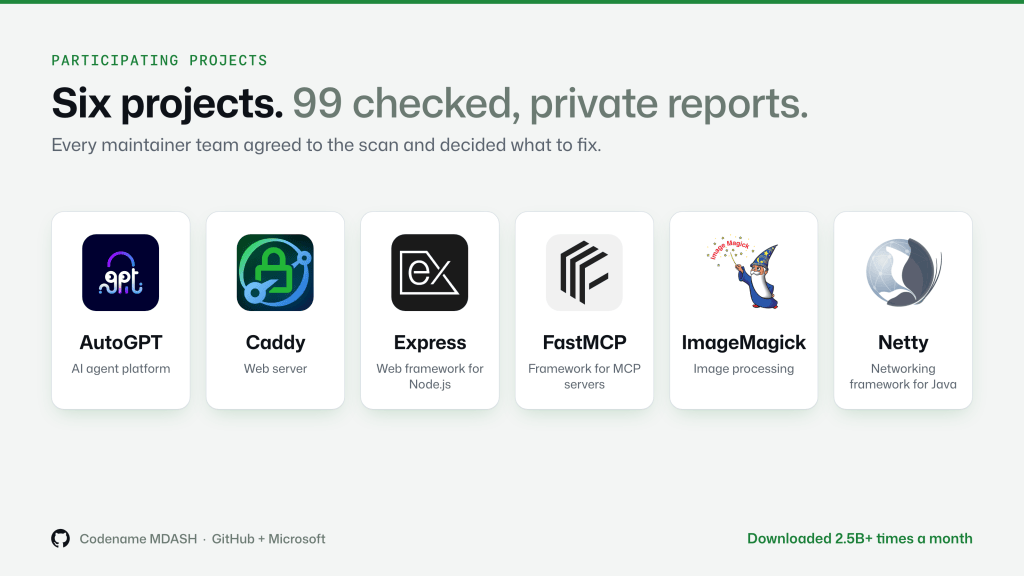
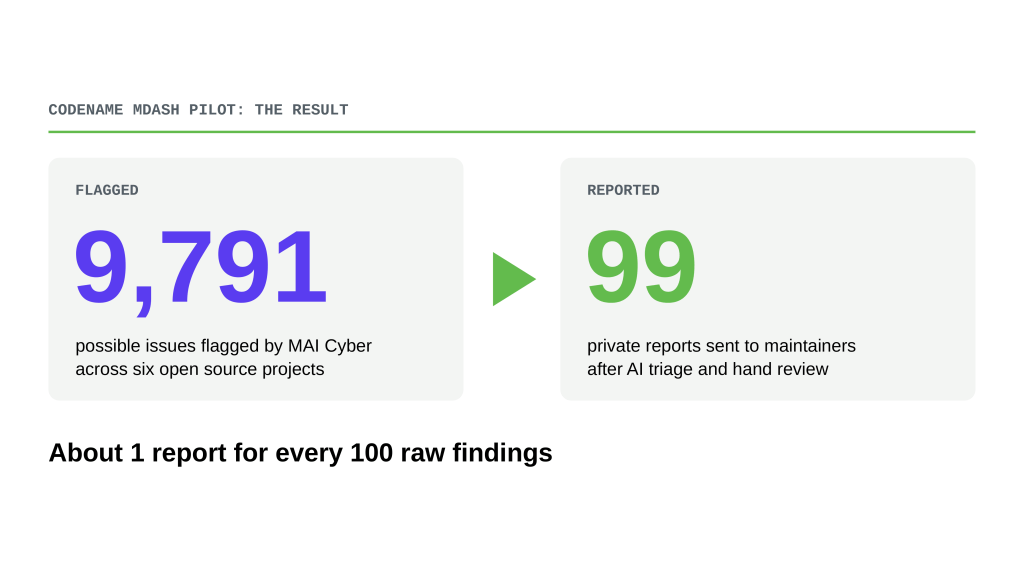
Scale is where the case gets interesting. Across the six projects, Codename MDASH, running Microsoft's MAI Cyber model, flagged thousands of possible issues. It took AI triage plus hand review by seven Microsoft FORGE Lab researchers to compress that pile into 99 private reports. As of November 15, 55 had been fixed, and 14 of those fixes were already in a release.
Which fixes landed first? A three-project case replay
Six projects is a small sample, so treat these as early lessons rather than a benchmark. Even so, the per-project timelines are the most useful part of the whole exercise.
The first fixes shipped about a week after the initial scan. Caddy's maintainers fixed 22 of the reports they received in a week or less, using the suggested fixes sometimes as written, sometimes adjusted.
A new check that AutoGPT's maintainers had recently shipped was broken. The report landed three days later and pointed at the right line. They pushed the fix further than the suggested patch, wrote it within a day, and had it in production less than a week later.
A Netty maintainer described the bottleneck directly: “Finding vulnerabilities is no longer our bottleneck. Fixing them is the hard part, and that depends on maintainers.”
| Project | What arrived | What the maintainers did |
|---|---|---|
| Caddy | 22 of the reports in one batch | Fixed them in a week or less, adapting patches |
| AutoGPT | Report on a freshly shipped check, three days later | Rewrote fix within a day, live in less than a week later |
| ImageMagick | 22 reports for a two-person team | One obscure case patched in 15 minutes |
ImageMagick, maintained by a two-person team, received 22 reports. One looked at first like a kind of issue the maintainers had seen before; the summary showed it wasn't and pointed to the exact lines of code, so they pushed a fix in 15 minutes. An ImageMagick maintainer said: “Normally, a security advisory would take us around 30 minutes to 1 hour on average to read, understand, and make a fix. It is a huge difference.”
Elsewhere the feedback was consistent. Express maintainers said the reports cut through the noise; one Express maintainer called Codename MDASH “very useful for cutting through the noise of vulnerability reports.” A Caddy maintainer noted it “was able to find unknown, obscure security bugs in our project with succinct reports, and it filled in gaps from some prior reports that hadn't been noticed.” A FastMCP maintainer wrote: “The Codename MDASH scan provided unique insights into the security of our project above and beyond what AI scanners have provided us in the past”.
Why should an ordinary user care about a maintainer's inbox?
Because the inbox is upstream of nearly everything you run. The human cost behind it is no longer a niche concern: SonarSource reported that 58% of open-source maintainers had either quit (22%) or considered quitting (36%) a project, while Intel's annual community survey found 45% of respondents named maintainer burnout their top challenge. Low-quality reports still reach maintainers every day. When the queue grows, defenders get slower — and Christian Grobmeier's warning stops being theoretical.
Timing makes that worse. Mandiant's M-Trends 2026 puts the mean time to exploit at an estimated −7 days, meaning exploitation often begins before a patch exists. Against that clock, a short list of verified, fix-ready reports beats a long list of raw warnings. The reach amplifies it: the Fund's alumni maintain software downloaded more than 20 billion times a month, and when a maintainer publishes an advisory that is reviewed for the GitHub Advisory Database, Dependabot can alert every repository depending on that package.
What do people get wrong about AI security scanning?
- More findings mean better security. They usually mean more unpaid triage. Duplicates and non-bugs push real work down the queue.
- AI has replaced human judgment. It has not. Seven researchers spent about two days per project checking findings by hand before a single report went out.
- Private reporting hides problems. It holds exploit detail back until a fix exists, which is the opposite of hiding it forever.
- Small projects are low priority. ImageMagick's two-person team turned 22 reports into fixes — proof that size and impact rarely line up.
What can you do today?
If you maintain an open-source project, switch on private vulnerability reporting so researchers can reach you without publishing a bug first. On GitHub you can turn on core security features in about two minutes with gh-secure. If you build on open source, enable Dependabot alerts so you know when a dependency needs a security update.
If you are the one sending AI-generated reports, hold yourself to the standard the maintainers asked for: check each finding against what the project already knows, its threat model and its security policy; report it privately; include a suggested fix; and let maintainers set the pace. Repositories using GitHub code security can lean on agentic autofix to help remediate alerts with Copilot.
A short checklist worth copying:
- Enable private vulnerability reporting on every project you own.
- Run gh-secure — it takes about two minutes.
- Turn on Dependabot alerts for your dependencies.
- Verify findings and attach a suggested fix before sending.
- Fund at least one maintainer whose work your product depends on.
FAQ: the questions readers actually ask
How many fixes did the pilot really produce?
Maintainers received 99 private reports; as of November 15 they had fixed 55, and 14 of those fixes were already in a release.
Did AI do all the verification?
No. AI triage narrowed the list, but seven Microsoft FORGE Lab researchers checked the remaining findings by hand — roughly about two days per project.
What is Codename MDASH?
It is Microsoft's multi-model agentic scanning harness that, in this pilot, used the MAI Cyber model to find issues and suggest patches.
Does this replace Dependabot?
No, it complements it. Verified advisories feed the GitHub Advisory Database, and Dependabot alerts the downstream repositories.
What should a non-maintainer do?
Enable Dependabot alerts, keep dependencies current, and support the maintainers behind the packages you ship — the funding picture below explains why.
What happens next?
Today Microsoft announced MAI Cyber 2; the pilot itself ran on the earlier MAI Cyber model. GitHub and Microsoft said they will keep working together on open-source security, folding these lessons into private vulnerability reporting and security advisories so low-quality reports cost maintainers less.
GitHub is also working with Microsoft to scale researcher review without cutting corners. Alumni projects will get AI security scans with findings checked before they are reported privately, plus GitHub Copilot Max, with support extending to future sessions of the GitHub Secure Open Source Fund.
The funding picture behind the fixes
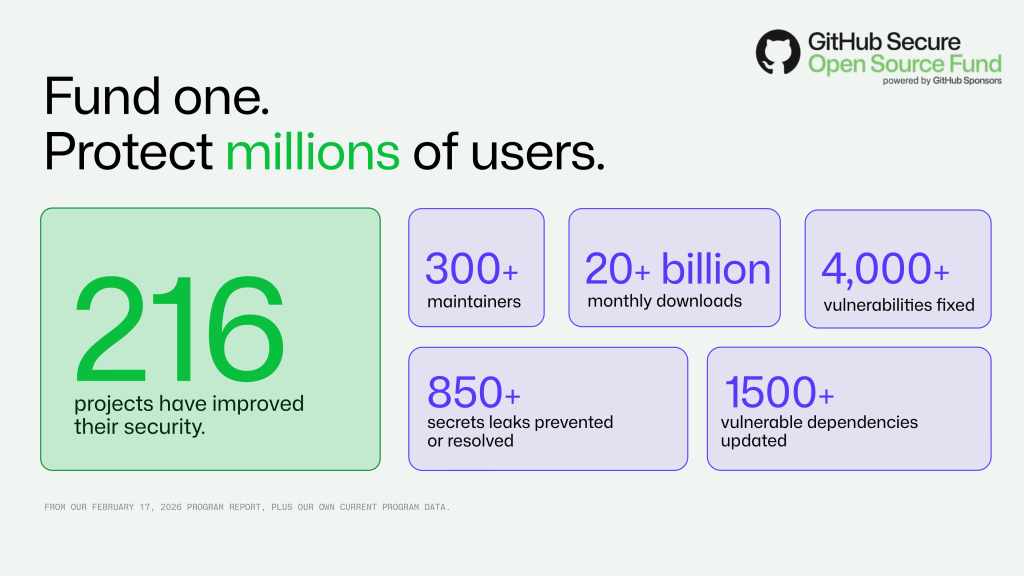
Context matters here. All six projects in the pilot are alumni of the GitHub Secure Open Source Fund, which gives each project $10,000 through GitHub Sponsors, plus security training and a supportive alumni community. The Fund reports 216 projects, with more than 300 maintainers fixing more than 4,000 vulnerabilities in software downloaded more than 20 billion times a month.
Through the Fund, maintainers also receive security training and Azure credits from Microsoft for Startups, alongside Microsoft’s European Security Program and its Secure Future Initiative, whose principle is security above all else. The sustainability problem is not abstract — we unpacked it in curl at Thirty, where a single maintainer carries a critical library for the whole ecosystem. If your software depends on open source, back the maintainers you rely on.
Appendix: the full alumni roster
AI, machine learning and intelligent systems
- ACI.dev
- AlbumentationsX
- ArviZ
- AutoGPT/GravitasML
- CAMEL-AI
- Caracal
- CocoIndex
- Code-Graph-RAG
- CodeCarbon
- Cognee
- Deep Agents
- DIPY
- DocsGPT
- Jupyter
- LadybugDB
- LangChain
- Matplotlib
- n8n-MCP
- Nasiko
- NumPy
- Ollama
- ONNX
- OpenBB Platform
- OpenClaw
- OpenCV
- OpenMetadata
- OpenSearch
- PageIndex
- pandas
- Pydantic
- PyMC
- Ruby-OpenAI
- Scenic
- scikit-learn
- SciPy
- Serena
- TokenOps
- TraceRoot
- Zeus
Build systems, supply chain and release tooling
- Apache Airflow
- Babel
- Bluefin
- bootc
- Browserslist
- Changesets
- Colima
- Concourse
- Cucumber
- CycloneDX Python Library
- Flux
- Foundry
- Gitoxide
- golangci-lint
- GoReleaser
- hardhat-deploy
- Jenkins
- JReleaser
- Jupyter Docker Stacks
- NixOS/Nixpkgs
- node-lru-cache
- oapi-codegen
- PostCSS
- PyPI/Warehouse
- rimraf
- Task
- Termux
- Terra
- Turborepo
- Warpgate
- webpack
- zizmor
Core languages, runtimes and foundational libraries
- Apache Commons
- Apache Groovy
- Byte Buddy
- core-js
- CPython
- FS2
- Gleam
- Himmelblau
- htmx
- LLVM
- modernc.org/sqlite
- NAPI-RS
- Node.js
- Pkl
- Pyodide
- Rustls
- termcolor
- time-rs
Developer tools and productivity platforms
- AirQo
- API Dash
- ArduPilot
- AssertJ
- AsyncAPI Initiative
- Bevy
- Bootstrap
- calibre
- Charset Normalizer
- Cheerio
- Ciphey
- Cobra
- CodeRunner
- CSS Declaration Sorter
- DataJourney
- Diesel
- DIGIT
- Electron
- ERPNext
- fabric.js
- GitPython
- Hoppscotch
- ImageMagick
- jQuery
- js-yaml
- jsoup
- JUnit
- libyt
- LORIS
- MapStruct
- Mastodon
- Mathesar
- Mautic
- Mermaid
- MessageFormat
- Mockoon
- NativeScript
- Next.js
- Nuxt
- nvm
- Oh My Zsh
- p5.js
- Path-to-RegExp
- Pelias Geocoder
- Pest
- Pillow
- Polly
- Proyecto Respira
- PypeIt
- python-benedict
- qs
- React Starter Kit
- Readest
- Resolve
- Rocket.Chat
- Selenium
- shadcn/ui
- Sphinx
- Spyder
- ssh_config
- StackQL
- Stirling PDF
- Svelte
- Thunderbird for Android
- ToolJet
- Two.js
- Viper
- virtualenv
- Vuetify
- Wagmi
- WebdriverIO
- xyflow
- YAML
- Yii Framework
- Yjs
Web, networking, APIs and infrastructure services
- actix-web
- aiohttp
- Apache APISIX
- Apache Shiro
- Apache Solr
- Apache ZooKeeper
- Arkime
- Caddy
- cmux
- Cryptomator
- curl
- CycloneDX .NET Library
- CycloneDX cdxgen
- Ente
- etcd
- evcc
- Express
- external-secrets
- FastAPI
- Fastify
- Haraka
- Helmet.js
- Home Assistant
- Hummingbird
- jose
- Keycloak
- Keyshade
- kgateway
- Log4j
- mimetype
- NetBird
- Netty
- Oauth2 (Ruby)
- OAuthlib
- openapi-stack
- OpenWISP
- PGPainless
- quic-go
- ScanAPI
- ScanCode
- Sniffnet
- Social Auth App Django
- Stalwart
- Starlette
- UAParser.js
- urllib3
- Vapor
- varlock
- Veramo
- WebAuthn (Go)
- ZITADEL
Verdict: is this approach worth backing?
Here is my honest read after replaying the case. If you are a maintainer, the pilot's design is worth supporting: a report that arrives checked, private, and paired with a candidate patch costs you far less attention than a raw scan, and the Caddy, AutoGPT and ImageMagick timelines show what that saved attention buys. If you ship AI-generated findings to open-source projects, adopt the three-part rule — verify, report privately, include a fix — or stop sending them. And if you merely consume open source, the cheapest useful move is to enable Dependabot alerts and put money behind the maintainers you depend on. The bottleneck was never finding bugs; it is the people willing to manage the security. Pay them, and stop adding to the pile.