
AI in Climate Science, Compared: What These Tools Nail, What They Miss and When to Trust Them
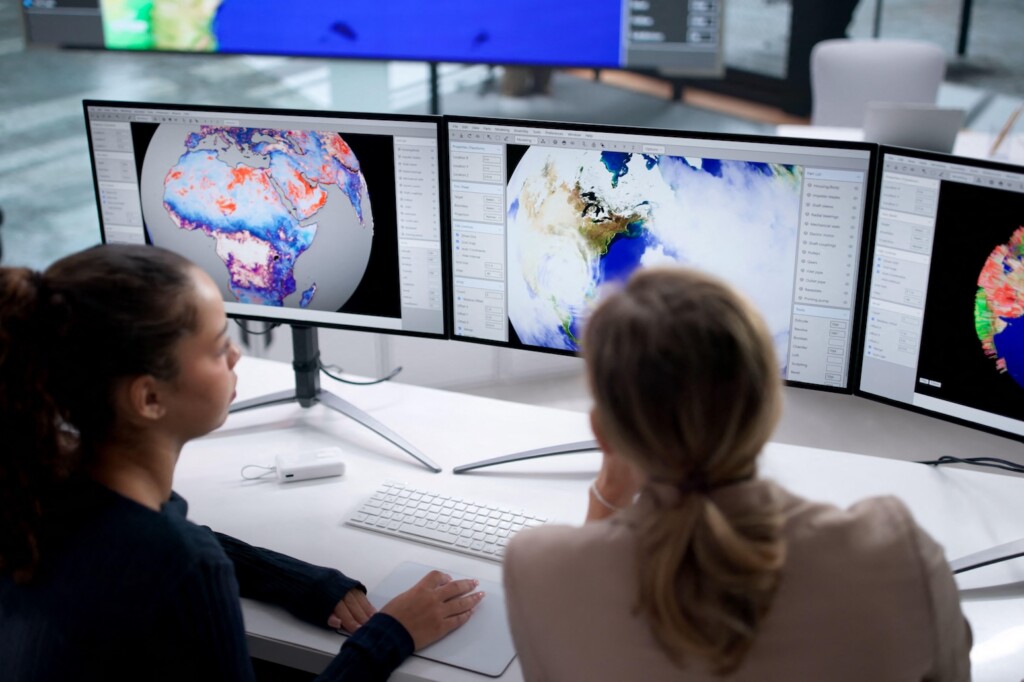
Computer screens displaying weather patterns. Credit: Andriy Popov / Alamy Stock Photo
Two headlines about artificial intelligence and the planet can run on the same morning and both be accurate. One model calls a storm track days ahead on a slice of the computing power a supercomputer once demanded; the same AI construction boom is driving data-centre electricity use sharply higher. They only look like a contradiction if you treat "AI for climate" as one product with one verdict. It is not. It is a stack of very different tools, each with its own job, its own failure mode and its own bill. Carbon Brief spoke to 10 experts whose work spans climate-related fields, from developing climate forecasts to analysing changes in the energy grid, about how AI is being used. This MyTechDailyNews piece reorganises their answers as a side-by-side review: what works today, what does not, who gets the benefit — and how a non-specialist should read the next "AI solves climate" story.
Begin with the naming problem, because it decides how useful the rest of this comparison is. When most readers hear "AI", they hear the chatbots — the large language models behind ChatGPT, Claude and Gemini. Most climate researchers work with something narrower and much older: machine learning pointed at physical systems. Those two things have almost nothing in common operationally, and conflating them is the root of most bad arguments in this space.
The scoreboard: six jobs, six very different verdicts
Read the table below as the summary judgement of the expert round-up. Each row is a task, not a company.
| Job | Where it stands now | The catch | Best-fit scenario |
|---|---|---|---|
| Short-range weather forecasting | Operational, not experimental | Skills are measured mostly on typical weather | Emergency response, farming, energy trading |
| Record-breaking and unprecedented extremes | Underperforms physics-based models | The training record does not contain the event | Only with hybrid designs and physical constraints |
| Long-lead climate projection | Early and contested | Useful climate information requires projections for future climates that lie outside the observational record | AI emulators accelerating existing models |
| Satellite image analytics | Mature and unglamorous | Only works where the sensors already exist | Methane leak alerts, deforestation, glacier watch |
| Sea ice and polar forecasting | Promising, evidence-thin | Observations of ice and snow thickness remain sparse | Seasonal route and risk planning |
| Grid and policy analytics | Growing fastest in practical uptake | Prediction is not the same as proving a policy worked | Renewables forecasting, battery control, scenario sweeps |
Round 1: forecasting — a clear win on one timescale, a real gap on another
Dr Doug McNeall, science lead in data-driven climate modelling at the UK Met Office
McNeall puts the rise of AI weather-prediction models at the top of the year's developments. They learn from vast volumes of weather data to predict the next few hours ahead, then feed those predictions back into themselves again and again to build forecasts stretching two weeks into the future. Crucially, they demonstrated that AI can be accurate while needing far less computing power than existing numerical models, which simulate the climate through mathematical equations.
His caveat is the one that matters for this comparison: those models were built for relatively short timescales, where observations such as temperature, rainfall or sea ice extent are plentiful and where performance can be checked quickly and rigorously. Climate prediction is a different sport — the target state has not happened yet, so there is no answer key. McNeall's preferred path is therefore hybrid: let AI emulate or accelerate existing models rather than run purely data-driven, keeping the physical understanding that underpins confidence while making climate risk information cheaper and more accessible.
Prof William Collins, professor of AI for climate science at the University of East Anglia
"We're seeing a really exciting renaissance in both weather and climate science…Machine learning [a subset of AI that uses algorithms to let computers learn from data and make predictions without being explicitly programmed] has had an enormous impact on numerical weather prediction," he says. His marker of that shift is institutional: the European Center for Mid-Range Weather Forecasts now deploys an AI forecast system alongside the traditional forecast system as part of official communication of weather predictions to the European community. In his reading, AI systems are now absolutely competitive with the world's leading numerical weather prediction.
The hard edge, in his words: "We're literally trying to predict the future. We don't have observations of it. So, where does the data come from to inform the models? That is, at the moment, the central challenge that the climate community is attempting to overcome."
Dr Amirpasha Mozaffari, researcher in Earth artificial intelligence at the Barcelona Supercomputing Centre
Mozaffari supplies the trade-off that a buying decision should hinge on: AI forecast models perform well on typical weather yet underperform physics-based models on record-breaking and unprecedented extremes — precisely the events that matter most for adaptation to climate change. Fixing that, through hybrid models, physical constraints that force outputs to obey the laws of physics, or new ways of evaluating models on data they have never seen, is the field's central open problem.
What the operational record adds since those interviews
The abstract claim "AI is competitive" has since been made concrete. The European Center for Mid-Range Weather Forecasts switched its machine-learned system, the Artificial Intelligence Forecasting System, to operational status in February 2025; the centre reports it outperforms state-of-the-art physics-based models on many measures, including tropical cyclone tracks, with gains of up to 20% (source: ecmwf.int). In ECMWF's own evaluation of an updated version, the AI system is credited with roughly 12 to 24 hours of extra usable lead time in the medium range versus its physics-based counterpart (arxiv.org). For a reader trying to judge a headline, that is the honest benchmark: AI now wins on average cases and on cost, while the extremes — the ones that kill people — remain the unresolved part of the comparison.
Round 2: watching the planet — the least glamorous and most useful category
Dr Stefano Materia, researcher in climate variability and change at the Barcelona Supercomputing Centre
The proliferation of Earth-observation satellites has produced a flood of geospatial data — imagery showing deforestation or sea ice melt — that no human team can read in time to act. Materia describes AI as the translator that turns raw pixels into actionable climate intelligence. Methane tracking and ecosystem monitoring are two examples he gives. Methane is a potent greenhouse gas whose leaks are largely invisible, so algorithms now scan hyperspectral imagery from satellites automatically to pinpoint specific industrial leaks globally and alert operators in near real time. Meanwhile, machine-learning models process thousands of satellite images daily to detect illegal logging, track land-use changes and monitor glacier retreat long before a person could manually review the footage.
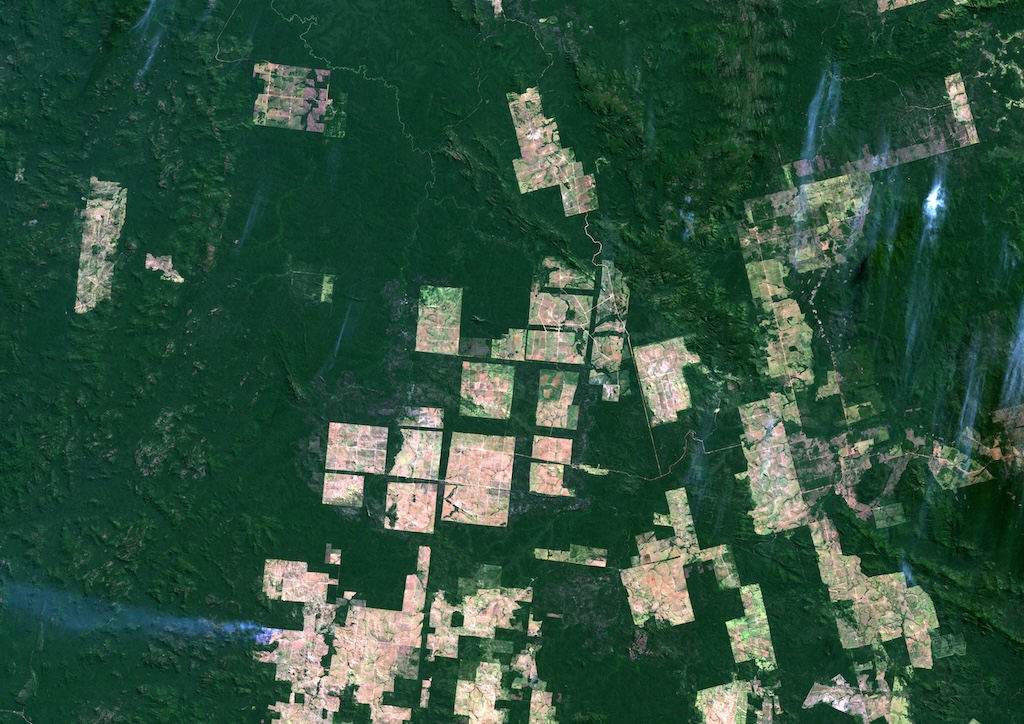 Satellite image showing deforestation in Para, Brazil. Credit: Universal Images Group North America LLC / Alamy Stock Photo
Dr Clare Eayrs, polar research scientist at the Environmental Fluid Dynamics Lab at New York University
In sea ice research, machine learning now sits across the whole modelling workflow. The most mature use is squeezing more from existing observations: mapping fine-scale sea ice deformation from ship radar, or classifying snow layers in micropenetrometer profiles, which measure how hard or soft each layer of snow is. Forecasting is the visible one — Ice Net, a sea ice forecasting system, was an early demonstration that a deep-learning system could outperform a leading physical model in seasonal Arctic forecasts. Machine-learning systems now predict sea ice concentration, thickness and drift.
Prof Cristiana Stan, vice-chair of the World Climate Research Programme (WCRP)
Stan's angle is comparative infrastructure. AI now appears across all major parts of the WCRP; the "weather prediction model intercomparison project" — an initiative to create a centralised database of physics-based, machine-learning and hybrid model forecasts — puts the three families side by side. Because it focuses on operational models, it offers a direct comparison between state-of-the-art systems, is intended to accelerate the next generation of operational models and helps develop metrics for each family's strengths and weaknesses. Downscaling, refining coarse model output into high resolution, is another AI strong suit.
Dr William Collins
Collins flags the institutional milestone: the Intergovernmental Panel on Climate Change (IPCC) is performing its seventh assessment report (AR7), and this time, for the very first time, there is a model intercomparison project just for models using AI for weather and climate forecasting. He calls it a real milestone, an exciting proof of principle, and the harbinger of many more developments of that kind.
Dr Amirpasha Mozaffari, on the speed of transfer
His comparison is against recent history. A few years ago it took two or three years for a new architecture to travel from the machine-learning community into weather and climate work; today it is a matter of months, with diffusion models, foundation models and generative ensembles arriving almost as soon as they appear elsewhere. He also notes the cost of running a global forecast has dropped by orders of magnitude — which, in principle, changes who can produce weather and climate information at all.
Round 3: grids and policy — the practical tier most readers never hear about
Prof Priya Donti, assistant professor at the Massachusetts Institute of Technology and co-founder of Climate Change AI
As more solar, wind and other renewable energy enters the power grid, the grid itself has to be managed differently. Donti splits AI's role into two jobs. The first is better prediction of solar and wind power output, to shrink uncertainty and let operators plan with more foresight. The second is optimising and controlling the many components already on the grid — generators, batteries, flexible industrial loads, the batteries inside electric vehicles, heating and cooling systems.
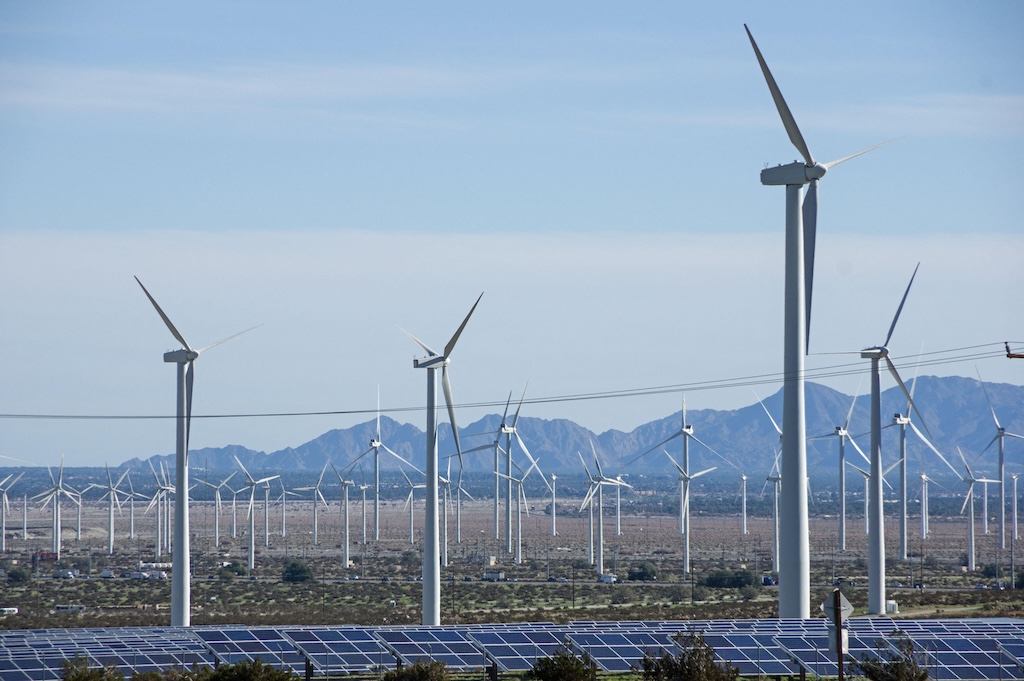 Wind turbines and solar panels in California. Credit: Tom Grundy / Alamy Stock Photo
Dr Carlos Rodriguez-Pardo, postdoctoral researcher at Politecnico di Milano, affiliated scientist at the European Institute on Economics and the Environment and at the Euro-Mediterranean Center on Climate Change
Rodriguez-Pardo maps AI against the whole climate policy cycle, which is the clearest way to see what each stage can and cannot borrow from machine learning.
- Measurement. The first stage is measurement: understanding what is happening, what has been tried and who is exposed. Machine learning processes satellite imagery to estimate emissions, improves air quality monitoring, harmonises fragmented policy databases and maps a scientific literature that has grown far beyond what any human team could read.
- Modelling futures. The second stage is modelling futures. Scenario models are computationally very expensive, so AI-based emulators that reproduce their behaviour at a small fraction of the cost are transforming what is possible: instead of a handful of scenarios, teams can explore thousands and quantify uncertainties previously out of reach. Reinforcement learning — a type of AI in which a program learns decisions through trial and error — lets researchers study how countries or electricity producers compete and cooperate under different policy designs, revealing strategies classical analysis misses.
- Evaluation. The third stage is evaluation, where causal machine learning extends the toolkit used to answer whether a policy actually worked — a different and much harder question than predicting what happens next.
The access comparison: four ways to get an AI forecast, ranked by what you give up
Cost falling by orders of magnitude changes the buyer, not just the bill. Here is how the main routes stack up today, using the same trade-off lens the experts apply to models.
| Route | What you get | What you give up |
|---|---|---|
| Open weights on GitHub | Google DeepMind released WeatherNext 2, its medium-range model, in November 2025 with model code and pretrained weights published openly (github.com, developers.google.com) | Support, guaranteed updates, and any influence over the training data |
| Managed cloud or API | WeatherNext 2 forecast data is reachable through Earth Engine and BigQuery, and third-party services now expose it via API — no GPU required | Vendor lock-in and opaque versioning |
| Official operational feeds | Validated, continuously verified systems such as the European Center for Mid-Range Weather Forecasts' traditional plus AI pairing | Cost and licensing constraints |
| Build your own | Full control of physics, resolution and evaluation | Exactly the barrier cheap inference was supposed to remove |
The nuance, straight from the round-up: cheap inference — running a trained model on new data — does not by itself redistribute power. As Mozaffari warns, being able to run someone else's model is not the same as having a say in what it is trained on, how it is evaluated, or whether it serves your decisions.
Dr Amirpasha Mozzafari: the inequality case
He warns that frontier models are built almost exclusively in the global north, trained on data that is densest where observations are richest and validated against benchmarks that reflect the same regions. Without deliberate effort to share data infrastructure, evaluation metrics that centre on people's wellbeing and genuine co-production of knowledge, AI risks automating and amplifying the existing divide in the global climate information system rather than closing it.
Dr Carlos Rodriguez-Pardo: the optimistic case
If done well, he argues, developing AI-based Earth system models could dramatically lower barriers to entry. A small research group, or an agency in a data-poor region, could adapt a pre-trained model on modest hardware rather than building bespoke systems from scratch. That matters because the data is thinnest and the resolution gap is largest exactly where vulnerability to climate change is highest.
Dr David Rolnick, associate professor in the school of computer science at McGill University and cofounder of Climate Change AI
Rolnick frames the criteria a fair comparison should use: climate action should fundamentally be about democratisation of action and equitable response to climate change, in both mitigation and adaptation. The consolidation of large-scale AI can often work counter to those goals by consolidating power in certain geographies and stakeholders, and by defining action based upon the goals of those stakeholders. Technology built inside specific institutions does not necessarily understand the needs of the majority of the world's population or of local stakeholders elsewhere.
Outside this round-up, the multilateral system has started to answer the distribution question: at an extraordinary session in October 2025 the World Meteorological Congress endorsed integrating AI into WMO's global observation, data-processing and forecasting infrastructure, while insisting that AI products undergo strict validation before operational use, that open data and open tools apply, and that national meteorological services remain the authoritative source of alerts (wmo.int). Pilot projects involving the weather services of Norway and Malawi, built around a "Forecasts-in-a-Box" concept, are being watched as a template for resource-poor countries.
The energy ledger: which AI footprint is actually in dispute
Put the two numbers next to each other and the debate gets much clearer.
- Macrotrend. The International Energy Agency projects electricity use from data centres roughly doubling, from about 485 TWh in 2025 to around 950 TWh in 2030, or about 3% of global electricity (iea.org).
- Micro-reality. Rolnick notes that the massive energy, water and other requirements people attach to AI refer to large-scale generative and agentic systems — not to the smaller models actually used to fight climate change, where the whole point has been a drop in compute cost of orders of magnitude.
That is not a licence to ignore the footprint; it is a scoping rule for the comparison. Ask which system the claim is about: a chatbot answering a query, or a trained forecast network running inference on a national grid. In the round-up, the risk named most often is the opposite one — that apparent success is read as a reason to invest less in observations. Eayrs is blunt about the Antarctic case: observations of sea ice and snow thickness remain sparse, understanding of snow-ice processes remains limited, and the field needs more targeted observations, not fewer.
What the next few years look like, tiered by confidence
High confidence
Stan reports that the WCRP has stood up a task team on exactly this question, covering modelling and projections, data and observations, AI impacts and services, engagement with the private sector integrating AI and machine learning into climate research, and the scientific rigour and trustworthiness of those methods.
Already fixed on the calendar
Collins expects AI to be an integral part of the eighth Coupled Model Intercomparison Project, with machine-learning codes running alongside traditional climate models. He also thinks the IPCC's eighth assessment, likely due in the late 2020s, may itself be substantially written using large language models — synthesis being the core human task of the report, and arguably not one that requires humans. In September 2026 the IPCC established an "informal group" on AI to "provide timely guidance on the responsible use of AI and emerging digital technologies in IPCC processes". His own test for a useful system: AI should be telling us the known unknowns, not the known knowns, because the value of an assessment is in naming what is not certain.
Promising but unproven
Materia calls the fusion of AI with climate and land-vegetation modelling a paradigm shift. Rather than replacing physical models, hybrid modelling merges the mathematical rigour and physical consistency of process-based Earth system models with the pattern-recognition power and speed of machine learning — aiming to clear computational bottlenecks, replace unresolved subgrid processes too small for a model's grid cells, improve the terrestrial biosphere, narrow uncertainties on the terrestrial carbon sink and pinpoint emergent constraints and non-linear tipping points.
The unglamorous prerequisite
Eayrs points out that most of what we know about Antarctic sea ice comes from the satellite era, which begins in 1979 — a short record for a system with strong decadal variability. Much of the earlier picture sits in ship logs, whaling records, expedition photographs and early aerial and pre-1979 satellite imagery, which machine learning is well suited to extract. Lengthening that record would improve almost everything else, including the training and testing of AI systems.
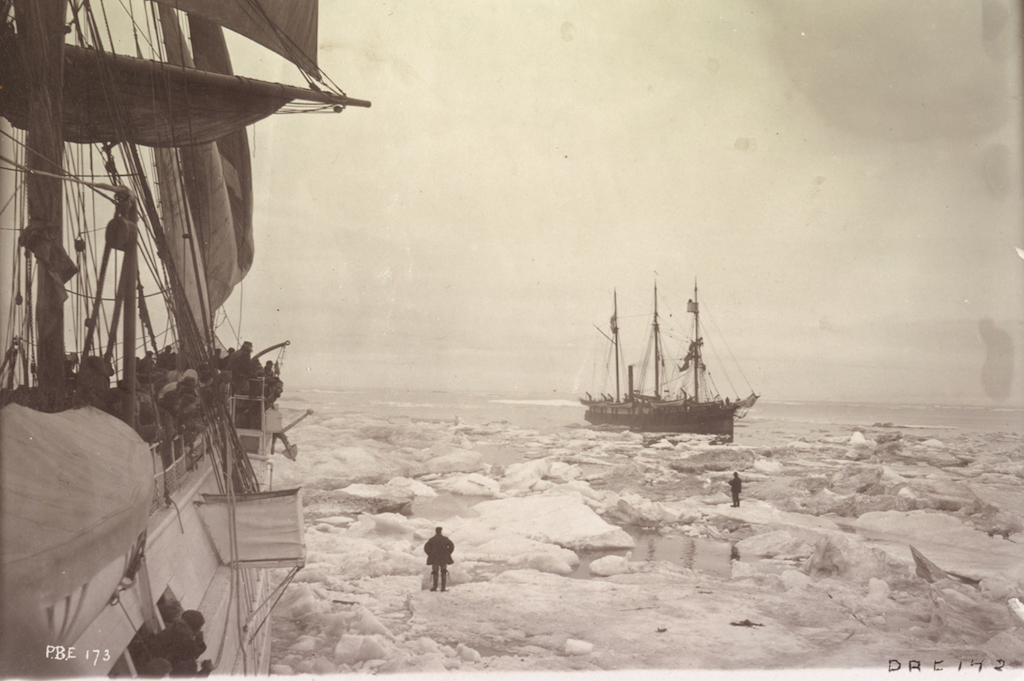 “The Bear” whaling ship getting free from the ice pack. Credit: New Bedford Whaling Museum
Worth noting for readers who follow scenario work: the modelling community this AI wave is entering has been shaped for decades by figures such as Prof Detlef van Vuuren of PBL Netherlands Environmental Assessment Agency, whose career has centred on coordinating the model exercises and scenario families that feed IPCC assessments — a reminder that the guardrails around machine-learned projections will be set by people who have spent years arguing about what a scenario is allowed to claim.
Common misconceptions, corrected
- "AI means chatbots, so AI for climate means asking a chatbot about carbon." Rolnick says AI is frequently thought of as large generative models from big tech companies, but that is not mostly what is useful for tackling climate change.
- "AI's energy use automatically cancels its climate value." Donti's concern is subtler and arguably more damaging: the public thinks of AI as one specific thing, often large language models and chatbots, and people making funding allocation decisions may hold that mismatched understanding — which means the right science does not necessarily get funded.
- "Better models mean fewer instruments in the field." Eayrs: good performance is necessary but not enough; the field needs independent evaluation, physical credibility, process-based validation, robustness and some degree of interpretability.
- "An impressive demo equals a usable forecast." The whole reason the weather prediction model intercomparison project exists is that demos are judged on typical conditions, while adaptation depends on extremes.
Risk register: five things that can go wrong, ranked by how likely
| Risk | Who raises it | Why it is plausible |
|---|---|---|
| Attention shifting away from other climate action | Dr David Rolnick | He calls it the first and foremost risk: AI diverging attention from other forms of climate action |
| Confidently wrong answers | Dr William Collins | The test is getting the right answer for the right reason; the failure mode is a plausible answer that is "truthy" but not the truth. Ask a computer and it will always obey, always give you an answer — the open question is validity |
| Cutting observations because models look fine | Dr Clare Eayrs | She says the risk she worries about most is exactly this, especially where sea ice and snow data are already thin |
| Unequal data and evaluation | Dr Amirpasha Mozzafari | Frontier models are trained and benchmarked in the global north, where records are densest |
| Energy and water burden of large systems | Multiple experts | Real but concentrated in large-scale generative and agentic systems rather than research models |
FAQ: the questions readers actually ask
Does an AI forecast beat a physics model for my purposes?
For the next few hours up to about two weeks, on ordinary conditions, yes — and usually at a fraction of the compute. For record-setting heat, an unprecedented flood or a 2050s projection, no: use a hybrid or physics-based system, or an emulator of one.
Is AI a climate villain or a climate tool?
Both, depending on which system you mean. The footprint argument mostly describes large-scale generative and agentic services. The research tools described in the round-up are prized precisely because their cost fell by orders of magnitude.
Should small countries and startups bother?
The technical route is open — pretrained weights on public repositories and hosted API tiers mean a modest GPU is no longer the barrier. The political route is slower: whoever chooses the training data and the benchmarks still decides whose risk gets modelled well.
How do I judge an AI climate claim in the news?
Ask four things in order: What job is the model doing? Over what horizon? Validated against what, by whom? And is there a physics cross-check?
Is this changing how the IPCC works?
Yes, visibly. The seventh assessment report and its AR7 cycle include the first model intercomparison project for AI-based weather and climate models, an informal group was set up in September 2026 to guide responsible use of AI in IPCC processes, and the eighth assessment is expected to lean on large language models for synthesis.
Action checklist: what to do with this comparison
- Match the tool to the timescale. Use AI models for nowcasting and the medium range; use physics or hybrids for extremes and long-lead projections.
- Ask who validated it. Prefer products compared inside a structured intercomparison over vendor benchmarks; treat an unverified result as a hypothesis.
- Check the observation budget. If a pitch implies sensors can be cut, discount it — the model inherits the record's gaps.
- Separate chatbots from climate tools in your own spending. If you commission research or buy a service, name the job, not the buzzword.
- Price the energy honestly. Distinguish inference on a trained forecast network from training a frontier model.
- Watch for equity defaults. Ask whether a system was benchmarked on the region you depend on.
Put plainly, the verdict on this comparison is a set of conditions rather than a score. AI has already won the near-term forecast and the satellite pipeline, is winning the cost war by orders of magnitude, and still has to prove itself on the extremes and the projections that adaptation actually depends on. The experts' shared warning is not that the technology will fail; it is that a good-looking number can quietly replace an instrument in the field, a funding line or a decision that a human should still own. If you take one habit from this review, make it this: before believing any AI climate claim, ask what job it was hired for.
Reviewed and edited by Sarah Chen, Tech Daily. Questions or corrections for the MyTechDailyNews team: hello@techdaily.com.