
67% and two-thirds: MyTechDailyNews reads China’s September car shift
When a single month of dealer receipts, fleet renewals and household budgets compress into one number, September becomes an unusually clear checkpoint for China’s car market. The latest China Passenger Car Association reading points to a 67% share for new-energy vehicles, with two-thirds of new car sales now in the electric or plug-in camp. For MyTechDailyNews readers, the question is not whether the headline is striking; it is what the mix, the prices and the policy calendar reveal about everyday mobility choices.
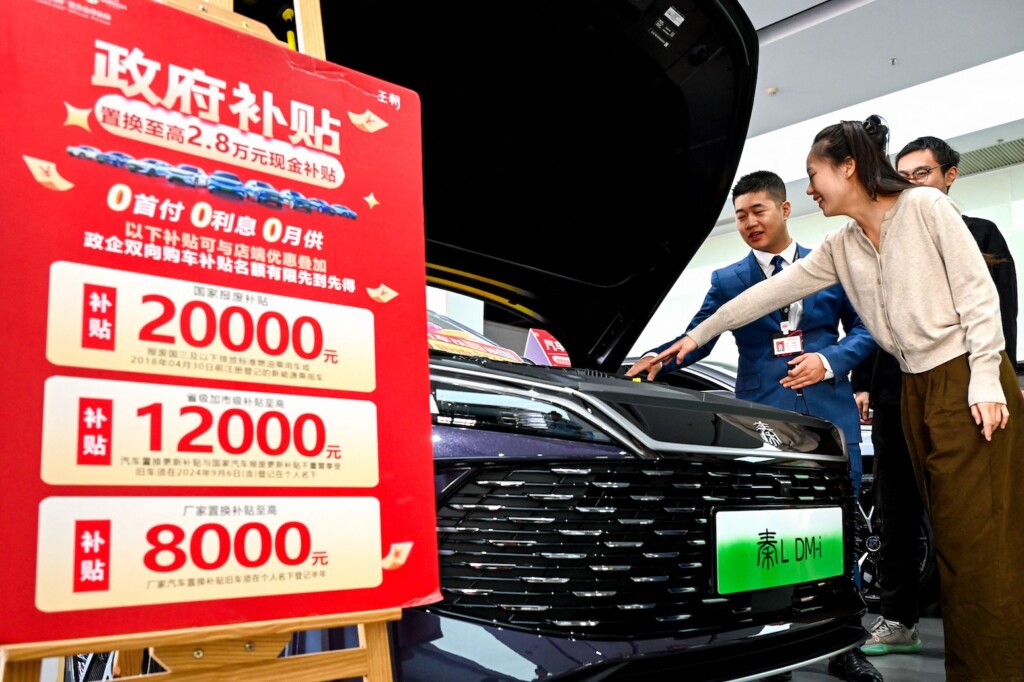 In the accompanying photo by Cynthia Lee / Alamy Stock Photo, Citizens purchase new energy vehicles through a trade in promotion event at a BYD 4S dealership in Nanchang, Jiangxi province. That showroom-level view matters: national data from CPCA describes the month of September as the first time two out of every three cars sold in China were NEVs. The category includes battery-electric cars and plug-in hybrids, but the story is now defined by price signals, trade-in timing and the shrinking space for petrol-only vehicles.
Record share, shrinking market
The share leap looks contradictory at first glance. NEV sales were lower than last year, yet the record persisted because internal-combustion demand weakened faster. A compact summary of the first nine months of 2026 makes the divergence visible: fuel-only cars were down 31% year-on-year, plug-in hybrids were down 26%, while battery EVs were only down 4%. The same pattern reappears in the September snapshot. This September, total passenger-car retail volumes were falling 28% year-on-year. Combustion models drove much of the decline, with a fall 43% year-on-year in September and 31% in 2026 to date. Plug-in hybrids were also weak, having fallen by 36% year-on-year and by 26% in 2026 to date. Pure battery electric cars held up better: they declined 8.5% from a year earlier in September and 4% in 2026 to date. Across the NEV category, sales fell by 17% and 13% in 2026 to date.
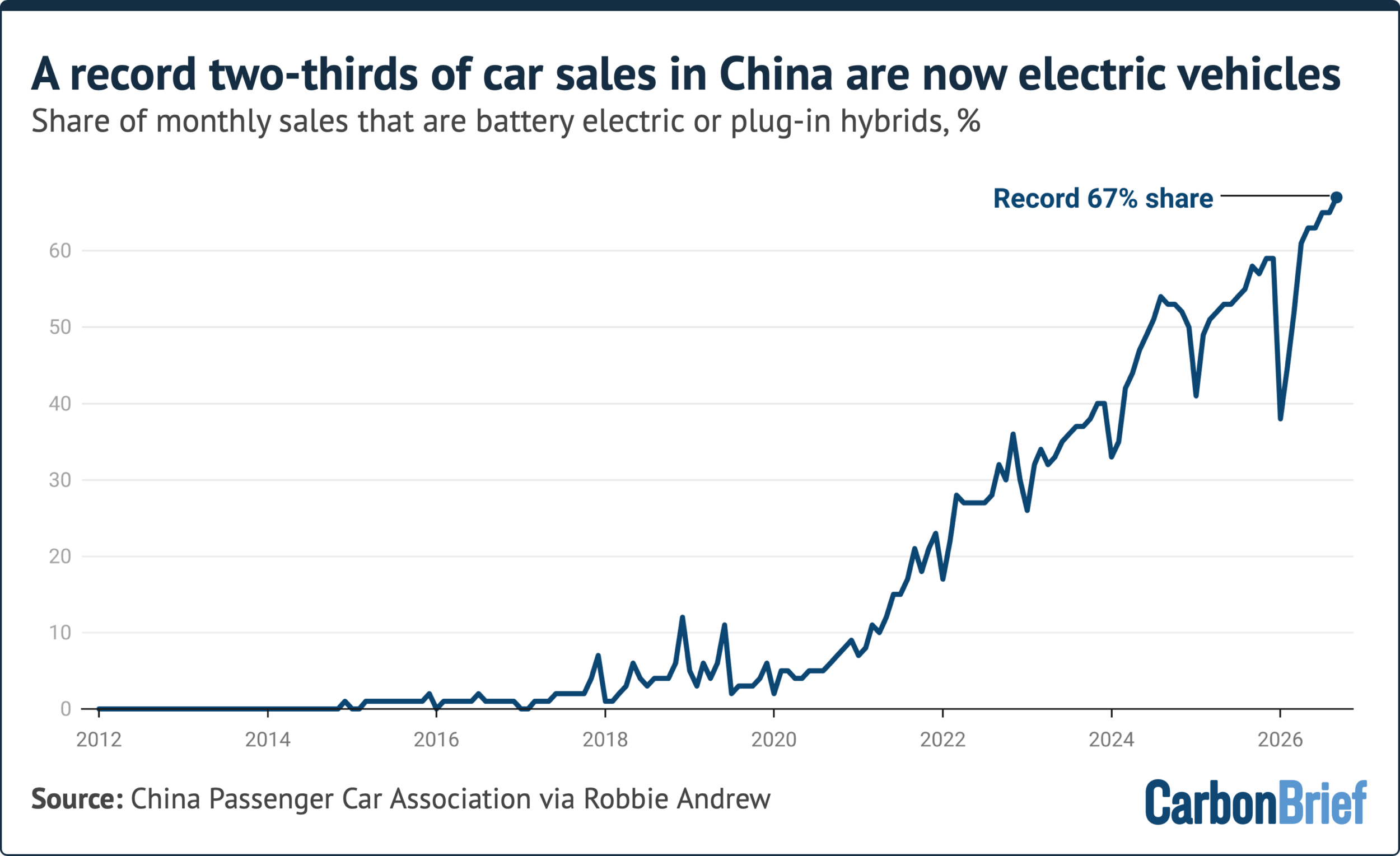
That record does not appear from nowhere. The share has moved from just 6% in 2020 up to 58% in 2026 to date and the month of September peak. This year, the line also recovered from 39% in January, after the full purchase tax exemption that had lasted more than a decade ended in December 2025. Policy trackers and market briefings, including CnEVPost’s January retail recap and the Climate Policy Database’s vehicle-purchase-tax note, describe a transition to a smaller incentive structure in 2026-2027, which helps explain why the early-year share dipped before rebounding.
Why oil prices and safety narratives matter
Chinese technology outlet OFweek framed part of the change as petrol cars giving up market share because electric alternatives performed more attractively. Cui Dongshu, the CPCA’s secretary-general, pointed to higher fuel prices when speaking to National Business Daily. The energy backdrop is broad: oil imports into China in January-September have fallen 15% compared to 2025, equivalent to 470m barrels, while the strait of Hormuz crisis tightened supply and lifted prices. Euan Graham, a senior energy analyst at Ember, told Carbon Brief that China’s passenger-car NEV fleet has displaced 143m barrels so far during the strait of Hormuz crisis. A separate estimate cited to the Brookings Institute put the EV fleet’s role at accounted for 12% of the decrease in China’s oil use post-Hormuz. The same line of analysis, summarized by Carbon Brief, notes that the expanding EV fleet has offset demand for 143m barrels since the start of the Hormuz crisis. Erica Downs of Columbia University’s Center on Global Energy Policy says the crisis is reinforcing China’s electrification of road transport, and argues that the world’s largest oil supply disruption vindicates an earlier policy bet tied to oil-supply security. Global fuel-price stress also sits inside a wider transition narrative: coverage by OilPrice.com of IEA data has described rising EV shares abroad as fuel volatility reshapes household budgets.
Why buyers stayed cautious
Even with the record, demand was not uniformly strong. Zhang Yichao, a partner at AlixPartners, tells Carbon Brief that NEVs benefit from government trade-in policies and a strong pipeline of new models, especially those tied to noticeable innovation. In his reading, those factors help explain why NEV sales fell more slowly than combustion-car sales. Cui told China National Radio that the September 2026 decline also reflected a high base from the same month in 2025, changes to trade-in policies and holiday-period disruptions. Wood Mackenzie adds that weaker demand reflects demand pull-forward in 2025 caused by subsidy changes and tighter financing conditions. Zhang is not expecting another explosive share expansion either: he says he does not see much more room ahead and believes the NEV share is unlikely to exceed 80%, because premium segments and specific use cases will keep combustion demand alive.
Exports as the other growth engine
Meanwhile, amid slowing domestic sales, Chinese carmakers’ exports of NEVs more than doubled in 2026 to date / in September from a year earlier. The CPCA reports 1,084,000 NEVs sold domestically and 558,000 NEVs exported in September, while domestic NEV retail sales fell 17% in September 2026 and exports were increasing 164% year-on-year. Independent trade coverage, including Gasgoo’s September market review, frames the export jump as the factor cushioning a weaker domestic retail picture. Exports have become a core priority for some carmakers as they absorb weak home demand, intense competition and thinner margins.
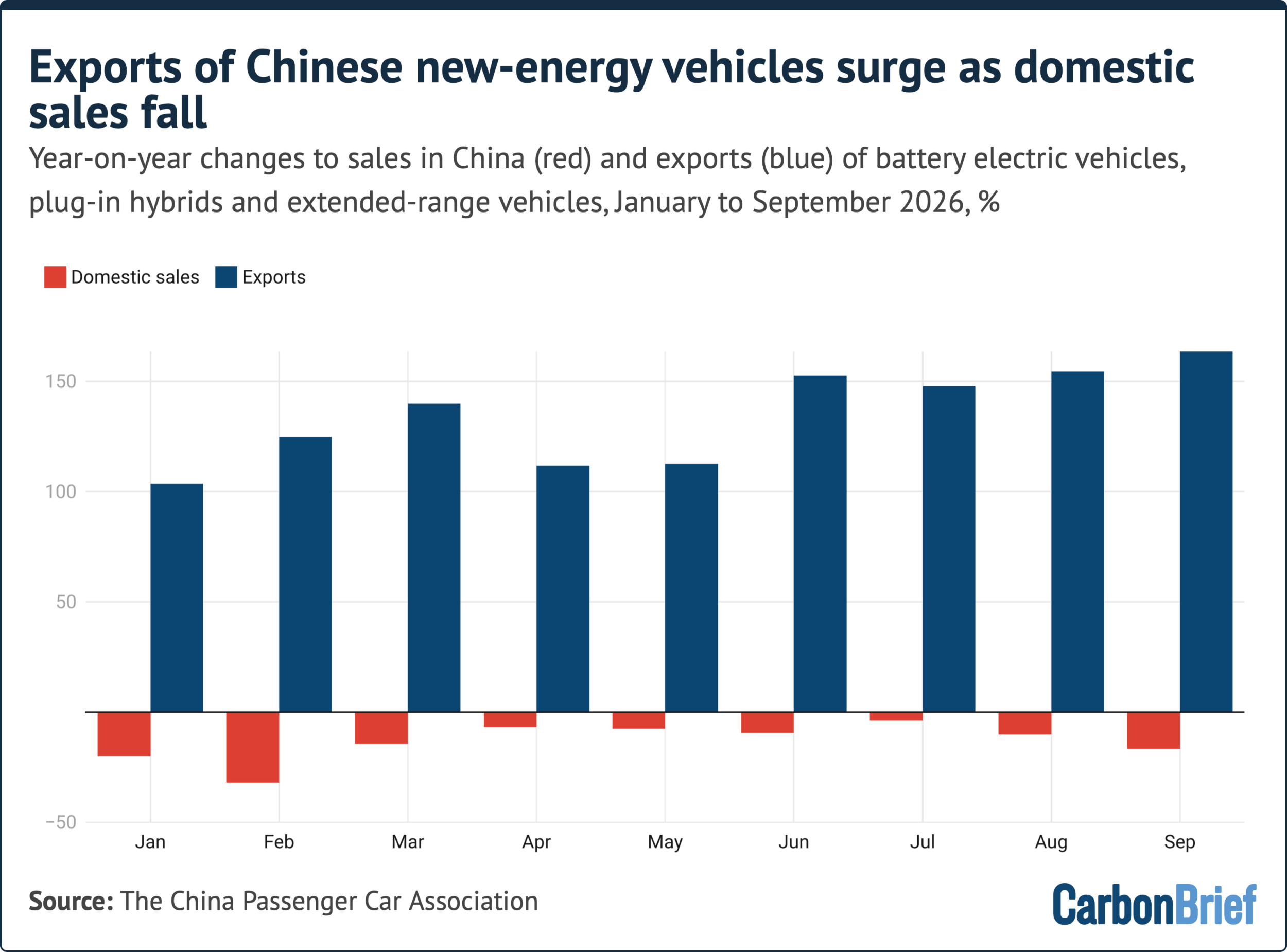
That external growth is not frictionless. The EU has responded with tariffs on imported electric cars from China and plans to reduce reliance on some hybrid imports, while Mexico and Turkey have also raised barriers around Chinese EV imports. At the same time, the Chinese government has adjusted policy levers that may cool outbound sales, including cuts to VAT export rebates. Analysts differ: some see the impact as limited because manufacturers can absorb or reprice, while others believe export prices may rise and alter the pace of overseas expansion.
Longer view: a decade-long tilt, not a one-month spike
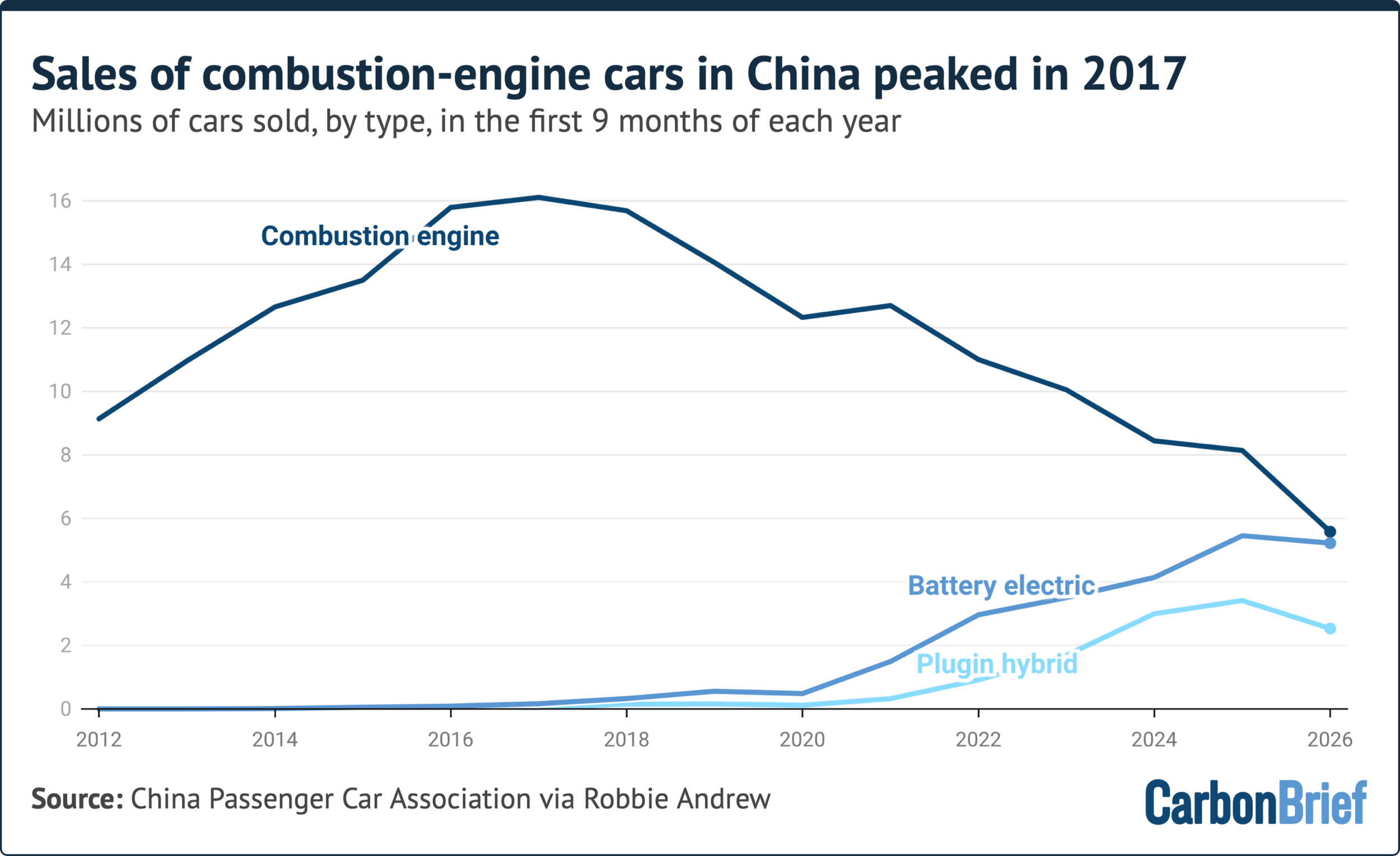
To understand why September could matter beyond a single reporting window, it helps to look at the longer curve. Combustion-car sales in China peaked in 2017 and the category has been shrinking across the past decade. The current jump in NEV share is therefore a continuation of a structural tilt, accelerated by fuel prices, product availability and policy design.
How to read the numbers: a quick checklist
- Look at share and volume together: the record does not require NEV volume growth.
- Separate battery electric vehicles from plug-in hybrids; both are NEVs, but their price exposure, charging habits and use cases differ.
- Track fuel costs and charging costs as household variables, not just oil headlines.
- Check policy timing: tax changes, trade-in support and holiday calendars can shift buyers between months.
- Compare domestic retail with export data; Chinese manufacturers are increasingly operating on two demand curves at once.
Common misconceptions
- Misconception: A higher NEV share means NEV sales were booming. Reality: In several categories, sales were weaker, but combustion vehicles fell faster.
- Misconception: The shift is only about environmental messaging. Reality: Fuel prices, product pipelines, financing and trade-in programs shape the buyer decision.
- Misconception: Exports can fully replace domestic softness. Reality: Tariffs, VAT rebate changes and local policy constraints make overseas growth less straightforward.
Action advice for everyday readers
For consumers, the practical lesson is to compare total cost of ownership, not badge novelty. If a plug-in hybrid is chosen, verify whether the vehicle’s battery size and charging access fit real mileage; if a battery electric vehicle is chosen, confirm charging availability before assuming price stability. For product and market teams, the signal is to watch the gap between domestic share, export momentum and policy resets; the September figure is useful precisely because it compresses all three pressures into one month.
FAQ: what this September record does not settle
- Does 67% mean electric cars won automatically? No. It means the competitive frame changed faster than absolute NEV volume in September.
- Why did the share recover after January? The end of the full exemption created a reset, while trade-in support, model launches and fuel-cost stress later lifted NEV appeal.
- Does Hormuz matter to car buyers? Yes, because it links global energy supply to local pump prices and makes electric alternatives more attractive on running costs.
- Could exports keep rising? They can, but tariffs, VAT rebate adjustments and destination-market rules make the path less linear.
- Is 80% share possible? The CPCA-linked view from Zhang Yichao suggests room is narrowing, with premium and niche uses likely preserving combustion demand.
MyTechDailyNews reads this result as a warning and a forecast in one package: the headline share shows how fast the buying consensus is moving, while the underlying volume weakness shows how unevenly that move is distributed. September is not a finish line. It is a signpost toward a car market where price signals, energy security and export strategy decide who adapts first.