
Bloomberg Intelligence's 2030 Forecast: China, the United States and Who Actually Leads AI — A MyTechDailyNews Breakdown
By Sarah Chen, MyTechDailyNews
Every AI feature people touch in daily life sits at the end of a long chain: software written by researchers, silicon built in factories, electricity drawn from the grid. A study released at the end of October tries to map who owns each link of that chain before the decade closes — and its conclusion is less about a single winner than about how the work gets divided.
On October 28, Bloomberg reported on new research from Bloomberg Intelligence whose argument can be stated in one sentence: by 2030, China could hold the global lead in large language models, the core AI technology behind chatbots, coding assistants and image generators, and could stay at least competitive in every other technology field the team treats as strategically important.

The Number at the Centre of the Report
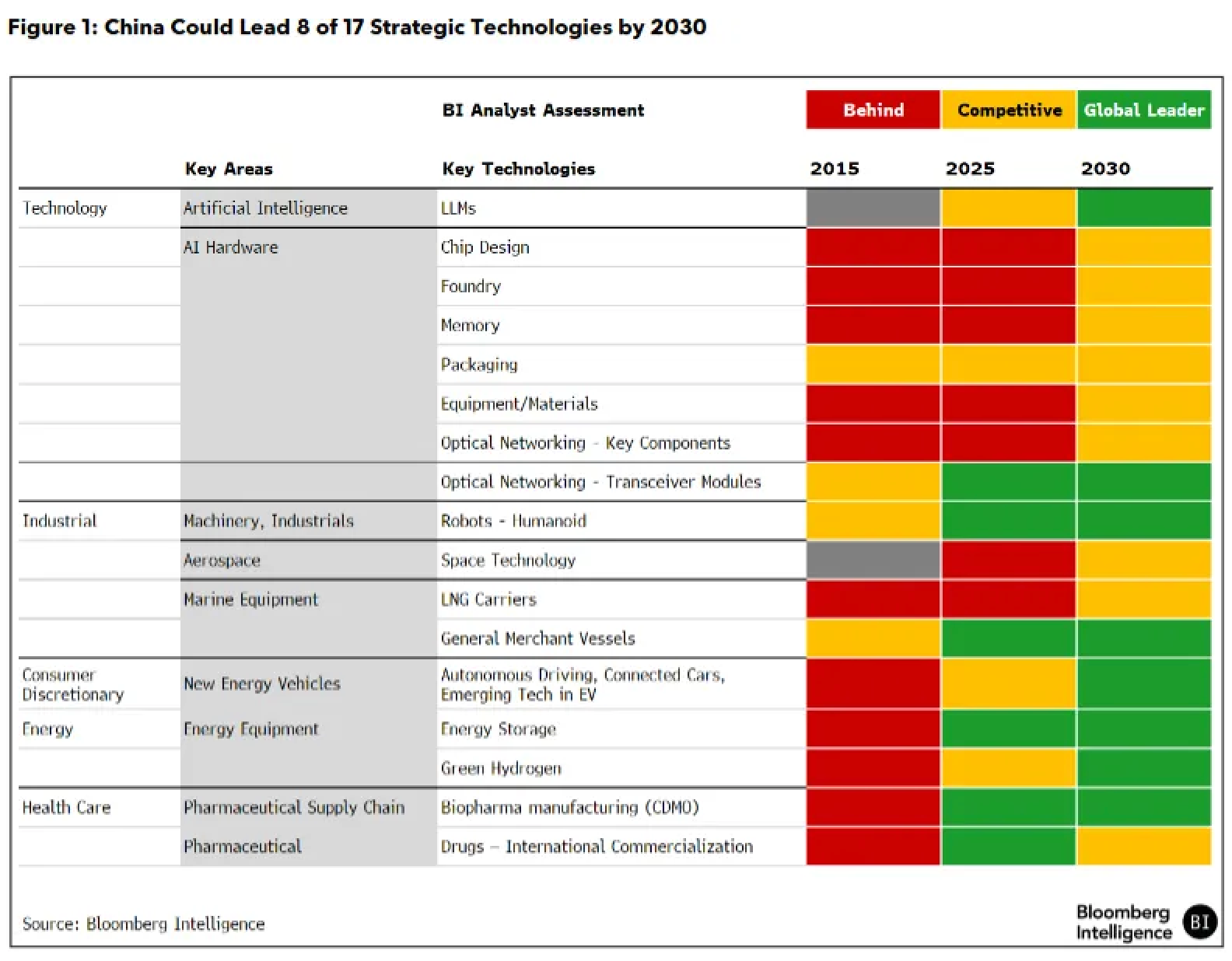
The analyst team is led by Francis Chan, also romanised as Chen Yongfu, and its headline is a fraction. By the end of 2030, the study says, China will be leading in 8 of 17 key industries — and large language models are one of those 8 industries.
For the other important categories of the AI race, the picture reads as a before-and-after. Today, Chinese companies are mostly behind. By 2030, the researchers expect them to be competitive. Those categories are the physical side of the industry: the hardware required to run AI at all, from chips to optical networking components.
- Time horizon: the end of 2030.
- Scoreboard: 8 industries leading out of 17 key industries.
- AI software: large language models, where a Chinese lead is expected.
- AI hardware: from chips to optical networking components, forecast to move from “behind” to “competitive”.
- Already ahead today: humanoid robot production and parts of shipbuilding, plus research and development spending that has caught up with the United States.
Two Countries, Two Different Advantages
The report's own summary refuses a winner-takes-all ending: “By 2030, the United States and China are expected to jointly lead the development of AI technology, and neither country is likely to achieve comprehensive dominance.” Both countries finish the decade strong, in other words — just not in the same places.
The division the analysts describe is easy to sketch. American models are expected to keep a slight edge at the frontier, meaning the most capable systems at the very top of the market. China's strength, the study argues, is efficiency: “China's expertise in software optimization positions it favorably for low-cost AI applications.” Semiconductors are the hinge of the whole argument. The report expects China to narrow the gap, while cautioning that complete self-sufficiency is not something it will reach for the time being.
Why the Efficiency Argument Is the Part Everyday Users Feel
A useful comparison is two kinds of food business. One chases the most impressive dish ever created; the other perfects a kitchen that can serve a very good meal at a price millions can pay. The study expects the United States to stay marginally ahead on the first, and China to be well placed on the second.
For ordinary users, that second track is the one that shows up in a wallet and in a battery. If the expectation about low-cost AI applications holds, the practical result is capable AI features spreading into cheaper products and services rather than staying reserved for premium ones. It also reframes what “winning” means: the decisive contest may be cost and reach, not only the highest possible benchmark score.
The Other Fields Covered by the Same Research
| Field | Where the study expects China to stand |
|---|---|
| Large language models | A global leader by 2030 |
| AI hardware, from chips to optical networking components | Competitive by 2030, starting from behind today |
| New energy | Global leader in all three new-energy sectors, electric vehicles and energy storage included |
| Biopharmaceutical manufacturing | A global leading position |
| Humanoid robot production | Already holding a lead |
| Shipbuilding | Already leading in parts of the industry |
| Research and development spending | Has caught up with the United States |
Read together, the energy, medicine, robotics and shipbuilding lines explain the report's wider claim: the forecast is not that one country wins AI, but that China ends the decade with a lead in 8 industries while remaining at least competitive across the strategically important fields it tracks.
Common Misconceptions
- “The study says China will win the AI race.” It says the opposite: both countries are expected to lead together, with neither achieving full dominance.
- “A lead in large language models means a lead everywhere in AI.” No — the study places Chinese firms behind in several other AI categories today and expects mere competitiveness, not leadership, by 2030.
- “Closing the chip gap means China stops relying on imports.” The report explicitly expects China to narrow the gap without becoming fully self-sufficient for the time being.
- “Everything in the report is a future story.” Humanoid robot production and parts of shipbuilding are described as already leading, and research and development spending has already caught up with the United States.
FAQ: The Questions This Forecast Will Prompt
Who published this, and when did it appear?
Bloomberg reported on it on October 28. The underlying research is from Bloomberg Intelligence, whose analyst team is led by Francis Chan, also romanised as Chen Yongfu.
How many industries does the study track, and how many would China lead?
It tracks 17 key industries and expects China to lead in 8 of them by the end of 2030, with large language models among the 8.
Does that mean the United States falls behind?
No. The study expects the two countries to lead AI development jointly, with American models possibly holding a slight edge at the frontier.
Why are optical networking components part of an AI conversation?
Because models do not run on software alone. The categories the report flags as lagging today are the hardware needed to operate AI, spanning chips through optical networking components.
Is this a measurement or a projection?
It is a projection to 2030 from a research team, mixed with present-day observations — the current lead in humanoid robot production and parts of shipbuilding, and the catch-up in research and development spending.
What Readers Can Do With This
- Use the “8 of 17” framing instead of a single-winner narrative whenever an AI story involves the United States and China.
- Watch the hardware categories — chips and optical networking components — as the early indicator. If the study's timeline is wrong, it will most likely show there first.
- Pay attention to cost rather than only capability. The report's central AI claim pairs a possible American frontier edge with China's software optimization strength in low-cost applications.
- Keep semiconductors as the open question: narrowing the gap and reaching self-sufficiency are two very different outcomes in this forecast.
- For product and market teams, note the non-AI lines too — all three new-energy sectors, electric vehicles and energy storage included, plus biopharmaceutical manufacturing, humanoid robots and shipbuilding.
The value of this report for a general reader is that it replaces a dramatic question — who wins AI? — with a more answerable one: who is good at what, and where does that show up in the tools and prices people meet day by day. On that reading, 2030 is not a finish line with one flag on it, but a decade in which large language models, cheap AI applications, chips, energy, medicine and shipyards each get a different owner of the lead. MyTechDailyNews will keep tracking which of those forecasts hold. For story tips or questions about our coverage, contact Tech Daily at hello@techdaily.com.