
Buyer-Side AI Agents Are Rewiring How Customers Shop: A Practical Playbook for Teams in 2026
Most marketing teams are still busy adding tools that make their own work faster. The sharper change, according to the Martech for 2026 report scheduled for release on December 2, is happening on the customer's side: software that researches, compares, negotiates and pays before a human ever opens your site. Below is a step-by-step playbook, plus a checklist, the traps to avoid and the measurement habits to build over the next 6-12 months.
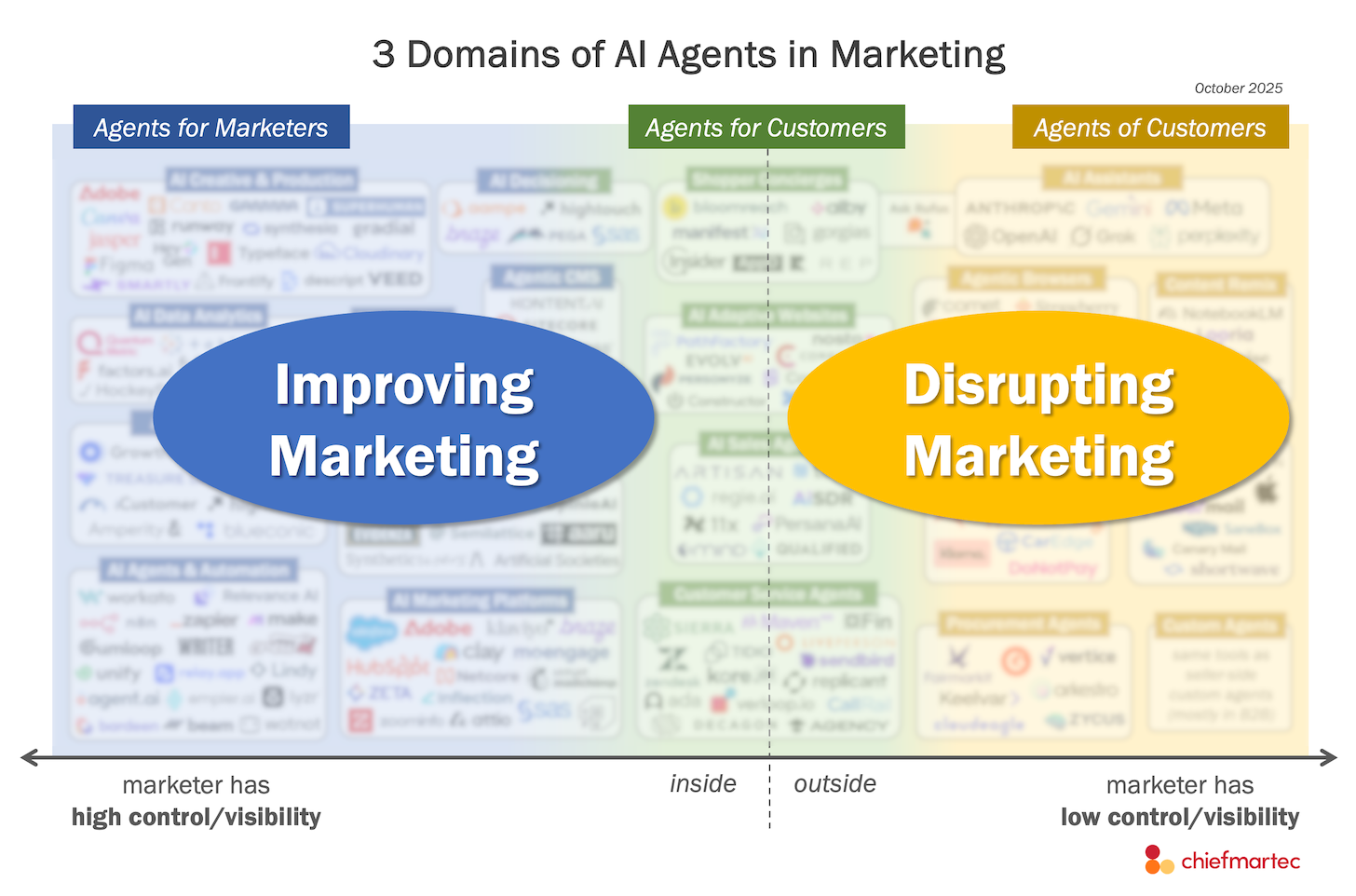
Three shifts that matter more than any new tool
- The buyer's shortlist is now assembled by software. Discovery, comparison and even payment can finish before a prospect sees your brand.
- Visibility collapses first, control follows. Marketers lose the click-through, the referrer, the session path and the last touch.
- Preparation is practical, not theoretical. Machine-readable product truth, agent traffic measurement and rules for machine-to-machine contact beat another campaign.
What actually counts as an AI agent in marketing?

The report's test is not model size or how many tools a vendor claims to have. It asks a simpler question: who does the agent work for, who does it interact with, and who does it benefit?
On that definition, almost every agent in marketing today works for marketers. In the AI & Data in Marketing study, 90.3% of participants reported using AI agents somewhere in their martech stack, even if only for experimentation or limited production use cases. Hundreds of new agentic tools, plus hundreds of agents added to existing martech platforms, brainstorm, produce, distribute and analyze campaigns and programs.
Their mission is to improve marketing. Often they make it cheaper; some executives treat efficiency as strategy through the cliché do more with less. In the best cases they also make marketing more effective. Even so, almost all of these gains remain incremental, however significant they feel in a quarterly review.
The people surveyed are also not hobbyists. They skew more tech-savvy than the average marketing team, yet they run martech and marketing operations at major B2C and B2B brands - pragmatic, responsible, and competing at the top of their game.
Why the real disruption sits on the buyer's side of the transaction
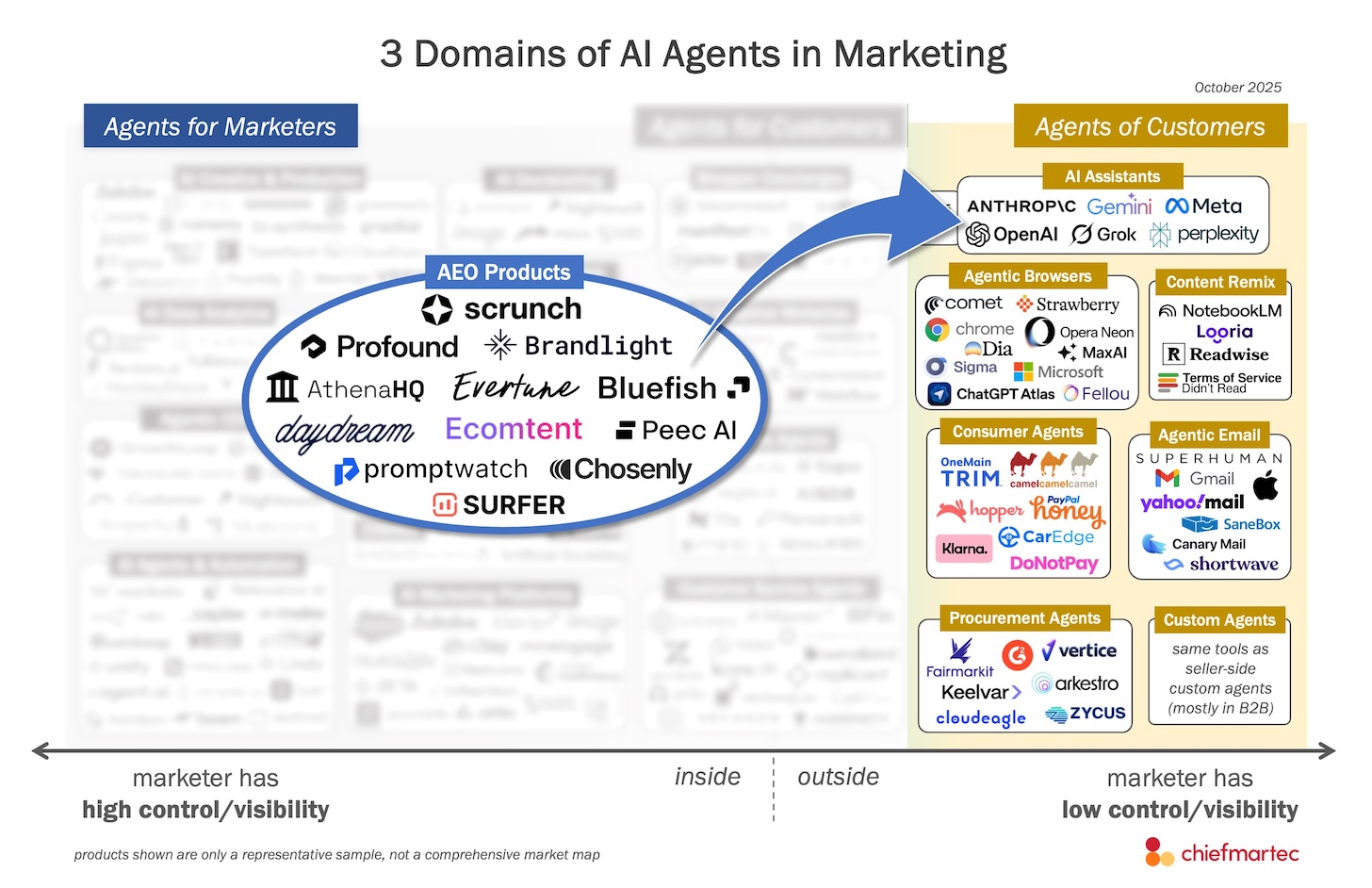
Because the discovery layer itself is being swapped out. The clearest example is the displacement of classic Google search, and the SEO playbooks marketers have spent the past 25 years honing to win that channel, by AI assistants such as ChatGPT, Claude, Perplexity and Google's own Gemini platform.
Buyer-side AI agents are true disruptors because they fundamentally change how buyers find, evaluate and engage with B2C brands and B2B vendors. In this Great Rewiring of the Buyer's Journey, marketers are losing visibility and control at exactly the moment the shortlist is created. A whole category of AEO products has sprung up to address the challenge and is growing rapidly, but those products are early in their evolution while the buyer-side agent environment advances even faster. As the report puts it, it is like chasing a bullet train with a bicycle.
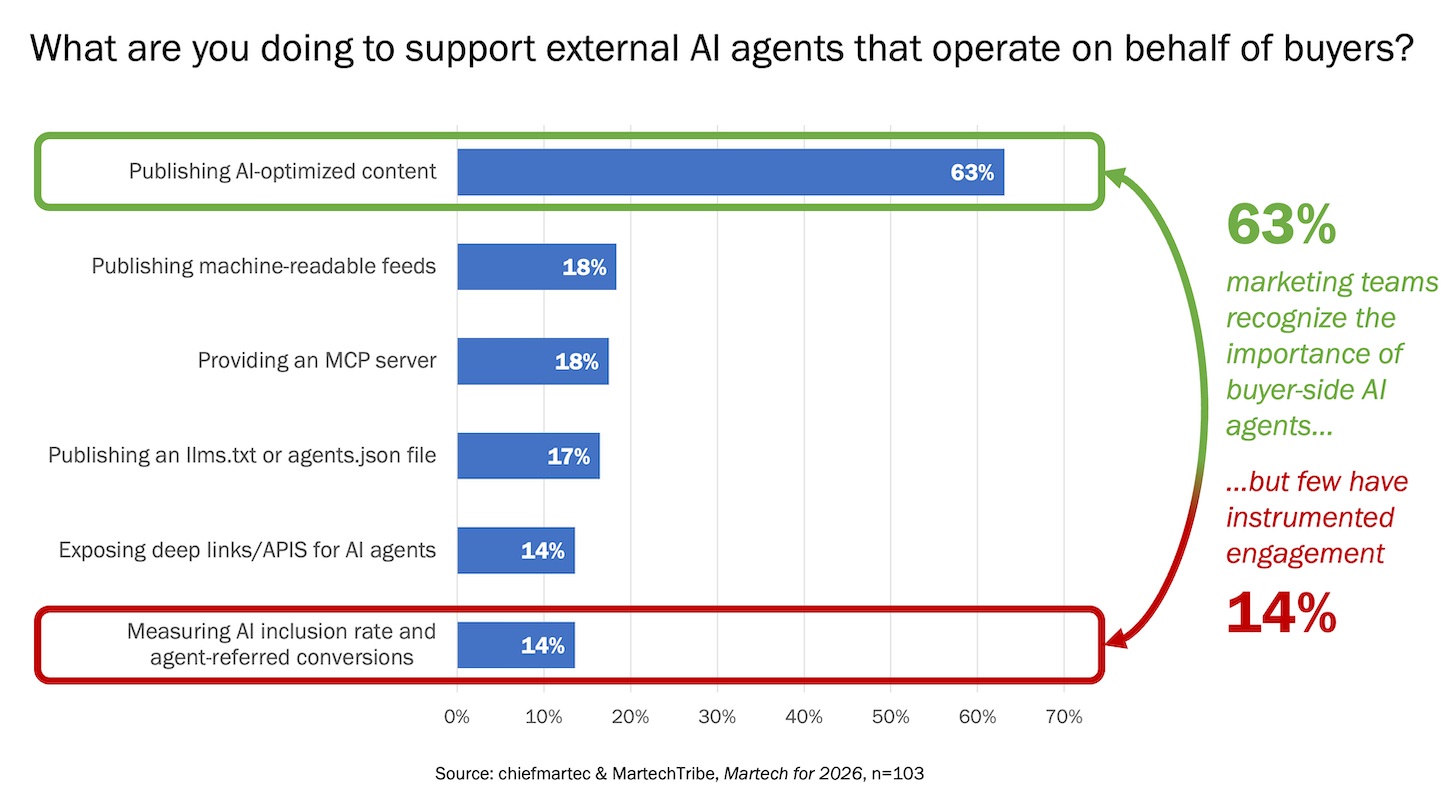
The adoption numbers show a community that sees the problem but has not yet instrumented it. In the Martech for 2026 research, the majority of marketing teams (63%) recognize this shift in buyer search channels and behaviors and are intentionally adapting content strategies accordingly. Very few (14%) have instrumented this yet. That single gap is the most actionable figure here: strategy without measurement means budgets move on anecdote. Instrumentation is expected to be prioritized in 2026.
From answer engines to action engines: what is already shipping?
The acceleration is expected inside the next 6-12 months, because assistants are no longer only answering questions. They are becoming agentic action engines that can engage with agents or humans on the seller's side in service of a customer's goal.
OpenAI launched Instant Checkout a couple of months ago, enabling users to purchase products from Etsy and Shopify stores directly within ChatGPT. A deal to do the same with Walmart was announced a few weeks later. In parallel with ChatGPT Apps, which embed 3rd-party services directly into ChatGPT's conversational interface - initial apps include Booking.com, Canva, Coursera, Figma, Spotify and Zillow - users can increasingly bypass a vendor's own web experience with their AI assistant.
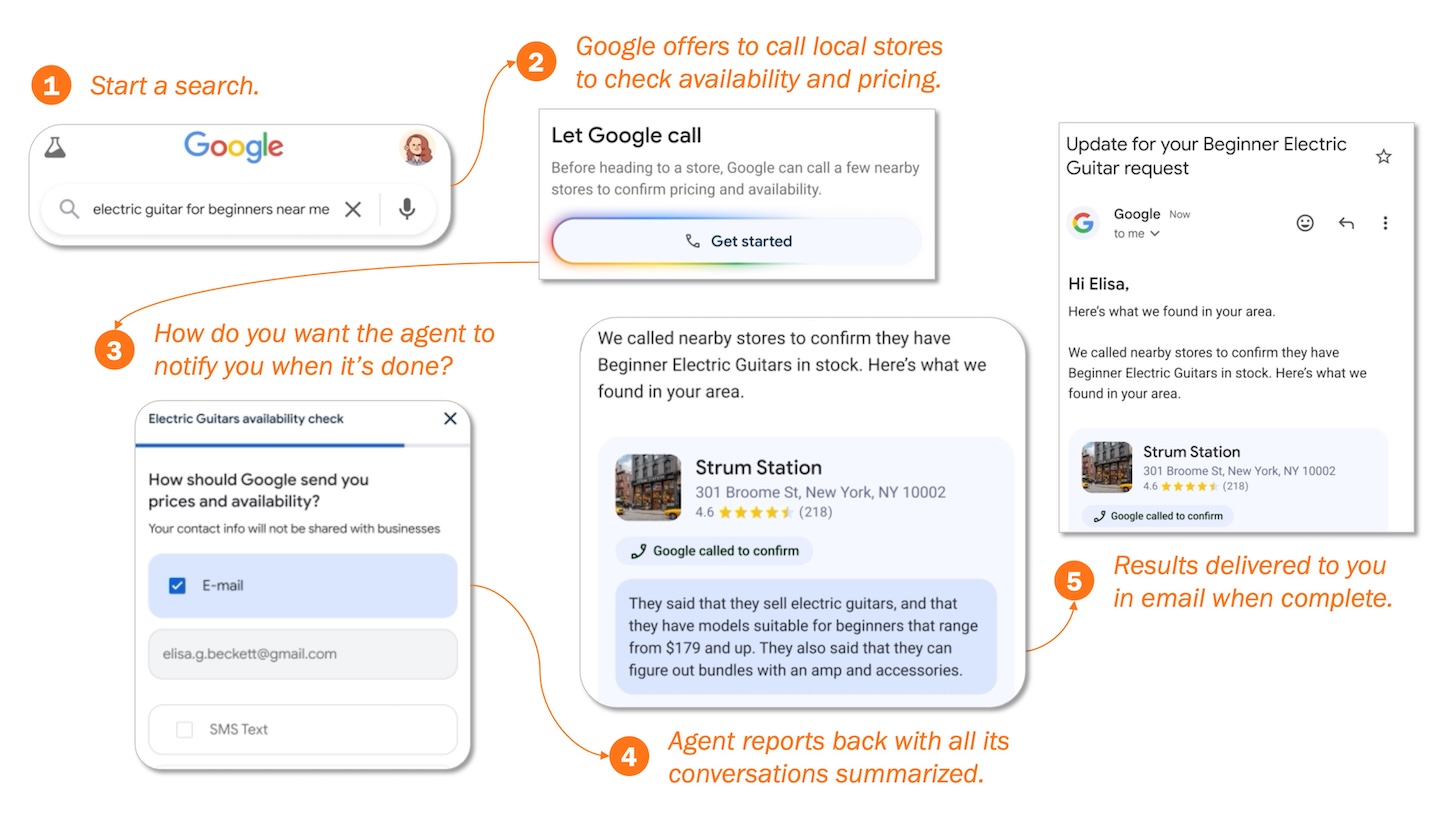
Google has launched similar transactional functionality with its agentic checkout feature, which can track prices for a desired purchase until they fall within a specified budget and then automatically buy it with Google Pay. One new feature with Google's Gemini AI agent is the option to have it call local stores to check pricing and availability: Google can place voice calls to multiple stores, ask the humans they connect with questions on the user's behalf, and report answers and offers over email.
Two open standards make this concrete rather than speculative. Stripe and OpenAI published the Agentic Commerce Protocol on September 29, 2025 as the open standard behind Instant Checkout, with an application route for merchants (Stripe newsroom, stripe.com). Google answered on January 11, 2026 with the Universal Commerce Protocol, described in its developer documentation as powering checkout in AI Mode in Search and the Gemini app (developers.google.com/merchant/ucp). The practical translation: "be discoverable" becomes "be machine-readable" - current product feeds, truthful price and stock, plain-language return terms, and a checkout path an agent can actually complete.
What happens when an AI agent calls your sales team?
There is irony in the reversal. For the past year, some B2B sellers have been enthusiastic about deploying outbound AI SDRs that tirelessly reach out to prospects and alert a human sales rep only when the AI finds a promising opportunity. The concern that human prospects had to wade through more personalized, but actually impersonal, incoming emails, texts and phone calls was secondary; the goal was efficiency for reps, not for customers.
Now the buyer can sit back while an AI agent calls human salespeople on their behalf. That creates new efficiency for the customer, but less for salespeople who face a rising volume of incoming calls from agents. They may choose to hang up, but then they risk foregoing a possible sale if a competitor is willing to take the call.
Having AI agents engage humans in either direction is not particularly efficient. This is expected to be a very brief intermediate state that hastens adoption of agent-to-agent interactions - and that creates the new game for marketers: how to market to and serve AI agents as intelligent intermediaries working on behalf of the target audience.
Seller-side agents vs. buyer-side agents: know which one you are fixing
| Dimension | Seller-side agent (your stack) | Buyer-side agent (their stack) |
|---|---|---|
| Who pays for it | Your software budget | The customer, or the platform bundling it |
| What it optimizes | Output volume and cost per asset | Fit, price, availability and risk for one person |
| What it consumes | Your briefs, CRM and DAM | Your feeds, structured data, pricing rules and public answers |
| What fails if you ignore it | Productivity targets | Consideration itself - you are never in the set |
| Sane KPI | Cycle time, cost per campaign | Assisted agent sessions, mentions, agent-completed checkout |
A five-step playbook for the next two quarters
- Map the agent's path, not the funnel. Pick your three highest-intent queries and ask what an assistant can actually read about you: price, stock, delivery window, return terms, integrations, security. Where the answer needs a login or a form, assume it is missing.
- Clean the machine-readable layer. Reconcile product feeds, structured data and the FAQ on each page so a model never has to guess between three conflicting numbers - a store that answers "in stock" by phone while the feed says otherwise will lose the agent's recommendation.
- Instrument before you scale. This closes the 14% gap: separate assistant and agent traffic from human sessions, log which surfaces refer you, and report agent-assisted conversions weekly instead of defending a guess in the next planning cycle.
- Rewrite content for extraction. Lead with the answer in 40-80 words, then evidence, then caveats; use comparison tables, dated statistics and one original data point per piece. The report's own survey design is a model of the specificity assistants reward.
- Set rules of engagement for machine contact. Decide who answers inbound agent calls and chats, publish price parity rules, cap discounting depth, and give agent-driven requests an auditable path to a human - because a competitor will take that call.
Nine-item readiness checklist
- Product feed, page copy and phone scripts state the same price and availability.
- Structured data marks up price, stock, shipping, returns and FAQ answers.
- Checkout is reachable without a human, or an approved agent endpoint exists.
- Assistant and agent traffic is segmented in analytics with its own conversion goal.
- Comparison and "best X for Y" pages carry dated figures and named sources.
- Attribution model credits assisted agent sessions, not only last click.
- A documented policy tells sales how to respond when the caller is software.
- Legal and brand review covers what an agent may promise on your behalf.
- A quarterly re-test checks citations across ChatGPT, Perplexity and Google's assistant surfaces.
Common pitfalls, and what to do instead
- "AEO is a plugin." Tools cannot restore visibility that the referral layer no longer emits; measurement and content structure come first.
- "Optimize for one model and you are done." Assistants cite different sources for different questions; test several, and treat volatility as the baseline.
- "Gate everything and the lead is stronger." Behind a form, your answer simply does not exist for an agent evaluating options.
- "Zero-party data wins personalization." The efficiency the report describes is incremental; buying signals now travel through intermediaries you cannot track.
- "Wait for official statistics." The 63% who adapt and the 14% who measure are separated by six months, not by budget.
How big is the prize, and who absorbs the oversight cost?
McKinsey & Company frames the stakes plainly: by 2030 the US B2C retail market alone could see up to $1 trillion in orchestrated revenue from agentic commerce, with larger global projections (mckinsey.com). Traffic shifts are already measurable: Adobe reported AI-referral traffic to US retail sites up 62% year over year in July 2026 (Digital Commerce 360), a maturing of the 1,200% surge Adobe Analytics logged back in March 2025.
The other side of the ledger is supervision. G2's 2026 AI Agents Report says 66% of B2B software buyers already have agents in production, while oversight is eating into returns - including 31% of buyers reporting staff spending six or more hours a week supervising agents (PR Newswire, prnewswire.com). Read next to the 14% instrumentation figure, the exposure is obvious: teams are absorbing real supervision costs for buyer behavior they cannot yet see, let alone forecast.
FAQ: what readers ask about AI agents in marketing
Is SEO dead now?
No. The channel that teams have optimized for the past 25 years is shrinking as an entry point, and Google's own assistants are part of that shift. Treat classic search as one input to answer engines rather than the destination, and measure the difference instead of assuming it.
What is the difference between SEO, AEO and GEO?
SEO wins rankings on a results page; AEO (answer engine optimization) wins inclusion in a generated answer; GEO (generative engine optimization) covers being retrievable and citable across generative surfaces broadly. The AEO product category is growing fast but early, so none of them replaces instrumentation.
Can a small brand with no data team act on this?
Yes, and cheaply. Merchant-facing rails already lower the bar: Instant Checkout started with Etsy and Shopify stores before the Walmart deal, so the practical first steps are feed hygiene, plain return and shipping answers, and analytics that can name agent-driven sessions.
Should we reply to agents that contact our sales team?
Yes. Hanging up looks efficient until a competitor answers, and these machine-initiated conversations are the earliest evidence of demand that never reaches your website. Log them as a source, not as an anomaly.
What is the first metric to fix?
Assisted agent sessions: visits or checkout requests that arrive from an assistant surface, plus the rate at which your pages get cited in answers. Everything else in the playbook depends on having a number you trust.
Where the underlying research lives
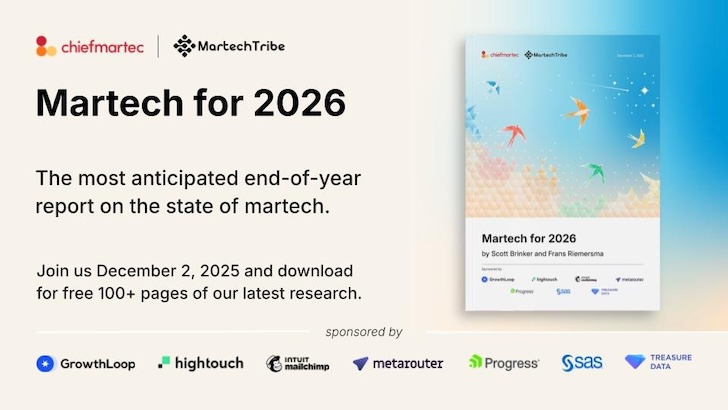
The 100+ page Martech for 2026 report, supported by GrowthLoop, Hightouch, Intuit Mailchimp, MetaRouter, Progress, SAS and Treasure Data, examines the first pragmatic steps of that journey.
This playbook was written by Sarah Chen for MyTechDailyNews, published by Tech Daily. Spotted something to correct, or want to share how your team is measuring agent traffic? Write to the newsroom at hello@techdaily.com.
Sources and further reading
- McKinsey & Company, "The agentic commerce opportunity" - https://www.mckinsey.com/capabilities/quantumblack/our-insights/the-agentic-commerce-opportunity-how-ai-agents-are-ushering-in-a-new-era-for-consumers-and-merchants
- Stripe Newsroom, Instant Checkout and the Agentic Commerce Protocol (September 29, 2025) - https://stripe.com/newsroom/news/stripe-openai-instant-checkout
- Google for Developers, Universal Commerce Protocol documentation - https://developers.google.com/merchant/ucp
- G2, 2026 AI Agents Report press release - https://www.prnewswire.com/news-releases/new-g2-research-ai-agents-have-moved-from-pilot-to-production-but-oversight-comes-at-a-cost-302908654.html
- Digital Commerce 360 on Adobe's July 2026 AI-referral data - https://www.digitalcommerce360.com/2026-08-19/adobe-ai-referral-traffic-data-july-2026/