
MyTechDailyNews General Compares 13 brands in the Microsoft Outage: A Side-by-Side Guide to What Landed, What Didn't and Why
Short answer: the posts that landed did one of two things — they tied the joke to a product people already associate with a break or a meal, or they attached a concrete offer. When Microsoft Outlook went dark last Friday, most of the 13 brands took one of those routes; the rest added noise. Here is the side-by-side read, with the trade-off and the decision rule behind each play.
What happened, and why did the window stay open so long?
Bottom line: this was a capacity-upgrade problem, not an attack, and recovery was gradual. According to Associated Press, a global disruption to Microsoft 365 stretched from Thursday into Friday the 13th, leaving hundreds of millions of users cut off from Outlook, Teams, Copilot and SharePoint. On Friday, Microsoft apologised and attributed the incident to a recent network change that followed a capacity upgrade, ruling out a cyberattack or AI agents as the cause. The clearest primary reference for the timeline is the Associated Press report on services being fully restored.
The scale matters because it explains the attention. Ookla's Downdetector data shows the November 2026 Microsoft 365 outage drew more than 7 million reports, the most in 12 months, while Downdetector said reports reached 74 countries and territories in about an hour. CBC tracked a disruption lasting more than 12 hours. These are report and reach counts, not a verified headcount of affected users — useful as an attention proxy, not a customer total.
That gap between systems down and everyone talking about it is where real-time marketing lives. Because when the inbox is down, there is always social media. The four plays below are the patterns the 13 brands actually used.
Which plays landed, and what did each one cost?
Conclusion first: product-as-punchline and offer-backed posts delivered the clearest business value; pure wordplay won the raw engagement numbers. This table is the quick-scan version, and the sections after it show the exact posts.
| Play | Brands in this story | The mechanism | Trade-off | Best fit |
|---|---|---|---|---|
| 1. Permission to log off | Burger King, KitKat, Nando's Malaysia | A joke that gives stressed workers an excuse to step away | Highly shareable, weak conversion path | Brands whose product already means break |
| 2. Product-as-punchline | IKEA Singapore, Kinder Bueno, OATSIDE, Oreo, Subway Malaysia, McDonald's | Make the product the answer to the outage | Strong recall, needs a clever visual or mascot | Food and drink brands with recognisable assets |
| 3. Offer-backed | Chili's, Pizza Hut Malaysia, Pizza Hut Singapore | Joke plus a discount or giveaway | Measurable demand, promo fatigue risk | Chains with an app or loyalty hook |
| 4. Competitive jab | Wendy's, Yahoo | Name-drop a rival or the unread-inbox pile | Buzz, but can read as mean | Brands with an established snark voice |
Play 1: permission to log off — why did these jokes work?
Burger King — a Whopper while you wait
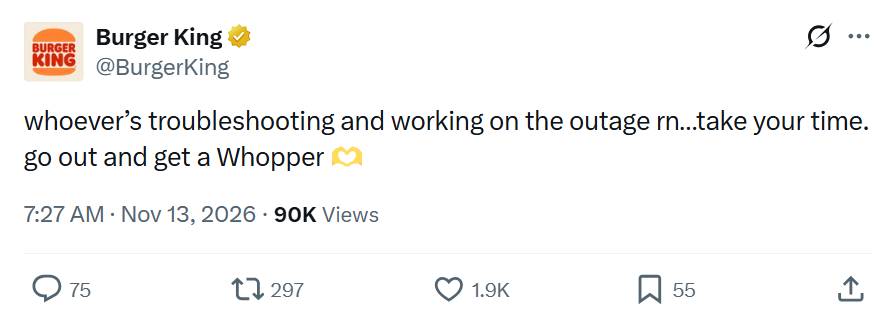
Burger King took to X with a short and sweet quip, telling whoever was troubleshooting the outage to take their time — and perhaps even enjoy a Whopper. The joke taps into the online sentiment that, while the outage was stressful, many workers felt somewhat relieved to step away from their screens.
KitKat — the break that writes itself
Across multiple markets, KitKat leaned on its iconic slogan: "Have a break, have a KitKat". On its global Instagram account, a man faced with Outlook being down says, "I'm just going for a break". The caption read, "Microsoft 🤝 KitKat 🤝 Having a Break". In Malaysia, the post was simpler: a KitKat sticking out of the Outlook logo, captioned "The universe blocked your emails so you can have a break!" The fit is almost unfair — the product name already contains the remedy.
Nando's Malaysia — one word, done
Nando's Malaysia went meme-coded, showing an employee grilling the Outlook logo with the text "cooked". The caption read: "kalau korang kat opis lagi, here's your sign to balik." — "If you're still in the office, here's your sign to go home".
Play 2: product-as-punchline — when is your SKU the answer?
IKEA Singapore — the plush-toy pun
IKEA Singapore went cute, posting its jerboa soft toy with the line "Thank god there's no outage on this micro-soft." The caption added: "Phew, that almost caused widespread panic." The post has since gathered over 21,900 likes. It is the clearest example of a visual doing the work a paragraph of copy could not.
Kinder Bueno — the snack as colleague
"The only thing you and your coworker are opening today." That is how Kinder Bueno described its chocolate biscuit and wafer treat, urging fans to "forget the emails" and tag a favourite coworker to open something "better".
OATSIDE — pour it on the laptop
Singaporean plant-based oat milk brand OATSIDE had its bear mascot pouring a carton onto a laptop with Outlook open. The post read, "Microsoft left Teams running, but we got you covered."
Oreo — two-panel problem and fix
Oreo's Malaysia and Singapore Instagram account showed a glass of milk marked "Something went wrong"; the next slide put an Oreo in that glass with "Everything just feels right,". The joke needs no explanation.
Subway Malaysia — 365 days
"Microsoft 365 is down," Subway Malaysia reported, before the punchline: "Our subs? Fresh 365 days a year." The caption added "No downtime, just good bites".
McDonald's — the rice meme, reworked
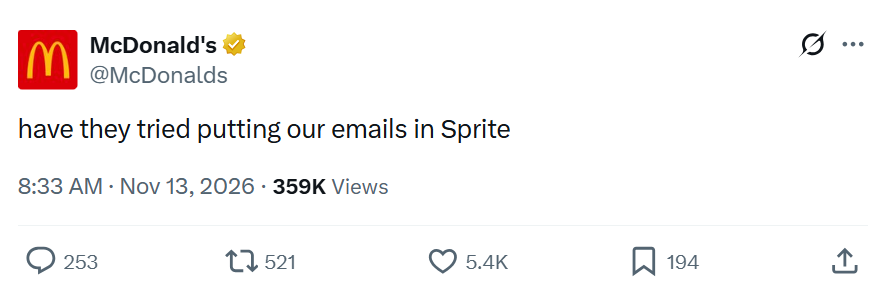
On X, McDonald's offered one line: "have they tried putting our emails in Sprite"? It spoofs "have you tried putting it in rice", the trick some people use to dry out waterlogged devices. Sprite does the joke's heavy lifting.
Play 3: offer-backed posts — did the discounts convert?
Chili's — the loudest call to action
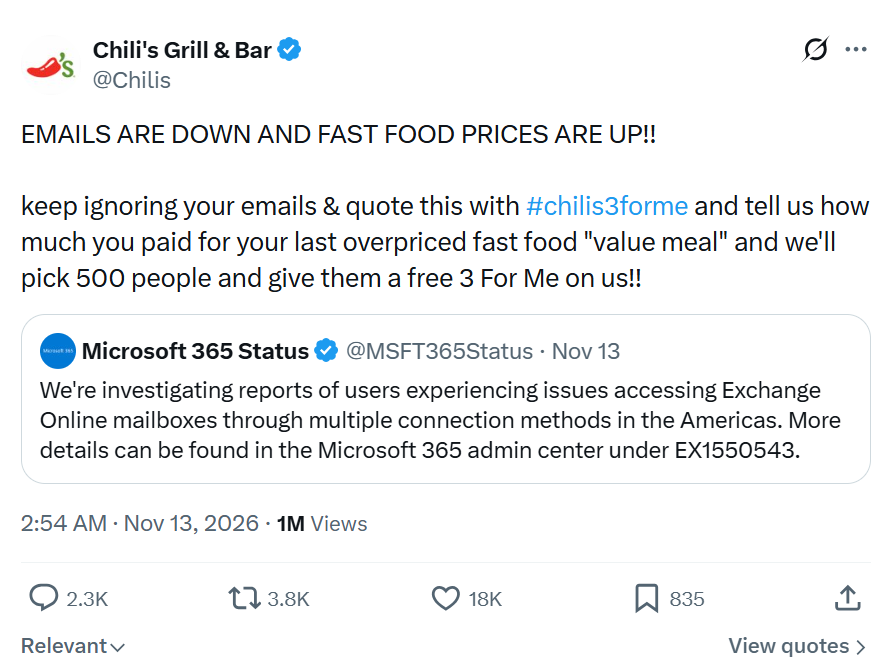
Chili's replied directly to the official Microsoft 365 Status account: "EMAILS ARE DOWN AND FAST FOOD PRICES ARE UP!!" It followed with: "Keep ignoring your emails & quote this with #chilis3forme and tell us how much you paid for your last overpriced fast food "value meal" and we'll pick 500 people and give them a free 3 For Me on us!!" The post drew over 16,000 likes and invited users to call out other brands' expensive prices, positioning Chili's as a brand that cares about affordability. Of the plays here, this is the only one with a clear next step for the reader.
Pizza Hut Malaysia and Singapore — two different hooks
Pizza Hut Malaysia reminded people they could open a different app: "Korang tak perlukan Outlook untuk order Pizza Hut" — "You don't need Outlook to order Pizza Hut". It paired the joke with an RM5 promo. Across the causeway, Pizza Hut Singapore pushed its new festive Starizo pizza: "Someone wished a little too hard on our Starizo,". Same outage, two very different commercial goals.
Play 4: competitive jabs — funny or just mean?
Wendy's — the Venn diagram
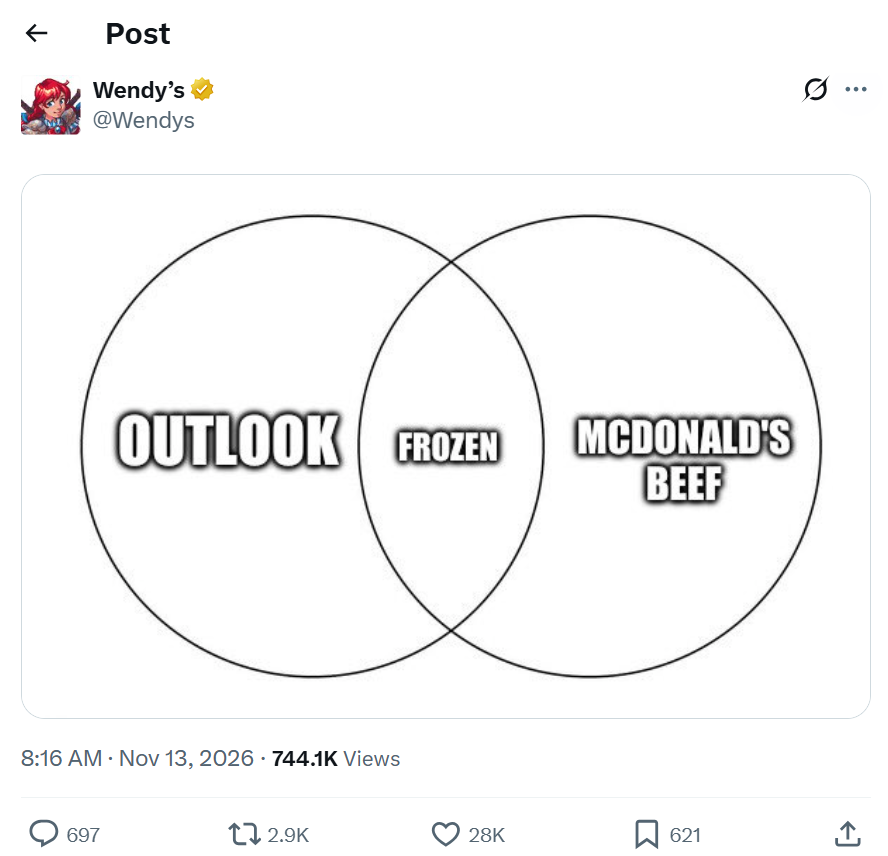
Wendy's went spicy on X, name-dropping rival McDonald's. Its Venn diagram put "Outlook" on one side and "McDonald's beef" on the other. The intersection? "Frozen." That is a joke with a long-running feud behind it, which is why it lands for Wendy's and might not for you.
Yahoo — the inbox nobody wanted
As a competitor, Yahoo joined the fun without naming Outlook, using a text-only Instagram post: "Work email down? Great! Now time for your 346,538 unread personal emails." It drew over 102,000 likes — the biggest number in this set, and a reminder that reach and revenue are different scoreboards.
What are the common misconceptions about outage marketing?
- Silence is worse than any joke. Not true. A post that ignores people locked out of work can read as tone-deaf. The permission-to-log-off jokes worked because they acknowledged the pain first.
- Speed is everything. Fast helps, but only when the joke fits the brand. A PRSA career resource reports that brands responding within 30 minutes of a crisis see 37% less negative sentiment spread — that is about having a holding plan, not about publishing any old pun.
- Likes equal results. Yahoo's 102,000 likes came with no offer; Chili's 16,000 likes came with a 500-person giveaway. Different goals, different numbers.
Pure PR's same-week guide on real-time PR during an outage offers the working rule: "look for a genuine moment to show up" and "make sure the joke, offer or idea actually lands in the real world" (source).
Action checklist: what should your brand do next time?
- Confirm the outage is real and operational, not a security incident — Microsoft itself had to rule out a cyberattack or AI agents as the cause.
- Ask the fit question: does our product or voice naturally intersect with the moment?
- Pick one of the four plays above before you write a word, so the post has a job.
- If you make an offer, make it measurable. Chili's tracked entries; that is why it can call the post a success.
- Keep promos in proportion. The same logic behind our note on promos in transactional emails applies here: an offer should help, not erode trust.
- Pre-approve a holding line and a kill switch. Speed without a plan is how brands post the wrong joke.
FAQ: quick answers about brands and the Microsoft 365 outage
Was this a cyberattack?
No. On Friday, Microsoft attributed the incident to a recent network change following a capacity upgrade and ruled out a cyberattack or AI agents as the cause, according to Associated Press.
How many users were affected?
Reports put it at hundreds of millions of users cut off from Outlook, Teams, Copilot and SharePoint. Downdetector logged more than 7 million reports across the episode, but report counts are not a user headcount.
Which post performed best?
By likes, Yahoo's unread-email joke with over 102,000 likes, followed by IKEA Singapore with over 21,900 and Chili's with over 16,000. By commercial intent, Chili's offer-backed post is the strongest.
Should every brand join an outage conversation?
No. The four plays here share one precondition: a genuine link between the brand and the moment. If you have to force the connection, skip it.
What to watch next
The interesting question is not whether brands will keep posting during outages — they will — but whether the four-play playbook gets more disciplined. As more companies pre-build reactive content, the advantage shifts from being first to being right for the brand. When the next Microsoft 365 disruption starts, will your team be measuring likes, or measuring something that survives the reboot?
Reference sources
- Associated Press — Microsoft says services fully restored after hourslong global outage
- Ookla — Microsoft's Outage Clocked In Around the World
- CBC — Microsoft outage live updates (more than 12 hours)
- Pure PR — How to Run Real-Time PR During a Global Outage
- PRSA — Social Media Crisis Management: Real-Time Response Strategies