
From Clinic Queue to Print Bed: What the 3D Systems and BioSummer Dental NextDent 300 Expansion Means for Care in Europe
Anyone who has waited for a set of dentures knows that the wait, not the hardware, is the real story: an impression, a wax try-in, a fitting, an adjustment, and another trip back to the chair weeks later. So an industrial announcement that landed this week deserves a translation for ordinary readers. 3D Systems has widened a long-running strategic distribution partnership with BioSummer Dental, a France-based distributor of advanced digital dentistry solutions, and the hardware moving through that channel is one of the few pieces of dental equipment whose regulatory status has quietly been deciding how fast patients get their teeth.
Under the expanded agreement, BioSummer Dental adds the NextDent 300 MultiJet 3D printer to its portfolio and is preparing to deliver initial units to several strategic customers across Europe. That is the headline. The more useful question for a general tech audience is why a distribution deal, rather than a product launch, is the meaningful signal — and what it does to the speed, availability and cost of a treatment that hundreds of millions of people still depend on.
What was actually announced, and what was not
This is a channel story with a regulatory trigger. The NextDent Jet Base and Teeth materials received certification under the EU Medical Device Regulation — formally EU MDR 2017/745 — in April 2026, and that is what opened commercialisation throughout the European Union for the wider NextDent Jetted Denture Solution. With the milestone reached, the company moved to widen market access through strategic distributors: BioSummer Dental, which combines an established presence in the dental industry with digital-workflow expertise, now positions the NextDent 300 for laboratories in France and the rest of Europe, and the two partners say they want to accelerate adoption of digital denture workflows more broadly.
What the news is not: a claim that dentures are now produced automatically from scan to delivery, or that every European laboratory can order one next week. Fabrication is the step that has been industrialised. The clinical steps around it — diagnostics, scanning or impression, jaw-relation records, and the final adjustments a dentist makes in your mouth — are untouched by the announcement.
The real gatekeeper was paperwork, not machinery
3D printing has been sold into dental laboratories for years, so why did this particular printer need a certification milestone before it could be distributed at scale? Because the EU MDR, in application since 26 May 2021, replaced the older device directives with a regime that requires manufacturers to evidence classification, clinical evaluation and post-market surveillance rather than rely on lighter declarations of conformity. Regulatory guides written for dental device makers under EU MDR 2017/745 describe the burden concentrating in three places — classification decisions, clinical evidence and Notified Body readiness — and warn that inconsistent submissions generate more questions and longer review cycles (mdxcro.com).
The commercial consequence is simple and rarely explained in consumer coverage: an uncertified bio-compatible material is a research sample; a certified one is a product a distributor can legally sell and a lab can legally put into a patient. Company statements around the certification describe it as Class IIa, the mid-range risk class used for devices with longer-term body contact, and pair that status with a demand argument of more than 60 million edentulous patients across the US and EU (3dsystems.com press release, 28 April 2026). Read that way, the April 2026 approval was the launch event, and this partnership is simply the first large-scale distribution echo of it.
Inside the machine: what a print bed of dentures actually changes
For readers outside the industry, the useful comparison is two ways of building the same object. Conventional full dentures are made in stages that laboratories themselves document as roughly a ten-step craft sequence: a wax set-up is tried, then flasked, heated, the wax flushed out, acrylic packed in, cured, deflasked, trimmed, finished and polished (blog.ddslab.com). Teeth and pink base are separate components bonded together, so every stage adds skilled labour, and every bond is somewhere fit or appearance can drift.
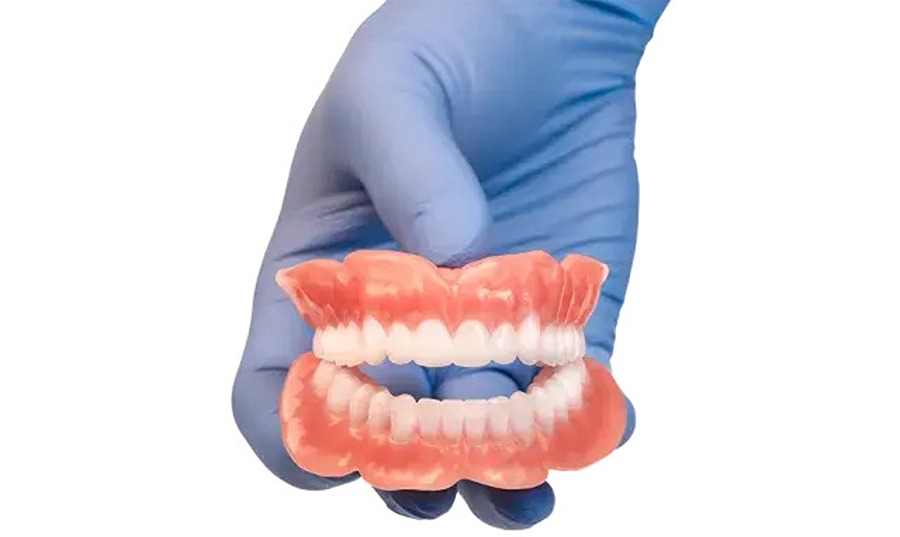
A MultiJet printer works the way an office inkjet prints a colour document, except the "ink" is a photopolymerised resin and the output is a solid object. Base material and tooth material are jetted in one pass, so gum and teeth emerge as a single monolithic piece rather than two parts assembled afterwards. Published specifications put the build volume at roughly 294 x 211 x 50 mm, enough for an average of about 15 dentures per run, with individual prints described in the region of 20 minutes (3dsystems.com product page; todaysmedicaldevelopments.com). When the same solution was released commercially in the US, the vendor contrasted that pace with a roughly five-day turnaround for conventional one-piece denture production (todaysmedicaldevelopments.com).
| Dimension | Conventional workflow | Jetted digital workflow |
|---|---|---|
| Part count | Base and teeth made separately, then bonded | One monolithic piece printed in a single pass |
| Skilled labour | Wax-up, flasking, packing, deflasking, polishing | File prep, print, support removal, finishing |
| Batching | Effectively one case moving at a time | Multiple cases in one build (≈15 per run, per published specs) |
| Variability | Depends heavily on individual technician habit | Repeatable job; software handles nesting and supports |
| Patient touchpoints | Clinic pages describe several visits spread over weeks | Fabrication compressed; clinical visits unchanged in number of steps |
The demand math sitting behind a distribution deal
Dentures feel like an old-fashioned product but scale like a consumer one. Figures cited around the European regulatory approval put more than 180 million people worldwide wearing dentures, generating annual production of roughly 13.7 million denture sets (businesswire.com, 25 March 2026). Demography points the same direction: research summaries of the dentures market note the global population aged 60 and above is projected to reach 2.1 billion by 2050 (researchandmarkets.com). And 3D Systems has sized the wider digital dental category at more than $14 billion by 2032 (company press release, 18 February 2025).
Stack those numbers and the strategy becomes obvious. Demand at that volume cannot be met by adding technicians one hire at a time, so the constraint shifts to throughput and to reach — which is exactly what a distributor with existing relationships in France and other European markets supplies. The printer is the least interesting part of the deal; the pipeline is the point.
Why laboratories, not dental offices, are the buyer
The first units are going to labs, and that changes how — and how fast — the benefit reaches a patient. A dental laboratory is a small manufacturer: it buys capital equipment, staffs technicians, and is currently losing a fight for skilled hands. Lab-industry commentary and vendor case studies repeatedly identify the technician shortage as the reason automation is being adopted, with integrated digital workflows framed as a way to scale output without scaling craft labour at the same rate (blog.ddslab.com; stratasys.com case study of a German clinic).
A machine that batches fifteen cases while a technician does something else improves per-unit economics at the lab first. Only afterwards does anything reach the patient: shorter waits, fewer remakes, and more consistent aesthetics. Expect any price effect to show up as throughput and lead-time improvement long before it shows up on a clinic invoice.
Five questions readers keep asking
Is a printed denture safer than a hand-made one?
"Safer" is the wrong frame. The right frame is "evidenced and repeatable": certification under the EU Medical Device Regulation means the materials had to carry a documented biocompatibility and clinical-evaluation case, and the printing step removes several manual operations where variability could creep in. Fit still depends on the accuracy of the scan or impression and on the dentist's adjustment work, neither of which the printer controls.
Will this make dentures cheaper?
Nothing in the announcement commits to a price. The stated intent of the workflow is lower labour content per denture, but the printer itself is capital equipment with consumables and service contracts. The realistic path is cost-per-case falling for labs that run machines close to capacity, then competitive pricing appearing unevenly in the consumer market. If you are choosing a clinic today, ask for the fee in writing and ask what the quoted price includes for adjustments.
Can I get one of these near me this year?
Certification opens the whole European Union commercially, but rollout is deliberately staged: initial units go to a handful of strategic customers through a distributor. The practical question to ask your dentist is not which printer the lab owns but whether your case goes through an entirely digital design-and-manufacture chain, and how many visits that chain requires.
Does this replace dentists or technicians?
No. It automates fabrication, not diagnosis or jaw-relation judgement. What it changes is where the technician's time goes: from wax and flask work toward file preparation, machine supervision and finishing. For an industry short of hands, that is closer to relieving the shortage than eliminating the job.
Is there an access upside?
There is, and it shows up outside the commercial channel. On 29 October 2026 the company donated a NextDent 300 MultiJet 3D printer to Remote Area Medical, a US non-profit that delivers free dental, vision and medical care, specifically to expand its capacity for making dentures (3dsystems.com press release; tctmagazine.com). Faster, less labour-dependent production is one of the few realistic answers to the backlog in low-cost denture care.
Common misconceptions worth correcting
- "3D-printed" means no human craftsmanship. It means the human work moves earlier (design files) and later (finishing, polishing, fitting). The number of skilled hours falls; it does not vanish.
- Regulatory approval covers the denture, not just the printer. Under EU MDR 2017/745 the evidence obligations attach to the materials and the finished device. A printer without certified materials cannot be sold as a denture solution.
- A digital workflow is one thing. Many clinics call a scanned impression "digital", while the lab still produces base and teeth separately and assembles them. Monolithic jetting and hybrid digital-analogue chains are different products with different failure rates.
- Speed equals quality. Faster turnaround is a productivity gain. Whether a patient needs fewer adjustment visits depends on design accuracy and the clinician's fitting work.
Checklist: six things to confirm before assuming you are getting a digital denture
- Ask whether the base and teeth are produced as one piece or assembled from separate parts.
- Ask how many visits the plan includes, and what happens if a fit adjustment is needed after delivery.
- Ask whether the lab has a CE-marked, EU MDR-compliant material set for the device going in your mouth.
- Ask what the quoted fee includes: rebases, repairs and follow-up adjustments are often billed separately.
- Ask about colour and shade selection — realistic aesthetics is the claim that distinguishes the newest materials from earlier printed bases.
- Ask what the turnaround is in working days, not in marketing language.
Action advice, by reader type
If you or a relative need dentures now
Do not wait for the new channel. Treatment quality today is dominated by the clinician and the lab relationship, not by the printer brand. Use the checklist above at the consultation, and ask specifically how many appointments and how many weeks the plan assumes — that is the variable digital fabrication actually improves.
If you run or work in a laboratory
Treat this as a capacity-and-labour decision, not a technology decision. Model two numbers before you commit: technician hours per case in your current chain, and the batch occupancy you can realistically sustain. A machine that prints fifteen dentures per run only pays if design files and finishing capacity keep pace with it.
If you build, sell or market health technology
The lesson here is that regulation is the product gate. Two practical moves: budget classification and clinical-evidence work as part of the launch plan rather than after it, and design your channel strategy around distributors who already hold laboratory trust — that is precisely the pattern in this announcement.
Trend judgment: four things to watch next
- Delivery discipline. European commercialisation of the solution was targeted for summer 2026 once certification landed (businesswire.com, 25 March 2026). Watch whether first units to strategic customers turn into routine orders, or stall in pilot mode.
- Where the money actually sits. Hardware is a one-off sale; the recurring line is certified materials. Expect distributor deals to be written around consumable volume, and price pressure to appear first on printers.
- Regulation as a moat. Every competitor printing base-and-tooth materials now faces the same evidence hurdle, so the number of certified monolithic denture options in the European Union will grow slowly — and consolidation, not new entrants, becomes the likelier route to market.
- Access spin-off. The donation to Remote Area Medical is a hint that speed-to-patient has humanitarian value. Watch for charitable or subsidised programmes adopting the same workflow, which could put printed dentures in front of patients who have never had a lab-made option at all.
The bottom line
Read as consumer technology news, this is not really about a printer joining a distributor's catalogue. It is the first broad distribution move after a certification that converted a promising dental manufacturing method into a legally sellable product across the European Union. The visible change for a lab is fewer manual steps and more cases per run; the visible change for a reader should eventually be a shorter, more predictable route from lost teeth to a finished set — provided the distributor network, not just the machine, keeps expanding.
Sources consulted for this explainer
- 3D Systems product page, NextDent 300 MultiJet — build and print specifications (3dsystems.com)
- 3D Systems EU MDR certification and Class IIa announcements, April 2026 (3dsystems.com press releases)
- Businesswire, "3D Systems Achieves Full-Scope EU MDR Certification", 25 March 2026 — global denture user and production figures
- Today's Medical Developments — US commercial release coverage and turnaround comparison
- mdxcro.com — EU MDR 2017/745 guidance for dental device manufacturers
- blog.ddslab.com — ten-step conventional denture fabrication; dental laboratory trends
- researchandmarkets.com — dentures market outlook and ageing-population projection
- TCT Magazine — donation of a NextDent 300 to Remote Area Medical
Written by Sarah Chen for MyTechDailyNews, published by Tech Daily. Corrections and story tips: hello@techdaily.com.