
AI Agents or Hybrid SaaS: Which 2026 B2B Go-to-Market Bets Deserve Your Budget?
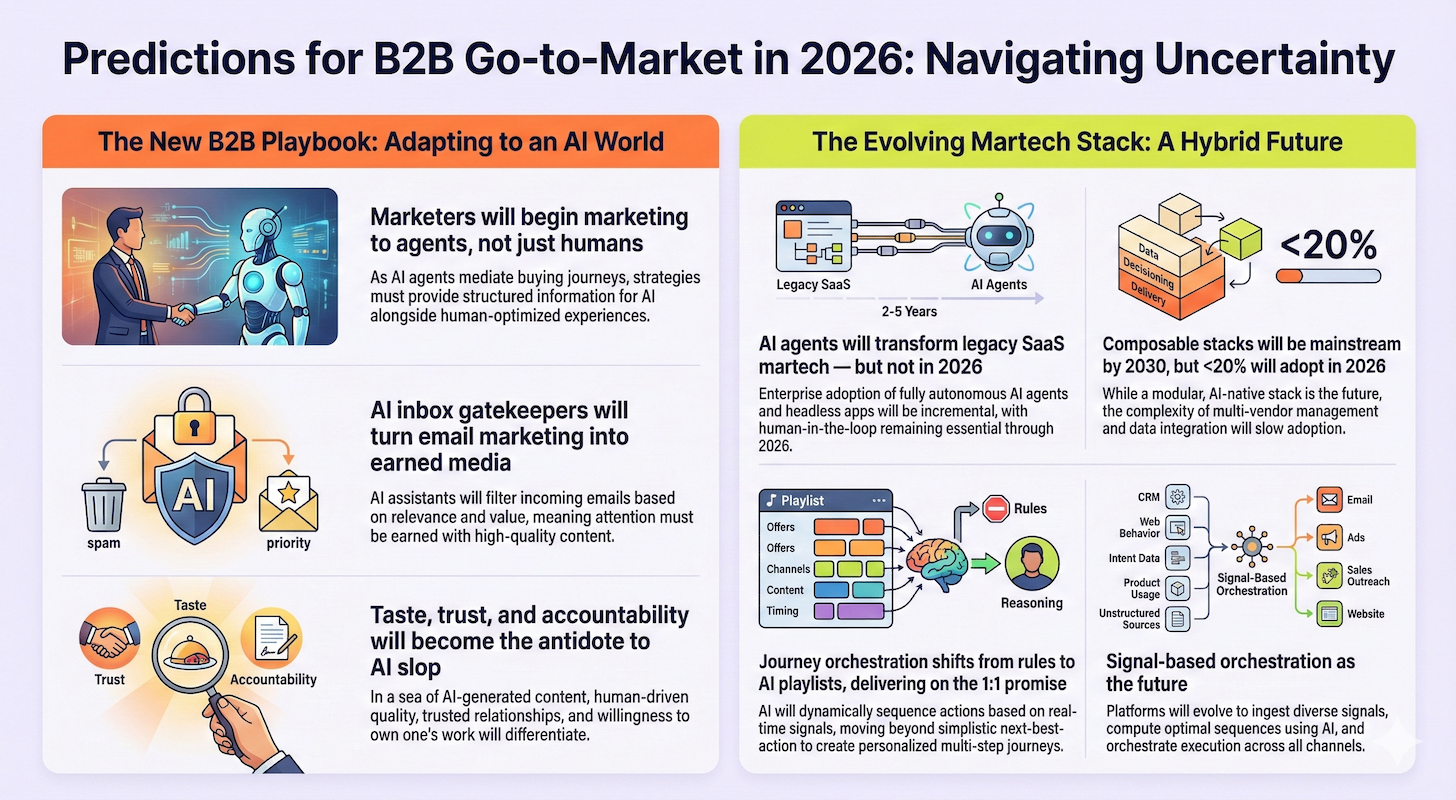
Short answer: 2026 rewards hybrid, not autonomous. Buy AI that is built into platforms you already trust, fund context engineering and agent-facing infrastructure now, and postpone a full composable re-architecture. Jon Miller — the Marketo co-founder and original CMO — has published his fourth annual go-to-market forecast, and reading the 2023, 2024 and 2025 editions together teaches one honest lesson: the direction is real, the pace is corporate.
This Tech Daily guide scores each prediction against your roadmap, then compares the three decisions teams actually face this year: market to humans or to agents, retrofit or replace the stack, integrated suite or composable architecture. Trade-offs, not hype.
What is on the 2026 prediction list?
Conclusion first: eleven shifts are on the scoreboard, and roughly half of them need a purchase order this year.
- Marketing starts addressing agents, not only humans
- Legacy SaaS martech gets transformed by AI — but not in 2026
- Composable stacks go mainstream by 2030, while only a small minority adopts this year
- Context engineering becomes a recognized GTM practice
- Reasoning systems start displacing brittle rules
- Journey orchestration moves from rules to AI playlists and finally delivers the decades-old 1:1 personalization promise
- AI inbox gatekeepers make email feel like earned media
- Taste, trust and accountability counter AI slop
- Public intent signals commoditize, while proprietary signals generate "alpha"
- Where martech is headed after 2026, plus rapid-fire mini-predictions
- AI-driven uncertainty intensifies, and preparation is the only answer
Independently of the forecast, adoption data points the same way. The G2 2026 AI Agents Insight Report, published 14 October 2026 from a survey of more than 1,000 B2B decision makers, found AI agent adoption among B2B software buyers climbed from 69% to 86% year over year, with 66% of companies now running agents in limited or full production — while noting that human oversight is eating into returns. Read together with Miller's autonomy figures below, the two sets are not in conflict: purchasing agents, supervising agents and letting agents act alone are three different budget lines.
Where should the 2026 budget go: a scoreboard
Conclusion first: fund infrastructure and context, pilot reasoning and playlists, defer re-platforming.
| Prediction | What 2026 actually looks like | Budget verdict | Best suited to |
|---|---|---|---|
| Marketing to agents | Services, structured data and intent capture sit beside brand experiences | Fund now | Any team whose buyers self-serve research |
| Reasoning replacing rules | Reasoning assists inside campaign tools, not rule deletion | Pilot | Teams drowning in exception logic |
| Journey orchestration | AI-suggested playlists with human approval loops | Fund now | Mid-market with at least one ops specialist |
| Fully composable stack | <20% adopt; most settle for composable lite | Defer | High-maturity teams with engineering support |
| Context engineering | A named discipline with owners, documents and reusable assets | Fund now | Everyone, including small teams |
| Legacy SaaS replaced | Hybrid experimentation with human-in-the-loop | Hold | Regulated and compliance-heavy enterprises |
| AI inbox gatekeepers | Summaries replace opens; relevance earns attention | Rework creative | High-volume email senders |
| Intent signals | Public data commoditizes; proprietary signals generate alpha | Fund measurement | Account-based programs |
| Uncertainty | Vendor stories outrun procurement reality | Reserve budget | All planners |
Should you market to agents, to humans, or to both?
Answer: to both, but with different money. Agents need machine-readable services and structured facts; humans still need brand, emotion and relationships. Scott Brinker calls the shift "from martech to marketing to tech", which is another way of saying that AI agents are now part of the buying committee rather than bots to block.
The evidence already in hand
The TrustRadius 2025 report says 90% of B2B buyers used tools like ChatGPT for research and 72% encountered Google AI Overviews while evaluating vendors. Chiefmartec and MartechTribe, in the Martech for 2026 report, found 63% of marketers publish AI-optimized content such as structured FAQs and schema markup, and they tend to their presence on the platforms where large models source answers, including Reddit and G2. Digital Bloom measured 51% of companies planning to increase AEO investment, against 14% for traditional SEO. Gartner went further in a February 2024 press release, forecasting that traditional search engine volume would drop 25% by 2026 as queries move to chatbots and virtual agents.
Five moves that follow
- AI as the new analyst briefing. How a model describes your company becomes a product marketing KPI; executive teams will watch AI positioning the way they once watched search rankings.
- AI advertising. Perplexity already sells sponsored follow-up questions, Google shows search and shopping ads inside AI-generated summaries for complex or commercial queries, and OpenAI plans to monetize free users with ads — though those plans were temporarily deprioritized after December's "code red" focused on core product quality.
- Agent identification and tracking. When an agent requests pricing or product specs, that is first-party intent and belongs in scoring and buying-stage prediction, contributing to Marketing Qualified Accounts just like a human visit. It requires "agent deanonymization": an unknown startup's agent researching your category may be noise, while a Fortune 500 company's agent comparing you against competitors could be pipeline.
- Dual-audience content architecture. Expect a headless model: one foundation layer of core data, content and services feeding two distribution paths. Humans get branded website experiences optimized for emotional engagement; agents get direct access to services — pricing APIs that return dynamic quotes, knowledge bases that answer detailed product questions — and both get responses matched to role and buying stage. Building this needs infrastructure that answers detailed queries accurately; chat vendors like Qualified have been building those systems, which likely contributed to their acquisition by Salesforce.
- Agent nurturing. Pure speculation: because polling a company for updates is computationally expensive, agents may "register" or "opt-in" to proactive updates from vendors their humans care about, and "agent nurturing" could emerge as a channel.
What will not change
Agents optimize for objective criteria — capabilities, pricing, compliance requirements — and do not care about your brand story. Humans still make the final call, at least for now: the 6sense Buyer Experience Report for 2025 showed buyers averaged 16 vendor interactions, unchanged from 2024. Agents compress research; people sign contracts.
Shelf-life test: tactic or infrastructure?
| Investment | Expected half-life | Verdict |
|---|---|---|
| Special markup, structured FAQs, machine-readable formatting | Short — resembles the keyword-stuffing era | Experiment cheaply, don't build a moat on it |
| Presence where models source answers (Reddit, review sites) | Medium — follows model behavior | Keep, measure citations |
| Headless data and services layer | Long — survives model changes | Build first |
| Agent-visitor capture into account scoring | Long — proprietary and defensible | Build now, own the outcome |
Miller's hot take is worth quoting as a warning label: even Google's own AI documentation confirms, "You don’t need to create new machine-readable files, AI text files, or markup to appear in these features." Static markup is likely to age out as models read human-optimized content better; the service infrastructure underneath probably will not.
Autonomous agents or SaaS with AI built in?
Answer: SaaS with AI built in. Anyone who spends time on LinkedIn has seen the proclamation: "SaaS is dead." As Brinker notes, follow only the techno-optimist influencers claiming to run whole departments with vibe-coded agents and you will feel desperately behind.
The dream version: you describe a goal and AI orchestrates everything across channels, no campaign builder required. "Promote our Q4 launch to enterprise accounts in financial services" becomes a single request that an AI translates into personalized content, coordinated timing, channel selection and budget optimization. Miller's prediction is that this rebuild takes 2-5 years, and 2026 is a year of hybrid experimentation in which old and new SaaS platforms coexist with agentic AI and human-in-the-loop stays essential.
The three disruption fronts
1. From software tools to autonomous agents
If you can hire digital workers who never sleep and scale infinitely, why buy licenses? Several of the fastest-growing AI companies, including Cursor and Harvey, are not helping humans work better so much as replacing labor. Brendan Short argues the next major GTM company will be one that "sells labor" rather than software — AI agents managed by GTM operators, paid for outcomes instead of seats.
Yet the pricing evidence is messy, and that is useful for buyers. Salesforce launched consumption-based Agentforce "Flex Credits" on 15 May 2025 at about $0.10 per action after its original $2-per-conversation model, and later added per-user licenses from roughly $125 per user per month, according to Salesforce's own announcement and SaaStr's breakdown. Even the loudest agent vendor is selling a hybrid — which is exactly what a 2026 buyer should expect to negotiate.
2. From user interfaces to headless applications
Instead of logging into individual platforms, many people will work inside their chatbot of choice: a CMO simply asks "which campaigns performed best this quarter". Chat is not always better than clicks, though — for experienced users doing repetitive work, a familiar interface usually beats describing intent and waiting. This is why the Model Context Protocol matters: rather than custom connectors between every AI app and every tool, MCP offers a standardized protocol where each side builds one connection.
3. From monolithic platforms to composable apps
AI now writes mini-applications for narrow problems, often unprompted, and non-engineers can vibe code simple fixes. Over time that shrinks the long tail of lower-value apps in various app stores. The limits are real: as Martech for 2026 puts it, simple dashboards and internal tracking tools are fine for non-engineers, anything touching sensitive data needs qualified developers, and complex enterprise platforms such as CRM and MAP should still be bought from commercial vendors.
Four brakes on 2026 adoption
- Usage reality. In 2025, 81% of AI usage is "assist-only", while less than 10% lets agents act autonomously.
- Organizational absorption. Brinker's Martec's Law holds that technology changes faster than companies can absorb it — think mainframe to enterprise software, enterprise software to SaaS, or how long MQLs persisted even after better options like MQAs existed.
- Enterprise requirements. SaaS value is the infrastructure built over years: compliance, security, governance, auditability, scalability and integrations. An AI layer does not erase any of them.
- Hard engineering and hallucinations. Dynamic orchestration across millions of contacts, bidirectional sync with Salesforce, complex data models and edge cases do not dissolve; and you cannot let agents decide whether to honor CAN-SPAM opt-outs or GDPR deletion requests.
The pricing model tells the story best: if SaaS were truly dead, outcome-based pricing would be everywhere. Instead Salesforce's Agentic Enterprise License Agreement uses credits but keeps seats at the core, because, as CFO Amy Weaver explained, customers prefer seat pricing since "it gives you predictability."
Retrofit, replace, or wait
| Option | Strength | Weakness | Choose it if |
|---|---|---|---|
| Legacy suite plus AI add-ons | Compliance and integrations already proven | Agent behavior bolted onto old data models | You operate in a regulated category and cannot tolerate surprises |
| AI-native platform | Agentic, API-driven and MCP-enabled at the core, with today's UI and oversight patterns | New vendor risk, migration effort | You can run a controlled pilot on one journey or channel |
| Wait a cycle | No wasted spend | Lose the learning curve; context work compounds | Only if you spend the year on data, services and documented context instead |
What actually gets adopted looks like advanced driver assistance rather than a self-driving car: enterprise marketers want a better Marketo, AI-assisted campaign creation that still shows the workflow before executing, intelligent segmentation they can review and adjust, and AI providing "air traffic control" between campaigns to prevent message conflicts — with familiar interfaces and human approval loops.
Integrated suite, composable stack, or composable lite?
Answer: composable lite for most teams. A composable stack is built from modular layers rather than one vendor suite:
- A Data layer as the source of truth, combining customer data from multiple sources
- A Decisioning layer for intelligence such as audience selection and journey orchestration
- Delivery tools that execute messages across channels via APIs
The movement is measurable but slow. The Digital Bloom analysis of martech stacks showed marketing automation platforms' role as the "center" of B2B stacks decline from about ~31% to ~26% of respondents year over year, while custom platforms — a proxy for composable — grew from 2% to 10%. Most mid-market B2B firms still prefer integrated platforms such as Marketo or HubSpot. Miller's call: by 2030 a modular, AI-native, signal-driven stack is the norm, but fewer than 20% of B2B teams will run a fully composable architecture in 2026. The blunt shorthand for this year, in his own numbering, is <20%.
Why so slow
- Complexity transfers, it does not vanish. You trade vendor-managed convenience for control, and take on making the pieces work together; MCP improves this only gradually.
- Multi-vendor management is harder than it looks. Mike Lowndes, VP Analyst at Gartner, put it plainly: "Especially in B2B, the challenges of adopting composable solutions are significant. Many organizations struggle to manage multiple vendors and contracts effectively, particularly if they lack the necessary digital maturity."
- Warehouses are still built for engineers. In practice, legacy martech struggles to reach product and behavioral data stored centrally, producing silos, API-limit workarounds and manual extracts.
- Decisioning and Delivery are hard to separate. Your ESP may not support the personalization a model envisioned, and optimizing outcomes needs a closed feedback loop. As Real Story Group observed, "true orchestration requires closing the loop across data, decisioning, and content layers" — something few stacks achieve today.
| Criterion | Integrated suite | Fully composable | Composable lite |
|---|---|---|---|
| Time to value | Fastest | Slowest | Middle |
| Vendor lock-in risk | High | Low | Medium |
| Ops maturity needed | Low to medium | High | Medium |
| AI readiness | Vendor-paced | Best control of context | Warehouse feeds models, MAP executes |
| Budget predictability | High | Low early on | Medium |
| Fits | Lean teams, one segment | Platform teams with engineering | Most mid-market B2B in 2026 |
The realistic path: keep the warehouse as an important source of truth, but let your MAP, website, chat tools and ad platforms keep working as more than dumb pipes. Final journey orchestration stays inside the MAP while scoring, segmentation and some intelligence shift toward the warehouse — a stepping stone rather than a demolition.
Is context engineering worth its own budget line?
Answer: yes — it is the least hyped item on the list with the clearest payback. Poor data quality is consistently cited as the biggest obstacle teams hit with AI, but "data quality" undersells the problem: the real gap is operational context. Miller predicts that in 2026, context engineering — systematically capturing and structuring the knowledge that makes AI useful rather than generic — becomes a recognized practice across GTM operations teams. The term itself, popularized in engineering circles as the practice of filling a model's context window with just the right information at each step (see LangChain's July 2025 explainer), gets a marketing translation here.
What counts as context? Start by connecting AI to the sources your team already uses: CRM, data warehouse, call recordings, marketing platforms, internal documentation. Connection is not enough; you need an enablement layer that explains what data means and why — campaign naming conventions, which segments to include or exclude and the reasoning, what a "webinar campaign" means at your company (which tactics to build, what the follow-up sequence looks like, how leads route), and the logic behind a Salesforce schema shaped by ten years of customization.
Today that knowledge is nowhere formal. It lives in Slack threads and tribal memory, and when your best marketing-ops person leaves, it walks out with them. Legacy platforms can tell you which campaign a lead is in, but not why that campaign exists, what the strategy was, or what the team tried and abandoned: they store outcomes, not decision logic.
What changes: ops teams spend time teaching their AI platforms "skills" — how to read the schema, how to build a webinar campaign, which segments to use and when. It looks like onboarding a new hire, except the knowledge becomes durable and reusable instead of trapped in one person's head. That also answers the oversight bill flagged in the G2 report: documented context shortens review loops, so supervision stops scaling linearly with volume.
Five common misconceptions
- "Adoption equals autonomy." Buying agents and letting them act unsupervised are different maturity stages; most deployments keep a human in the loop.
- "AEO markup is the moat." Tactics age out; the headless data and services layer is what compounds.
- "Composable is cheaper." It transfers cost from licenses to integration, contracts and governance.
- "More signals mean better targeting." Public intent data commoditizes; the edge comes from proprietary signals that generate alpha.
- "AI gatekeepers kill email." They raise the bar: relevance, value and trust earn delivery, which is closer to earned media than to blasting.
Your 90-day action list
- Audit where agents already touch you: pricing pages, spec requests, API probes, assistant-driven traffic. Tag those visits before you change a single template.
- Publish one machine-readable source of truth for product facts, dynamic pricing and compliance answers, and test it with three assistants before touching schema markup.
- Write the first ten context documents: naming conventions, segment include and exclude rules with reasoning, the anatomy of one campaign type, routing logic, and known anti-patterns.
- Run one reasoning pilot against a rules-based workflow and compare cycle time, exception handling and review effort.
- Score the stack decision on operational maturity, not enthusiasm: if you cannot manage three vendor contracts cleanly, choose composable lite.
- Renegotiate with incumbent vendors around AI-assisted workflows you can approve, audit and roll back — and price the oversight hours honestly.
- Reserve budget for uncertainty: the year's biggest risk is not moving too slowly, it is buying the wrong layer twice.
FAQ: the questions teams ask first
Should we stop doing SEO and switch to AEO?
Do not frame it as a switch. Traditional search budgets are shrinking relative to AI-answer work — Digital Bloom's 51% versus 14% investment intent shows where boards are leaning — but the durable asset is the services and data layer that both channels read from. Treat structured markup as a cheap, temporary experiment.
What is context engineering in one sentence?
It is the practice of writing down how your team actually makes GTM decisions, in a form an AI can consume — the naming rules, segment logic, campaign anatomy and the reasoning behind a decade of customization.
Are we too small for composable?
If you have one ops generalist, yes for now. The pattern that fits is composable lite: warehouse as a source of truth, MAP still owning orchestration. Revisit when you can staff multi-vendor governance.
Will AI agents actually buy software this year?
They will increasingly evaluate, and that already changes what you publish. Final decisions still involve humans: the 6sense figure of 16 vendor interactions held flat year over year, which is the clearest signal that relationship-building is not obsolete.
Which single metric should a CMO watch in 2026?
Two, actually: how assistants describe your company versus competitors, and what share of your qualified pipeline came from agent-identified traffic. The first is the new analyst briefing; the second proves the investment was not theater.
References
- Jon Miller — 11 predictions for B2B go-to-market in 2026
- G2 2026 AI Agents Insight Report press release (14 October 2026)
- Gartner — search engine volume forecast to drop 25% by 2026
- Salesforce — Agentforce Flex Credits pricing announcement (15 May 2025)
- LangChain — context engineering for agents (July 2025)
Written by Sarah Chen, technology editor at Tech Daily. Spotted an error or want to challenge a verdict in this comparison? Email the newsroom at hello@techdaily.com.