
MyTechDailyNews Guide: Arrowspace S1 Electric Screwdriver Adds AI Screw Recognition and Smart Case Bit Lighting
Arrowspace S1 is being presented by Arrowmax as a compact electric screwdriver aimed at one recurring repair annoyance: finding the right driver bit. Instead of asking users to estimate a screw size from memory, the tool uses a high-definition camera and an AI model to analyze the screw head, then sends the result to a phone app through a local connection.
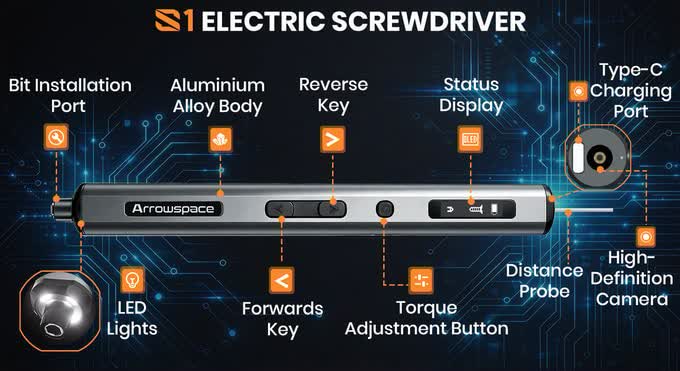
At the center of the process is the probe near the tail of the device. The user places the probe against the screw surface, allowing the camera to capture the head at its intended focus distance. Arrowmax says the company’s in-house trained model then evaluates the image and determines the screw specification. The model was trained on tens of thousands of real screw photos collected by the engineering team, with no external dataset used, which the company describes as a way to keep both accuracy and data provenance under internal control.
Once an answer is produced, the Arrowspace S1 does not stop at the display. It can connect locally to the companion mobile app, which shows the live camera image and presents the suggested bit, torque setting, and related operating details. The workflow is described as completing without internet access.
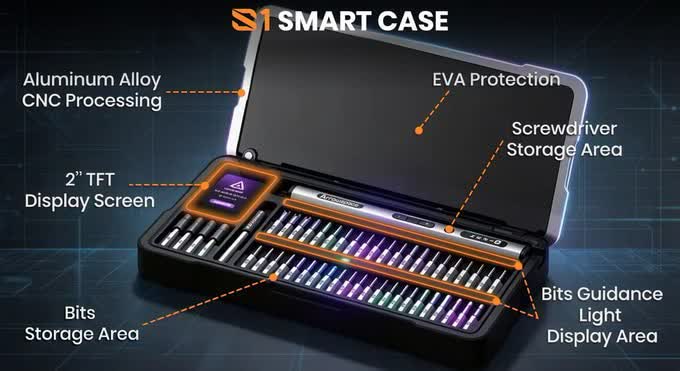
The optional Smart Case adds a more hands-on layer. The organizer holds 52 driver bits, and each bit position has an LED indicator. When the system identifies the required size, the corresponding lamp can light, helping the user pick the matching bit without scanning the whole tray. If used with the screwdriver, the same workflow can also set the recommended torque automatically, reducing the risk of stripped screw heads, damaged threads, or overtightening.
What the Arrowspace S1 hardware includes
For the tool itself, the published description centers on a small OLED screen that reports battery level, torque, and rotation direction. Power comes from a 600mAh lithium-polymer battery. Arrowmax states the expected runtime is about 90 minutes, or enough work to complete about 900 screws in the company’s example. Charging uses USB-C, with a full charge described as taking about 70 minutes. The torque range spans 1 to 10 kgf/cm.
The repair scope emphasized in the campaign is close to consumer electronics and delicate objects rather than heavy-duty fasteners. Laptop screws, phone screws, glasses screws, and similar tiny fasteners are the natural context for the AI identification feature and the automatic torque recommendation.
Launch pricing and reward tiers
Arrowmax has opened a crowdfunding campaign for the product on the Kickstarter platform. The standalone early-bird tier is listed at about $80. The kit tier, which includes the Smart Case and the 52 bits, is listed at about $129. The campaign launched on October 20 and reached its funding goal within 24 hours. The total raised later became more than ten times the initial target.
| Version | What it includes | Early price |
|---|---|---|
| Arrowspace S1 only | Electric screwdriver, camera, AI-assisted screw identification, local app sync | about $80 |
| Arrowspace S1 + Smart Case | Screwdriver plus Smart Case with 52 bits and LED bit-position prompts | about $129 |
Accessories are also mentioned, including an angle adapter, a bit conversion set, and a mini vise. These parts are framed as extensions for different assembly and repair positions, not as a separate core product.
Why the product matters beyond novelty
An electric screwdriver is a familiar tool, but screw sizes are often tiny and visually similar. For people who open a laptop once every few years, the real bottleneck is rarely turning the screwdriver; it is knowing which bit to use and whether the torque is appropriate. The Arrowspace S1 addresses that specific mismatch. If its identification rate reaches its intended level, the product could point to a broader direction for smart hand tools: fewer guesswork steps, more guided workflows, and tighter coupling between a physical tool and a companion app.
Checklist before you decide
- Confirm whether you often repair small consumer devices where 1 to 10 kgf/cm and fine bits are useful.
- Decide if the Smart Case’s 52 bits and LED prompts solve your main problem, or if the screwdriver alone is enough.
- Remember the campaign was launched on October 20 on the Kickstarter platform and reached its funding goal within 24 hours, with later pledges exceeding the initial target by more than ten times.
- Check the reward tiers: about $80 for the standalone early price and about $129 for the Smart Case kit.
- Review included accessories such as the angle adapter, bit conversion set, and mini vise only if your repair setup needs them.
Common misconceptions
- This is not described as a fully autonomous robot screwdriver. It assists with identification and recommended settings; the user still performs the repair.
- The app does not require an internet connection in the stated flow; it connects locally to show live image and settings.
- The training data description is specific: tens of thousands of real screw photos collected by Arrowmax, not a generic open dataset.
- The 52 bits are part of the Smart Case accessory path, not an assumption that every user needs the case.
- Early-bird pricing reflects crowdfunding timing, not a permanent retail price claim.
FAQ
What does the AI actually identify?
The AI analyzes a captured image of the screw head and attempts to determine the screw specification. The result is shown through the tool’s local app connection, including the recommended bit and torque.
How does the Smart Case help?
The Smart Case stores 52 bits, each with an LED at its position. When the recommended size is identified, the matching lamp lights, helping the user locate the correct bit.
Is the tool offline?
The described workflow completes without internet access because the identification data is synchronized to the phone app through a local connection.
What are the battery and runtime figures?
The stated battery is 600mAh lithium-polymer. Arrowmax describes about 90 minutes of continuous use or about 900 screws in its example, with full charging taking about 70 minutes over USB-C.
Action suggestions
If you are deciding whether to back the campaign, start with your most common repair scenario. If you mostly open laptops, phones, or glasses, the Arrowspace S1’s camera, local app, Smart Case prompts, and automatic torque recommendation form a clear workflow. If you only need occasional manual screwing, the standalone tier may be enough; if you regularly lose track of tiny bits, the kit tier is the more logical comparison point. Before committing, use the checklist above to verify the price tier, accessory needs, and whether the stated 1 to 10 kgf/cm range matches the kind of delicate fasteners you expect to handle.
For MyTechDailyNews readers, the bigger takeaway is not that a screwdriver got a camera. It is that a small tool can become easier to trust when the hardest part of the task—recognition and selection—is moved from memory to a guided, local, hardware-and-app system.