
Kimi K3.1 Pro vs Kimi K3: Should Teams Switch to Moonshot’s New Open Agent Model?
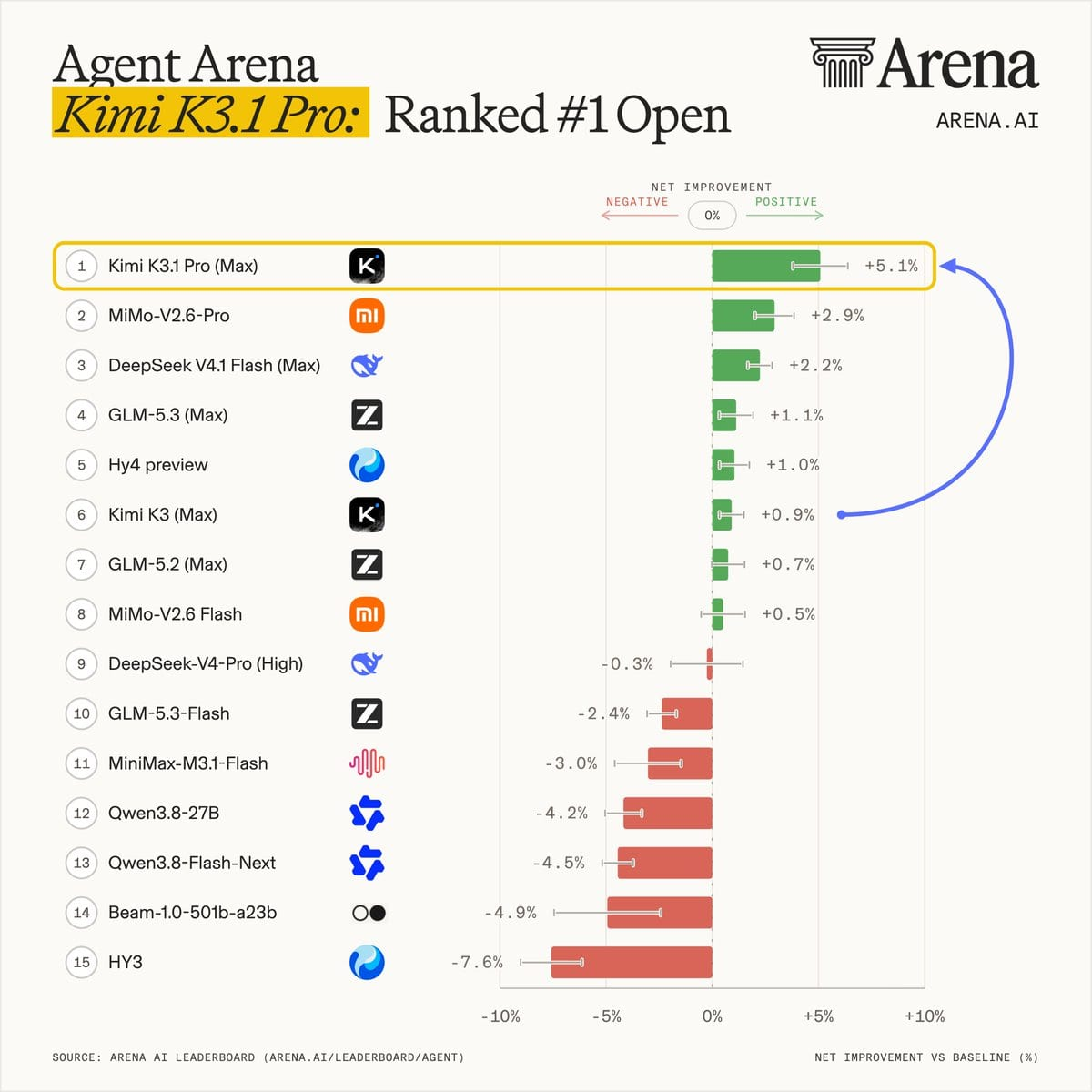
Kimi K3.1 Pro (Max) is usually the better agent choice, because Arena's user-session ranking shows a +5.1% net improvement rate, up 4.2 percentage points from Kimi K3 (Max)'s +0.9%, based on more than 17,500 real long-horizon tasks. Kimi K3 still makes sense as a fallback when teams want the proven base model, but K3.1 Pro's gains in shell reliability, steering and confirmed success are harder to ignore.
What did Arena actually measure?
Arena is not a static exam. Its ranking compares how models perform in real tasks submitted by users over time, not just how they answer isolated prompts. This update is built from more than 17,500 authentic, long-duration agent sessions, which makes it closer to a live productivity test than a closed benchmark.
In that environment, Kimi K3.1 Pro (Max) posted a +5.1% net improvement rate, while the previous-generation Kimi K3 (Max) sat at +0.9%. The difference is 4.2 percentage points, and it matters because agent work is cumulative: a model that fails once during a file move, a command sequence or a user redirection can force a human to restart the whole workflow. A larger net gain therefore points to fewer interruptions, not merely a higher abstract score.
How do Kimi K3.1 Pro and Kimi K3 compare on the leaderboard?
The headline number is useful, but the submetrics explain why the jump happened. For product teams and writers, the model choice is often decided by these smaller frictions: can it run commands, accept redirection, and satisfy users without repeated hand-holding?
| Metric | Kimi K3 (Max) | Kimi K3.1 Pro (Max) | What it tells you |
|---|---|---|---|
| Net improvement | +0.9% | +5.1% | The aggregate user-session result improved by 4.2 percentage points. |
| Bash Reliability | -4.5%, ranked 13th | +7.9%, ranked first among open models | Shell command execution became a clear strength instead of a weak point. |
| Praise vs Complaint | +1.3% | +7.7% | Real users responded more positively when the model worked through tasks. |
| Steerability | Not listed in the update | +6.5%, ranked first among open models | The model is better at changing direction after user feedback. |
| Confirmed Success | +3.8% | +3.9%, ranked fourth | Task completion confirmed by users is stable, but the improvement is modest. |
The pattern is clear: K3.1 Pro looks strongest where long agent runs can go wrong in practical ways. Bash Reliability moved from -4.5% and ranked 13th for K3 to +7.9% and ranked first among open models. Steerability reached +6.5%, again ranked first among open models. Praise vs Complaint climbed from +1.3% to +7.7%. Confirmed Success, however, changed only from +3.8% to +3.9%, ranked fourth, which suggests the update improves the process of working with users more than the final binary claim of success.
Why architecture and context size matter in practice
According to Moonshot AI's model materials, Kimi K3.1 Pro is a mixture-of-experts model with 2.8 trillion total parameters and about 104 billion active parameters for each inference step. It supports about 1 million tokens of context, carries native multimodal capability, and was positioned for stronger performance in coding, 3D creation, financial research, factual accuracy and complex agent task execution.
For non-specialists, the mixture-of-experts design can be understood like a large newsroom: the organization is enormous, but only a small team is pulled onto each article. The full parameter count determines the model's stored capacity and deployment weight, while active parameters influence the compute needed for each generated answer. The context window is the working desk: more space means the model can keep more documents, logs and instructions in view at once, although it does not guarantee that every detail will be retrieved perfectly.
Independent evaluator Artificial Analysis adds a useful cross-check. In its launch coverage, it reported that Kimi K3.1 Pro started at fourth place on the Artificial Analysis Intelligence Index and ranked third on GDPval-AA with 1,846 Elo, 312 Elo above Kimi K3, behind only Claude Opus 5.5. It also estimated the cost per task at roughly $1.98, close to K3, while noting that K3.1 Pro used about 55,000 output tokens per Intelligence Index task, 14% more than K3's 48,000.
That cost detail is important for ordinary readers: a stronger agent does not always mean a cheaper one, but the published independent numbers suggest the price gap may be manageable when the work involves multi-step drafting, code editing, or long-context research. If your workload is short one-line replies, K3 may still be sufficient. If your workflow is a chain of actions with user corrections, K3.1 Pro appears more valuable.
Switch, stay, or test first: a practical comparison
- Switch now if: your agents use terminal commands, require repeated redirection, or process long documents and repositories. The Arena data shows K3.1 Pro moved into the top open-model position on Bash Reliability and Steerability, while Praise vs Complaint improved sharply.
- Stay on K3 if: you already have a stable prompt system, your tasks are short and deterministic, and you are optimizing for operational familiarity rather than the strongest available open-model profile.
- Test first if: you expect to self-host after downloading the weights from Hugging Face. Open weights reduce vendor lock-in, but deployment cost, latency, storage, evaluation and license interpretation still need internal review.
- Be cautious if: your use case depends on a single “success confirmation” metric. Confirmed Success changed only slightly, from +3.8% to +3.9%, so you should not assume every end-to-end task will close automatically.
Four common misconceptions
-
A 1 million-token context means perfect memory. It means the model can accept and consider a very large amount of information. Long-document accuracy still depends on the task, the ordering of information, retrieval method and output constraints. For real workflows, teams should test chunking, citations and follow-up questions before assuming context size alone solves recall.
-
Open weights mean the model is instantly free to commercialize. The weights being available on Hugging Face is a major step for transparency and self-hosting, but teams must still read the model card, license terms and deployment conditions. Open access changes who can run the model; it does not erase engineering and compliance work.
-
A higher net improvement rate proves business value. Arena's +5.1% is a strong signal across many real sessions, but your own users may weigh different tasks. A coding agent, a customer-support bot and a research assistant do not benefit equally from shell reliability and steering.
-
Kimi K3.1 Pro replaces every closed frontier model. The Arena open-model ranking is one lens. Independent evaluations such as Artificial Analysis still place it behind Claude Opus 5.5 on the specific metrics mentioned in its launch coverage. The realistic decision is whether it is the best trade-off for your cost, control and privacy requirements.
Action plan for readers evaluating the model
- Take the 10 tasks where K3 most often failed: shell commands, mid-task user redirection, long-context questions, code repair and multi-step formatting.
- Run both models on the same prompts and keep the inputs identical. Record failures by type: wrong command, refusal, lost instruction, unnecessary rewriting, citation error or user dissatisfaction.
- Track three practical outcomes: whether the agent finished without manual repair, whether the user complained, and whether the result was confirmed as complete.
- Compare latency and token use. Artificial Analysis reported roughly similar cost per task, but higher output tokens per task, so test your own usage profile.
- If self-hosting is the goal, download the Kimi K3.1 Pro weights from Hugging Face only after a staging environment can validate the model card, license, hardware needs and security review.
FAQ
What does the Arena ranking tell me that a standard benchmark does not?
Arena uses user-driven sessions, so it reflects whether a model can complete work in an interactive setting. The latest update covers more than 17,500 real long-horizon agent conversations, and Kimi K3.1 Pro (Max) improved over Kimi K3 (Max) by 4.2 percentage points in net improvement rate.
Is Kimi K3.1 Pro better than Kimi K3?
For most agent-style tasks, yes. The Arena update gives it +7.9% Bash Reliability compared with K3's -4.5%, +7.7% Praise vs Complaint compared with +1.3%, and +6.5% Steerability. Confirmed Success is only slightly higher, at +3.9% versus +3.8%, so K3 remains a rational choice for teams that need continuity over maximum capability.
What is new in the model's technical profile?
Moonshot AI describes Kimi K3.1 Pro as a 2.8 trillion total-parameter MoE model with about 104 billion active parameters, about 1 million tokens of context, native multimodal capability, and stronger support for coding, 3D creation, financial research, factual accuracy and complex agent tasks.
Can I use it without an API?
The model weights are now available for download on Hugging Face, which makes local or private deployment possible. That is different from API access: self-hosting requires hardware, serving software, testing and governance.
Does the cost increase significantly when moving from K3 to K3.1 Pro?
Independent data from Artificial Analysis estimated cost per task at about $1.98, broadly similar to K3, but the model used more output tokens, so real savings depend on how long your prompts and answers are.
Source notes
- Artificial Analysis, “Kimi K3.1 Pro launches at 4th on the Intelligence Index and 3rd on GDPval-AA” — independent launch evaluation and cost-per-task figures.
- Moonshot AI Kimi platform documentation for Kimi K3.1 Pro — official positioning as a K3.1-series model with 1 million-token context.
- IT之家 coverage of the Arena open-model ranking update — public reporting on the Arena agent leaderboard metrics and open-weight release.