
Apple's FY2026 Q4 Scorecard: iPhone, Mac, iPad, Services and China Compared — What to Do Before You Upgrade
By Sarah Chen, MyTechDailyNews General desk (Tech Daily)
Earnings filings read a lot like product reviews if you know where to look. Apple (NASDAQ:AAPL) today published the results of its fiscal fourth quarter of 2026 — the three months that closed on September 26, and released on November 3 — and the document works as a verdict on what people actually paid for: handsets, subscriptions, a laptop line that finally learned to be touched, and two categories that quietly went backwards.
Instead of a straight recap, we ran the numbers the way we would run a lab test: same axes, same period, side by side. Each block below ends with the trade-off it implies, and the piece finishes with a buyer's checklist, the misconceptions worth retiring, and an FAQ.
Baseline scoreboard: four record labels, one quarter
The headline claim from the filing is that revenue, iPhone sales and earnings per share each set a September-quarter best, while the subscription side of the house set an all-time high. Read as a test bench, the table shows something more interesting: growth was not evenly distributed, and the fastest-moving line on the page is a cost.
| Line item | Quarter ended September 26 | Year earlier | Change | Read-through |
|---|---|---|---|---|
| Total revenue | $114.477 billion | $102.466 billion | up 12% | A September-quarter record |
| Product revenue | $82.904 billion | $73.716 billion | up 12% | Hardware still carries roughly three-quarters of the business |
| Services revenue | $31.573 billion | $28.750 billion | up 10% | An all-time high, about 28% of total revenue |
| Gross profit | $54.820 billion | $48.341 billion | up 13% | Gross margin held at 48% |
| Total operating expenses | $19.189 billion | $15.914 billion | up 21% | The fastest-growing number in the report |
| Operating income | $35.631 billion | $32.427 billion | up 10% | Spending ate part of the gross-profit gain |
| Net profit | $30.711 billion | $27.466 billion | up 12% | A September-quarter record |
| Diluted EPS | $2.10 | $1.85 | up 14% | Grew faster than revenue, a buyback signature |
The 21% jump in spending is the detail general readers should not skip. When research, marketing and admin costs outrun every revenue line except one, it usually means a company is pre-paying for a transition — here, the artificial-intelligence build-out that shows up in the product names quoted below.
Segments head to head: iPhone, Mac, iPad, wearables, Services
Put the five reporting groups on one chart and the quarter stops being a single story.
| Business line | This quarter | Year earlier | Change | What it means for you |
|---|---|---|---|---|
| iPhone | $57.583 billion | $49.025 billion | up 17% | Roughly half of everything Apple sold; the Pro tier and its higher prices did most of the lifting, while the newest flagship contributed only days |
| Mac | $10.792 billion | $8.726 billion | up 24% | The fastest grower of the lot — touch arrived on Mac for the first time |
| iPad | $6.229 billion | $6.952 billion | down 10% | Tablets keep losing ground to bigger phones |
| Wearables, home and accessories | $8.300 billion | $9.013 billion | down 8% | Watch, pods and smart-home gear are the softest corner of the portfolio |
| Services | $31.573 billion | $28.750 billion | up 10% | Steadier than hardware, and now bigger than iPhone-minus-services comparisons suggest at first glance |
The comparison that matters at checkout: the two shrinking lines are exactly the two lines most households already own. If your iPad is three years old, the vendor's own numbers say the upgrade cycle there is not being pushed with new hardware this year. If you are weighing a tablet against a bigger phone, the pricing logic inside this filing favors the phone.
Regions compared: who actually carried the quarter
| Region | Revenue | Year earlier | Change |
|---|---|---|---|
| Greater China (mainland China, Hong Kong, Macao and the Taiwan region) | $17.539 billion | $14.493 billion | up 21% |
| Americas | $48.680 billion | $44.192 billion | up 10% |
| Europe | $32.008 billion | $28.703 billion | up 12% |
| Japan | $6.540 billion | $6.636 billion | down 1% |
| Other Asia Pacific | $9.710 billion | $8.442 billion | up 15% |
Two regions behave like mature markets on a wait-and-see cycle — the Americas at up 10% and Japan at down 1% — while Greater China and the wider Asia Pacific ran ahead of the company average. That spread is why the same report can be described as a record and a disappointment in the same paragraph, a point expanded below.
One quarter versus a whole fiscal year
- Fiscal 2026 revenue reached $478.834 billion, up 15% against $416.161 billion in fiscal 2025.
- Fiscal 2026 net profit reached $132.175 billion, versus $112.010 billion the year before, up 18%.
Annual profit growing faster than annual revenue is the cleanest sign of pricing power rather than volume growth — and it frames the quarter above as the finish line of the best year in the company's own description, not a one-off spike.
Market reaction: down 1.83% before, up 0.47% after
Where revenue beat, the tape was already skeptical. Apple shares opened on the Nasdaq exchange on Monday at $342.67 and closed the regular session $6.31 lower, at $338.32, a decline of 1.83%. After the results crossed, the stock moved up $1.58 to $339.90, a gain of 0.47% — up less than 1% after hours, a muted response given the record line items.
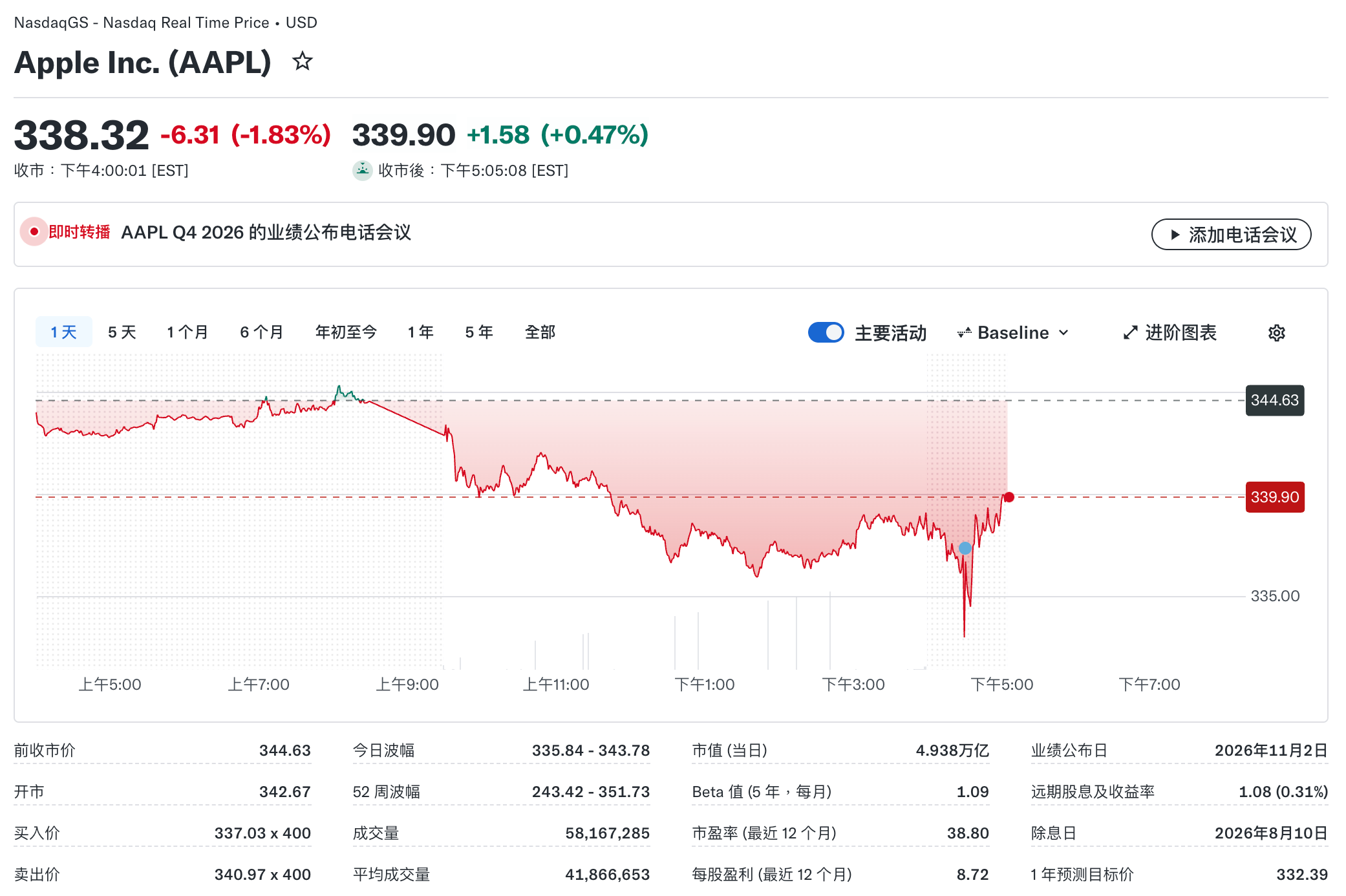
Apple stock rose 0.47% in after-hours trading.
Over the trailing 52 weeks the shares traded between a high of $351.73 and a low of $243.42, so the closing print sits near the top of that range. Reader takeaway: a small after-hours tick is not a referendum on the products; it is a comment on how much of that growth was already priced in.
The cash that went back out the door
Apple's board declared a cash dividend of $0.27 per share of common stock to holders registered at the close of trading on November 12, 2026, payable on November 16, 2026. Against a $338.32 share price, that single payout is worth roughly 0.08% of the position — the dividend is the visible part of shareholder returns, not the substantial part. The company's chief financial officer put the quarter's cash return in a different league entirely (see the quote below).
Two executives, two different arguments
Read the two statements as competing framings rather than identical praise. The chief executive sells the product roadmap; the finance chief sells the cash machine.
John Ternus, Apple's CEO, said: 'Today, Apple is proud to report that September-quarter revenue reached a record $114.5 billion, up 12% year on year, with iPhone setting a September-quarter record and Services reaching an all-time high, closing out the best fiscal year in our history. We are ending the year with the most ambitious product lineup we have ever shipped, including the iPhone Duo, the most transformative device since the original iPhone, and our most powerful iPhone 18 Pro and iPhone 18 Pro Max to date. We also just introduced a new generation of hardware for the home, and we brought touch to the Mac for the first time. Add the new Siri AI, and this is a stunning lineup that will carry us into the holiday season.'
Kevan Parekh, Apple's CFO, said: 'Apple delivered record September-quarter net profit and earnings per share. Our record September quarter closes out a strong fiscal 2026, in which annual revenue reached a record $479 billion and earnings per share grew by double digits. This quarter we generated $28 billion of operating cash flow, which allowed us to return $28 billion to shareholders. Thanks to our very high customer satisfaction and loyalty, our active installed base of devices reached an all-time high across every major product category and geographic region.'
The contrast is useful for readers: the roadmap language (iPhone Duo, iPhone 18 Pro, iPhone 18 Pro Max, Siri AI, touch on Mac, new home hardware) sits almost entirely in the forward tense, while the installed-base claim is the one sentence in the whole release that speaks directly to how sticky an existing owner's ecosystem is.
Buying decision: iPhone 18 Pro, iPhone 18 Pro Max and iPhone Duo compared
The CEO quote puts three very different machines in one sentence, so we compared them the way we would in a lab, using the September launch coverage from CNET and PCMag plus pre-earnings market summaries.
| Model | Entry price | Format | Rated video playback | Choose it if |
|---|---|---|---|---|
| iPhone 18 Pro | $1,199 | Conventional flagship slab | Full-day, lightest of the three | You want one-handed use and Pro cameras without paying for a second screen |
| iPhone 18 Pro Max | $1,299 | Larger flagship slab | Longest of the slab pair | Streaming, navigation and long shoots dominate your screen time |
| iPhone Duo | $1,999 (256GB) | Book-style foldable: 7.6-inch inner display plus 5.4-inch outer display, titanium frame, IP68, eSIM only | Up to 31 hours on the inner display, up to 44 hours on the outer display | You genuinely work on the phone: split-screen reading, pen input, tablet-sized canvas in a pocket |
The honest trade-off on the foldable: you pay $800 over the smaller Pro for a bigger canvas, and you accept a hinge mechanism with more than 100 parts, a 5.2mm unfolded profile and the repair economics that come with any first-generation format. PCMag's event coverage filed the same caution — impressive hardware, eye-watering price. If a foldable is not already your habit, the Pro tier is where the value curve bends.
Context the filing does not contain: the bar, the window, and the memory bill
Three pieces of outside information change how the record should be read.
- The expectations were lower than the print. Wall Street consensus ahead of the release sat around $113.4 billion of revenue and $1.99 in earnings per share, according to the pre-earnings estimate roundup published by Sina Finance — meaning reported revenue cleared the bar by roughly a billion dollars and EPS by about 11 cents. Bank of America was even more cautious, modeling $113.0 billion and $1.97 while also trimming its fiscal 2027 iPhone shipment estimate by 9 million units to 247 million against a Street assumption nearer 260 million, per its note carried by Zhitong Caijing. A beat, in other words — but against a skeptical Street.
- The new flagship barely counts in these numbers. iPhone 18 Pro preorders opened on September 12 and shelves filled on September 18, leaving the quarter roughly one week of new-device sales inside a three-month period, as market summaries of Apple's own sales calendar note. So most of the 17% iPhone gain is a mix-and-price story carried by the previous model generation, with the true read on iPhone 18 demand deferred to the holiday report.
- Component costs are the swing factor. Analysts flagged rising DRAM and memory prices as pressure on future margins before the print, according to Tech Times' coverage of the previous quarter, and Apple itself cited supply constraints across iPhone, Mac and iPad on its July call. That explains why the home-hardware and tablet lines look thin while spending climbs.
The China paradox: up 21% and still a miss
The single most confusing line for a casual reader is that Greater China grew 21% and was still described as falling short. Two external data points make it legible.
First, Counterpoint Research's third-quarter China tracker recorded overall shipments at a 14-year low for the market, with Huawei first at 21.3% share and Apple second at 19.5%, up 4.8 points and jumping from sixth place. Winning share in a shrinking pond looks different from winning share in a growing one: the absolute growth was real, the expectation set by earlier quarters was higher.
Second, MacRumors summarized launch tracking showing the iPhone 18 Pro tier performing unusually well in China while sales softened in the United States and Japan — the same pattern the region table above shows, with Japan at down 1%. Counterpoint analysts also observed that a delayed standard-model iPhone 18 nudged early buyers toward the Pro tier, which flatters revenue per unit while leaving unit volume flat or lower. Industry figures from IDC circulating in financial media put Apple's third-quarter global iPhone shipments at 57.3 million units, down 4% year on year, even as revenue rose.
Services: the engine nobody photographs
At $31.573 billion, the subscription stack grew 10% and reached an all-time high — but its growth rate now trails iPhone's 17%. Two reference points say the base is still widening rather than saturating: AppleInsider reported the company crossing 1.5 billion paid subscriptions around the June quarter, when Services generated $30.74 billion, so this quarter added roughly $830 million sequentially on top of that milestone; and Apple's own newsroom announced in June that the global App Store facilitated more than $1.4 trillion in developer billings and sales in 2025.
For readers, the comparison is practical: the phone is bought once, the services are billed monthly, and a 10% growth rate on a recurring base is a statement about how many subscriptions a typical household now juggles.
Common misconceptions worth retiring
- 'A record quarter means everyone upgraded.' Revenue records can be built from higher prices on the same or fewer units; the shipment-versus-revenue divergence above is the tell.
- 'China grew 21%, so China is fine.' It beat its own prior year and still missed the number analysts had modeled. Growth and expectation are different meters.
- 'Services is a side business.' It is about 28% of revenue and the largest profit-margin contributor, which is why every subscription price change eventually shows up in this line.
- 'The stock barely moved, so nothing changed.' The shares had already lost 1.83% in the session before the release and traded inside a $243.42–$351.73 52-week band, so a 0.47% after-hours tick reflects pre-positioning, not indifference.
- 'EPS up 14% means 14% more profit per customer.' Part of that gap over revenue growth comes from a shrinking share count funded by cash returned to shareholders.
Upgrade checklist: five questions before you buy this holiday season
- Am I paying for a device or for a habit? If most of my screen time is one app, the smaller Pro is the rational pick; if I edit, read or multitask, the foldable earns its premium.
- Do I actually need the second largest screen I own? With iPad down 10% and a 5.4-inch foldable outer display now in the lineup, big-phone buyers are the direct substitutes.
- Is my region getting the AI features at launch? Reporting from MacRumors indicates some AI capabilities announced in 2026 were not switched on in every market at release — check before paying a flagship premium for an assistant.
- Can I afford the storage tier, not just the phone? Memory cost inflation is the analyst-flagged reason price steps are unlikely to reverse.
- Am I inside a carrier or trade-in window that expires before the January report? If yes, the discount beats waiting for a model that is already on shelves.
Action advice by reader type
- Everyday buyer: Treat the foldable as an early-adopter product with first-generation mechanics and the Pro tier as the mature choice. Compare your current handset's camera and battery, not its marketing year.
- Subscription-heavy household: Audit recurring charges this month. A $31.573 billion quarter is built from many small ones, and the cheapest optimization available to you is cancellation.
- App developer or small online business: The $1.4 trillion ecosystem figure is a reminder that distribution fees and featured placement matter more than a single device cycle; budget for retention rather than launch-week spikes.
- Investor-curious reader: Watch three things in the next report — the holiday-quarter guide, whether iPad stabilizes, and whether operating expense growth above 21% continues to compress operating income at 10% growth.
FAQ
Q: What exactly was a record here?
A: Revenue, iPhone sales and earnings per share each set September-quarter bests, and Services reached an all-time high — the full year closed at $478.834 billion in revenue.
Q: Did the whole company grow?
A: No. iPhone, Mac, Services and every region except Japan grew; iPad fell 10% and wearables, home and accessories fell 8%.
Q: How much is the dividend worth to a normal holder?
A: $0.27 per share, for holders registered at the November 12, 2026 close, paid November 16, 2026 — a fraction of a percent of the share price. The larger return channel was the $28 billion handed back in the quarter.
Q: Should I expect a price cut on older models?
A: Nothing in the filing points that way, and component-cost pressure argued in analyst notes suggests list prices stay firm even where discounts appear.
Q: What is the next number that matters?
A: The December quarter, Apple's biggest, which is where the first complete run of iPhone 18 and iPhone Duo sales will show; results historically land in late January.
The verdict we would print
Score it as a product test and the quarter is a clear win on phones and money, a draw on subscriptions, and a loss on the two categories readers were told to love years ago. That split is the useful signal: the industry's growth is now bought with premium pricing on fewer, dearer screens rather than with more devices in more hands. Before the next report lands, the smartest reader move is boring — know which line on your own monthly statement is hardware and which is rent.
Spotted something we should recheck in this comparison, or have a purchase decision you want stress-tested on our numbers desk? Email the MyTechDailyNews team at hello@techdaily.com.