
Apple Offer After 12 Interview Rounds, Rejection After 11: What Ultra-Long Tech Hiring Really Costs You
How many conversations with strangers is one job worth? That question has moved from the margins of job-seeking forums to the centre of this week's tech conversation, and it now has two competing answers supplied by two real cases. Treating a marathon interview loop as something you evaluate before buying — time spent, information gained, risk carried — turns an emotional argument into a decision a reader can actually make.
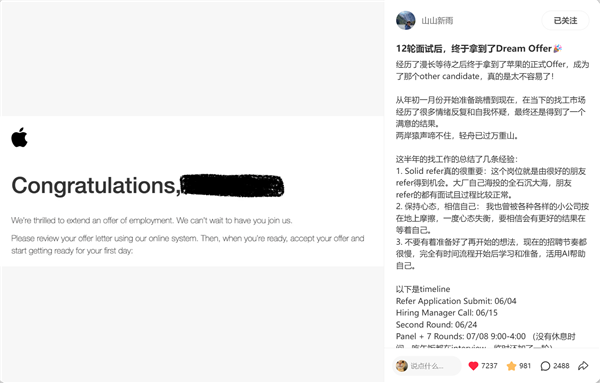
The raw material comes from posts on Xiaohongshu. One applicant submitted a resume to an Apple opening in early June and only received the formal offer in mid-October — a run of more than four months, packed with 12 interview rounds.
The most brutal stretch was the onsite block scheduled for July 8. Because the position sat outside the candidate's home city, they flew in for it. Interviewers kept them busy from 9 a.m. to 4 p.m.: seven hours, seven consecutive interviews, a different interviewer in each one, each session running between 30 minutes and one hour, with lunch swallowed while still talking.
Not long after the success post started circulating, another name appeared in the same conversation: Jojo.
Jojo had also applied to an Apple role, began interviewing in July and carried on until October, finishing 11 rounds. The response at the end of that effort was a rejection.
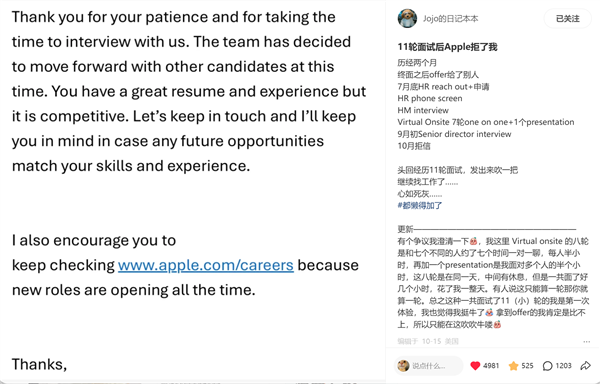
Commenters rushed to the winning post with a joke that lands colder than it sounds: "Congratulations on beating Jojo." It is still unconfirmed whether the two people were chasing the same seat, but the arithmetic of "rejected after 11 rounds, hired after 12" is what unsettled people — a single round separating triumph from nothing, a single round carrying a weight it plainly cannot carry. A widely shared line summed it up: even hell only has 18 levels, while an autumn-recruitment loop can run past them.
One round cannot be the deciding variable
Read as a comparison, these two timelines behave more like a lottery with a long entry period than like an exam with a passing mark. If a decision genuinely hinged on the twelfth conversation rather than the eleventh, the first eleven would have collected almost no usable signal — which is not how a functioning interview panel works. The more likely explanation is that the verdict had crystallised earlier, and the remaining rounds were scheduling, cross-team approvals and headcount checks. For a candidate, that distinction matters: you are not being measured continuously, you are being processed.
Why employers stretched their funnels
The macro backdrop is supply. Figures published by China's Ministry of Education put the 2025 graduating class of ordinary higher-education institutions at 12.22 million people, with the 2026 class expected to reach 12.70 million, an increase of 480,000, keeping total graduate numbers at a historic high.
Multi-round, high-intensity interviewing is not an Apple peculiarity either. In recent years leading technology companies have generally lengthened their hiring chains and raised screening bars: with a deep applicant pool and relatively few premium openings, firms become more cautious and lean on many rounds and cross-checking assessments to reduce the cost of a wrong hire. Longer loops and longer waits have become the default rather than the exception.
Benchmarking the loop: what counts as normal
Length only means something next to a reference point. Here is how the case compares with what recruiters, prep guides and campus-hiring reports describe as typical.
| Process type | Rounds you should expect | Clock time for an answer | What it signals |
|---|---|---|---|
| Campus hires at most domestic companies | 3 to 5 rounds (screener, hiring-team peer, manager, department head, HR close) | About one to two weeks | Each round owns a distinct question; the loop ends when the information does |
| An Apple onsite day, per candidate reports and interview-preparation guides | Five to eight back-to-back interviews, occasionally up to ten, roughly 45 to 60 minutes each (Testlify, SpaceComplexity) | One day for the loop, weeks for the decision afterwards | Team-based scoring: many evaluators sign off, no single interviewer decides |
| The Xiaohongshu case | 12 counted interactions spread over more than four months | Four months, from early June to mid-October | Front-end screens plus onsite plus post-onsite matching stacked on top of each other |
One caveat that gets lost in retelling: counting every chat with a different interviewer as a "round" inflates the number. Twelve conversations inside one day-long loop are a very different burden from twelve separate decision gates. Some of the "dozen rounds" people report are not one vacancy at all — a failed candidacy in one group gets pulled from a shared talent pool and re-screened independently by two or three other groups, which feels like an endless loop but is really a chain of separate small processes.
Rigorous or just drawn out: a two-column scorecard
| Worth your months (healthy long loop) | Cut your losses (dragging loop) |
|---|---|
| Each round has a different seniority level and a different evaluation goal | Two consecutive interviewers ask near-identical project and basics questions |
| HR states the full route up front: how many stages, what format, roughly when results land | Every stage ends with "wait for notice"; progress questions get vague answers |
| Interviews are dense in time, e.g. one onsite day | Weeks of silence between stages with no owner |
| The requisition has a visible headcount and a closing date | The posting stays open indefinitely while you are still being interviewed |
| Feedback or a decision arrives even when it is negative | Rejection surfaces weeks later with no explanation |
Do extra rounds actually make hiring smarter?
The research literature points at structure, not volume. Decades of meta-analysis summarised in the journal Industrial and Organizational Psychology find that structured interviews — same questions, same rating scale, same notes discipline — predict job performance meaningfully better than free-form conversations, while unstructured formats sit near the bottom of the ranking (Huffcutt, 2023). Nothing in that body of work says a twelfth conversation beats an eighth simply because it exists. When interviewers improvise and questions repeat, the marginal information in each added round approaches zero, and what you are actually enduring is coordination overhead, not assessment.
There is a second layer worth naming: automated screening. In New York City, Local Law 144 — administered by the city's Department of Consumer and Worker Protection — requires employers and recruiters using automated employment decision tools to complete an independent bias audit beforehand, publish a summary of its results and notify candidates that the tool was used (nyc.gov). Annex III of the EU AI Act likewise treats systems used for recruitment or for decisions affecting employment as high-risk (artificialintelligenceact.eu). For applicants, the practical upshot is that you are entitled to know when a machine rather than a person is filtering you — and that a video interview scored by software with no follow-up question at all is a compliance surface, not a conversation.
The employer pays too — and usually learns late
Recruiting-industry surveys consistently flag the downside of marathon funnels: a majority of job seekers report losing interest in a role once a process runs well past the two-week mark, and staffing firms cite offer declines blamed on a poor candidate experience rather than on the package itself (Glassdoor findings as reported by cfstaffing.com; hiringthing.com). Strong candidates also tend to stay on the market for only days at a time, so a four-month loop is a bad trade if a rival employer closes in two weeks. Add internal costs — interviewer hours, scheduling effort, backfill delay — and you get why recruiters say privately that they will push a business team to trim a process that has outlived its usefulness.
Checklist before you commit to a marathon
- In the first recruiter call, ask the three-part question: how many stages, what format each one takes, and roughly when a decision arrives.
- Never run a single pipeline. Keep two or three live processes so a long loop is a choice rather than a hostage situation.
- Write down your sunk costs: flights, hotel nights, days off, rescheduled commitments. Seeing the number makes the decision concrete.
- After every round, log one new thing you learned about the job. If two rounds in a row add nothing, treat the process as low-signal.
- Check the expiry date on anything you already hold; some letters lapse in three to seven days and will not wait for someone else's approval chain.
- Set a stop-loss rule in advance — a date, a round count, or a silence period — and honour it.
- Interview the company back. A process that exhausts you before day one rarely improves after you sign.
Common misconceptions
- "More rounds means higher standards." Structure and clear evaluation criteria make hiring strict; calendar count does not.
- "All big-tech jobs take ten-plus rounds." Many operations, sales, marketing and junior engineering tracks still close in three to five conversations. Ultra-long loops cluster in scarce core-technology and graduate-leadership roles.
- "One more round and I would have got it." Outcomes are usually set by the panel's aggregate score, not by whichever interview happened to stand last.
- "Being picked up by another department means progress." That is often talent-pool circulation, which resets the clock instead of advancing it.
- "No news yet means they are still considering me." It can equally mean the requisition is frozen and nobody told the candidate.
FAQ
Is a twelve-round process a red flag?
Not automatically. Twelve interactions compressed into one onsite day plus a normal set of screens can be legitimate for a cross-functional role. Twelve rounds spread over four months with repeated questions and no published timeline are a different animal.
Should I pay for a cross-city onsite?
Treat it as an investment with a cap. If the company does not cover travel and the structure of the loop is unclear, ask the recruiter for the full agenda first, then decide whether one in-person day is worth the trip on its own merits.
Can I accept another offer while a loop is still open?
Yes. Declining a late-stage process to take a concrete role is a rational move, not a cowardly one — and if the loop really matters to you, telling the recruiter about your deadline is legitimate pressure.
Does an 11-round rejection say anything about my ability?
Far less than it feels like. It mostly reports headcount, team fit and internal timing. Ask for feedback once, then deprioritise the process emotionally.
What should companies change?
Publish the stage map up front, cap duplicate interviews with a shared scorecard, give candidates a decision date, and let HR trim loops that clearly outlive their purpose.
The verdict
Two people did nearly the same thing and received opposite results, and the difference is not a lesson about effort. Judge a hiring process the way you would judge any product that demands months of commitment: what each stage actually measures, who owns the timeline, what it costs you in travel and calendar, and what your alternatives expire into. The candidate who turns down a fifth redundant interview is not quitting early; they are refusing to pay for a signal-free upgrade.
Employers, meanwhile, should stop treating length as free. A loop that outlives a graduate's offer window does not produce better hires — it produces faster dropouts, weaker acceptance rates and a reputation that follows the company onto social feeds, where one applicant's four-month story becomes the thread that scares off the next twelve.