
PROLED XDR on the MacBook Pro: What Apple's OLED Move Means for the Laptop You Buy Next
By Sarah Chen, Tech Daily
Every few years one product decision turns a display technology from a niche option into something shoppers actively compare at checkout. Apple's choice to fit the new MacBook Pro with a PROLED XDR panel — the first tandem OLED touchscreen in the MacBook lineup — is that kind of decision, and the ripples will be felt far beyond one company's store shelves.
The change, stated plainly
The new MacBook Pro ships with the PROLED XDR display, making it the first machine in the MacBook lineup to carry a tandem-structure OLED touchscreen. TrendForce puts shipments of this model at 1.2 million to 1.5 million units in 2027. The move is being read as a significant turn in Apple's notebook display direction, and as a possible accelerant for the whole premium laptop segment's shift to OLED.
Why the pricing story matters to normal buyers
Two details explain why enthusiasm may not translate into an immediate upgrade wave: the 14-inch model opens at $2,899, and in the early period it is sold in parallel with the existing Mini-LED version. A high entry price plus a still-current alternative tends to soften short-term replacement demand. Even so, the product update reinforces Apple's premium positioning and shows an intent to cover the market through several price bands rather than a single flagship tier.
Apple enters a lane Lenovo, HP and ASUS already paved
Before this launch, the global OLED notebook market was driven mainly by Windows brands — Lenovo, HP and ASUS among them — which have gradually brought OLED panels into more price series, so the technology no longer appears only on a handful of high-end machines. Apple's entry is expected to raise market attention on OLED laptops further, push more brands to treat OLED as a priority in future planning, and lift consumer acceptance of the display technology overall.
What an OLED panel does differently — in everyday terms
In picture quality, body design and display performance, OLED holds real advantages over a traditional LCD: higher contrast, deeper black levels and faster pixel response, along with a better fit for thin and light notebooks. The counterweights are equally concrete: panel manufacturing cost, production yield, and the different brightness and lifespan demands of different products still shape how far the technology spreads.
| What you notice as a user | How OLED compares | What still limits it |
|---|---|---|
| Dark scenes and high-contrast content | Higher contrast and deeper blacks than a traditional LCD | Brightness requirements differ across product types |
| Fast motion, scrolling and video | Faster pixel response speed | Lifespan expectations vary across products |
| Weight and thickness | Better suited to thin notebook designs | Panel manufacturing cost and production yield |
| How widely it appears | Apple's arrival raises attention and consumer acceptance | Short-term upgrade demand can be dampened by price |
Behind the panel: Samsung Display, Asan and a dedicated line
Samsung Display is currently the exclusive OLED panel supplier for this new MacBook Pro. To serve it, the company has designated the first phase of its A6 project — the sixth-generation-and-above large-size OLED line at its Asan campus in Korea — as an Apple-dedicated production facility.
The order also carries strategic weight for the supplier: this laptop is the first product to reach mass production on Samsung Display's G8.6 generation fine metal mask (FMM) OLED line. Choosing Samsung Display to panel its first high-end OLED notebook both reflects Samsung's capability in advanced display technology and consolidates its competitive position in the high-end OLED panel market.
Why 254 pixels per inch is a manufacturing story
The tandem OLED structure in the new MacBook Pro runs at 254 pixels per inch, which places demanding requirements on panel manufacturing. Stacking multiple emissive layers is what allows brightness, energy efficiency and panel lifespan to be balanced more effectively — but the process is more complex, raising the bar on material cost, production yield and process control.
Who else is trying to get in — and where they are aiming
Other panel makers are pushing qualification work for related products, yet Apple's strict technical specifications, combined with the supply advantage Samsung Display has already established, make this a high-threshold chain to enter. As a result, LG Display, BOE and TCL CSOT are directing more effort toward winning panel orders for a future OLED version of the MacBook Air, a product expected to arrive in 2029.
The market math: shrinking notebooks, growing OLED share
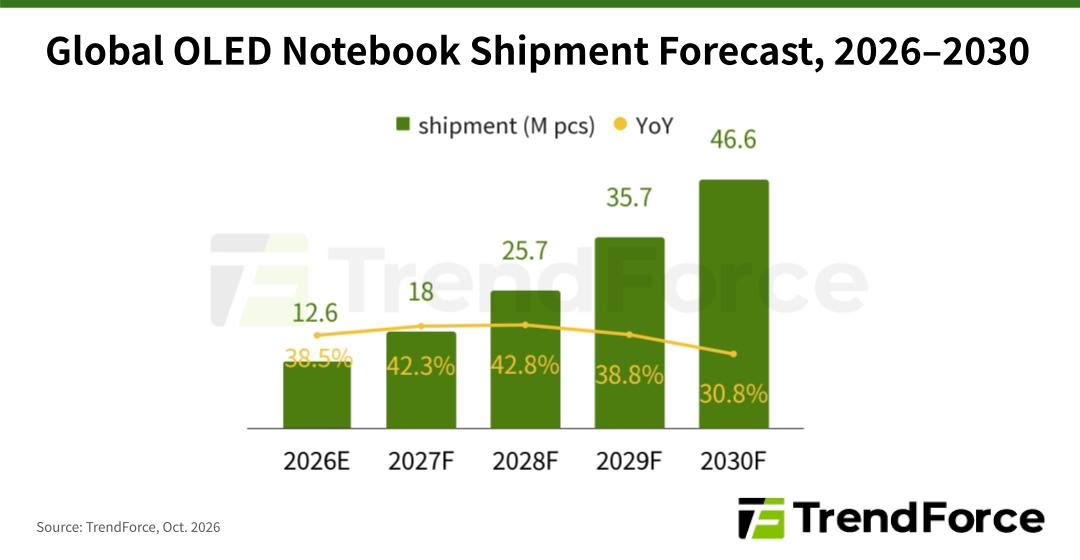
TrendForce's view is that even with the global notebook market expected to contract for two consecutive years, OLED notebook shipments can still grow against that tide. Apple's product transition adds demand for OLED panels and pushes the wider industry chain to speed up technical upgrades, especially in high resolution, low power consumption and high brightness.
As Apple gradually extends OLED across its notebook lineup, competition among display panel suppliers is expected to intensify further. The vendors best placed to win major notebook brand orders will be those that balance production cost, manufacturing yield, display performance and large-scale supply capability. OLED is unlikely to fully replace LCD panels in the short term, but as capacity expands and the technology keeps maturing, its penetration of the notebook market should rise.
Common misconceptions
- "OLED laptops are a brand-new category." Windows brands including Lenovo, HP and ASUS have been moving OLED into more price series for years; it was never exclusive to flagship machines.
- "Every new MacBook goes OLED now." The new MacBook Pro is being sold alongside the existing Mini-LED version, and the OLED MacBook Air is only expected in 2029.
- "More models means cheaper models." Panel cost, yield, brightness and lifespan requirements are still the variables deciding how far the technology reaches.
- "The supplier list is settled forever." Other panel makers are pursuing qualification, even though strict specifications and Samsung Display's supply position set a high bar.
Checklist: how to follow this story
- Read the price ladder first: the 14-inch model's $2,899 starting point is the clearest signal of how premium Apple's first OLED step is.
- Compare the two display options in the same line, because Mini-LED and the new OLED version are being sold in parallel.
- Use TrendForce's 2027 range of 1.2 million to 1.5 million units as the benchmark for real demand.
- Keep 2029 in view: the expected OLED MacBook Air is the volume opportunity most suppliers are chasing.
- Track qualification news around LG Display, BOE and TCL CSOT as the earliest sign that supply competition is opening up.
FAQ
Is the new MacBook Pro the first OLED laptop available?
No. OLED notebook panels were largely brought to market by Windows brands such as Lenovo, HP and ASUS across several price tiers. What is new is that the MacBook lineup now has one, in the form of the PROLED XDR tandem OLED touchscreen.
Do I need to upgrade right away?
There is nothing in this launch that forces it. The 14-inch model starts at $2,899 and the existing Mini-LED version continues to be sold in parallel, so several valid configurations remain on offer at the same time.
Who builds the screen, and could that change?
Samsung Display is the exclusive panel supplier for now, producing through the first phase of its A6 project at the Asan campus in Korea on the sixth-generation-and-above large-size line; it is also the first mass-production product on the company's G8.6 generation FMM OLED line. LG Display, BOE and TCL CSOT are aiming at future orders, most visibly the MacBook Air expected in 2029.
Will OLED take over laptops quickly?
Not immediately. OLED shipments are expected to grow even while the overall notebook market contracts for two consecutive years, but the technology still faces cost, yield, brightness and lifespan questions before it can challenge LCD broadly.
What does "tandem" actually buy you?
It refers to stacking multiple emissive layers, which is how brightness, energy efficiency and panel lifespan are balanced more effectively — and at 254 pixels per inch on this model, it is also what makes the panel harder to build.
Action advice
For everyday buyers: treat this as an information milestone rather than a reason to replace a working machine. If you are in the market anyway, line the Mini-LED and OLED configurations up side by side and decide how much contrast, black level and pixel response are worth at the $2,899 entry point.
For product and marketing teams: OLED is moving from a differentiator reserved for halo models to a baseline expectation in premium notebook planning, with Apple's entry lifting consumer acceptance. Build comparisons around viewing experience, thinness and price band rather than panel acronyms alone.
For industry watchers: the balance to track is between production cost, manufacturing yield, display performance and volume supply — that combination will decide which suppliers land the next round of orders.
The takeaway
Apple's OLED debut in the MacBook Pro is less about one laptop than about the questions it forces on everyone else: suppliers must prove they can hit premium specifications at premium volume, competing brands must decide how far down their price lists OLED travels, and buyers finally have a reason to judge a notebook by its display as carefully as by its processor or memory.
Reach the Tech Daily editorial team at hello@techdaily.com.