
How AI Demand Flipped Flash Memory Pricing and Weakened Apple's Buying Power
Scott Nelson once felt like the weaker side in deals with Apple. During a ride through the Southern California desert, the Kioxia sales executive stopped his off-road motorcycle, took out a rifle and shot an old iPod. That broken device, Apple's first product to use flash memory, later sat on his desk as a reminder of a long-running dispute over who captured value in the supply chain. Today, the balance appears to have shifted: AI data centers are buying so much flash that suppliers such as Kioxia have more leverage, while Apple faces sharply higher storage costs.
From a Desert Ride to a Pricing Reversal
Nelson had spent years selling flash chips used in iPhone storage for photos, music and apps. Kioxia, the Japanese manufacturer, had little negotiating power against Apple, the world's largest flash buyer. Apple reportedly used its scale to push prices to the lowest levels in the industry and required suppliers to open their books so it could monitor sales and verify that no other customer received a better deal.
Suppliers resented what they saw as an unequal bargain: Apple bought flash at very low prices and sold storage upgrades to consumers at far higher margins. Nelson's frustration was visible enough that he switched to an Android phone as a form of protest.
Why Apple's Memory Bill Suddenly Grew
The change has been driven by AI infrastructure demand. TechInsights said hyperscale data center operators have pushed flash prices to five times their prior level over the past year, opening a new era for suppliers. The research firm estimated that two years ago, Apple bought nearly twice as much flash capacity as Microsoft, Amazon, Meta and Google combined. Now, those cloud giants are buying about twice as much flash as Apple.
At a major industry conference in Santa Clara, California this summer, supplier sales teams privately celebrated what some viewed as poetic justice. Meta, Microsoft and Amazon signed contracts with Kioxia this year that promised higher prices for long-term, stable supply and protected Kioxia's profitability if market conditions reversed. Kioxia declined to comment.
Hyperscale buyers can absorb higher flash costs more easily than Apple can. In data center construction, flash represents a smaller share of total cost than in an iPhone, and accounting rules allow companies to spread that expense over future years.
TechInsights estimates Apple's flash spending this year could reach $25 billion, compared with about $6 billion in 2025 for roughly the same amount of flash. Apple executive chairman Tim Cook has compared rising memory chip prices to a once-in-a-century flood.
The Numbers Behind the Squeeze
People familiar with the matter said Apple was caught off guard after disregarding earlier analyst warnings. The company's executives had believed they understood the market better than anyone else. In 2005, flash cost $68 per GB. By 2023, that had fallen to 5 cents. Now AI demand has pushed prices above 30 cents per GB, a 550% increase that threatens the high margins Apple earns from extra storage.
| Time period | Flash price |
|---|---|
| 2005 | $68 per GB |
| 2023 | 5 cents |
| Now | Above 30 cents per GB |
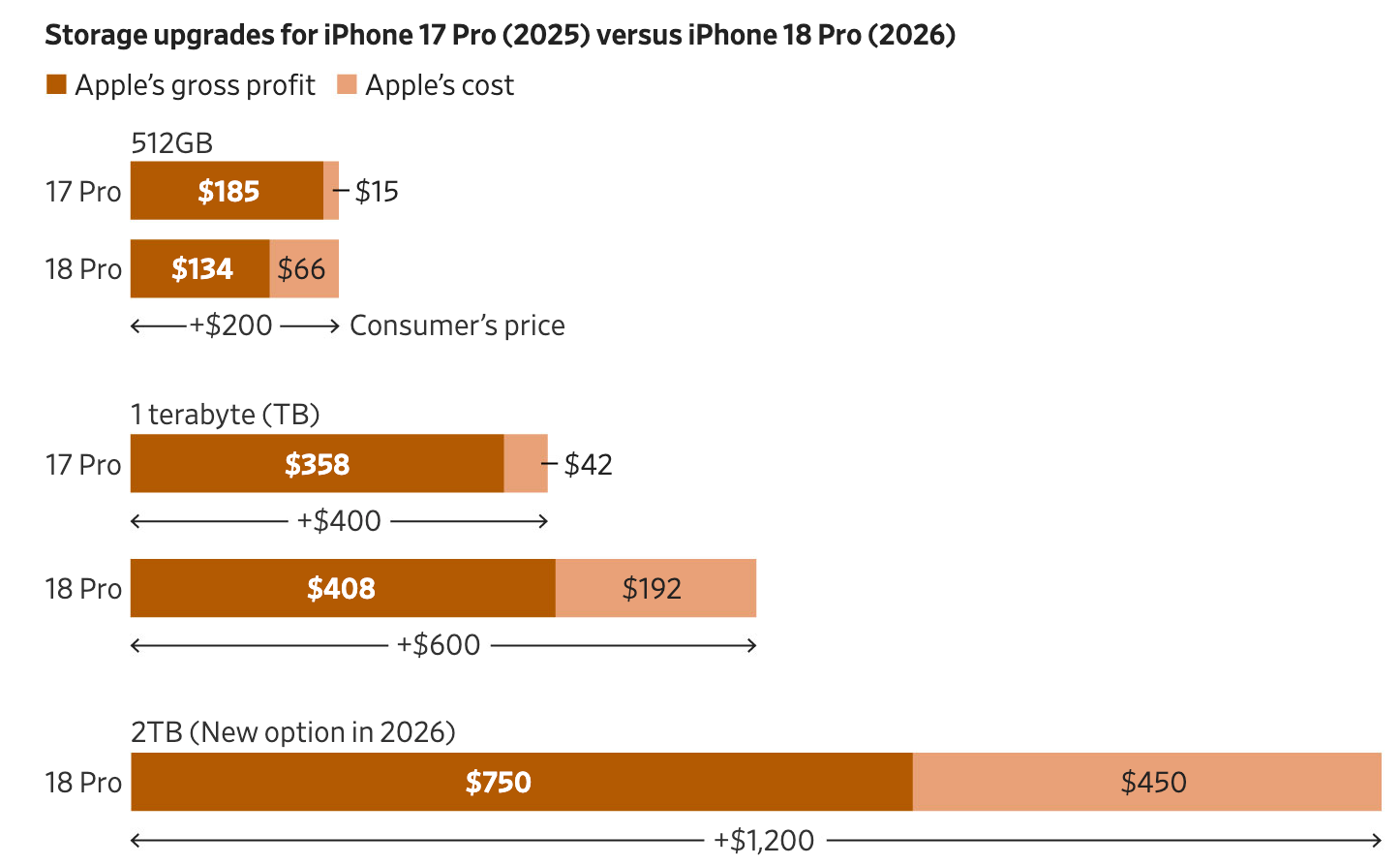
Customers who bought an iPhone 17 Pro last year could pay an additional $200 to double storage from 256GB. The Wall Street Journal analysis found that the incremental cost of that storage to Apple was $15 at the time and has since risen to $66.
Suppliers Regain Leverage
"Apple has always tried to drive memory prices down when dealing with suppliers," said TechInsights analyst Walt Coon. "Now that the balance of power has changed, suppliers' frustration has been fully expressed."
Apple said in a statement, "For years, we have worked with many suppliers, and the partnerships built over decades are deeply important to us. We look forward to continuing our important collaboration with them in the future."
The pricing swing matters because storage upgrades have been a highly profitable business. The Wall Street Journal found that from the early days of the iPhone and iPad through 2025, Apple earned more than 80 cents of gross margin for every $1 charged for additional storage. For Mac computers sold since 2010, the average margin was close to 80 cents per dollar.
Apple has raised prices on nearly all of its products in recent months. iPhone prices rose by an average of 13%, including some older models that were often discounted in prior years. The unresolved question is whether consumers will keep upgrading on the same schedule or extend iPhone lifetimes; for flash makers, the question is whether Apple can regain its former negotiating advantage.
"Apple's relationship with the flash industry has always been love-hate," said Mark Newman of Bernstein Research. For years, Apple provided manufacturers with stable demand. But its ability to force low prices benefited Apple shareholders while leaving suppliers feeling shortchanged.
How Flash Became Central to Apple's Business
The relationship traces back to 2001, when engineers at Toshiba, Kioxia's former name, showed two Apple executives a 1.8-inch, 5GB hard drive they had developed without a clear use case. A person familiar with the meeting said Apple quickly saw that it fit a secret project. Apple secured exclusive rights to the small drive, which became the core of the iPod, one of Apple's breakout products.
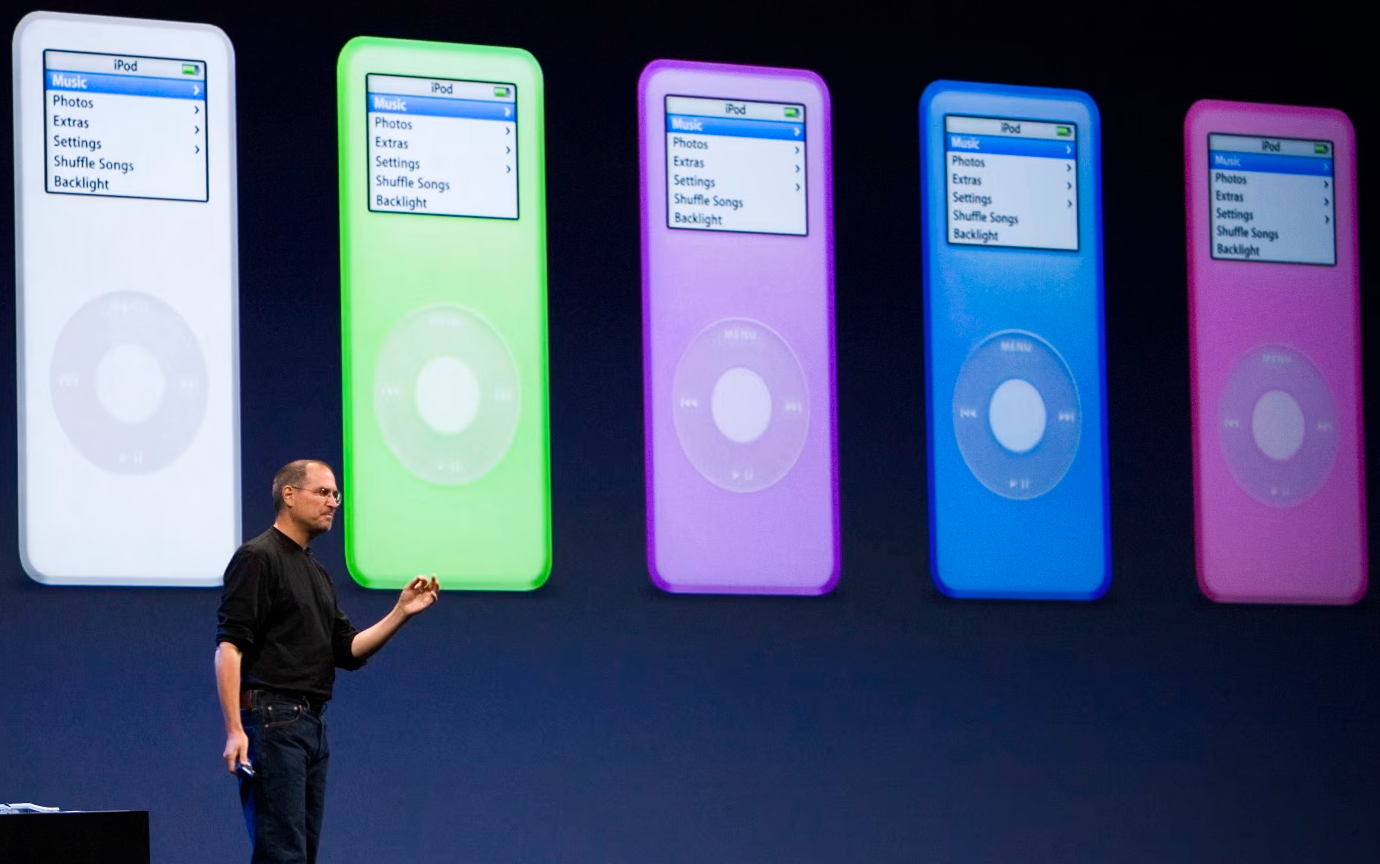
Flash then took storage technology further. Unlike hard drives with spinning disks and failure-prone moving parts, flash is a chip-based storage method with no moving parts, smaller size, greater capacity and lower power consumption. In 2005, Apple launched the iPod Nano, a music player thinner than a pencil, after prepaying $1.25 billion to secure flash supply through 2010 from five companies. Suppliers saw the opportunity and expanded factories. In June 2007, Apple introduced the iPhone, changing consumer electronics.
As the iPhone succeeded, Apple captured more than one-fifth of global flash supply. TechInsights estimated Apple spent $3 billion to $4 billion annually, becoming the world's largest flash buyer.
How Aggressive Buying Worked - Until It Didn't
Apple's huge demand increased its leverage. Suppliers accepted terms that pushed Apple's purchase prices to industry lows, partly because chip manufacturing has high fixed costs and factories need strong utilization to profit. At the same time, suppliers benefited from Apple's large orders.
Another tactic was refusal to commit. Apple sometimes placed low-price orders but declined to accept deliveries when flash prices fell, leaving suppliers with unsold chips, including products customized for Apple. Kioxia executives joked that they felt like Charlie Brown, the U.S. comic character, trying to kick a football while Lucy pulled it away at the last moment.
The stalemate often ended with suppliers lowering prices further for Apple.
Tony Blevins, who led Apple's procurement group, was a key figure. Suppliers described him as a skillful negotiator, and some viewed his methods as ruthless. He earned the nickname "Blevins Terminator."

Blevins left Apple in 2022. He sometimes scheduled suppliers into back-to-back meetings, allowing competing sales teams to encounter one another and intensifying pressure. Sales representatives learned to carry energy bars for endurance; Apple executives could stretch negotiations past midnight without a dinner break.
His reputation for playing the hard-line role also gave his team leverage: when terms did not match expectations, negotiators threatened to bring in Blevins. A contract clause gave Apple the right to audit supplier books. People familiar with the agreements said flash makers usually had to treat Apple as the most-favored customer, ensuring no other buyer received a lower price; Apple used audits to verify that.
More than a decade ago, Apple learned that Micron had sold flash to another customer at a lower price and later obtained a settlement worth tens of millions of dollars through arbitration, according to people familiar with the matter. Apple audited suppliers so frequently that Blevins negotiated volume discounts with Deloitte.
The audits also gave Apple first-hand visibility into supplier operations, including machine output on factory floors. That intelligence helped Apple negotiators gauge how urgently each supplier needed large orders.
IDC estimates that about 100 million iPhone users paid extra last year to increase storage for high-definition video, downloads, message attachments and data-heavy apps. Many paid $200 for an additional 256GB, while some paid as much as $800 for 1.75TB. The Wall Street Journal analysis found that, at an 85% profit margin, those upgrades generated more than $10 billion in gross profit. Mac and iPad users also bought larger capacities, adding billions of dollars more; Apple also charges monthly iCloud storage fees when devices run out of space.
Old Conflicts Made the Shift More Dramatic
For years, flash suppliers tried to change the negotiating balance. Around late 2015, SanDisk refused Apple's request for more supply because other customers were willing to pay more. A person familiar with the call said Blevins threatened retaliation against a SanDisk sales representative and claimed he would make SanDisk CEO Sanjay Mehrotra crawl back to Apple on his knees to beg for the relationship.
Around 2017, flash supply tightened. SanDisk's new owner, Western Digital, asked Apple Pay to charge a fee to reserve flash chips without promising to sell them to Apple. Blevins was furious. People familiar with the exchange said he wrote the date on a whiteboard, circled it, and sent the photo to Western Digital executive Mike Cordano, warning of future retaliation.
One year later, flash prices fell and Blevins saw his chance. When Cordano and colleague Jerry Kagele brought a refund check to soften the relationship, Blevins demanded they never charge reservation fees again. They agreed, and the two sides sealed the understanding with a handshake. As a punishment, Blevins told them that if Western Digital wanted Apple to buy its flash, it would have to pay Apple to test the chips, while Apple remained free of any obligation to purchase. Apple security then escorted the two executives out.
The industry's low point came in 2023. Remote-work device demand from the pandemic faded, and flash fell to just 5 cents per GB. Bernstein Research estimated the flash sector suffered $19 billion in operating losses that year, while Apple alone earned $14 billion in gross profit from selling extra storage capacity. Nelson said those days were painful: "I hope we never go through a period like that again."
What This Means for Everyday Readers and Tech Businesses
Checklist: why the change matters
- For Apple, higher flash costs could pressure device profitability and shape product pricing, storage tiers and iCloud decisions.
- For consumers, the main question is whether phone prices, upgrade costs and storage options change enough to affect buying habits.
- For suppliers, AI demand offers new pricing power, but long-term contracts also reduce the risk of another severe downturn.
- For competitors such as Microsoft, Amazon, Meta and Google, scale and accounting treatment can make storage inflation easier to absorb than for consumer device makers.
- For the industry, the story shows how a product category once viewed as a commodity can become strategic when a new technology cycle arrives.
Common misconceptions
- "This is only a chip industry issue." The cost of flash can influence smartphone margins, upgrade prices and supplier relationships.
- "Apple's power is gone permanently." The company remains a major buyer and can still shape sourcing strategy, but the market has changed.
- "Suppliers simply raised prices because they wanted revenge." AI demand, long-term contracts and accounting for cloud infrastructure are the structural drivers.
- "Storage upgrades are free money forever." The Wall Street Journal calculation shows how sensitive this business is to underlying flash costs.
Action prompts
- Watch iPhone storage pricing, trade-in offers and iCloud bundles for signs that Apple is managing memory cost pressure through product design.
- Pay attention to AI infrastructure spending, because cloud demand is now a leading indicator for flash supply tightness.
- For business readers, map product gross margins to input categories; a component once considered routine can become a strategic constraint when demand shocks arrive.
FAQ
Why did flash prices rise?
AI data center operators bought large amounts of flash to support model training and inference infrastructure, tightening supply and allowing suppliers such as Kioxia to negotiate higher prices.
Why does this affect Apple more than cloud companies?
Flash is a major cost item in iPhones and other devices, while data center buyers can spread storage costs over future years and may be less price-sensitive than consumer device makers.
What did the old iPod shooting represent?
It symbolized supplier frustration with Apple's historic buying power. The iPod was Apple's first flash-based device, and its broken remains became a marker of how much the negotiating relationship had changed.
What should readers watch next?
Track Apple product prices, supplier contract terms, and whether AI demand continues to keep flash supply tight.