
Who Really Runs Anthropic Before the IPO? A Plain-English Map of Its Split Control
Before Anthropic rings the opening bell, its power is not concentrated in a single chair or a founder majority in the ordinary sense. Instead, control is deliberately sliced across several layers: the current board of directors, an independent Long-Term Benefit Trust holding a special class of shares, a founder bloc with a locked-in voting majority, and an employee-vote mechanism that can override certain trustee decisions. This guide walks you through each layer in the order you would actually encounter them in a news report, so you can follow corporate-control stories like this without a law degree.
The Board Today: Who Sits at the Table
The board of directors is currently chaired by President Daniela Amodei. Its members include CEO Dario Amodei, her brother; Netflix co-founder Reed Hastings; Christopher Liddell, former chief financial officer of Microsoft and General Motors; Vas Narasimhan, CEO of Novartis; and Yasmin Razavi, a partner at Spark Capital. The board presently carries one vacancy.
For readers who follow corporate news casually, that roster is the part you will most often see quoted in financial coverage, because it is the formal governing body visible in any filing.
The Long-Term Benefit Trust: The Independent Group With Unusual Reach
Anthropic hands an important share of its board-level control to the Long-Term Benefit Trust, or LTBT. The LTBT is an independent group whose stated goal is to keep the company focused on its mission of benefiting humanity. It holds a class of shares that gives it the right to elect and remove the majority of directors — specifically, the Class T directors.
The LTBT is chaired by Neil Shah, a global-health expert and former executive director of the charity-evaluation nonprofit GiveWell. Its members include former Federal Reserve chair Ben Bernanke, national-security specialist Richard Fontaine, and Harvard physicist Christopher Stubbs. The trust also has one open seat right now; remaining members will pick the replacement themselves.
The practical takeaway: an entity that does not report to public shareholders can still swing most of the boardroom. That is unusual enough to explain why Anthropic's governance keeps landing on tech-news front pages.
The Founders' Special Shares: 50.1% and Three Seats
Anthropic's seven founders jointly hold a class of special shares. A majority of those founders therefore controls 50.1% of shareholder voting rights, which is enough to elect three board members. If the founders cannot form a majority for any reason, their shares revert to voting proportionally alongside ordinary shareholders.
Where Employees Enter the Picture
The board acts as a counterweight to the LTBT. When the LTBT nominates one of its four directors as a designated director, or removes that person without cause — meaning no misconduct is alleged — the board's nomination committee can refuse the move and send the final call to an employee vote.
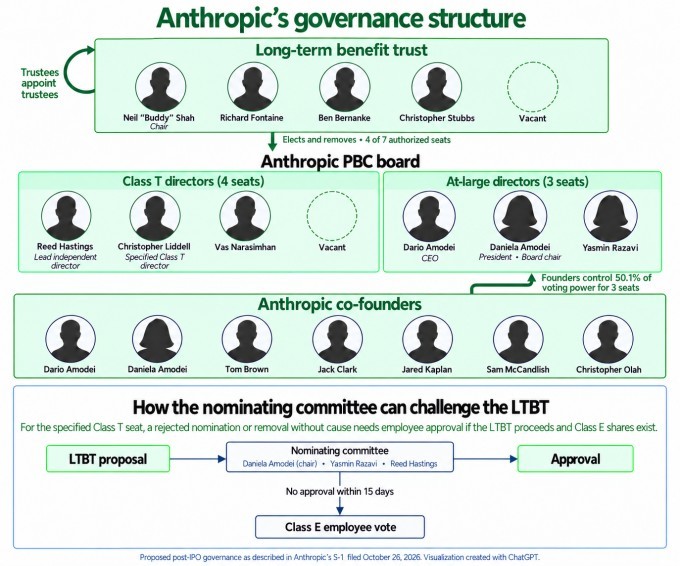
In short, the staff is not merely a constituency to be placated; in defined situations they hold the tiebreaker on a specific trustee seat.
What Could Make This Balance Shift — Lessons From OpenAI
The dynamics of this layered structure are hard to forecast. Reporting has noted that a similar arrangement was effectively overthrown before: OpenAI's board briefly removed CEO Sam Altman after concluding he had not been candid with them, but strong employee loyalty to Altman pushed the board to reverse course, restore him, and stand up a new governance structure. Anthropic's design appears to institutionalize that kind of employee power.
Two fracture scenarios follow directly from the rules above. If the seven founders fail to act as a united bloc, ordinary shareholders may end up with more influence than the current numbers suggest. And if employees side with the board rather than with the trust, they can overrule the LTBT on a board-seat question.
The Sunset Clauses: When Founder Control Ends
Founder control is not permanent. Ten years after the IPO, the founders may choose to give up their special voting power; that control also ends automatically if fewer than three founders remain. Meanwhile, the LTBT persists unless 85% of ordinary shareholders vote to dissolve it, or it decides to exit with board approval. Only if both classes of special shareholders disappear — reporting frames that hope as "not because of an AI-caused catastrophe" — do ordinary shareholders finally gain full control.
Quick Checklist: Who Holds What
- Board of directors: Chaired by President Daniela Amodei; members include CEO Dario Amodei, Reed Hastings (Netflix), Christopher Liddell (ex-Microsoft and General Motors CFO), Vas Narasimhan (Novartis CEO), and Yasmin Razavi (Spark Capital). Currently one vacancy.
- Long-Term Benefit Trust (LTBT): An independent group chaired by Neil Shah, with members Ben Bernanke, Richard Fontaine, and Christopher Stubbs. Holds a class of shares allowing it to elect and remove the majority of Class T directors. Also has one open seat.
- Founders' bloc: Seven founders jointly hold a class of special shares giving them 50.1% shareholder voting rights and the right to elect three board members. Shares vote proportionally only if the founders cannot agree.
- Employee vote: Can override the LTBT when the nomination committee refuses a designated director removal or appointment without cause.
- Founder-control sunset: Ends ten years after the IPO, or automatically if fewer than three founders remain.
- LTBT sunset: Ends if 85% of ordinary shareholders vote to dissolve it, or it exits with board approval.
- Ordinary-shareholder supremacy: Only when both classes of special shareholders are gone.
Common Misconceptions
- "The CEO controls the company." Dario Amodei sits on the board, but the board's majority seats are shaped by the LTBT and the founder bloc, not by the CEO's own vote.
- "Investors will own the outcome after the IPO." Ordinary shareholders do not gain final control unless both classes of special shares vanish.
- "The LTBT is just an advisory panel." It holds an actual class of shares that lets it elect and remove Class T directors.
- "Employees have no say." They can break a tie on a designated LTBT director seat under defined conditions.
- "This structure is permanent." Both the founder bloc and the trust have explicit sunset triggers.
FAQ
Q: Does Anthropic have one shareholder with majority economic ownership?
A: The article does not describe an economic majority. It describes a voting majority: seven founders jointly hold a class of special shares worth 50.1% of shareholder voting rights.
Q: How many Class T directors does the LTBT appoint?
A: The trust holds a class of shares with the right to elect and remove the majority of Class T directors; in the employee-vote scenario the trust is described as having four directors, one of whom is the designated seat.
Q: What happens to the vacant seats?
A: The board carries one vacancy, and the LTBT also has one open seat whose replacement the remaining members will choose themselves.
Q: Is the OpenAI comparison a prediction about Anthropic?
A: No. Reporting merely uses OpenAI's board episode involving Sam Altman as an example of how a similar layered structure can be overturned in practice. The comparison illustrates unpredictability, not a forecast.
Q: What ends founder control?
A: A founder choice ten years after the IPO, or automatic termination when fewer than three founders remain.
Action Advice: How to Follow This Story Without Getting Lost
- Track the vacancies first. When the board or LTBT fills its current open seat, the balance of the named members shifts, which changes how a future removal vote might look.
- Watch for founder departures. Any resignation that brings the active founder count under three triggers the automatic end of the 50.1% special-share block.
- Mark the ten-year-after-IPO date on your calendar. That is the earliest planned moment at which the founders can voluntarily release control.
- Follow ordinary-shareholder vote thresholds. Dissolving the LTBT requires 85% of ordinary shareholders, so any proxy-filing discussion of that ratio is worth reading closely.
- Separate voting from ownership. When judging coverage of Anthropic's governance, ask whether an article means voting control or economic stake; the rules described here are voting rules.
- Compare the OpenAI precedent only as a caution. Use it to remind yourself that institutional arrangements can break under pressure, not to predict a specific outcome for Anthropic.
Governance structures like this read as convoluted until you line them up as a sequence of who appoints whom, who can remove whom, and which votes dissolve which rights. Once you see Anthropic's board, Long-Term Benefit Trust, founder special shares, and employee tiebreaker as four linked mechanisms rather than four separate news items, the company's pre-IPO control map becomes a single connected picture — and any future headline about a change to one of those pieces immediately signals how the others might react.