
MyTechDailyNews General: Anthropic IPO Test After Meta's $95 Billion AI Signal
For everyday tech readers, the story around Anthropic PBC is less about one company listing and more about the next big test for the AI boom: can public markets absorb an enormous new share sale after Meta's $95 billion equity move? The mood has warmed a little since October, but the conditions for a large IPO remain difficult, and the result could ripple through both stocks and credit markets.
Why a slightly warmer market still leaves the IPO question open
Anthropic PBC is preparing an IPO with a fundraising target that would rank among the largest ever. The company was founded by Dario Amodei, and the Claude chatbot has made it a central name in the AI race. Reuters has reported that the company's fundraising ceiling could reach $100 billion, above the $86 billion record set by SpaceX in June.
That comparison is not just numerical. SpaceX has a mature launch business and a Starlink communications service that can generate profits and support Musk's broader AI plans. Anthropic's revenue growth is strong, but investors still need to judge whether an AI company's listing can be understood and priced by ordinary shareholders.
Meta's $95 billion move as a practical test case
Meta announced a $95 billion equity package. The Facebook parent sold $38 billion in common and preferred shares, exceeding its initial target, and plans to raise another $60 billion through targeted placements from next year. Nvidia, AMD and Broadcom are expected to take up a small portion, while most of the demand still has to come from the broader market.
The market response was also notable. On Monday, after the news landed, Meta's stock fell by less than 2%. That suggests investors were willing to accept a very large share sale tied to AI spending.
The financing mix is shifting from credit to equity
Yorkville Ives says Meta's “debt-financing phase has ended.” Its long-term borrowing rose to $81 billion in the third quarter, compared with $29 billion in the same period last year. AI infrastructure spending has already drawn heavily on credit; now part of that need is being passed to stock investors.
Other large technology-related equity deals are also appearing. This month, Schneider Electric closed a $23 billion purchase of the United States software company PTC. To fund it, Schneider raised €6 billion, equal to about $6.7 billion. For France, Europe and a company not usually seen as a mega tech issuer, the deal was a significant achievement, especially as funding costs in France have risen sharply.
Table: what each large deal shows
| Deal or company | Size or record | Connection to the AI funding story |
|---|---|---|
| Meta | $95 billion equity plan; $38 billion first sale; $60 billion planned from next year | Shows investors are willing to put large capital into the AI mainline. |
| SpaceX | $86 billion IPO record in June | Provides a scale benchmark for Anthropic's planned offering. |
| Anthropic PBC | Reported potential IPO ceiling of $100 billion | Tests whether public markets can price a major AI company through a new listing. |
| Schneider Electric | $23 billion PTC purchase financed with €6 billion, about $6.7 billion | Shows large equity-linked transactions can still be completed, without turning into an IPO template. |
Blue-chip share sales are not the same thing as an IPO
At first glance, all this equity issuance seems to favor Anthropic. Yet Meta and Schneider Electric are already well-known public-market names. Existing shareholders may have clear reasons to add to a familiar company when new shares are offered. An IPO is a different test: it asks whether a new company can win enough fresh risk appetite, and it requires investors to find cash to participate.
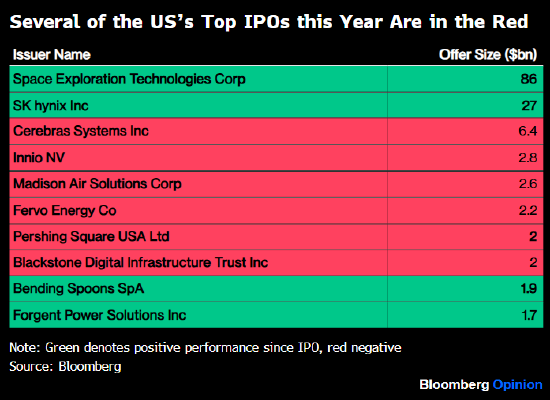
Although Anthropic currently has the glow of a “must-own asset,” the decision to buy or not buy still rests with investors. The environment is also less friendly than when SpaceX went public. The 10-year Treasury yield in the United States has moved from 4.5% to 5%. While SpaceX's share performance has modestly outperformed the broader market, most United States IPOs this year have disappointed, with an average gain of only 2%. Data center operator listings have been especially weak.
Valuation logic is harder and liquidity pressure is the hidden risk
SpaceX gives public investors two tangible pillars: launch services and Starlink. Anthropic has strong revenue growth, but its valuation logic is harder to grasp because investors must judge expectations around its position in AI. Retail money is also likely to be part of the demand story.
The bigger question is whether one IPO can affect the whole market. The United States has the deepest capital market in the world, but liquidity is not infinite. Asset managers can fund new share purchases only if clients add money or if they sell existing holdings. That is why some point to June, before the SpaceX sale, when the top 10 S&P 500 companies weakened slightly. That pattern may have reflected investors freeing up cash.
What strategists are watching: supply, buyflows and the AI trade
Some equity strategists remain cautiously positive after tracing money flows across the market. Meta and Alphabet have shifted from buying back shares to issuing them, turning from providers of cash returns into users of market liquidity. Other sectors have offset that effect through share repurchases, and the list is not limited to Nvidia or Micron, the direct beneficiaries of AI spending.
Deutsche Bank argues that the current wave of equity issuance is being caused by strong buying demand, and that new stock supply growth may slow, but will not end the rally. Goldman Sachs points to history: over the past 30 years, the S&P 500 has typically moved sideways in the weeks before and after giant IPOs, then resumed its rise. The bank's analysts say, “We expect new equity supply will not end the bull market in the short term,” noting that corporate equity financing this year has been only 1% of United States stock market capitalization.
The theoretical answer is that the market can digest a huge new supply. In practice, Anthropic is still an IPO, and IPOs are driven by sentiment and variables that no model can fully remove. Everyone is watching because the deal has become a symbol of the AI trade—and the AI trade is the market's central story right now.
Checklist: what readers should track as the Anthropic IPO develops
- Whether the final target stays near $100 billion or moves closer to the $86 billion SpaceX benchmark.
- Whether Meta-style large share sales continue to cause only limited stock declines, such as the less-than-2% move after Monday's news.
- How the United States 10-year Treasury yield trend interacts with IPO appetite, especially after its move from 4.5% to 5%.
- Whether average IPO gains this year, now around 2%, improve before Anthropic prices its offering.
- Whether fund inflows or portfolio sales are used to support new listings, given the liquidity constraint in the world's deepest market.
FAQ: common questions about the IPO, Meta and AI capital
Why does Meta's sale matter to readers who only care about AI products?
Because AI products depend on chips, data centers and financing. Meta's $95 billion plan shows that huge equity funding can still be sold when investors believe in the AI spending cycle. That helps the mood around companies like Anthropic, but it does not guarantee a successful IPO.
What makes Anthropic different from SpaceX?
SpaceX is anchored by launch services and Starlink, while Anthropic is the company behind Claude. SpaceX has a clearer cash engine from its businesses; Anthropic's story depends more on investor expectations about its position in AI.
Is this only a stock-market issue?
No. Credit markets are involved because AI infrastructure spending first leaned heavily on debt. Yorkville Ives' view that Meta's “debt-financing phase has ended” marks a shift toward equity investors, which changes who absorbs the risk.
What did Goldman Sachs say about big IPOs?
It pointed to the past 30 years, when mega IPOs usually caused short-term pressure but not a market breakdown. In the weeks before and after giant listings, the S&P 500 generally moved sideways, then continued higher.
Common misconceptions to avoid
- Confusing a follow-on sale by a known public company with a brand-new IPO. Meta and Schneider Electric may be able to raise large amounts because investors already know them; an IPO tests a different type of risk appetite.
- Assuming that a huge target automatically means the market wants it. The $100 billion ceiling is only as meaningful as the demand investors provide at the final price.
- Thinking that AI's popularity removes normal constraints. Liquidity still comes from new money or from selling other assets, not from nowhere.
- Reading strategists' historical analogies as certainty. The S&P 500 pattern over the past 30 years reduces fear of a permanent shock, but it does not remove IPO-specific sentiment risk.
Action advice: how to read this story like a market-aware tech follower
- Watch the size, not just the headline: compare any final Anthropic figure with Meta's $95 billion plan and SpaceX's $86 billion record.
- Read market reaction as a gauge: a small share decline after a very large supply event is different from a big decline.
- Keep time frames clear: June benchmark, October mood, Monday news, third-quarter debt, this year IPO performance, and the past 30 years history.
- Use the strategist view carefully: Deutsche Bank and Goldman Sachs describe absorption capacity, but Anthropic remains a sentiment-sensitive IPO.
In short, the Anthropic PBC listing is not just another company story. It is a practical test of whether the market's AI optimism can move from product excitement to new-share demand. The warmer tone since October helps, Meta's $95 billion test helps, and strategist history helps; but IPO conditions, rising yields and the difficulty of pricing an AI company mean the outcome still needs to be judged by real investor behavior.