
MyTechDailyNews Explainer: Anthropic’s IPO, $518 Billion Compute Promises and the AI Cost War
Public listings often turn private momentum into visible trade-offs, and this story is no different: a company built on Claude and coding tools is now being judged by revenue, losses, and the size of its long-term compute bill.
What changed: from private momentum to public scrutiny
On October 26, it was reported that Anthropic had filed an IPO document with U.S. securities regulators. The company had grown through Claude and developer-focused coding tools, and Reuters disclosed that its 2025 revenue reached $4.59 billion, while first half of 2026 revenue rose to $16.29 billion.
The other side of the prospectus was less comfortable: first half of 2026 net loss reached $80.7 billion. About $72.4 billion of that came from convertible note fair-value changes rather than cash outflow; the real operating loss was about $693 million, or about $0.693 billion.
Investors also looked at the next ten years of commitments. The filing points to at least $518 billion in compute purchasing, with about 80% non-cancellable or payable regardless of usage. Anthropic plans to raise $100 billion in the IPO and has raised $150 billion in total since founding. That has touched a nerve in U.S. markets, where AI infrastructure spending already faces concern. Industry voices say the listing matters: if it does not go well, the wider market could be dragged along.
Why revenue growth still may not equal easy profit
Anthropic is often read as a commercial template for AI. Instead of waiting for mass consumer traffic, it entered through coding and enterprise services. Claude gathered developers, while enterprises bought model capability through API calls and paid subscriptions. In this picture, a model is not just a chat window; it is part of software development, knowledge work and business processes.
The logic is attractive because companies are willing to pay for tools that improve productivity. In coding, value is not only whether an answer sounds right. It is whether the model can write, debug, test and carry out complex tasks. If that shortens development cycles and reduces repetitive labor, the payment case becomes concrete.
One AI CEO, speaking to iFeng Technology, framed it this way: “Everyone first discovered that AI coding had strong commercialization conversion ability, and this earliest came from Anthropic; now Anthropic has also begun doing AI pharmaceuticals, and future definitely someone will follow.”
But revenue growth and profit quality can separate. Reuters’ summary of Anthropic’s filing shows 2025 operating loss of about $8.06 billion and first half of 2026 operating loss of about $0.693 billion. In the same period, computing and infrastructure spending was close to $9 billion, up from about $2.3 billion a year earlier.
That is the tension at the center of the IPO: the business is expanding quickly, yet each sold token carries a cost. Training needs compute, inference needs compute, and larger user bases plus more complex tasks keep increasing consumption. When AI moves from simple Q&A toward coding agents and complex task execution, more reasoning rounds, tool calls and repeated validation can change the unit-cost structure.

Paying customers do not automatically mean high margins. If more revenue requires continuously more compute, scale and profit improvement may not move together. Anthropic’s long-term cloud, compute and infrastructure agreements are also in view: Reuters reported commitments over $500 billion for the next ten years, with the prospectus framing it as at least $518 billion and about 80% hard commitments.
None of this means the company has made no progress. Revenue growth and enterprise expansion show that buyers are willing to pay for model capability. The open questions are whether inference costs can fall as capabilities improve, and whether customer prices can cover models, compute and service delivery as more work is delegated to AI.
The other route: open source, low cost and chain leaders
If Anthropic represents high-value enterprise scenarios, DeepSeek has pushed the industry to treat cost itself as a competitive feature. Early on, DeepSeek made markets re-examine the cost of training and using large models. Attention landed on performance and training-cost disclosures, but commercialization asks a broader question: can low cost extend into deployment, inference and real usage?
OpenRouter data provides one signal. In call volume, DeepSeek’s models were first on the weekly chart for three consecutive weeks. minimax, Zhipu and Tencent models also remained in the top 5.
This suggests capability is not only achieved by adding parameters or stacking compute. Architecture design, training method, inference efficiency and resource scheduling can affect unit cost. Low cost also changes how models enter markets, and the industry can now see two very different development paths.
The contrast sharpened recently. The U.S. Department of Homeland Security ordered federal agencies to remove DeepSeek products and third-party services built on its models. Around the same time, DeepSeek said it would fully open-source its internal inference framework DeepInfer, compatible with the two major compute platforms from Nvidia and Huawei Ascend. The scene placed DeepSeek at the front of global AI competition, and its response was not contraction but widening its technical base.
Funding also accelerated. Multiple media reports said DeepSeek was close to completing about 100 billion yuan RMB financing. From September, the round was kept being raised: an initial plan of 50 billion yuan, then 80 billion yuan, finally 100 billion yuan. Added to June’s first round of about 51 billion yuan, DeepSeek raised about 150 billion yuan within half a year, while the pre-money valuation stayed at 500 billion yuan RMB.
The investor list was unusually broad. Based on statistics from the self-media outlet Money Tides, more than 20 investment institutions gathered. Existing shareholders IDG Capital, Shixiang Technology, Zhengxin Valley Capital, Monolith, CATL, Tencent and Guozhi Investment continued. New participants included China Mobile, China Telecom, China Life Investment, GigaDevice-affiliated Shixi Capital, SMIC Juyuan Capital, Boyu Capital, CPE Source Peak, Gaorong Capital, Legend Capital, CITIC Investment, Meituan Longzhu, Hengdian Capital and Geely Capital. Other listed companies and industrial capital, including Muyuan Foods, Zhihu, Century Huatong, Perfect World, Giant Network and Dahua Technology, also participated indirectly, making the list too crowded to name one by one.
Founder Liang Wenfeng appears to value industrial usefulness. That is visible in the energy depth of the CATL camp and the domestic storage-chip ties of the GigaDevice camp.
Yet large money brings spending pressure. A person close to DeepSeek told iFeng Technology that the company is mapping a new growth route for investors, including major team expansion. After June’s about 51 billion yuan first round settled, DeepSeek published a June 25 recruitment notice saying it would “expand all departments to at least double their size”, with 33 openings covering technology research and development, compute infrastructure, product implementation, frontier algorithm research and general functions across seven major sections, including data-center infrastructure roles in Ulanqab.
In September, DeepSeek Harness team lead Cui Tianyi posted about 150 recruitment slots and described demand as “unprecedented”. Reported pay also drew attention: a Tsinghua University Yao Class intern was said to receive a pre-tax daily rate of 5,500 yuan, with monthly pay above 120,000 yuan, while a campus-hired core systems R&D engineer role was quoted at 60,000 to 90,000 yuan monthly. By contrast, Liang Wenfeng has kept a low-key style: offices are mainly in Beijing and Hangzhou, and he has long rented a simple apartment in Beijing.
Price cuts force OpenAI to move
OpenAI has been the most direction-shifting player. It first chased the upper limit of model intelligence, then wanted consumer reach, once imagining a “WeChat for the AI era” that connects everything. Facing huge losses and revenue being overtaken, it also learned from Anthropic and pushed into AI coding for better commercial conversion. More recently, its behavior looks closer to DeepSeek’s cost-first logic.
On September 23 this year, GPT-6 Sol and Luna arrived together. Luna’s API input price was cut to $0.1 per million tokens, an industry-floor level. Half a month later, on October 7, OpenAI gave Luna directly to free users, covering the full ChatGPT population: paid users got Sol, free users got Luna.
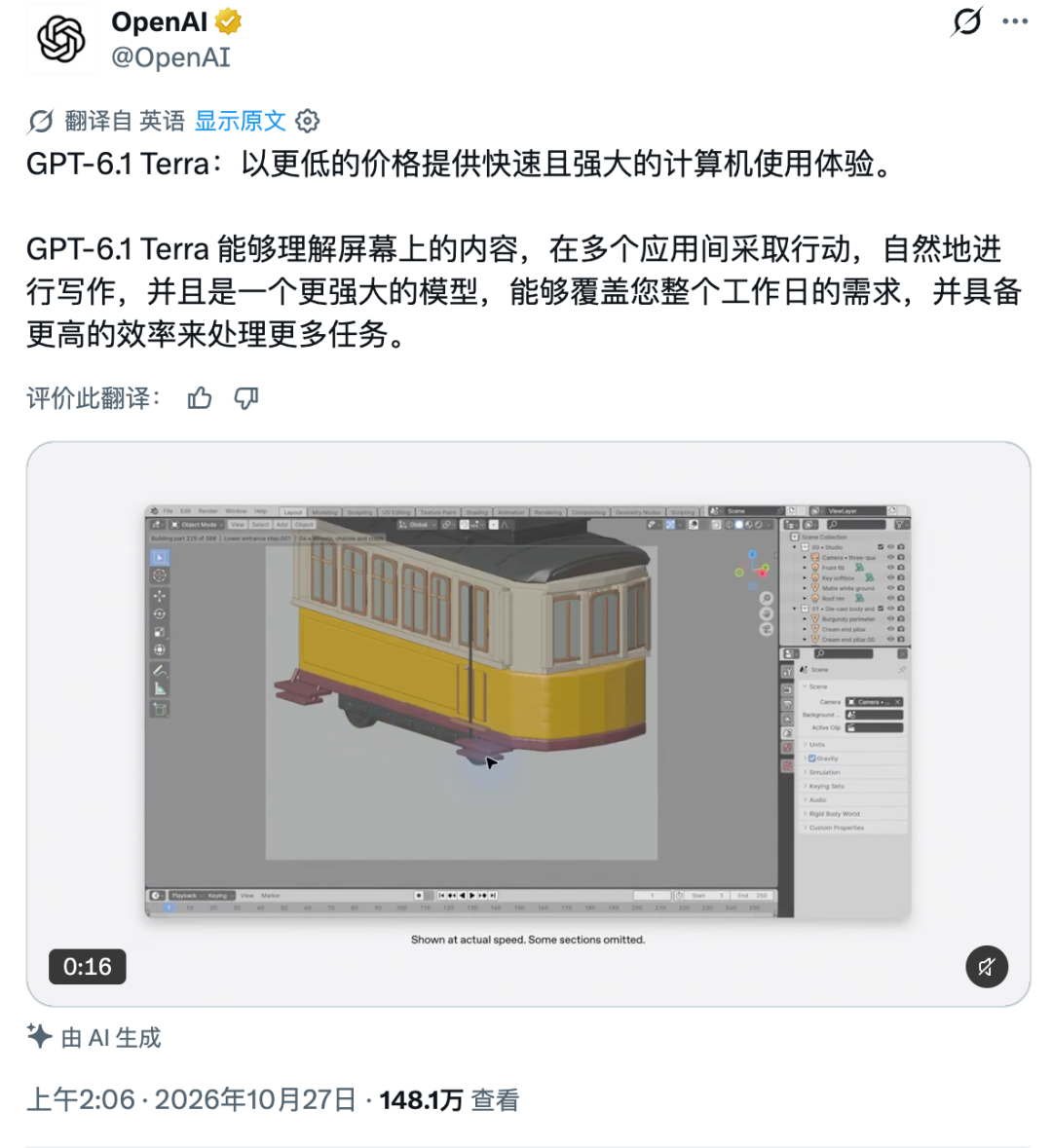
Then, on October 26, OpenAI released GPT-6.1 Terra, a mid-tier model centered on computer operation and everyday office tasks. Its standard API price was reduced by 50% compared with the previous GPT-5.6 Terra. OpenAI also said that in some task tests, Terra could complete work at far lower cost than flagship models.
One industry person said, “OpenAI is still in a swinging stage; the fact that they are working on embodied-intelligence models shows it. Compared with Anthropic, OpenAI is often wavering, but it will soon be educated by the market and do profitable business.” In a visibly crowded large-model market, failure to keep building advantage on its core offering could quickly make momentum vanish.
Checklist: what to watch when the headlines settle
- Track the gap between accounting loss and cash loss: the $80.7 billion first half of 2026 loss included about $72.4 billion of convertible-note fair-value changes.
- Read the compute clause as a contract, not a slogan: at least $518 billion for the next ten years, with about 80% unavoidable or usage-independent.
- Compare revenue with operating spend: first half of 2026 revenue was $16.29 billion, while infrastructure spending in that period was close to $9 billion.
- Watch price curves: GPT-6.1 Terra was priced reduced by 50% below GPT-5.6 Terra, and Luna had been pushed to $0.1 per million tokens.
- Follow distribution, not only model scores: OpenRouter first place for three consecutive weeks showed how call volume can signal real use.
Common misconceptions
| Misconception | What the filing or report actually says |
|---|---|
| Net loss means all cash left the company. | About $72.4 billion came from fair-value changes of convertible notes, not cash outflow; operating loss was about $693 million. |
| Enterprise demand automatically solves AI profitability. | Customers do pay, but each token may require more reasoning, tool calls and validation as tasks grow complex. |
| Low-cost models are only a single-market story. | The industry is seeing two paths: high-value enterprise capability and low unit-cost distribution, with OpenRouter top 5 names including DeepSeek, minimax, Zhipu and Tencent. |
| Open source means commercial weakness. | DeepSeek’s DeepInfer open-source move, compatible with Nvidia and Huawei Ascend, shows another way to widen use of a technical base. |
FAQ: the questions readers ask first
Why does Anthropic’s IPO matter beyond its own stock? Because the company has become a reference point for AI commercialization. Its prospectus shows both fast enterprise adoption and the weight of compute contracts, so investors can see whether a model business can grow without letting infrastructure costs outrun revenue.
Why can revenue grow so fast and the headline loss be huge? The headline loss includes non-cash fair-value movement: about $72.4 billion. The operating loss is much smaller at about $693 million, but still reveals real spending on compute and infrastructure.
What are the $518 billion commitments? They are future compute purchasing promises over the next ten years, with about 80% described as non-cancellable or payable regardless of usage. That is a major reason the market is watching the IPO.
Is DeepSeek simply cheaper, or does it change the competition? It changes more than price. It also changes entry method: low cost can support deployment, inference and real use, while open-source DeepInfer and the funding list suggest an attempt to spread its base.
Why is OpenAI lowering prices? The report describes OpenAI as moving from frontier ambition toward cheaper, more commercial offerings after losses and competition. GPT-6.1 Terra, Luna and free-user distribution point to the same pressure: win usable cost, not only benchmark bragging rights.
Action suggestions for everyday tech readers
For ordinary readers, the practical move is to read AI company news through four filters: who is paying, what the real cash burn is, how long the compute promises last, and whether model prices are falling. For product teams, the signal is to check task-level cost, not just model quality. For investors, the signal is to treat “net loss” as a line to decompose. For policy and enterprise buyers, the signal is to watch distribution, regulation and open-source compatibility together.