
MyTechDailyNews Explains Claude's New Limits on Game Remakes and DIY Reverse Engineering
Artificial intelligence has lowered the barrier to copying what a familiar game feels like. With text prompts, assets and code snippets, a small team can sketch rules, maps, items or interface behaviors that look close to a well-known title. In the latest round of AI-policy discussion, reports say Anthropic's assistant Claude has become more cautious when requests involve reproducing existing game mechanics, creating unofficial ports or supporting reverse engineering work. That shift has moved quickly from developer forums to ordinary hobby projects, and it is now part of a wider conversation about what AI assistants should help build.
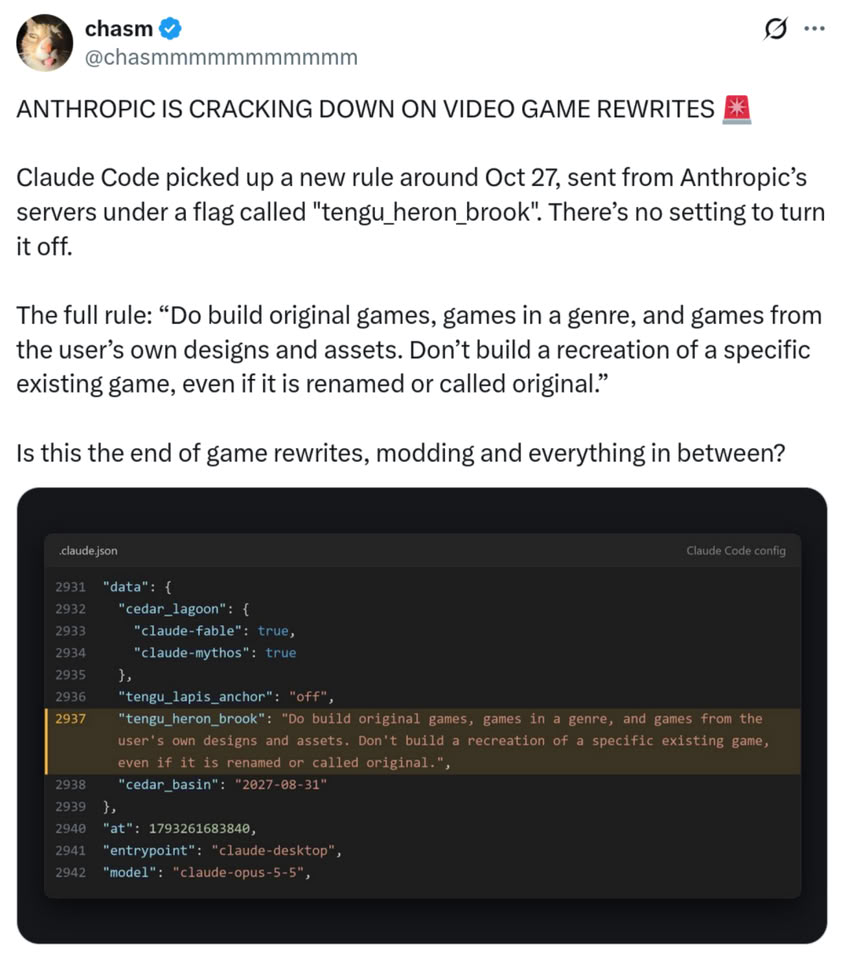
What the Reported Rule Actually Says
The starting point of the discussion is not a broad statement that AI may never help with game work. It is a narrower boundary. According to one user on the X platform, one clause in the Claude rules says: “Original games can be built, games within a genre, and games based on the user's own designs and assets. Do not build a remake of one specific existing game, even if it is renamed or presented as original.” The wording gives two sides of the same line: genre inspiration is treated as a legitimate creative path, while a copy that remains too close to one particular game is treated as off limits, even if the name is changed.
That distinction explains why the topic has become sensitive. A game can borrow the rhythm of a battle-royale shooter, the survival structure of an open-world adventure or the visual language of a retro platformer, but still not become a practical clone of a famous title. From the user side, the question is where original design stops and a renamed remake begins. From the platform side, the concern is copyright exposure, legal risk and the public impression left when AI outputs look too much like a protected product.
From Small Home Workshops to Controversial Clones
Before this reported rule became a talking point, the broader trend was already visible. Using AI to clone games, reverse engineer software and decompile old builds has become increasingly common. Projects can appear almost overnight. Some start as curiosity, some as nostalgia, and some as attempts to make a familiar experience run on newer hardware. As these small experiments multiply, observers describe the result as a small home-workshop-style industry: not large studios, but scattered makers, tinkerers and self-organized groups producing playable pieces with limited resources.
Not every project is the same. Some have attracted controversy because they look too close to existing franchises, including clones associated with Fortnite and Fallout. Others are less commercial and more personal: player-made console ports, fan recreations or experiments aimed at preserving a version of a game that has become difficult to access. The reported Claude boundary does not erase those motives, but it does add another hurdle for people who ask an AI assistant to help recreate game mechanics or reproduce existing games.
Why Users Say the Change Spread Beyond Gaming
Although the clause is framed around game remakes, reports shared on Reddit suggest the practical effect may not stay inside gaming. Some users said Claude became reluctant to invoke a widely used capability called Reverse Engineer Anything. That capability had been associated with tasks such as breaking vendor lock-in on smart televisions, adding features to car infotainment systems, and recompiling electronic games so they can run on other platforms. These are not ordinary entertainment-only requests; they sit closer to repair, accessibility, device freedom and preservation.
For non-specialists, the important point is that a single rule written for one obvious category can touch adjacent categories. A maker who wants to move a favorite game to a new device may not think of the work as a remake, but a system that detects similar mechanics, assets or compilation patterns may still treat it as risky. Likewise, a user asking for a technical translation of one platform's behavior into another platform's language may see the request blocked because the output looks too close to an existing product.
What It Means for Game Clones and DIY Projects
| Situation | What users reported | Why the situation matters |
|---|---|---|
| A prompt asks for a near copy of one known game | Claude is said to refuse recreation of game mechanics or reproduction of an existing game. | The most direct target of the reported clause is renamed remakes, not generic genre work. |
| A developer asks for help with their own early prototype | Some reports say refusal can happen even when the underlying work belongs to the developer, because later development needs similar mechanics. | This creates confusion: the project may be original, but the requested output can still look like a risky copy. |
| A maker asks for help outside games | Reddit users described refusals linked to Reverse Engineer Anything, affecting smart TV unlocking, car infotainment enhancements and cross-platform recompiling. | It shows the boundary can affect hardware tinkering and preservation, not only commercial clone games. |
Checklist: How to Tell Whether a Project Is Still on the Original Side
- Name the genre, not the target game. If the request says “make a tactical shooter inspired by a general design style” rather than “make the next clone of one famous game”, the boundary becomes clearer.
- Separate user-owned assets from borrowed assets. The reported rule is friendlier to projects built on the user's own designs and materials.
- Explain the purpose. If the task is learning, repair, porting, preservation or adding features to a device, say that plainly instead of only asking for output that resembles a protected title.
- Keep project history separate. If your own early prototype later looks like a known game, document why the mechanics are independent and provide original references.
- Avoid renamed clones. A change of title is not enough according to the reported clause; the design still has to be genuinely distinct.
- Use AI for structural guidance, not for copying a named title. Ask for rules, balance ideas, architecture or debugging approaches instead of reproducing a specific game's content.
Common Misconceptions About the Claude Restriction
- Myth: AI can no longer help with any game project. Reality: The reported boundary still allows original games, games in a genre and games based on the user's own designs and assets.
- Myth: This only affects obvious commercial copies. Reality: Users say some requests involving their own early work were refused because the later development relied on similar mechanics.
- Myth: The issue is only about public relations. Reality: The discussion includes copyright risk, legal exposure and possible pressure from large game companies, according to the framing of the reports.
- Myth: Changing a game's name solves the problem. Reality: The clause quoted on the X platform explicitly says a renamed remake still counts if it is a reproduction of one specific existing game.
Action Suggestions for Readers, Modders and Small Teams
- Describe your project as original before asking for code or design help. Start with your own theme, rules, art direction and feature list.
- When asking for reverse engineering help, define the hardware or software you own and the repair, porting or compatibility goal. This helps separate learning from copying.
- For game ideas, use broad genre terms and independent examples. If you are making a battle-royale style prototype, discuss pacing, map flow and team design instead of naming a specific title as the target.
- For team workflow, keep a short design provenance file. It can record who created which concept, which assets are original and which references are inspirational rather than copied.
- When a refusal happens, reframe the request around your own materials. If the original task is legitimate, make the ownership and creative distance visible.
FAQ: Claude, Anthropic, Game Remakes and Reverse Engineering
Did Anthropic officially announce the new Claude rule?
The content summarized here is based on user reports and the coverage first highlighted by Tom's Hardware. The quoted line is presented as one clause reported by one user on the X platform.
Can Claude still help me make a game like Fortnite or Fallout?
According to the reported boundary, it can help with original games, games within a genre and games based on the user's own designs and assets. What it reportedly refuses is building a remake of one specific existing game, even if it is renamed or called original. So a project inspired by a genre may remain different from a direct clone of a named title.
Why did GitHub issues increase after the rule?
Users reported that the restriction produced many new questions on Claude's GitHub page. Some issues came from developers who believed the refused task involved their own work from an early stage of a project, but the output still involved mechanics that could resemble a known game.
Does the change affect only video games?
Not according to the reports. Reddit users said the effect reached other areas, including requests connected to Reverse Engineer Anything. Those requests were previously associated with unlocking smart TVs, adding features to car infotainment systems and recompiling games to run on other platforms.
What should a small maker do if a request is blocked?
The practical path is to make the originality of the project clearer. Ask about a genre, not a clone; reference your own materials; describe ownership and purpose; and split the request into learning, design guidance or debugging rather than recreating an existing game.
The Larger Lesson for Everyday Users
The most useful takeaway from this story is not that AI is suddenly closing the door to creative help. It is that the line between inspiration and replication has become easier to test, easier to automate and easier to misunderstand. A home-workshop-style maker may see an AI assistant as a tool for finishing a prototype, but a platform may see the same prompt as a route to a renamed remake or a risky reverse engineering output. As a result, users need to be more explicit about what they are building, what they own and what they hope to learn.
For MyTechDailyNews readers, the topic is relevant because it sits at the intersection of daily tech use, content creation and hardware tinkering. The game side gets attention first because titles are easy to recognize. The wider side matters too: smart TVs, car systems, porting projects and preservation efforts all depend on a practical balance between permission, ownership and technical freedom. The reported Claude rule does not remove every possibility; it changes the way users should phrase, document and structure requests so that original work is less likely to be mistaken for a copy.