
Tech Daily Case File: How Andes Technology Reshaped the Cuzco RISC-V Plan Around AI Revenue
TAIPEI, Taiwan — Most chip stories are filed as triumphs or failures. The one worth studying right now is neither: it is a resourcing decision, made in public, by a company that built a halo product and then deliberately took its foot off the accelerator. Andes Technology CTO Charlie Su told EE Times that development of the company's high-end Cuzco RISC-V CPU IP has been slowed while engineering headcount is pointed at a fast-growing AI business. Told as a case retrospective, the sequence of signals he describes — a demo that drew interest but not licences, an ecosystem running behind the silicon, and a revenue engine that suddenly needed people — reads like a playbook any product team can reuse.
Below: what was built, what changed, what happened next, and five lessons generalist tech readers can carry out of it. No register-transfer level required.
Case file at a glance
| Field | Detail |
|---|---|
| Company | Andes Technology, commercial CPU IP supplier headquartered in Taiwan (TWSE-listed) |
| Product slowed | Cuzco, high-end RISC-V CPU IP, originally developed by the US spinout Condor |
| Public debut | Hot Chips 2025, where the core first showed its data-centre ambitions |
| Status change | Technology pulled back in-house earlier this year and the pace reduced |
| Trigger | AI now accounts for half of revenue, growing 30% last year and expected to grow 50% this year |
| Outcome | The ambition survives; the timeline lengthens, and the product may reappear under another name |
Step 1 — The original bet was bigger than a side project
Condor Computing was set up in Austin, Texas in March 2023 as a wholly owned Andes Technology research and development subsidiary, created specifically to design ultra-high-performance RISC-V CPU IP in the United States — a country that accounted for a growing slice of the company's sales. At the Hot Chips 2025 conference, the resulting Cuzco core was presented as an RVA23-profile design that could scale to eight cores with a private L2 per core and a large shared L3, a 12-stage pipeline and a wide out-of-order front end; that spec picture was described in conference coverage by The Next Platform and in the Hot Chips 2025 paper itself. Nothing on that slide reads like a hobby project. That is exactly why the decision to slow it is instructive.
Step 2 — The ecosystem clock ran slower than the silicon clock
RISC-V's software story improved quickly but unevenly. RISC-V International ratified the RVA23 profile in late 2024, and through 2025 and 2026 Linux distributions, toolchains and server vendors progressively aligned to it — yet adoption in production data-centre fleets still lags the availability of a competitive core. That gap is the first thing Su names.
Su said, “The ecosystem needs to gradually go there before you have the hardware, otherwise you cannot catch the opportunity,” — a line that, in plain terms, means a chip can be ready years before the software, drivers, hypervisors and customer roadmaps that would buy it.
Step 3 — The money moved somewhere else
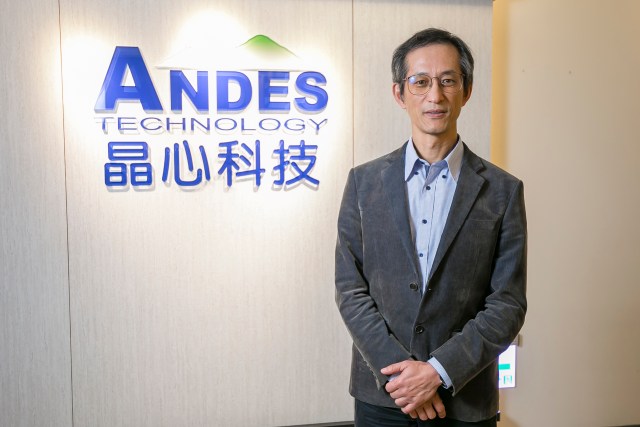 Andes Technology CTO Charlie Su (Source: Andes)
Meanwhile the AI side of the house compounded. Su said the AI business now accounts for half of Andes’s revenue, growing 30% last year and likely to grow 50% this year, which will require additional internal resources. Two details matter for readers who assume “AI revenue” means an AI accelerator.
- The company does sell a small deep learning accelerator with its own compiler, rated up to around 4 TOPS at 1 GHz — a chip more typical of edge boxes, cameras and appliances than of training clusters.
- Most of the AI money comes from AI chip companies that use Andes CPU cores for control, orchestration, and data movement, including Meta, d-Matrix, Fractile, and Axelera.
Su said many of these licences cover custom cores, and delivery schedules can be extremely demanding — custom work is labour, not a download. For scale, the company's own earnings release in March 2025 reported record annual revenue of roughly US$42 million for 2024, with licence revenue up 38.4% year over year; a business that size cannot staff two simultaneous moonshots and one crowded customer queue. Su's summary is blunt: “We started, but as time went on, we found the AI part of our business continued to grow very strongly.”
The response was arithmetic. Su said, “We decided to consolidate and slow down [Cuzco], so we could put more resources on the immediate revenue generation part,” adding that the decision was taken to protect near-term revenue.
Step 4 — Why Condor was the line that got cut
When engineers had to be reassigned, the spinout was the obvious candidate because Cuzco had not yet taken off commercially. Condor attracted plenty of attention after its launch at Hot Chips 2025, but inquiries have been slow to convert into licences — the classic gap between “impressive demo” and “purchase order” that any conference-going product team recognises.
Su said, “We could have put more effort into finishing Cuzco and maybe get one or two customers, but it’s not enough—we need to wait for bigger momentum,” and added, “So we decided to scale it back and move a little bit slower.”
Read as a case, this is the moment the decision crystallised: not a technical failure, not a lost market, but a conversion rate too thin to justify scarce senior CPU designers.
Step 5 — What the freed-up capacity went to
Su said the rise of agentic AI in the early part of 2026 is also a key driver for improving productivity and reducing headcount across the business this spring. He said Andes has its whole engineering team using AI agents to accelerate progress, with humans reviewing everything, and that consolidating Condor was linked to this strategy — the company is applying the same efficiency logic to itself that it sells to customers.
Concretely, the priorities that got the resources are unglamorous and close to everyday devices:
- A main processor core for the storage market sits high on the priority list — the company already has 10 customers in production with smaller controller cores.
- Automotive and robotics follow, both categories where a core, once designed in, stays in the field for a decade.
- AI customers' custom cores and delivery schedules, which is where revenue is compounding today.
The long-game argument, and the competitive backdrop
Su said Cuzco will still become a product, perhaps under another name, but the timeline has lengthened because Andes is working on it “slowly, while looking for signs we should speed up,” he added. He also argued that winning in IP is not necessarily about getting to market first, and that embedded customers may use the same cores for 10 years or more, albeit on different process nodes.
Su said, “The core that brings us the most revenue today is one we designed more than 10 years ago,” and added, “We want to do it right, make it reusable, instead of getting to market first.”
Two external shifts shape that thinking. First, recent changes in Arm’s business model following its launch of high-end CPU silicon are seen as positive for IP rivals, including Andes: Su said, “Arm changed its business model, and that has certainly affected customer trust, especially at the high end,” and noted, “[Embedded] customers also don’t know when it will hit their market.”
Second, the capital race for high-performance RISC-V got hotter, not colder, while Cuzco was being slowed. The broader market discussion includes SiFive’s $400M round — an oversubscribed Series G closed in April 2026 that reported a valuation of about $3.65 billion and drew participation from Nvidia, according to Reuters. In the same window, Meta agreed to buy RISC-V server-chip startup Rivos (Reuters, September 2025). Su's comments stayed on Andes's own priorities and the momentum needed for Cuzco, but the pattern is visible: big buyers are proving the data-centre demand exists, which is precisely the “bigger momentum” he is waiting for.
Su said, “The bottom line is that the market Cuzco tried to address is still there and will continue, so that’s where we want to hit next in terms of our performance level,” confirming the market itself was never the disputed part of the case.
Five reusable lessons from the case
- Slow the timeline, don't delete the ambition. The paused asset stayed inside the company, and its architecture is being reused — optionality is cheaper than cancellation.
- Treat ecosystem maturity as a specification. If the operating systems, drivers and customer roadmaps are not there yet, shipping hardware early converts attention into cost.
- Follow conversion, not interest. Demo inquiries after Hot Chips 2025 were plentiful; licences were not. Watch the metric two steps down the funnel.
- In IP and embedded, longevity beats being first. A core earning revenue today that was designed more than 10 years ago inverts the startup instinct.
- Spinouts are budget lines. Separate legal entities make it easier to be honest about what a business can afford right now.
Common misconceptions
- “Cuzco has been cancelled.” It has been slowed and re-scoped internally; Su is explicit that it will still become a product, perhaps with a different name.
- “Andes's AI business means AI accelerators.” The 4 TOPS part exists, but most AI revenue comes from RISC-V CPU cores managing control and data movement inside other companies' chips.
- “The chip disappointed technically.” The stated blockers were ecosystem sequencing and licence conversion, not a failed demonstration.
- “This is only about data centres.” Storage controllers, automotive and robotics chips sit inside the SSDs, cars and robots readers use.
- “Arm's move is neutral for everyone.” Vendor-versus-customer conflicts are a live trust question for chip designers, and rivals benefit.
Action advice by reader type
- Product and engineering leaders: write down the two or three observable signals that would justify restarting a paused project, and the two or three that would justify slowing it. Schedule that review quarterly — the Andes case turned on a conversion metric, not a mood.
- Hardware buyers and OEM teams: ask suppliers how long a core has been in production and how many nodes it has survived; treat a CPU vendor competing with its own customers as a procurement risk, not a curiosity.
- Developers and IT planners: for RISC-V hardware, check the profile target (an RVA23-class design is the current practical baseline) and confirm your toolchain, OS images and drivers exist before committing a roadmap.
- Analysts and investors: separate conference buzz from licence revenue, and watch where capital is placed — the SiFive round and the Meta/Rivos deal both say more about data-centre RISC-V timing than any single product launch.
FAQ
What exactly is Cuzco?
A high-end RISC-V CPU IP core aimed at data-centre-class workloads, developed by the Austin-based spinout Condor and shown publicly at Hot Chips 2025 before the technology came back in-house earlier this year.
Why is development slower now?
Two reasons Su gives: the software ecosystem has not yet reached the point where the hardware pays off, and the AI part of the business — half of revenue now — needs the engineers.
Is the project dead?
No. Su said it will still become a product, possibly under another name, at a pace described as “slowly, while looking for signs we should speed up.”
Does this hurt RISC-V's data-centre push?
Not necessarily. Andes's near-term focus is storage, automotive and robotics, while competitors such as SiFive are raising large rounds for the same data-centre ambition; the field is consolidating, not closing.
How did AI agents factor into this?
Su said the rise of agentic AI in the early part of 2026 is a key driver for productivity and headcount changes this spring, with the whole engineering team using AI agents under human review — and that consolidating Condor was linked to that strategy.
Where did the reporting come from?
The primary account is Charlie Su's interview with EE Times. Supporting details cited here come from Andes Technology's March 2025 earnings release, RISC-V International's RVA23 ratification notice, Hot Chips 2025 coverage via The Next Platform, and Reuters reporting on SiFive and Rivos. Corrections and tips to the Tech Daily desk: hello@techdaily.com.
Written by Sarah Chen, Tech Daily. MyTechDailyNews General — technology events explained as decisions you can learn from.