
Buy Now or Wait for 2029? AMD's Grimlock RDNA 5+ Roadmap, Compared Against the Chips You Can Actually Buy
By Sarah Chen | MyTechDailyNews
The most decision-relevant item to surface this week is not something you can pre-order. It is a date. Hardware leaker Kepler_L2 has placed AMD's Zen 7 APU family, code-named Grimlock, on track to appear in early 2029 with RDNA 5+ integrated graphics built in. Looked at properly, that is the far end of a bridge rather than a launch worth rearranging your budget around. Sitting between today and that point are a handheld chip line, a PlayStation-adjacent mobile part, one desktop graphics card and two server processors — and each of those is a different answer to the question most readers are actually asking: do I upgrade now, or do I hold?
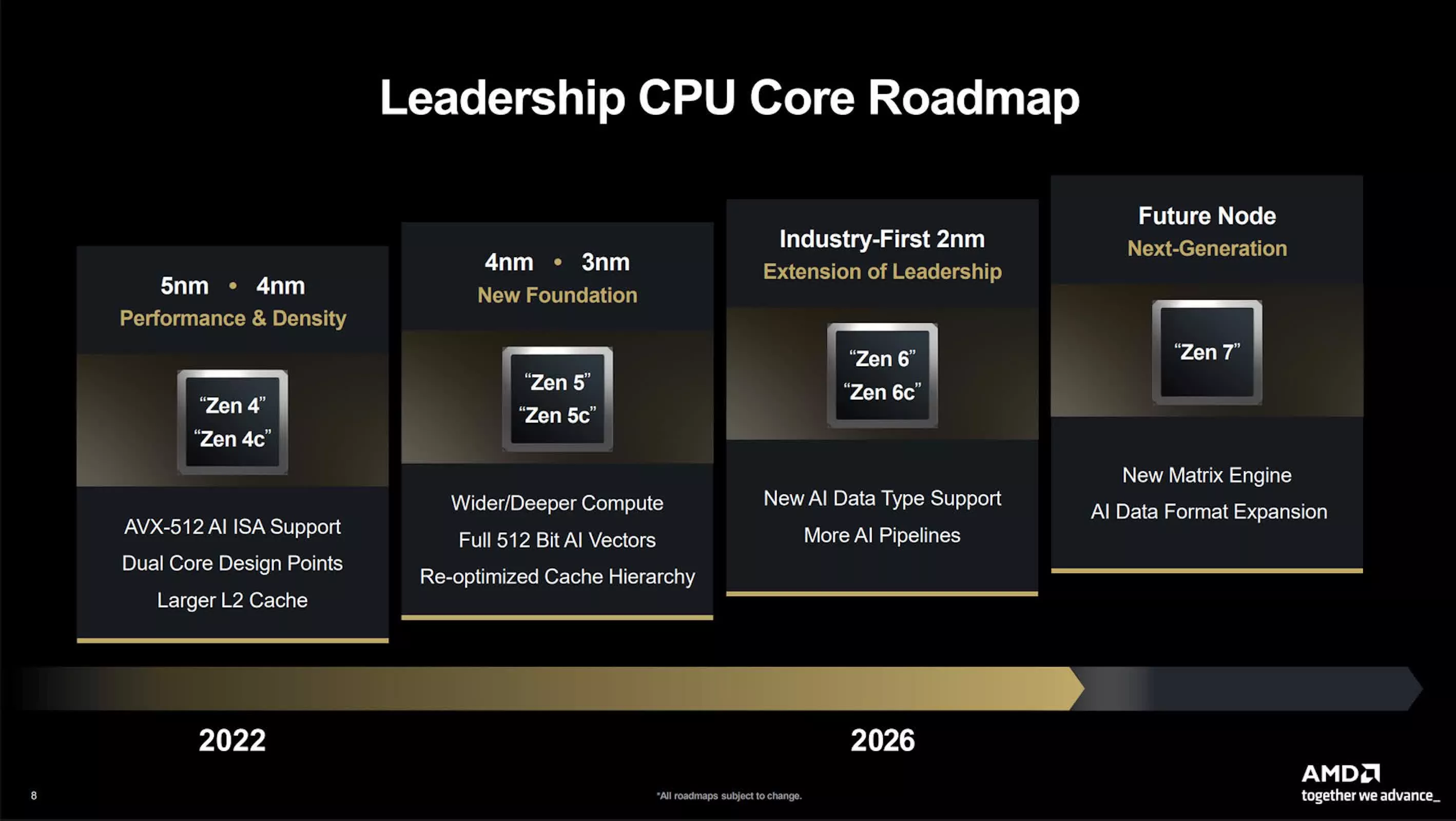
The comparison in four lines
- Buying a laptop this year: the integrated graphics you can actually purchase are already the strongest AMD has shipped in a thin-and-light, and nothing in the leak changes that for the next couple of product cycles.
- Buying a handheld this year or next: you are buying bridge silicon. That is not a downgrade — it is the only shelf AMD is stocking until the next-generation mobile parts land.
- Chasing RDNA 5-class graphics inside a single consumer chip: the honest read of the leak is that this is a post-2029 event for mainstream machines, not a 2029 one.
- Confidence level: low to medium. Every name, specification and window below traces to one unverified source; AMD has confirmed none of it.
One roadmap, five tracks — side by side
| Track | Expected window | CPU side | Graphics side | Where you meet it | The trade-off |
|---|---|---|---|---|---|
| On sale today | Now | Zen 5-era Ryzen AI silicon | RDNA 3.5-generation iGPU; AMD's own spec page lists the range-topping Radeon 8060S Graphics at 40 graphics cores and 2,900 MHz | Premium ultraportables, mobile workstations, mini-PCs | Graphics shares system memory rather than carrying its own |
| Handheld bridge | Between now and 2029 | Reported blend of Zen 6 and Zen 5 | RDNA 4m | Upcoming gaming handhelds, including the rumored Microsoft machine | Not RDNA 5, however it is marketed |
| Console-adjacent mobile | Around late 2027 | Zen 6c cores, up to 2.2GHz | RDNA 5 | Sony Canis, expected as a companion device to the PlayStation 6 ecosystem | Reported thermal design power of about 15W; Sony has published no schedule |
| Desktop discrete | Next year | n/a | RDNA 5 | A single high-end or sub-flagship card, pitched against a future 24GB version of the Nvidia RTX 5080 | One product, not a full stack |
| Server calendar | 2028, then 2030 | Zen 7 in the code-named-Florence EPYC, then Zen 8 in the code-named-Ravenna EPYC | n/a | Data centres; TSMC A16 and A17 manufacturing | Reveals cadence and process, not laptop pricing |
| Consumer APU | Early 2029 | Zen 7 Grimlock | RDNA 5+ | Performance Ryzen laptops and desktop APUs | Three-plus years away, and unconfirmed |
Track 1: what you can buy today is stronger than people remember
The comparison that matters for most shoppers is not RDNA 5 against RDNA 5+, it is RDNA 5+ against the graphics in a laptop that exists on a store shelf. AMD's product documentation for the Ryzen AI Max+ 395 credits it with Radeon 8060S Graphics carrying 40 graphics cores running at 2,900 MHz, and the mainstream premium part — the Radeon 890M found in Ryzen AI 300-series notebooks — is the reference point reviewers use when judging whether an ultraportable can host 1080p play at all. Independent testing has repeatedly put that class of chip within reach of entry-level discrete laptop graphics while drawing far less power.
Two practical consequences. First, a well-chosen current machine will not feel like a dead end when Grimlock eventually arrives: the gap that matters in daily use — memory bandwidth, sustained power, driver feature sets such as upscaling — is not closed by a newer architecture name. Second, if a purchase decision is being sold to you on the grounds that "the real next generation of AMD graphics is just around the corner," the leak actually argues the opposite: the corner is in early 2029.
Track 2: the bridge years, and the shipping-volume gate
Kepler_L2 previously told Digital Foundry that the handheld silicon Sony is pursuing under the Canis name may be the only mobile product presently aligned with AMD's RDNA 5 graphics architecture. The reported reason is commercial rather than technical: AMD is said to be withholding RDNA 5 platforms from PC makers such as Valve, Asus and MSI because their volumes do not clear the threshold AMD wants before it invests a mobile architecture in a partner. That is precisely why RDNA 5's arrival in mainstream handhelds is a question people keep asking and nobody has answered.
The bridge is the Ryzen Z3 series. Every handheld expected to reach shelves before 2029 — including the rumored Microsoft game device — is said to land on it, mixing Zen 6 and Zen 5 CPU designs with RDNA 4m graphics to cover demand for the next several years. Reporting that originated with Wccftech describes that family as a 25 × 25 mm package tuned around a 15W target for standard parts and roughly 25W for the Extreme variant, with RDNA 4m characterised as a derivative of RDNA 3.5 that borrows RDNA 4-class matrix hardware for machine-learning upscaling. If those details hold, the Z3 generation is best understood as a features-and-efficiency update rather than a leap — the same role RDNA 3.5 played after RDNA 3.
Handheld timelines reward patience and punish speculation in equal measure, and history is instructive: Valve's own tech-spec listing for the Steam Deck still describes a Zen 2 plus RDNA 2 custom APU, a combination that has stayed on sale and competitive for years. Mobile gaming hardware ages slowly because screen resolution does not race. Planning a 2026 or 2027 handheld purchase around a 2029 chip is, on that evidence, a losing trade.
Track 3: Sony Canis, and what a 15W console-class part buys you
For readers who care about remote play and console libraries rather than Windows handhelds, the more interesting date is around late 2027. The Sony Canis chip is expected on Zen 6c cores at up to 2.2GHz with a thermal design power of roughly 15W, and is tipped as an important companion device for the PlayStation 6 ecosystem — with the PlayStation 6 console itself likewise linked to RDNA 5 graphics and Zen 6 processing. Sony has announced no timetable for any of it, so treat the window as an industry estimate.
Value judgement: Canis and the Z3 bridge sit in the same watt envelope but serve different buyers. If your library lives on PlayStation, the console-adjacent path is worth watching. If your library lives on PC storefronts, the same 15W budget is being spent by hardware you can buy without an invitation-only ecosystem.
Track 4: the desktop detour next year
Before any of this reaches laptops, AMD is expected to ship just one RDNA 5-based desktop add-in card next year, positioned at the high-end or sub-flagship tier and set against a future 24GB variant of the Nvidia RTX 5080. Two cautions for anyone pricing that comparison today. The memory figure quoted in the rumor is a specification attached to a version of the card, not to the board currently listed on Nvidia's own RTX 5080 product page, which shows 16GB GDDR7. And a single launch is not a product stack: without mid-range parts, RDNA 5 on the desktop is a halo event whose main job may be to set expectations for whatever follows.
Track 5: the credibility check is the server calendar
The reason the 2029 date carries any weight at all is that AMD has said the surrounding parts out loud. The company has confirmed that the code-named-Florence next-generation EPYC server processor is scheduled for 2028 and will move to TSMC's A16 and A17 advanced processes, which is how future Ryzen products formally enter the angstrom era of manufacturing. Beyond that, the code-named-Ravenna EPYC on Zen 8 is currently planned for 2030. According to AMD's previously published direction for Zen 7, the architecture's priorities are stronger AI compute, lower system overhead and further security hardening.
Process is where a general reader should spend attention, because it is the part that shows up as fan noise and battery life. TSMC's technology materials describe A16 as the nanosheet node that introduces Super Power Rail backside power delivery, positioned for high-performance computing and AI products with complex signal routing and dense power networks — the family of chips that EPYC server parts belong to. Moving the feed lines beneath the transistors is a plain-language way of saying more performance per watt inside the same chassis.
Notice the ordering, though. Server silicon announces first, and consumer APU graphics arrive later on the same architecture. AMD's Zen 6 debut was staged on the EPYC side at the company's Advancing AI event; a Zen 7 graphics generation reaching a normal consumer APU in early 2029 fits that long-standing pattern rather than breaking it. So high-performance RDNA 5-series integrated graphics in mainstream consumer APUs looks like something after 2029, not something in it.
Reading the names: RDNA 5, RDNA 5+, RDNA 4m and what a plus actually signals
When asked directly, Kepler_L2 said RDNA 5+ is expected to appear alongside the Zen 7 Grimlock platform in 2029. Naming convention does most of the interpretive work here:
- A plus sign has historically meant continued optimisation and strengthening of an existing architecture, not a ground-up redesign.
- The closest precedent drawn by industry observers is AMD's move from RDNA 3 to RDNA 3.5 — the same role that RDNA 3.5 played for RDNA 3 is what RDNA 5+ is guessed to play for RDNA 5.
- An "m" suffix, as in RDNA 4m, has been read as a mobile-oriented variant rather than a distinct architecture.
- Translation for buyers: plan on RDNA 5+ being a better RDNA 5, not a different product category. If you are waiting for a step-change, the step-change people are betting on is the earlier one.
Five misconceptions worth dropping
- "5+ means a brand-new architecture." The plus sign, and the RDNA 3 to RDNA 3.5 precedent, point the other way — it is understood as an enhanced version.
- "New architectures reach handhelds automatically." The reported blocker is partner shipment volume, not silicon capability, which is exactly why Valve, Asus and MSI sit outside RDNA 5 for now.
- "A server announcement is a laptop announcement." Florence in 2028 and Ravenna in 2030 describe the data-centre path; the consumer APU picture is a separate, unconfirmed story.
- "Rumors with dates are effectively news." AMD has confirmed no product name, specification or release timing for Grimlock or RDNA 5+. Dates from leak channels move.
- "A newer GPU name always means a better experience." In integrated graphics, memory bandwidth, sustained power limits and driver features such as upscaling decide frame rates as much as architecture branding does.
Buy-now and hold-now checklist
Buy in the next 12 months if…
- You need a working laptop or handheld now, and a current Radeon 890M-class or Radeon 8060S-class machine clears your resolution and frame-rate target.
- You game at 1080p or below, dock occasionally, and would trade a theoretical architecture upgrade for better battery life today.
- Your library is console- or storefront-based and does not depend on a next-generation chip you cannot buy yet.
Hold if…
- You are chasing RDNA 5-class integrated graphics in a consumer APU — that is an early 2029 conversation, and realistically one for after 2029.
- You are waiting on the PlayStation-adjacent mobile chip: watch around late 2027, but do not pre-commit money to a date Sony has not published.
- Your next machine would be a five-year hold, where the angstrom-era efficiency of TSMC A16 and A17 parts could plausibly matter more than a graphics generation.
Frequently asked questions
Is any of this confirmed by AMD?
No. Grimlock, RDNA 5+ and their timing come from the leak channel Kepler_L2. AMD has not confirmed the product names, specifications or release windows, so treat the whole schedule as subject to change.
When would RDNA 5-class graphics reach an ordinary laptop or desktop APU?
On the current rumor, in a Zen 7 Grimlock APU in early 2029. Mainstream availability of that class of integrated graphics is best described as something after 2029.
Should I expect my next handheld to use RDNA 5?
Not according to the leak. Handhelds launching before 2029, including the rumored Microsoft device, are expected to use AMD's Ryzen Z3 platforms, which pair Zen 6 and Zen 5 elements with RDNA 4m graphics. Sony Canis is the exception, and it is not a Windows handheld.
How is RDNA 5+ different from RDNA 5?
It is understood as a refined version rather than a replacement — the analogy drawn by people tracking AMD's roadmap is RDNA 3 moving to RDNA 3.5.
Does the desktop card matter to laptop buyers?
Only indirectly. The single RDNA 5 add-in card expected next year, aimed against a future 24GB version of the Nvidia RTX 5080, tells you when AMD's new graphics architecture ships in silicon at all — the mobile version is gated by partner volume.
Why keep an eye on EPYC dates for a consumer question?
Because they are AMD's own, confirmed milestones. Florence in 2028 and Ravenna in 2030, plus the shift to TSMC A16 and A17, outline the architecture cadence that Zen 7 Grimlock eventually inherits.
Action points before you commit
- Fix your decision date to your own hardware need, not to a rumor's calendar year. A 2029 chip cannot answer a 2026 problem.
- Compare current machines on measurable specs — graphics core count, clock, memory bandwidth and power limit — rather than architecture labels. AMD's published spec pages give you all of these.
- Wait for an official AMD milestone before paying a premium for "next generation" wording in product pages or pre-order pitches.
- If you are buying a handheld, treat about 15W as the realistic sustained-power class for this whole generation and judge battery claims against it.
- Re-check the roadmap at AMD's own server and product events: when a leak and a confirmed EPYC date disagree, the confirmed date is the one to plan around.
The verdict a buyer can use
Strip away the codenames and this leak is a story about a gap. AMD's best available integrated graphics are already strong enough that a machine bought this year will not feel obsolete, while the architecture enthusiasts are circling — RDNA 5+ inside Zen 7 Grimlock — sits at the very beginning of 2029 at the earliest and is more usefully treated as an after-2029 prospect for normal consumers. In between lies a bridge of Ryzen Z3 handhelds, one RDNA 5 desktop card next year, a Sony Canis part around late 2027 and server chips that quietly reveal the schedule: Florence in 2028 on TSMC A16 and A17, Ravenna and Zen 8 in 2030. Compare those tracks against what is genuinely useful to you — battery life, resolution, library, and how long you intend to keep the machine — and the choice rarely comes down to the newest architecture name.
Follow MyTechDailyNews for plain-language coverage of chip roadmaps and the buying decisions they create. Questions or a tip about an upcoming launch? Reach our editorial team at hello@techdaily.com.