
Quantum Computers Keep Making Mistakes. Here's How AMD, IBM and ORNL Plan to Fix That by 2028
Quantum machines still produce too many errors to run serious science, and clearing those errors is mostly a classical-computing problem. That is what a new codesign platform from IBM and the Quantum Science Center at Oak Ridge National Laboratory (ORNL), built with AMD, is designed to tackle: it parks live quantum hardware next to powerful classical servers so engineers can measure, then shrink, the computing overhead of error correction — work aimed at the fault-tolerant machines targeted for 2028.
Below, MyTechDailyNews walks through what the platform actually is, which hardware sits in the rack, why the unglamorous classical half decides the timeline, and what to do with any of it if your work touches quantum, high-performance computing or emerging technology.
What exactly is a quantum error correction codesign platform?
It is a shared laboratory environment in which a live quantum processor and a live classical supercomputer are connected tightly enough for engineers to benchmark the handoff between them — and then redesign both sides when the measurements come back bad.
A useful analogy is a car factory that has to be retooled while the engine is still on the test bench. Instead of guessing what future hybrid systems will demand, the three partners are measuring the demand directly. The collaboration provides a shared environment to evaluate the architectures, software and workflows that future hybrid quantum systems will require, with each party covering a different layer: IBM contributes quantum computing technology, ORNL contributes scientific research plus a production computing environment, and AMD contributes the classical computing technologies and open software needed to connect quantum processing with scientific workloads.
The announcement, made in November 2026 by the Quantum Science Center at Oak Ridge National Laboratory, sits inside a wider federal programme: the platform continues support for the Quantum Genesis Mission of the Department of Energy and its progress toward a scientifically relevant quantum computer by 2028.
Which machines are actually in the first deployment?
Two named systems, deliberately placed next to each other rather than joined over a network. The first deployment brings together IBM quantum computers, including the 120-qubit IBM Quantum Nighthawk, and the Umbra HPC system, powered by AMD EPYC CPUs and AMD Instinct GPUs, in a colocated environment.
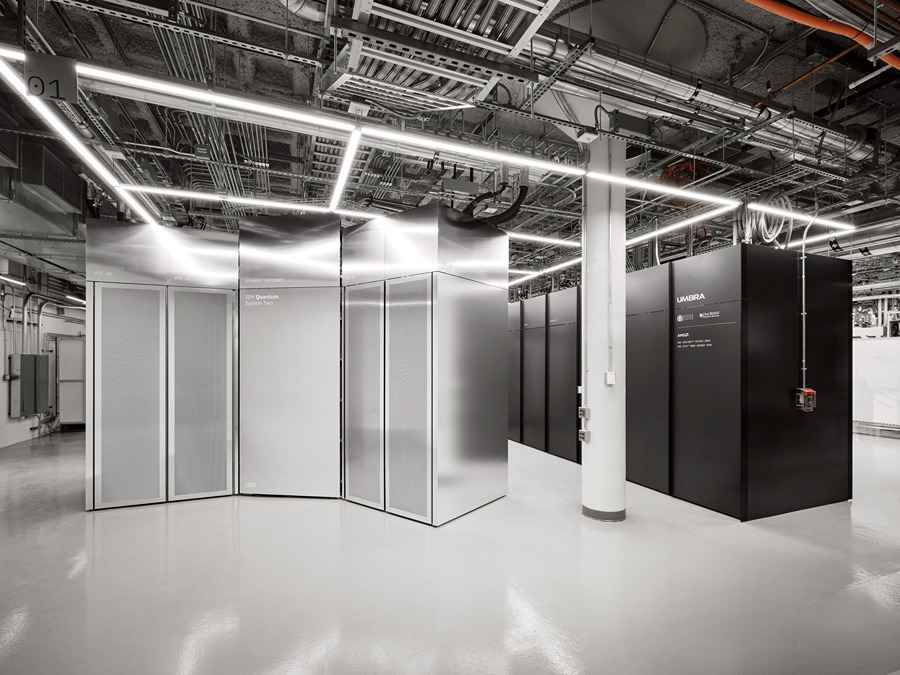 A new codesign platform for quantum error correction from IBM, Oak Ridge National Laboratory (ORNL) and AMD colocates IBM quantum computers with ORNL's Umbra High-Performance Computing system, shown to the right, nearest black rack. Umbra is composed of AMD Instinct MI355X GPUs and 5th Gen AMD EPYC CPUs. (Credit: IBM)
Two details that are easy to miss in a headline. First, Nighthawk is not just a qubit number: IBM unveiled the chip in November 2025 with 218 tunable couplers in a square-lattice layout, which lets each qubit reach its four nearest neighbours and run circuits roughly 30% more complex than the preceding Heron generation, according to IBM's launch coverage reprinted by Forbes. Second, co-location is the point — trade press reported that the Nighthawk machine and the MI355X-based Umbra system were placed side by side at IBM's quantum data centre in Poughkeepsie, New York, so that control and decoding traffic does not have to cross a wide-area link.
This work also builds on AMD's experience powering leadership-class supercomputers and an ongoing collaboration with IBM across GPU-accelerated scientific calculations and FPGA-based error decoding.
Why does error correction depend so much on classical computing?
Because a trustworthy quantum answer is assembled from a very large number of unreliable quantum parts, and the arithmetic that turns one into the other runs on ordinary silicon. Error correction is what stands between the quantum computers we have today and the ones that can perform real science; solving it takes work on both quantum and classical computing, with a large part of it on the classical side.
Two external figures make the scale concrete. The dominant surface-code approach encodes a single reliable logical qubit using on the order of a thousand noisy physical qubits, as described in peer-reviewed work published in Nature in December 2024. And the correction must land almost instantly: quantum error correction specialist Riverlane reports FPGA-based decoders reaching sub-20-microsecond latency for real-time correction — an argument for putting the classical hardware physically near the qubits rather than in a distant data centre.
Integrating the two kinds of machines also means reconciling three different workloads at once: control and feedback need precise timing and rapid responses, scientific calculation needs heavy parallel processing, and orchestration has to coordinate everything across those resources.
Which component does which job? A quick reference table
AMD works with its ecosystem and partners through deep codesign, using its high-performance portfolio to cover the classical requirements of quantum systems from real-time control through leadership-scale scientific computing. The division of labour looks like this:
| Layer | Technology in the platform | What it handles in a hybrid quantum system |
|---|---|---|
| Orchestration | AMD EPYC CPUs — on Umbra, 5th Gen AMD EPYC CPUs | Scheduling, queuing and general-purpose performance that coordinate complex hybrid classical-quantum systems |
| Simulation and analysis | AMD Instinct GPUs — on Umbra, AMD Instinct MI355X GPUs | Simulation, optimisation and the parallel scientific computations that surround quantum workloads |
| Control, readout, decoding | AMD Versal adaptive SoCs | Low-latency control, readout and decoding capability positioned near the quantum processor |
| Software glue | AMD ROCm open software ecosystem | Helps developers connect HPC and AI applications with this hardware into increasingly integrated quantum-classical environments |
Taken together, these technologies give quantum developers, system builders and research institutions a scalable classical foundation they can design around today.
What is the 2028 target, and who set it?
The U.S. Department of Energy set it. Under the Quantum Genesis Mission, the department's published goal is to accelerate development of fault-tolerant quantum computers, demonstrating systems whose logical qubits number in the low hundreds in 2028 — a different kind of milestone from the qubit-count records that usually make quantum headlines.
That reframing explains why the codesign platform exists. Reaching hundreds of logical qubits is not mainly a question of growing the chip; it is a question of running error correction quickly and reliably enough at scale, which is why the new platform gives AMD, IBM and Oak Ridge National Laboratory a shared environment to investigate those requirements together.
Expansion is already mapped out. Plans call for connecting the platform with the Oak Ridge Leadership Computing Facility (OLCF), which also houses ORNL's new Lux SI (Super Intelligence) + HPC supercomputer, powered by AMD EPYC CPUs and AMD Instinct GPUs. Those connections will extend the research environment to the full-scale system necessary to explore how integrated quantum, AI and scientific computing can accelerate scientific discoveries and national security.
Practical checklist: five steps if quantum touches your work
- Benchmark the classical loop before the quantum chip. Profile decoding throughput, control latency and orchestration overhead on classical hardware first; that is precisely what a colocated environment such as Umbra is built to expose.
- Evaluate systems on error budget, not qubit count. Compare physical qubits, logical qubits, gate fidelity and the number of two-qubit gates a job can survive before results degrade.
- Try public access routes instead of buying hardware. Research teams can request access through the Oak Ridge Leadership Computing Facility's Quantum Computing User Program, which routes users to commercial quantum systems and hybrid classical-quantum workflows; vendor cloud programmes, including IBM Quantum Network members, cover the rest.
- Write against open software layers. Toolchains built on stacks such as AMD ROCm keep simulation, optimisation and HPC code portable as quantum hardware generations change underneath them.
- Diary a 2028 review point. With the Department of Energy tying its Quantum Genesis Mission progress to that year, set an internal checkpoint to reassess whether fault-tolerant machines have moved from research infrastructure into your product roadmap.
Four common misconceptions about quantum error correction
- "More qubits means a better computer." Qubit count is only part of the story; what matters is how many errors survive, which is why a 120-qubit research processor and a fault-tolerant machine are not the same category of device.
- "Error correction is a physics problem." Much of the work is on the classical side — decoding syndromes, timing feedback, orchestrating workloads — which is exactly the ground this platform is meant to test.
- "Quantum computers will replace data-centre servers." The near-term architecture is hybrid: quantum processors handle narrow classes of problems while CPUs and GPUs do the control, simulation and correction around them.
- "This announcement means useful quantum computing is next year." The declared target is a scientifically relevant machine by 2028, and the platform's job is to measure how far the classical infrastructure still has to go.
FAQ: what readers ask about the AMD, IBM and ORNL platform
What is quantum error correction in one sentence?
The process of detecting and repairing the random mistakes a quantum processor makes, by spreading one logical qubit across many physical ones and constantly recalculating — a job that consumes large amounts of ordinary computing power.
Why are AMD, IBM and Oak Ridge National Laboratory working together?
Because neither half of the problem can be solved alone: IBM supplies quantum computers, ORNL supplies scientific research capacity and production HPC, and AMD supplies the classical CPUs, GPUs, adaptive SoCs and open software that connect quantum processing to real scientific workloads.
Is the IBM Quantum Nighthawk already a fault-tolerant machine?
No. It is a 120-qubit processor used here as the quantum half of an experiment in which classical hardware is tested alongside it, which is the point of a codesign platform.
When will this affect ordinary computer users?
Indirectly and gradually. The nearest effects are in materials science, chemistry, optimisation and national-security modelling at facilities such as the Oak Ridge Leadership Computing Facility; consumer-facing change depends on whether the 2028 fault-tolerance goal is met.
Where can I read the technical detail myself?
Further details are available through amd.com, alongside IBM's and ORNL's own programme pages.
What to take from this
The story behind the headline is not a race to bigger quantum chips; it is an effort to make the boring infrastructure around those chips fast enough, close enough and open enough to keep a quantum computer honest. For anyone building products or writing strategy, the practical signal is that the industry is now instrumenting the classical side of the equation in public, with a named year attached. Watch the logical-qubit arithmetic, test your own workloads against simulators on the systems already in the rack, and treat 2028 as a checkpoint for a decision rather than a launch date.
Sources
- IBM Quantum blog — "ORNL, IBM, AMD launch co-design platform for QEC": https://www.ibm.com/quantum/blog/ornl-amd-error-correction-co-design-platform
- U.S. Department of Energy — Quantum Genesis mission page: https://www.energy.gov/undersecretaryforscience/genesis-mission/quantum-genesis
- Nature (December 2024) — "Quantum error correction below the surface code threshold": https://www.nature.com/articles/s41586-024-08449-y
- Forbes / Moor Insights (December 2025) — IBM Nighthawk processor analysis: https://www.forbes.com/sites/moorinsights/2025-12-05/ibm-targets-quantum-advantage-by-2026-with-new-processors-and-tools/
- Riverlane — GPU, ASIC and FPGA trade-offs for quantum error correction: https://www.riverlane.com/blog/gpus-asics-or-fpgas-here-s-how-they-measure-up-for-quantum-error-correction
- StorageReview (November 2026) — co-located Nighthawk and Umbra deployment report: https://www.storagereview.com/news/ibm-ornl-amd-quantum-error-correction-co-design-platform-nighthawk-umbra-mi355x
- Oak Ridge Leadership Computing Facility — user programmes: https://www.olcf.ornl.gov/
- The Quantum Insider (November 2026) — platform launch coverage: https://thequantuminsider.com/2026/11/05/oak-ridge-national-laboratory-ibm-and-amd-launch-new-co-design-platform-for-quantum-error-correction/