
Amazon's AI Hardware Crackdown: A MyTechDailyNews Playbook for Buying a GPU Without Losing Your Account
Pay, wait, refresh the order page, and watch the shipping date never arrive. Buying high-end AI hardware has quietly become one of the riskier transactions on the consumer internet, and the risk is no longer confined to resellers gaming the system. Cancellations have started landing on ordinary shoppers, and in at least one reported case the account behind them was shut down for good. Here is a practical MyTechDailyNews walk-through of what happened, why a routine purchase can now look "suspicious" to an automated system, and the exact steps to protect your order, your membership and your money.
The checkout failures that triggered the story
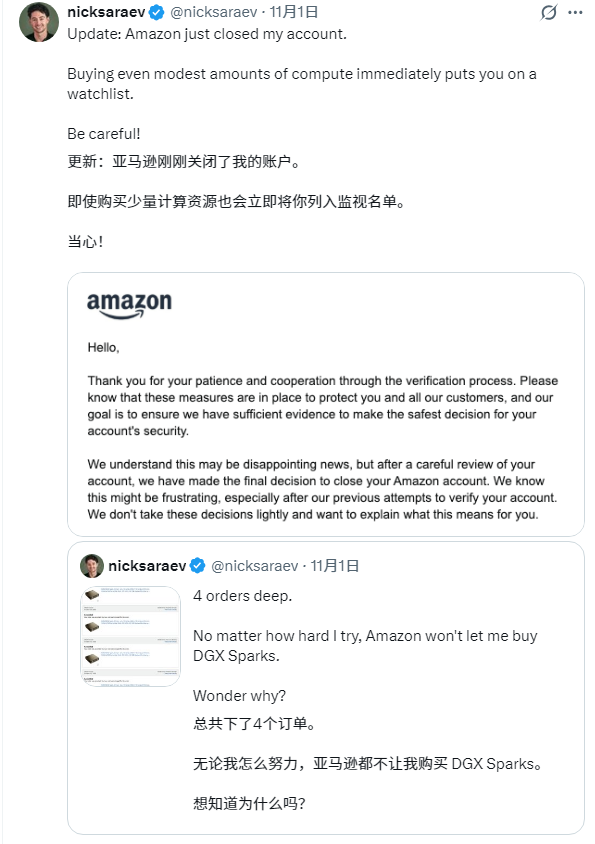
The case that set things off: a buyer posting as @nicksaraev says he placed 4 orders for NVIDIA DGX Spark machines on October 31, and every single one was cancelled. When he kept trying to get an order through, the platform did not release it — instead, after a verification step, his account was closed outright, with a message saying the decision had been made after careful review.
His frustration is less about the missing hardware than about the silence that followed. No violation was named, no rule was cited, and no appeal channel was offered. Everything attached to the account went dark at once: the Prime membership, the gift card balance, and the entire order history.
Epic Games boss Tim Sweeney describes a lighter but stranger version of the same pattern. His account was not closed. Yet after he ordered two NVIDIA GPUs, the everyday orders he had been placing for years began getting cancelled close to delivery. They could still be submitted normally; they just never shipped. Sweeney's own reading is that the GPU purchase planted a flag on the account, and everything bought afterwards inherited the side effects.
Why a small desktop AI box is being rationed like a staple
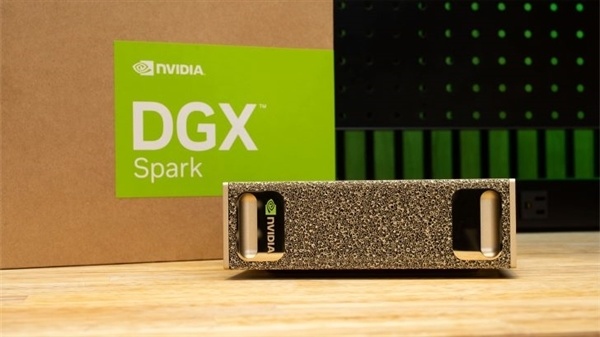
To understand why a shopping cart is now treated as a threat, look at the supply side. The DGX Spark is NVIDIA's compact desktop machine for local AI development, and it has moved into a strange pricing regime: the 64GB version arrived at a $4,999 starting price through six OEM partners (Acer, ASUS, Dell, Gigabyte, HP and MSI) on October 23, 2026, while the 128GB Founders Edition was repriced to $6,950 effective October 2, 2026 — a change NVIDIA tied to constrained memory supply and rising component costs, as summarised by technology research firm Futurum.
That constraint is measurable. Market research firm TrendForce projected in late September 2026 that conventional DRAM contract prices would rise 10–15% quarter on quarter in the fourth quarter of 2026, with NAND flash up 15–20%, driven by AI server demand. In August the same firm estimated that DRAM and NAND together would absorb roughly 47% of cloud providers' total capital spending in 2026. Think of it as an airline fueling up before the road trippers do: whatever memory the hyperscalers buy is what is left for the retail shelf.
With scarce stock and a wide gap between list price and street price, the line between a genuine buyer and a hoarder gets blurry fast — and platforms appear to be erring on the side of suspicion.
What an automated risk filter probably sees
It is still unconfirmed whether this wave of cancellations is a system malfunction or a deliberately designed anti-scalping measure. Given how acute the shortage is, restricting how many units one customer can buy is a plausible goal. But an account closure, as in @nicksaraev's case, is far stronger than a purchase cap, and that mismatch is what has shoppers uneasy. Below is a plain-language read of the behaviours that look risky to a machine, versus what they often mean in real life.
| Behaviour at checkout | How a risk filter may read it | The innocent explanation |
|---|---|---|
| Several identical high-value units in one day | Stock being assembled for resale | A lab, studio or small team pooling one budget |
| Repeated re-orders after a cancellation | Bots retrying an out-of-stock listing | A confused buyer obeying the "order again" button |
| A GPU purchase followed by unrelated orders | Account newly valuable, worth protecting | Someone upgrading a PC who still buys cables and batteries |
| Gift card balance used to pay | Hard-to-trace funds, common in resale rings | Family gifts and cashback accumulated over years |
| Price far above list on a live listing | Marketplace arbitrage | A third-party seller repricing scarce stock, not the buyer |
Before you order: a seven-point preflight checklist
- Buy one unit per order, per account. Multiple units of the same scarce product in a single day is the clearest pattern in the reported cases; spreading needs across channels is safer than stacking them in one cart.
- Check whether the listing is sold by the platform or by a marketplace seller. Third-party listings at heavy markups carry different cancellation and refund paths than items shipped by Amazon itself.
- Use a card, not a stack of gift cards, on the first high-value order. Payment methods that can be verified independently reduce the odds of being routed into a manual review loop.
- Keep the account "warm". An account that only ever buys one hot item looks thinner than one with a normal, multi-year buying history.
- Export your paper trail before you need it. Confirmation emails, invoices and the gift-card transaction history should live in your inbox or a download folder, not only inside the account.
- Consider the authorised OEM route for the 64GB model. The October 23, 2026 launch put that configuration on sale through partner brands rather than a single marketplace, and a direct vendor invoice is easier to defend than a resale listing.
- Decide in advance whether you need the hardware at all. A one-off fine-tuning job or a demo build is often cheaper rented by the hour than bought into a shortage.
If your order gets cancelled: five moves that actually get a response
- Confirm what happened to the money. An authorisation hold and a captured charge are different problems; check your bank statement before writing to anyone.
- Ask one narrow question in writing. "Was the payment released, and under what order status was this cancelled?" beats a long complaint, because written answers become evidence later.
- Stop re-ordering blindly. Repeated attempts were precisely what escalated @nicksaraev's case into a verification review and then an account closure.
- Save every message. Screenshot the cancellation notice and the closure email, including timestamps, before access disappears.
- Escalate outside the platform if the refund stalls. Card networks run their own dispute timelines that no retailer controls; consumer advocacy desks and, in the US, state attorney general complaint portals are the standard next step when a balance is locked inside a closed account.
If the account itself is closed: what is still yours
A closure is not a forfeiture. Funds you loaded and benefits you paid for remain claims, even when the storefront is locked. Three practical points:
- Gift card balance: original purchase receipts are the accepted proof of ownership, which is why keeping them outside the account matters. Amazon's own customer-service help hub documents balance-checking and account-management paths.
- Prime membership: a paid annual plan that becomes unusable is a refund question, not a favour — cite the paid start date and the closure date.
- Appeal channels: they exist in at least some markets; Amazon Japan, for example, publishes an account-status appeal form for closed accounts. The complaint in the DGX Spark case is that the buyer was handed no such door at all.
Five misconceptions about this AI hardware crackdown
- "Only scalpers get caught." Tim Sweeney's follow-on, perfectly ordinary orders were cancelled too — the trigger appears to be the GPU purchase, not the buyer's intent.
- "A cancelled order means a banned account." The two are different tiers of response; most cancellations never become closures, and closures mostly follow repeated retries after cancellation.
- "One item is always safe." A single order can still carry downstream effects if the system has flagged the account, which is exactly what the Epic Games case suggests.
- "The platform will explain itself." The email in the reported case said only that the decision followed careful review; no reason code was supplied.
- "Shortage means discounts eventually." With memory contract prices still climbing, the more likely direction for local AI boxes is upward repricing, as already seen on the 128GB Founders Edition.
Where else the hardware can realistically be bought
- OEM partner channels — the 64GB DGX Spark launched through Acer, ASUS, Dell, Gigabyte, HP and MSI, which is one more way to buy without joining a single crowded marketplace queue.
- Specialist integrators — NVIDIA partner PNY lists the 128GB machine with its 1,000 AI TOPS rating, and similar resellers ship to businesses and hobbyist labs alike.
- Community stock trackers — threads on NVIDIA's own developer forum track availability and flag marked-up listings, useful for spotting when street price has detached from list price.
- Rent instead of buying — for bursty workloads, hourly GPU rental sidesteps both the shortage and the checkout risk entirely.
FAQ: the questions readers keep sending us
Is this a technical glitch or a policy?
Unconfirmed. The evidence supports both readings: quantity caps on scarce compute hardware are a deliberate tool, but an outright account closure goes well beyond the scope of normal purchase limits, and no public explanation has been issued.
Does ordering two GPUs really affect unrelated purchases?
That is the pattern Sweeney describes: his later, ordinary orders were cancelled near delivery after the GPU purchase, while his account stayed open.
Should I open a second account to get around a limit?
No. Linked accounts are the fastest way to turn a single cancellation into a wider review. One clean account, one unit, one verifiable payment method.
What happens to my Prime membership and gift card money?
In the reported case they simply became inaccessible. That is recoverable in principle — receipts and paid-plan dates are the leverage — but it is exactly why copies should be kept outside the account.
Is the DGX Spark still worth it for local AI work?
If you need NVIDIA's software stack on a desktop, the 64GB option at $4,999 is the cheapest recent entry point, and two linked units pool memory for larger models through the built-in ConnectX-7 networking. If your workloads are seasonal, the risk premium of buying into a shortage is hard to justify.
Your 30-day action plan
- This week: back up invoices, gift-card receipts and Prime membership dates to your own drive or inbox.
- Before any big order: pick a channel with a defensible invoice (OEM or authorised integrator) rather than the highest-markup marketplace listing.
- If cancelled: send one narrow written query, stop re-ordering, log the timeline.
- If locked out: appeal with proof of funds and paid membership; escalate to your card issuer or a consumer complaint body if a refund stalls.
The uncomfortable lesson of this week's GPU cancellations is not that a retailer fought resellers; it is that when a category becomes scarce enough, "suspicious" stops describing intent and starts describing a shopping cart. Until the supply picture relaxes and the platforms explain their rules, treat an AI hardware purchase like a paperwork exercise: fewer units, cleaner payment, evidence saved in advance.
Written by Sarah Chen for MyTechDailyNews. Questions about this guide or a tip-off? Reach the Tech Daily desk at hello@techdaily.com.