
Sam Altman's 'Ram Altman' Memory Controversy: A MyTechDailyNews Practical Guide for PC Buyers
Sam Altman’s remark that DRAM sitting idle in personal computers can be an inefficient use of scarce supply has triggered a public backlash, which he answered on X by saying he supports users having enough memory and wants global production to expand. For ordinary readers, the story is not a simple PC-versus-data-centre fight. It is a memory shortage story: AI build-outs, DRAM supply limits, price pressure, and how much RAM your own computer should buy.
What happened, in plain English
The controversy started with the Cheeky Pint interview published on October 29. While discussing local AI models, OpenAI CEO Sam Altman spoke with Stripe co-founder John Collison. Altman said limited DRAM is often placed in personal computers but sits unused for about 95% of the time; when supply is tight, cloud data centres may use memory more intensively.

Some readers reacted as if the comment preferred AI servers over everyday PCs. Altman later said his point had been taken out of context. He said he wants people to have as much memory in their computers as they need and has long supported expanding global memory production. In another reply, he wrote: "I want you to have lots of memory, let's produce more." He also adopted a user's joke and changed his X display name to Ram Altman.
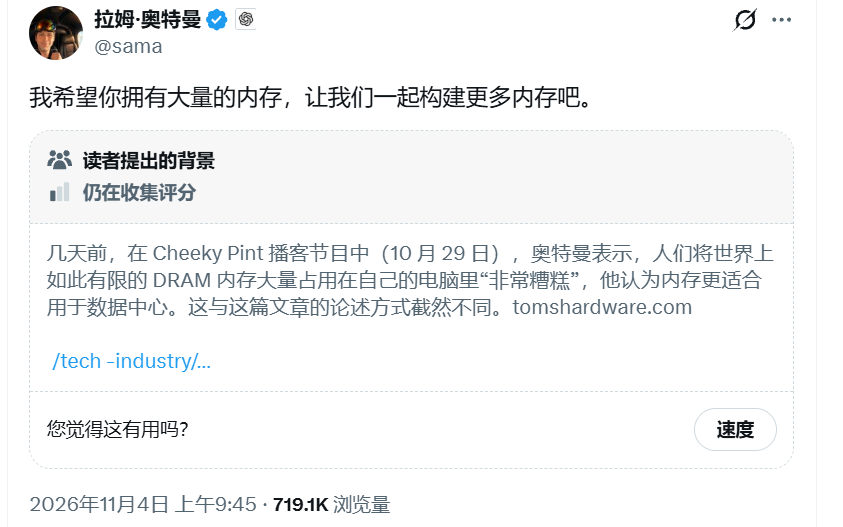
Why the Ram Altman response matters
The name change was not a policy proposal. It was a public-relations gesture. The more useful point is that Altman's later clarification moved the conversation away from 'who should own memory' toward 'how can the world make more memory'. The row is therefore less a war on PCs and more a symptom of an AI-driven supply bottleneck.
Why ordinary users should care about memory supply
Memory is a hidden infrastructure cost. Laptops, desktops, phones, routers, vehicles and servers all need volatile memory. Data-centre builders need standard DRAM and specialised high-bandwidth memory, HBM. AI training and inference workloads make large memory pools attractive, but the same factories also supply consumer devices.
A J.P. Morgan research item dated August 2026 estimated that DRAM prices could rise by more than 400% amid AI-driven demand. That is a market forecast, not a promise, but it shows why a sentence about idle PC memory can feel personal. If prices rise, readers may pay more for the same laptop or upgrade.
IEEE Spectrum has also linked the shortage to AI demand for HBM, which competes for production capacity within the broader memory market. This helps explain why 'produce more' is easier to say than to do.
A practical checklist before you buy or upgrade RAM
- Write down the real job: office work, gaming, video editing, coding, local AI, or home-server tasks.
- Check what your machine already has; more memory may not help if the bottleneck is storage, cooling, CPU power, or GPU capability.
- Match the module type: DDR4, DDR5, laptop SO-DIMM, desktop DIMM, or soldered memory may differ.
- Do not buy a 'futureproof' spec if you may not keep the device; memory prices can move, and machines age.
- If you need a large local AI box, budget for memory, fast storage, cooling and a suitable GPU, not just RAM.
- For price-sensitive buyers, decide whether you need speed today or whether a smaller upgrade now and a later expansion makes sense.
Common misconceptions, fact-checked
| Claim people repeat | What the record supports |
|---|---|
| Altman wants memory removed from PCs. | He said users should have as much memory as they need and later called for more production. |
| Data centres are always better than PCs. | Concentrating memory can improve utilization under scarcity, but local devices still provide privacy, offline access, responsiveness and ownership. |
| More supply can be turned on quickly. | Reports on the memory market say manufacturers remain cautious about big capex after boom-and-bust cycles; new capacity takes time. |
| The controversy means consumer PCs are dead. | There is no evidence in the dispute that PC computing is ending; it is a supply and pricing story. |
Action advice for four kinds of readers
- Everyday laptop or desktop user: upgrade only when applications feel slow, browser tabs become heavy, or creative tools use more memory.
- Local AI hobbyist: treat RAM as one part of the system; compare cloud inference, small local models, and a bigger desktop before spending.
- Small-business or IT buyer: check lead times and warranty terms, and keep a buffer for machines used by core workflows.
- Market observer: separate Altman's efficiency argument from the political reading of 'AI must get your RAM'; the clarification emphasises capacity expansion.
FAQ: quick answers for general tech readers
What did Sam Altman say about PCs and memory?
He said limited DRAM installed in personal computers often remains idle, with roughly about 95% of the time unused, and that concentrated cloud data centres can use memory more intensively when supply is tight.
Why did people react badly?
Readers heard a suggestion that ordinary computers were wasting a resource better saved for AI infrastructure. The timing made it sensitive because memory prices and AI build-outs are already squeezing consumer hardware.
What changed after the backlash?
Altman said his comments were taken out of context, said he supports sufficient memory in PCs, called for greater production, and adopted the display name Ram Altman.
Should readers rush to buy RAM?
No. Rushing can worsen price pressure and lead to incompatible or oversized upgrades. The practical approach is to match memory to workload, platform compatibility, budget and urgency.
Is this an AI-versus-PC fight?
Not necessarily. The clearer issue is scarce memory supply and how much of it is consumed by data centres, laptops, phones and other devices at the same time.
Bottom line: the Ram Altman episode is useful as a reminder that AI progress is also a supply-chain story. For general readers, the action is not to pick a side in a PC-versus-data-centre argument. It is to understand why memory matters, check what your own computer truly needs, and avoid overpaying when uncertainty is doing the talking.