
MyTechDailyNews Explainer: Alphabet's Near-$500 Billion Wall Street Shock and What It Means for Everyday Tech Readers
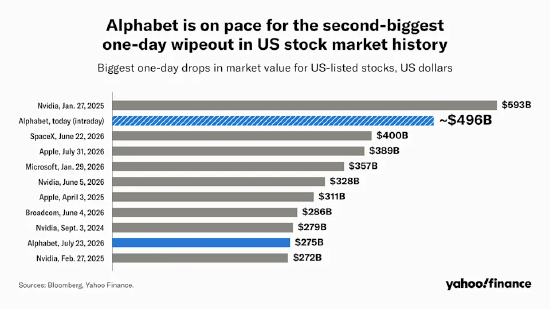
For ordinary technology-news readers, the headline was not simply that one share price moved. It was that Alphabet (GOOGL) saw about 12% of its share value disappear on Thursday after earnings, erasing nearly $500 billion in market value and producing the worst single-day performance since its 2004 listing. The event also entered the history books as the second-largest one-day market-value loss for a U.S.-listed company, a scale that forces investors, product watchers and casual users to ask the same question: did Google's business change, or did Wall Street's expectations?
At a glance: the checklist that explains the selloff
- Stock move: Alphabet (GOOGL) fell about 12% on Thursday after earnings.
- Scale: nearly $500 billion in market value was wiped out, the second-largest single-day market-value loss in the history of U.S.-listed companies.
- What looked positive: Google Cloud revenue doubled to about $31 billion, and Gemini users surpassed 1 billion.
- What disappointed: search revenue grew 12% to about $63 billion, below Wall Street's expected $65 billion.
- The cost side: AI investment caused free cash flow, the cash left after capital spending such as data centers, to turn into a loss of about $9 billion.
The simple version is this: Alphabet did not report a collapse in demand. It reported growth that still missed a higher expectation, while also telling investors that the price of competing in AI was rising fast enough to hurt near-term cash generation.
Why a record drop happened even when some numbers looked strong
Alphabet's earnings release carried clues for both bears and bulls. On one side, Google Cloud's revenue doubled to about $31 billion. On the other, the Gemini application passed 1 billion users, a milestone that shows its AI assistant is reaching a mass audience. Yet the market fixated on a different line: search revenue grew 12% to about $63 billion, below Wall Street's expected $65 billion.
That gap mattered because search remains the commercial heart of Alphabet's advertising business. Investors are not only asking whether Google is still building AI products. They are asking whether the cost of building them is starting to overwhelm the cash machine that has traditionally funded new bets. Because AI spending rose sharply, Alphabet's free cash flow turned negative by about $9 billion after subtracting capital expenditures such as data centers.
Pivotal Research chief executive Jeffrey Wlodarczak put the bear case plainly: “Bears would argue that this is the first quarter in which AI is truly starting to erode the core search business.” CFRA analyst Angelo Zino offered a more optimistic interpretation, saying the pullback “could be a buying opportunity.”
These two views capture why the same earnings report can be read as a warning and as a discount. The warning is that AI may be changing the economics of search. The discount is that Alphabet still has cloud growth, a billion-user Gemini platform and enough scale that a single quarter of heavy investment may not define the next decade.
How large was the loss in historical terms?
Before this episode, the largest recorded one-day market-value loss belonged to Nvidia. On January 27, 2025, China's DeepSeek triggered panic among AI investors, and Nvidia shed about $593 billion in a single trading session. Yahoo Finance estimated that if Alphabet closed around $274.75 with a decline close to 15%, it could match that record. As it stands, Alphabet has already passed SpaceX's June 22 loss of $400 billion, which had previously been the second-largest one-day market-value decline in history.
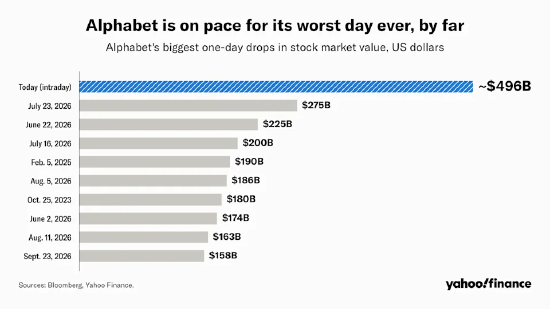
From an absolute-money perspective, the session was the most costly trading day for Alphabet itself. The company's previous largest single-day market-value loss occurred on July 23 and was about $275 billion. Bespoke Investment's social-platform data also showed that this was Alphabet's steepest post-earnings decline since going public; the previous highest mark was a near 10% share-price drop in July 2008.
The broader market context: large one-day losses are becoming less rare
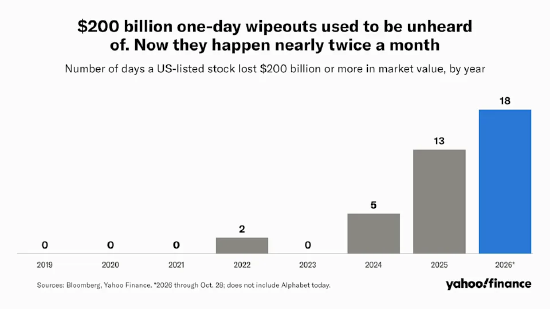
A loss of this scale would once have been considered unprecedented. Yahoo Finance, citing Bloomberg data, noted that as of Wednesday, U.S. stocks had already experienced 18 single-day market-value losses of $200 billion or more this year. That compares with 13 such losses in all of 2025, while before 2022 such one-day losses had never occurred. Since this May's stock-price high, Alphabet alone has shed about $1.4 trillion in market value.
That context matters for a general tech audience. A one-day plunge can feel like a verdict on a single company, but the market's recent history suggests that mega-cap technology firms are now routinely repriced in very large increments. The speed of the repricing can be unsettling, especially when it touches services that many users interact with daily.
What comes next: the Amazon and AWS test
Amazon is the last of the three big cloud providers to report earnings this week, with its release scheduled after Thursday's close. The result carries special significance for the AI investment debate. If Amazon's AWS posts rapid growth while its cash flow remains intact, the market may conclude that the problem is more specific to Google's search business. If Amazon also shows a quarter of cash consumption, doubts could widen around the broader AI investment trade.
For readers who want a plain-language way to understand the next report, the comparison is straightforward: cloud growth tells whether demand exists, while cash flow tells whether the spending is financially sustainable. Alphabet's report showed strong growth in parts of the business, but also showed that the cost of keeping that growth going is being pushed higher.
FAQ: the questions ordinary users are asking
Did Alphabet fall because Google products stopped working?
No. The stock decline followed an earnings report, not a consumer outage. The main issue discussed by analysts was the combination of search revenue growth falling below Wall Street's expected $65 billion and the cost of AI investment turning free cash flow negative by about $9 billion.
Is the near $500 billion loss the same as company cash?
No. Market value is a measure of what investors collectively assign to a company's shares at a point in time. A one-day market-value loss of nearly $500 billion reflects the change in that valuation after the drop of about 12% on Thursday; it does not mean Alphabet held $500 billion in cash in a bank account.
What is free cash flow, and why did it matter here?
Free cash flow is the cash left after capital spending, such as data centers. In Alphabet's case, the report said AI investment was so heavy that free cash flow became a loss of about $9 billion. That detail matters because investors use cash generation to judge whether a company can pay for new infrastructure without sacrificing financial flexibility.
Why do Gemini and Google Cloud matter if search disappointed?
They matter because they show Alphabet is growing beyond its traditional search business. Google Cloud revenue doubled to about $31 billion, and Gemini users surpassed 1 billion. At the same time, search revenue grew 12% to about $63 billion but still fell short of Wall Street's $65 billion expectation, which is why the market treated the report as a mixed outcome rather than a straightforward success.
Was Nvidia's larger record related to Alphabet's drop?
They are two separate events, but both illustrate how sharply AI expectations can move mega-cap stock valuations. Nvidia's record came on January 27, 2025, when China's DeepSeek triggered AI investor panic and Nvidia lost about $593 billion in one day. Alphabet's current drop was tied to its own earnings reaction.
Does this mean Alphabet shares are a buy?
The article reports different professional views rather than issuing advice. CFRA analyst Angelo Zino said the pullback “could be a buying opportunity,” while Pivotal Research chief executive Jeffrey Wlodarczak presented the bearish concern that AI may be eroding the search core. Individual investors should treat those comments as analysis, not as instructions.
Common misconceptions
- Misconception 1: a huge market-value number means the company ran out of money. It does not. The near $500 billion figure refers to the change in investor valuation after a one-day drop, not the company's bank balance.
- Misconception 2: cloud growth should cancel the search miss. Google Cloud revenue doubled to about $31 billion, but investors still cared about search because it remains central to Alphabet's economics; search revenue grew 12% to about $63 billion, below the Wall Street expectation of $65 billion.
- Misconception 3: Gemini passing 1 billion users proves the business is safe. It proves the product has scale. The earnings question was whether search and future AI spending can together support cash flow, and the report showed a free cash flow loss of about $9 billion.
- Misconception 4: Amazon's result will settle everything. Amazon's report can provide a comparison among the three big cloud providers, but one earnings cycle will not answer the full question of how AI spending will reshape Alphabet's profitability.
- Misconception 5: analyst quotes are facts. Jeffrey Wlodarczak's bear case and Angelo Zino's buy-side view are interpretations of the same earnings release. They are useful because they show how professionals can weigh the same numbers differently.
Action suggestions for readers following this story
- Read the earnings reaction as a valuation event, not a product review. When Alphabet fell about 12% on Thursday, the immediate question was whether Wall Street's expectations were met, not whether everyday users would notice a sudden service problem.
- Track the two sides of the AI story. On the demand side, note Google Cloud revenue doubled to about $31 billion and Gemini users surpassed 1 billion. On the finance side, watch whether search growth and AI spending create cash-flow pressure again.
- Compare the next cloud earnings report carefully. Amazon, as the last of the three big cloud providers to report this week after Thursday's close, can indicate whether cash-flow strain is a Google-specific issue or a wider feature of the AI investment trade.
- Put the one-day record in perspective. The loss was historically large, ranking as the second-largest single-day market-value loss for a U.S.-listed company and passing SpaceX's $400 billion mark from June 22, but it still does not replace longer-term analysis of Alphabet's cash generation, product adoption and competitive position.
- Separate information from investment decisions. The article explains what the numbers showed and how analysts interpreted them. If you manage personal money, treat phrases such as “could be a buying opportunity” as one analyst's view and consult a qualified advisor for decisions tailored to your situation.
Bottom line
Alphabet's nearly $500 billion market-value wipeout turned a routine earnings day into a historical market event. The company showed that parts of its AI and cloud business are scaling, but it also showed that Wall Street had set a higher bar for search and that the cost of building AI can quickly show up in cash-flow figures. The next major signal will come from Amazon's report after Thursday's close: if the broader cloud and AI spending picture looks healthier, the problem may be read as more specific to Google's search economics; if the same cash strain appears there, the market will likely widen its skepticism.