
Case Replay: Alibaba Sends T-Head to Hong Kong — What the AI Chip Spin-Off Actually Changes | MyTechDailyNews General
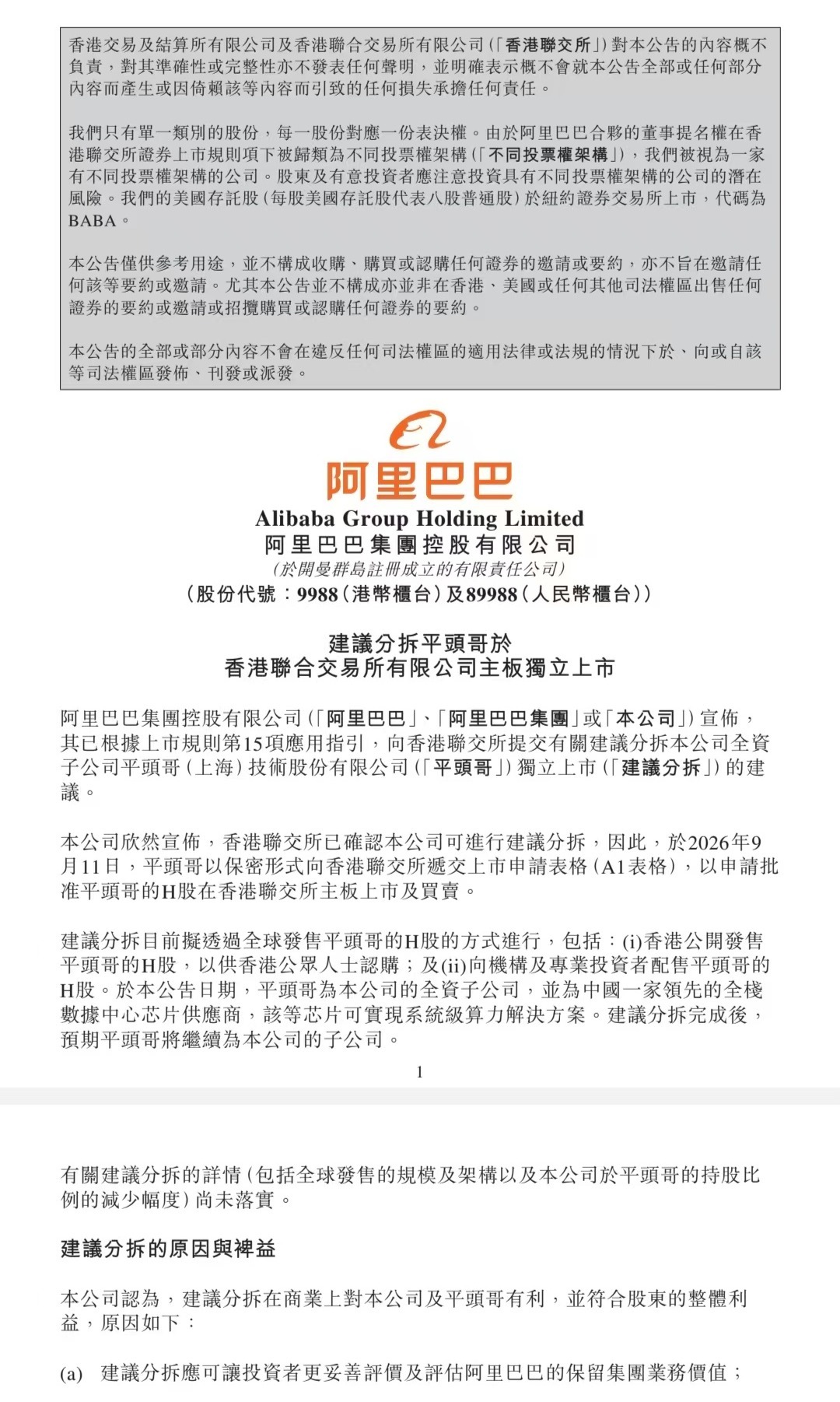
On November 10, Alibaba disclosed that it plans to spin off its wholly owned chip unit T-Head (Shanghai) Technology Co., Ltd. for a standalone listing on the Hong Kong Stock Exchange main board. The paperwork is not brand new: T-Head filed a confidential A1 application on September 11, 2026. What is new is that the exchange has confirmed Alibaba may go ahead, so a deal that existed only as a sealed draft now has a visible public path.
Here is the part I found most interesting: the story is less about a listing date and more about what happens when a chip team that has spent years supplying one very large customer has to start explaining itself to everybody else.
What happened on November 10 — and what did not
Short version: permission to proceed, not permission to trade. Alibaba's announcement says the Hong Kong Stock Exchange, the HKEX, has confirmed that the company may carry out the proposed spin-off, and that T-Head had already submitted its Form A1 listing application on September 11, 2026 in confidential form, seeking approval for its H shares to list and trade on the main board in Hong Kong.
The mechanics are set to be a global offering of H shares, split into a Hong Kong public offering plus placements to institutional and professional investors. Two things are deliberately left open. First, the size and structure of the offering, and the extent of any adjustment to Alibaba's shareholding, are not yet fixed. Second, the transaction still needs approval from the HKEX Listing Committee and completion of a filing with the China Securities Regulatory Commission, among other procedures. Once the split is done, T-Head is expected to remain an Alibaba subsidiary — this is a partial float, not a divorce.
Reuters framed the move as giving investors direct exposure to one of China's AI chip designers, while the SCMP reported language from the filing about allowing a "more efficient deployment" of Alibaba's financial resources. Both readings point the same way: a captive internal supplier gets a market price.
Why spin the chip unit out instead of keeping it inside
A subsidiary that mainly serves its own parent is hard to value from the outside. Split it off, and three things happen at once: it can raise its own money for expensive chip design cycles, it gets a separately quoted price that analysts can argue about, and the parent keeps control while letting the market fund part of the bill.
T-Head's own description supports that framing. Alibaba presents it as a leading full-stack data centre chip supplier in China whose chips provide system-level computing solutions. The company was set up in 2018, built by merging the acquired Zhongtian Micro chip team (C-Square Micro) with the chip group inside Alibaba's DAMO Academy. In the early years it worked mostly for Alibaba's own businesses, using in-house silicon to cut dependence on outside suppliers while building capability across cloud computing, artificial intelligence and connected devices.
The product story is where a listing document will be tested. In September 2026 T-Head launched its next-generation AI chip, the Zhenwu V900, which the company says delivers three times the performance of the previous-generation M890 and can scale to a super-large cluster of up to 500,000 chips for frontier large-model training. Alibaba expects the Zhenwu V900 to enter mass production and hit the market in the first quarter of 2027. Beyond accelerators, reporting on T-Head's XuanTie RISC-V work — Tom's Hardware covered the C930, which Alibaba called its first server-grade processor, with further designs on the roadmap — suggests the "full stack" label is not just marketing. That breadth is precisely what makes the valuation question tricky.
What a confidential A1 filing really means
Readers often treat "filed" as "about to list". It is not the same thing. An A1 is the formal listing application form submitted to the exchange; filing it confidentially lets a company run its preparation without triggering market speculation or leaking technical and commercial detail before the prospectus is ready.
There is also a clock. HKEX guidance on listing applications has long noted that an A1 lapses after six months, which is why refilings are routine in Hong Kong deals rather than signs of trouble. On the regulatory side, the China Securities Regulatory Commission filing step is a familiar companion to overseas listings by mainland China companies — it is the same kind of procedural gate we tracked when Apple Intelligence added tablet and laptop scenarios in China after the November 9 iPad and Mac filing.
How the AI chip IPO queue looks right now
Timing matters, and T-Head is walking into a busy lobby. Bloomberg reported that Moore Threads kicked off the recent wave of Chinese AI-linked listings late last year, raising 8 billion yuan in a heavily oversubscribed deal, and the SCMP later reported that the company had posted a 147% jump in first-half revenue while planning its own Hong Kong listing. Earlier in 2026, shares of Shanghai Biren Technology surged nearly 120% on the Hong Kong exchange by midday on its first trading day, according to Business Insider.
Demand on the other side of the trade is real too. GPU supply remains tight enough that national buyers keep talking contracts: as our related case file explains, South Korea's position has been that contracted Nvidia GPU deliveries hold despite the Jensen Huang probe. A listing gives a chip designer the balance-sheet muscle to keep up with that kind of demand.
Common misconceptions about this spin-off
- "T-Head is going public next week." No — only the confidential application is confirmed; the listing committee approval, the China Securities Regulatory Commission filing and the offering size are all still ahead.
- "Alibaba is selling its chip business." Alibaba's own wording is that T-Head is expected to remain its subsidiary after the split.
- "A confidential filing means something leaked." Confidential A1 submissions are standard practice, used precisely so that nothing has to leak.
- "Chip specs equal revenue." Cluster-scale claims and mass-production timelines are engineering statements until a prospectus turns them into audited numbers.
Action tips: what to watch, and what to do
- Watch for the published prospectus after the confidentiality window closes: offering size, use of proceeds, and how much of T-Head Alibaba retains are the three numbers that frame everything else.
- Track the two gates separately — an HKEX Listing Committee hearing date and a China Securities Regulatory Commission filing record are different signals with different clocks.
- Mark the production milestone: mass production and market launch of the Zhenwu V900 in the first quarter of 2027 is the date that validates the technology narrative.
- If you buy cloud or AI compute, read the "full-stack" claim as a procurement option, not a slogan — compare accelerator, CPU and system-level offerings against your own workload.
- If you follow the stock, treat the parent and the spun-off unit as one balance sheet for now, and discount any valuation until audited segment numbers appear.
FAQ: the questions readers are asking
Is T-Head already listed?
Not yet. The A1 application was filed on September 11, 2026 and the exchange has confirmed Alibaba may proceed, but approval from the HKEX Listing Committee and the China Securities Regulatory Commission filing are still required.
Will Alibaba still own T-Head?
Alibaba says T-Head is expected to remain its subsidiary after the split, with the spin-off carried out through a global offering of H shares, including a Hong Kong public offering and placements.
Why did the announcement come two months after the filing?
Because the filing was made in confidential form. The November 10 disclosure is the point where the process became public, not the point where it started.
Why should a normal tech reader care?
T-Head chips run inside the services millions of people use daily, and a listing decides how much independent money flows into that silicon roadmap. The claimed three-times performance gain over the M890 and support for clusters of up to 500,000 chips is, in plain terms, a bet on how big Chinese model training will get by 2027.
The open question I keep turning over: once T-Head has its own ticker, its own analyst calls and its own shareholders, will it still be happy building chips for one very demanding in-house customer — or will the market force it to become a supplier to everybody else? The prospectus, whenever it lands, should give the first honest hint.
Sources
- Reuters, "Alibaba AI chip unit T-Head files for Hong Kong IPO" — https://www.reuters.com/business/retail-consumer/alibaba-chip-unit-t-head-files-confidential-hong-kong-ipo-application-2026-11-10/
- South China Morning Post, "Alibaba chip unit T-Head files Hong Kong IPO plan amid China's AI self-sufficiency drive" — https://www.scmp.com/business/companies/article/3373974/alibaba-chip-unit-t-head-files-hong-kong-ipo-plan-amid-chinas-ai-self-sufficiency-drive
- HKEX guidance letter on listing applications (Form A1 six-month lapse) — https://www.hkex.com.hk/-/media/HKEX-Market/Listing/Rules-and-Guidance/Archive/Guidance-Letters/gl7-09.pdf
- Tom's Hardware, "Alibaba launches RISC-V-based XuanTie C930 server CPU" — https://www.tomshardware.com/pc-components/cpus/alibaba-launches-risc-v-based-xuantie-c930-server-cpu-ai-hpc-chip-ships-this-month-more-designs-to-follow
- Bloomberg, "China AI Chip Designer Moore Threads Plans Hong Kong Listing" — https://www.bloomberg.com/news/articles/2026-08-09/china-ai-chip-designer-moore-threads-plans-hong-kong-listing